There has been a great deal of speculation that a rivalry developed between Margot Fonteyn and Moira Shearer during the time that they both danced at the Sadler’s Wells Ballet, i.e. between 1942 and 1953.
Fonteyn wrote in her autobiography that she once felt threatened by Shearer’s meteoric rise within the company. As well she might. Shearer was a very gifted dancer, and Fonteyn may have believed that Shearer was capable of challenging her dominant position at Sadler’s Wells.
However, research into Moira Shearer’s career at Sadler’s Wells yields scant evidence of any actual rivalry. In fact, in as far as the demanding schedule of the ballet allowed for the development of friendships among the dancers, it seems that Fonteyn and Shearer were friends. It was not a deep friendship perhaps but one that lasted.
The attached undated photo of Fonteyn and Shearer seemingly enjoying practicing at the barre together surely speaks to that friendship.
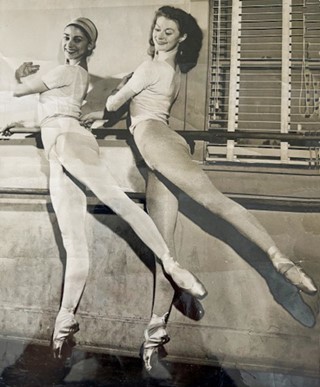
Margot Fonteyn and Moira Shearer practicing at the barre. Date and location unknown. Photographer unknown. Reproduced with permission of Ailsa Kennedy.
Fonteyn joined the (then) Vic-Wells Ballet in 1935 and soon became its leading ballerina. Shearer, seven years her junior, danced briefly with the Vic-Wells (while she was a student there in 1940) and joined the newly-named Sadler’s Wells Ballet in the spring of 1942. Thus, at any given time while they were dancing in the same company, Fonteyn enjoyed the dual advantages of maturity and experience. Shearer was intelligent and sensitive enough to recognize this.
Throughout Shearer’s brief tenure at Sadler’s Wells, Ninette de Valois, its director would call upon Fonteyn for almost all the major roles, particularly in the “classical” ballets like Sleeping Beauty and Swan Lake. Early in the 1940’s Shearer would be assigned leading roles in the minor ballets like Quest or The Clock Symphony. By the mid 1940s Shearer had eclipsed other ballerinas like Pamela May and Beryl Grey in a number of roles and became Fonteyn’s “deputy”. Fonteyn would always dance the opening night of a new production and would then share the role with Shearer and, sometimes with May, Grey or Violetta Elvin on subsequent dates.
There were some ballets, however, where Fonteyn and Shearer danced together. One example of this is Ashton’s ballet, Symphonic Variations. The attached photo of Fonteyn, Shearer and Michael Somes at practice was taken in Paris prior to a performance of Symphonic Variations.
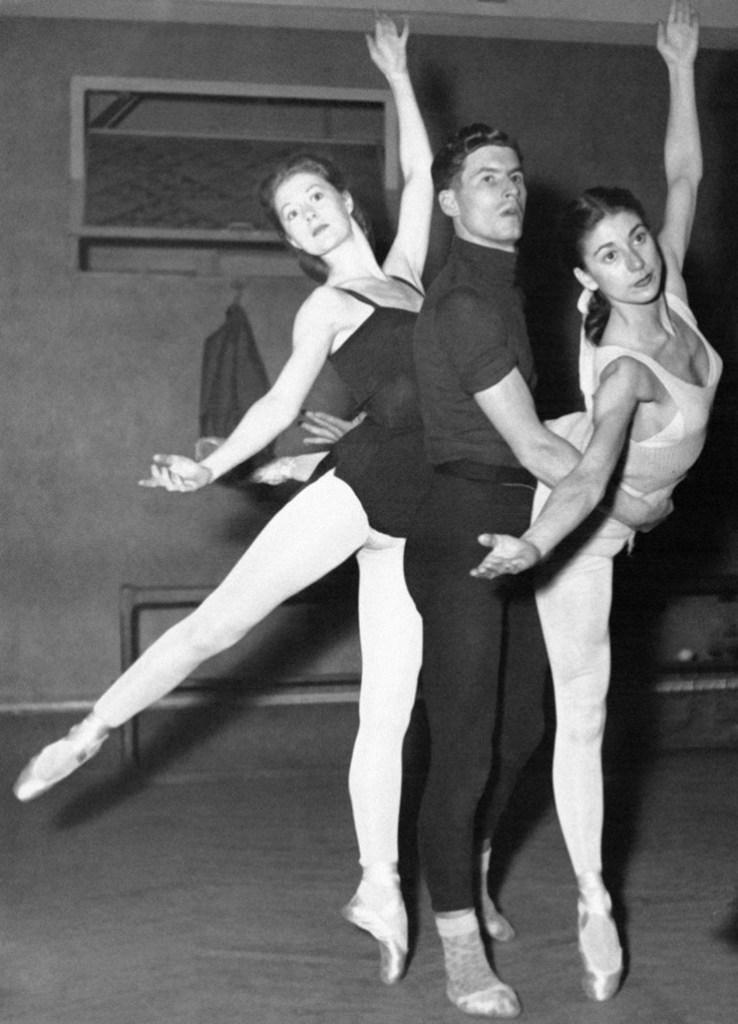
Moira Shearer, Michael Somes and Margot Fonteyn rehearsing Symphonic Variations in Paris, October 1948. Photographer unknown.
Another ballet in which they danced together is Don Juan which, in the autumn of 1948, was chosen to open the season at Covent Garden. In one of those strange turns of fate Fonteyn was seriously injured opening night on November 25th. Not only did this rule out her continued participation in Don Juan but also prevented her from rehearsing Fred Ashton’s new ballet, Cinderella which was to premiere a few weeks later.

Margot Fonteyn, Robert Helpmann and Moira Shearer during rehearsals for Don Juan at Covent Garden, November 23rd 1948. Photographer Jimmy Sime, Central Press Agency.
As the “second cast” ballerina for Cinderella, Shearer stepped into the breech. Ashton, who had designed the ballet to highlight Fonteyn’s abilities, was then forced to adapt it for Shearer, who was a completely different kind of dancer.
The ballet opened at Covent Garden on December 23rd and was a great success. Shearer had been presented her opportunity and took full advantage of it. She danced to packed houses from late December through early February. Violetta Elvin danced as Shearer’s alternate and she too enjoyed great success in the role.
When Fonteyn had recovered by mid February 1949, she took over the role and made it her own. This, once again, showed her pre-eminence among Sadler’s Wells’ dancers and Shearer would have immediately recognized and accepted this fact.
In her February 1991 obituary of Fonteyn, Shearer says of their relationship, “Margot was a kind and generous friend” and one she came to know and understand, although slowly. In the 1940s, as a result of sharing roles at Sadler’s Wells, Shearer remembered that she got to know Fonteyn a little better but “just a little”. However, Shearer wrote, Fonteyn’s “reserved nature made her almost enigmatic, and I never felt genuinely at ease with her”.
However, that was to change when Sadler’s Wells made their second tour of North America in 1950-51. The entire company travelled between venues by a special sleeper train and the dancers were bunked in pairs. Fonteyn initially shared her compartment with Pamela May but when May was injured, she left the tour to return to the U.K. and Shearer was then moved to share the compartment with Fonteyn. Once at the theatre they would also share a dressing room.
The shared experience of life on the road strengthened the bond between them and the friendship that resulted endured despite Shearer leaving the ballet in 1953 while Fonteyn continued to dance for many years. The fact that they both married and lived in different worlds also must have taken its toll on the friendship, but it didn’t end it.
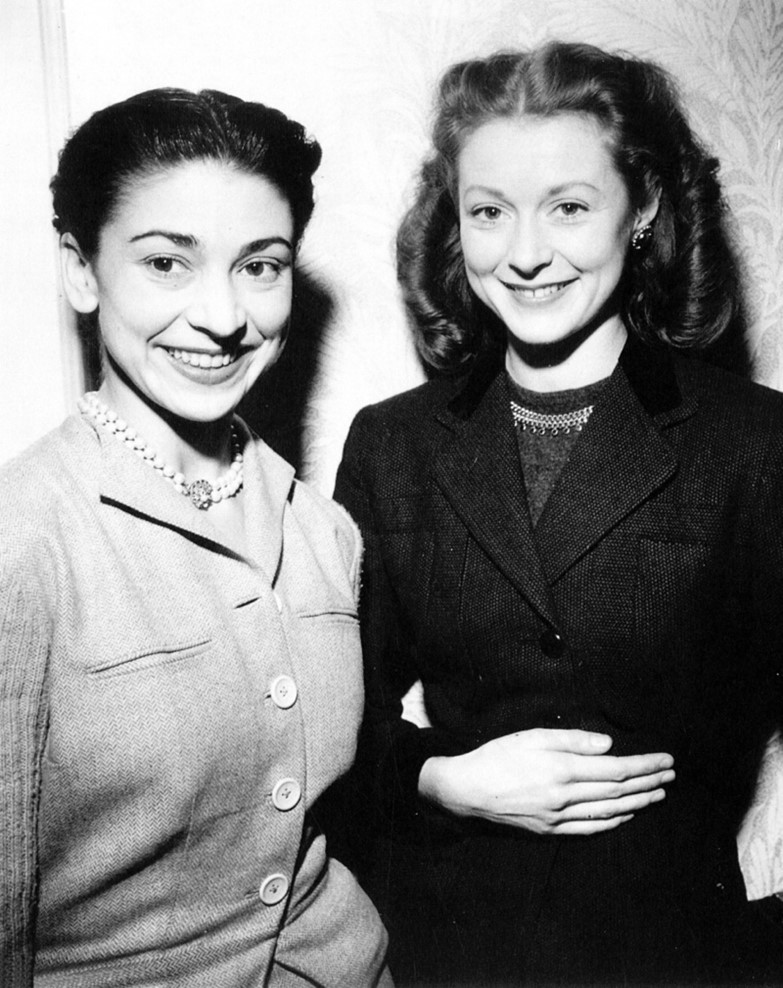
Margot Fonteyn and Moira Shearer, Ottowa in 1951. Location unknown. Photographer Bill and Jean Newton.
Several years after their marriage Shearer and Ludovic Kennedy moved from London to Amersham where she raised several of her children throughout the 1950s. Fonteyn, who married in 1956 and her husband, Tito Arias, visited Shearer and her family there.
In his 1978 interview with Shearer the British-American dance historian and critic Dale Harris remarked that Margot Fonteyn’s autobiography did not really reveal her. Shearer responded, “because she’s like that as a person”.
Shearer picks up this theme in the beautifully written and affectionate obituary of Fonteyn written in February 1991 and which she titles, “Margot: the modesty of true greatness”. Of Fonteyn, Shearer writes that “her greatest charm, both on the stage and off, was her quiet calm and modesty. And her control was of iron. In decades of performances, it gave her the ability to keep a standard of excellence which never wavered”. She goes on to say that Fonteyn “was never a virtuoso ballerina but brought something else to the stage, a wonderfully unbroken flow of movement that lulled audiences into that happy state of illusion which is the hallmark of ballet”. Shearer might have added that she, as the quintessential virtuoso ballerina, did not have those same qualities.
Shearer’s forthright evaluation of Fonteyn and some of the attached photos seem to speak eloquently of their relationship and friendship.
Sources.
Moira Shearer interviewed by Dale Harris in Edinburgh, August 29th 1976 and September 1st, 1978. Transcript of an audiotape held at the New York City Library, Lincoln Center.
Margot: the modesty of true greatness. Obituary of Margot Fonteyn written by Moira Shearer. Actual date not known but circa February 22nd, 1991. Publication unknown but possibly The Times (London) or The Guardian (London).
Margot Fonteyn: Autobiography. Random House Inc., London, published May 1st, 1976.
Various newspaper and magazine articles published in the UK, USA and Canada between 1943 and 1953.
 Moira Shearer
Leave a comment