Moira Shearer’s mother took her daughter to see the ballet company, Les Ballets Russes, when they appeared at Covent Garden in 1935. There she saw Leonide Massine dance in “La Boutique Fantasque”; she was nine years old and he was 39. When he came to dance with the Sadler’s Wells Ballet early in 1947 at the invitation of Ninette de Valois he was 51 and Shearer was 21.
As he was a guest artist (along with Danilova) he featured only occasionally in programmes that Spring 1947 season. Thus, although the ballets Massine brought with him were strenuously rehearsed under his direction, Shearer had limited opportunities to actually dance with him….. perhaps only 6 or 7 times in his ballet, “La Boutique Fantasque”, and, 12 times in “The Three-Cornered Hat” (Tricorne), also choreographed by him. Immediately following their final performance together (in Boutique) on June 21st they both flew to Nice to begin filming of “The Red Shoes” in Monte Carlo.
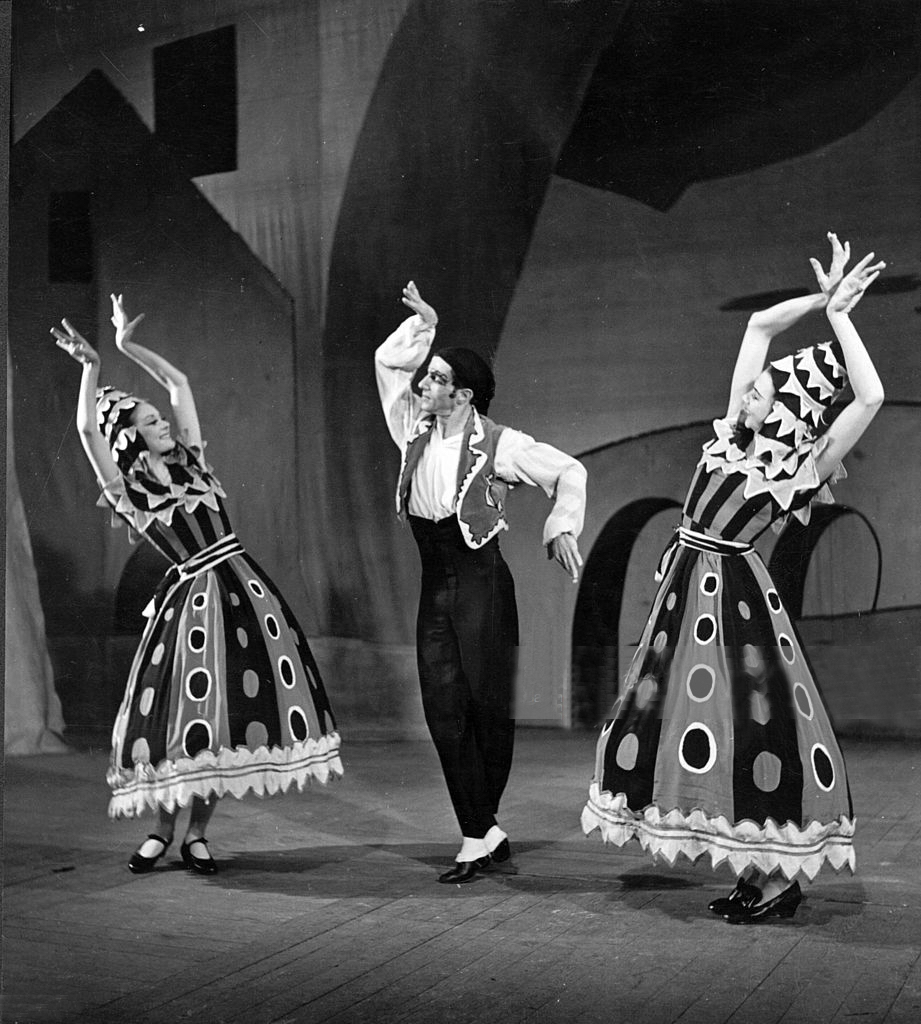
Moira Shearer, left and Beryl Grey dance with Leonide Massine in the “jota” in his ballet “La Boutique Fantasque” at Covent Garden in February 1947. Photographer, Baron, Getty Images.
Massine looms large in Shearer’s decision to appear in “The Red Shoes”. When one of the directors and producers, Michael Powell, first approached her in 1946 to take part in the film as an aspiring ballerina, she turned him down. Thus, he cast about for an alternative to her but was unable to find a dancer that met all his requirements. In the meantime, he set about hiring the rest of the cast. This included Anton Walbrook who was to play the lead as Boris Lermontov, the impresario, Robert Helpmann, Ludmilla Tcherina and Massine. Massine shared responsibility for the choreography with Helpmann and played the dual role of Grischa Ljubov, the dance director at the fictitious ballet company and as the shoemaker in the ballet that was central to the film’s story.
Powell approached Shearer again in 1947, nine months after his first attempt and, this time, she agreed to appear in the film. Along with de Valois’s urging to Shearer that she make a decision, the proposed participation of Massine was probably critical to Shearer’s change of heart. The filming was timed to take place during the summer break in the Sadler’s Wells schedule and would not impede Shearer’s return to the company in the autumn.
Besides the ballet choreographed by Helpmann and Massine, “The Red Shoes” featured several short excerpts of the classical ballets such as Swan Lake, Sylphides and Coppelia and of La Boutique Fantasque. Robert Helpmann accompanied Shearer in Coppelia and Massine joined her the can-can in Boutique that is illustrated in the screencap, below. When asked about these performances by Dale Harris, Shearer was very critical of the end product claiming that Michael Powell was “ignorant of ballet technique”. She felt that a lot of good dancing ended up on the cutting-room floor.
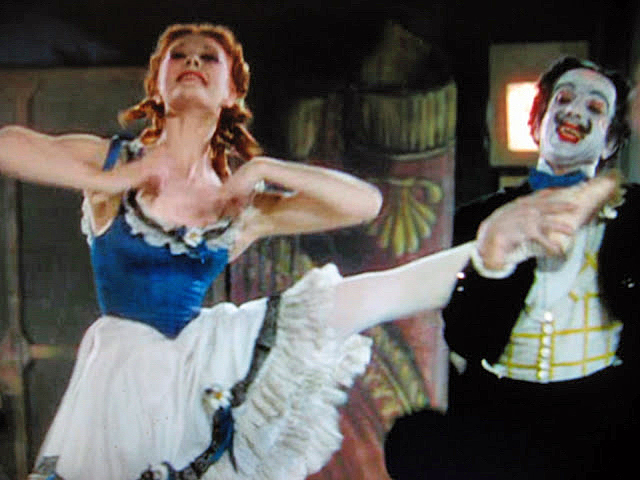
Moira Shearer and Leonide Massine dance the can-can in his ballet “La Boutique Fantasque” in an excerpt shown in the film, “The Red Shoes”, 1948. Photographer unkno In an interview she had with Brian McFarlane in July 1994 Shearer also took issue with Powell and Pressburger’s portrayal of the ballet company as a whole and particularly of Massine as the dance director of the fictitious Lermontov Ballet. She complained that “there was never a ballet company anywhere which was like that” and that the characterisation of Massine as a manic director was completely false. Powell had Massine behaving like a mad jumping bean”. Instead, the man with whom she had worked at Sadler’s Wells that Spring was, in her words, “courteous, friendly and reserved”.
The success of “The Red Shoes”, in Britain, Europe and North America was the basis, in 1951, of Powell and Pressburger’s next venture into ballet on film, “The Tales of Hoffmann”. The idea was first proposed to them by the eminent British musician and conductor, Sir Thomas Beecham. The cast and production crew were similar to that for The Red Shoes although, in this case, Fred Ashton was commissioned to create the choreography.
The story is in three major chapters to which Powell added a prologue and epilogue, both featuring Shearer’s dancing.
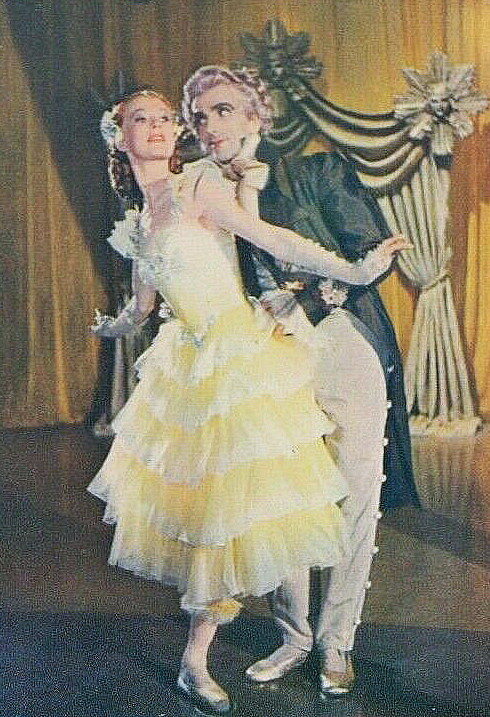
Moira Shearer portrays the mechanical doll, Olympia and Leonide Massine one her creators, Splanzani in the film, “The Tales of Hoffmann”, 1951. Photographer unknown.
All the major dancers … Shearer, Massine and Helpmann …. assumed multiple roles. Shearer portrayed a dragonfly in the prologue with the French dancer, Edmund Audran. In the following act she danced as a mechanical doll, Olympia, with her squabbling creators played by Massine, Helpmann and Ashton; subsequently she danced as Helpmann’s lover and finally, in the epilogue she partnered Audran again in a pas de deux.
Unlike The Red Shoes the dance sequences were shot in long takes and Shearer recounts that dancing to Ashton’s choreography was a great pleasure. Both she and Massine invested long hours in the production, often appearing on the set several hours before the majority of the other dancers, actors and production crew. During the filming of “The Red Shoes”, as both of them lived in west London Massine and Shearer would occasionally share a taxi to the film studios. During the filming of The Tales of Hoffmann Shearer’s husband, Ludovic Kennedy, would provide that service.
By 1951 Massine was in his mid 50s. Shearer’s career at Sadler’s Wells was winding down. Thus, The Tales of Hoffmann was the last opportunity for them to dance together.
Sources.
Moira Shearer interviewed by Dale Harris in Edinburgh, August 29th 1976 and September 1st 1978. Transcript of an audiotape held at the New York City Library, Lincoln Center.
Moira Shearer; Portrait of a Dancer, Pigeon Crowle, Faber & Faber, London 1950.
An Autobiography of British Cinema, Brian McFarlane, 1997.
Pitch Weekly, January 22nd, 1999, Dan Lybarger, An Interview with Moira Shearer and Jack Cardiff.
Royal Opera House, Covent Garden, Database.
Sadler’s Wells Ballet, programmes for individual performances, 1947.
 Moira Shearer
Leave a comment