The director Michael Powell, in discussing the evolution of his film, ‘The Red Shoes”, stated that its “salient feature …. is simply Moira Shearer. Before this film could be started it was necessary to find a dancer on the brink of becoming a (prima) ballerina, about 20 years of age; beautiful; exquisite figure and legs; strength of character, who could dance all the classical parts; and finally, a dancer who could act and not an actress who pretended to dance. If we had not found Moira Shearer, we could not have made the film”.
He found her in 1946, when Shearer was, in fact, just 20 years old. The discovery, some recall, was due, in part, to the intervention of the actor, Stewart Granger, who, at the time was employed by The Rank Organization, who were funding the film and by the Sadler’s Wells dancer Robert Helpmann.
Powell went to the ballet at Covent Garden and saw Shearer dance … and act. Shearer recalled that it was probably in the lead in Giselle, a role that requires the skills of both a dancer and an actor. However, although she had had minor roles in Giselle since 1942, she didn’t dance this leading role for the first time until July 1948. Others speculate that Powell saw her in her role as a lover in a ballet choreographed by Helpmann, Miracle in the Gorbals.
Powell was completely taken by Shearer. He said of her that “she had a cheeky face, (was) well bred and full of spirit. She had a magnificent body. She wasn’t slim, she just didn’t have an ounce of superfluous flesh”.
Powell and Shearer met for the first time, probably in the spring of 1946 and he handed her a copy of the script of “The Red Shoes”. Upon reading it she rejected the idea of her appearing in the film. She said of it, “I … hated the dialogue and the story because I felt it was so corny…. It’s such a sort of woman’s magaziny angle of the whole thing and no ballet would ever have been like that”
But Powell refused to give up on Shearer. He took a different tack. Shearer recalls that Powell and, presumably his business partner, Emeric Pressburger, “hovered around, came to the stage door (at Covent Garden) and dressing room – really a bore – wearing us down”.
There is no record of Powell directly approaching Ninette de Valois but she was obviously aware of his presence at Covent Garden and his interest in hiring Shearer. De Valois called Shearer to her office one day and demanded that she “get this off your chest and ours because I can’t stand these men bothering all of us any longer”.
Once Shearer had expressed her deep concern about the impact of making the film would have on her dancing career and once she had received assurances from de Valois that there would be none, Shearer agreed to sign a contract with Powell and Pressburger. Also critical in her decision to do this was the knowledge that the experienced and talented dancers, Leonide Massine and Helpmann, both would be involved in the production.
Shearer hired an agent and negotiated a contract worth £5000 + expenses for three months work. Her participation in the film had to be completed by the autumn. The Sadler’s Wells ballet season began with “Mamzelle Angot” on November 26th 1947 and Shearer was to dance in it. The spring season at Covent Garden concluded on June 21st with Shearer and Massine dancing in “La Boutique Fantasque”. The next day, Sunday, they both flew to Nice and filming of “The Red Shoes” began in Monte Carlo on June 23rd.
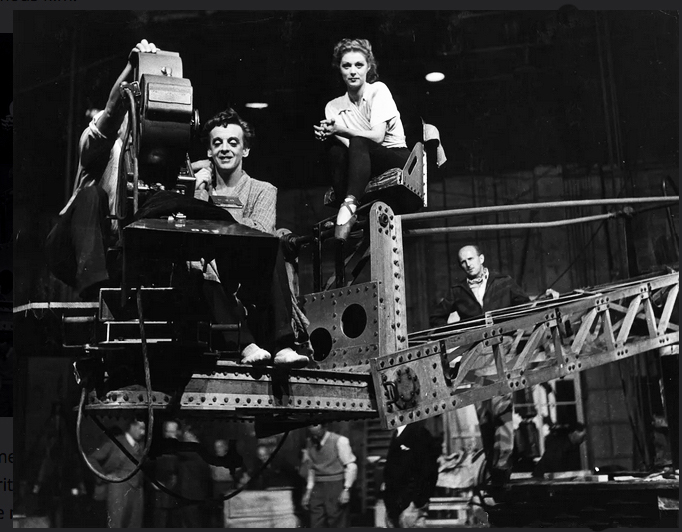
Production of “The Red Shoes” in 1947 at Pinewood Studios. Moira Shearer, wearing her red pointe shoes sits on a movie camera gantry with Robert Helpmann. Behind them stands, the director, Michael Powell and in the background is J. Arthur Rank whose company funded the film.. Photographer unknown.
Shearer did not get along with Powell during the filming although, apparently that didn’t prevent them, later, becoming friends. She conceded that he was a good director with regard to the “technical” aspects of film-making but that was inept in his relationships with the actors. She recalled that his inability to communicate with them drove them into themselves “rather than drawing them out”. In addition, he had no understanding of ballet. This was compounded by the fact that dancing on the concrete floors of the studio was extremely difficult and often resulted in injuries. The 15-minute ballet that is at the heart of the film was comprised of hundreds of takes of just a few seconds each. Staying warmed up ready to dance was a constant preoccupation for all the dancers.
Shearer’s 3-month commitment grew to four months and eventually to six. There is a photo of her in costume at Pinewood talking to Dirk Bogarde in the spring of 1948 when she was probably asked to come in to film minor revisions. Nonetheless, even if it was not renegotiated and supplemented, Shearer’s contract represented an enormous step-up in her income at the time. Her pay as one of the leading dancers at Sadler’s Wells in 1947 was between £30 to £50 a week.
Powell and Pressburger’s next film, “The Tales of Hoffmann”, was produced in the summer and autumn of 1950. In addition to Powell and Pressburger, each as the producer and director, the cast of characters was similar to that for “The Red Shoes”. However, there was one major change. The Rank Organization was replaced by Alexander Korda’s Film Finance Corporation as the source of funding. A central requirement of Korda’s financial backing was that Shearer play one of the lead roles. Powell approached Shearer and she agreed to take on the commitment as long as, as with “The Red Shoes”, the timing of the production fitted into her schedule at Sadler’s Wells. Thus, filming began at the Shepperton studio on July 1st, 1950, immediately after the spring ballet season ended. By mid August, Shearer’s work was done and she was able to go on holiday with her husband, Ludovic Kennedy.
Shearer’s working relationship with Powell was much happier than it had been in “The Red Shoes”. As there was no dialogue, filming largely followed Offenbach’s libretto as modified by the music director, Sir Thomas Beecham. Even more critical from Shearer’s point of view was that Fred Ashton was brought on board as choreographer. She found working with him “such a pleasure”. There are no photographs of Shearer working with Powell but a number of her rehearsing a pas de deux with Ashton. Powell had also undoubtedly taken note of the dancers’ complaints of working on a concrete floor in “The Red Shoes”. At Shepperton a special surface consisting of cork, felt and paint was applied to the studio floor. It was renewed each day.
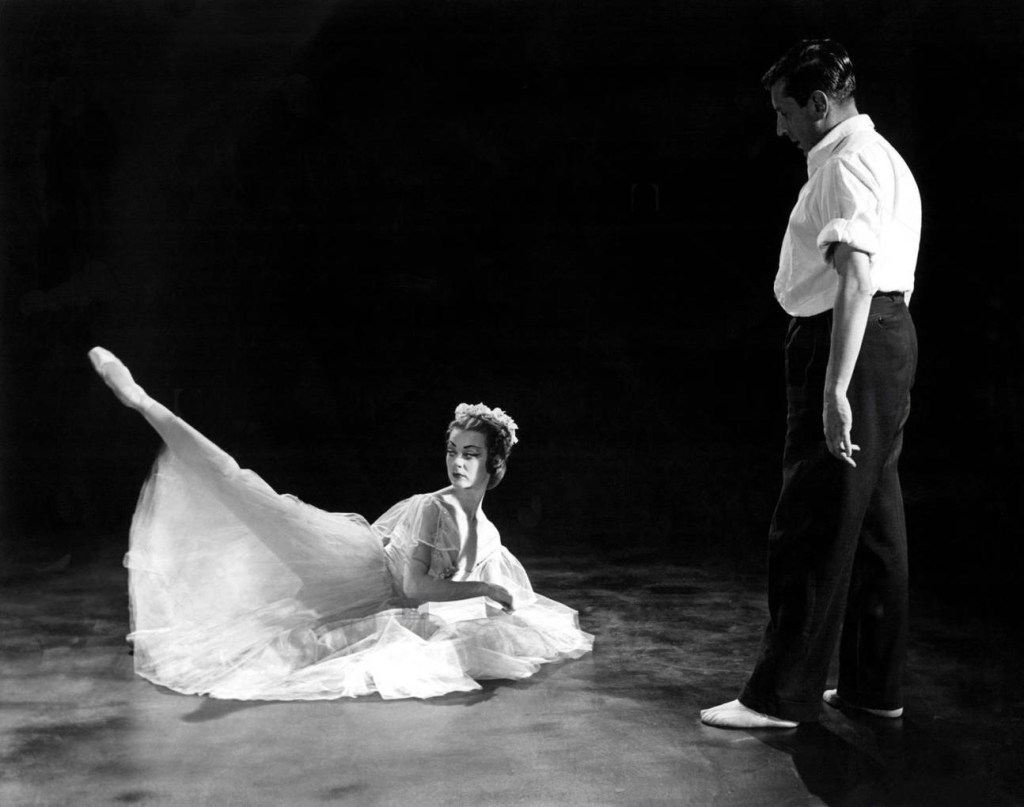
Fred Ashton coaching Moira Shearer during the filming of a ballet sequence in “The Tales of Hoffmann” at Shepperton Studios in the summer of 1951.. Photographer not known.
Powell’s more “hands-off” direction and innovative use of multiple cameras meant, for example, that Shearer’s lengthy dance as the doll in Olympia was shot in only two takes.
Shearer became heavily invested in the production and like Massine, who would arrive at the studio at 6 am each day to warm up, she put in long arduous hours. She also worked with Hans Heckroth, the set and costume designer, on the production of her extensive wardrobe. She assumed multiple personalities in the film each of which required a specific costume in whose design and execution she was involved.
In the prologue she dances as a dragonfly in a tightly-fitting bodysuit that highlights her magnificent ballerina’s body; in Act 1 she plays the role of Olympia, the mechanical doll, resplendent in her yellow tutu and pantalettes; later she reappears as a haughty medieval beauty and finally dances a pas-de-deux in a dress copied from one worn by the 19th century ballerina, Maria Taglione.
The prologue was added to Offenbach’s original score as a way of “introducing” Shearer and that, in reality, gave her an opportunity to do what she had been hired for – to dance. Because of this role and that as Olympia, Shearer dominates the first half of the film. In the final analysis Powell must have felt he had made a good investment in her.
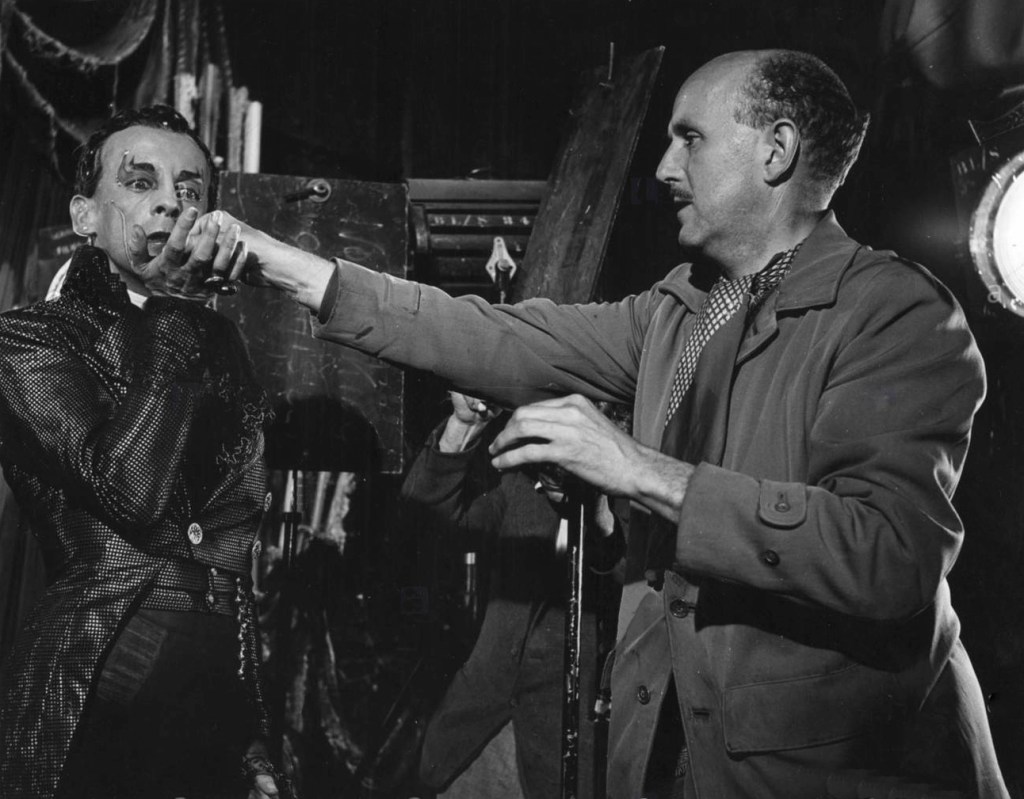
Michael Powell directs Robert Helpmann in a scene in the prologue of The Tales of Hoffmann at Shepperton Studios in the summer of 1951. Photographer not known.
The British and American critics had altogether diverse evaluations of “The Tales of Hoffmann”. Some loved it; for others it was lifeless, cold and flat. It did not achieve the same commercial success as “The Red Shoes”. However, it probably represents the best and happiest collaboration between Powell and Shearer.
Powell and Pressburger produced just a handful of films in the mid to late 1950s and after the release of the unsuccessful film, “Ill-met by Moonlight”, in 1957 they decided to dissolve their 18- year partnership. However, Powell determined to continue producing and directing films. He was still living in a large Victorian house on Melbury Road in Kensington, west London and, perhaps with an eye on limiting production costs, decided to use the house and neighbourhood for the setting of a romance titled “The Loving Eye”. It was to star the then virtually unknown actor, Paul Scofield and Moira Shearer. The film never came to fruition because Powell failed to raise funding for it so all that remains of his idea are a few polaroids that Powell took of Scofield and Shearer in situ and which he might have used to tempt would-be investors. This episode and the photos are the subject of a British Film Institute feature by Sam Wigley that draws the photos from the Michael Powell archive and is referenced in a link below.
However, as Wigley points out, the idea of using Melbury Road as a backdrop reemerged in Powell and Shearer’s final collaboration, “Peeping Tom”, that was produced in 1959. Powell had not originally intended to cast Shearer as the naïve stand-in to Shirley Ann Field but his original choice, Natasha Parry, was unexpectedly whisked off to New York to appear in a play produced by her husband, Peter Brook.
As Shearer recalled Powell appeared on her doorstep one evening and thrust a script into her hands, imploring her to, at least, read it, which she did. As it required only 4 days of her time, and as she considered him a friend, she agreed to take up the challenge. Numerous photos of Shearer with her co-star, Karl-Heinz Boehm, appear to show his discussing the script with her on the set. Her part must have been rewritten to allow Powell to exploit her dancing talents prior to her demise at the hands of the maniacal photographer played by Boehm.

Michael Powell directs Moira Shearer and Karl-Heinz Boehm on the set of “Peeping Tom” in 1959.. Photographer unknown.
Although she appears in several earlier scenes, including one with Shirley Ann Field, Shearer claims she was largely unaware of the overall plot. Thus, the final product came as quite a shock to her; as she put it, she had completely forgotten Powell’s “sadistic streak”.
Nonetheless Shearer attended the premiere of the film and, presumably, her friendship with Powell survived.
Sources.
Moira Shearer interviewed by Dale Harris in Edinburgh August 29th, 1976 and September 1st, 1978. Transcript of an audiotape held at the New York City Library, Lincoln Center.
powell-pressburger.org/Reviews_TRS/Critics2.html
David Thomson, The Independent, February 12th, 2006. What made Moira a Star?
bfi.org.uk/features/polaroids-from-michael-powells-unmade-kensington-romance
 Moira Shearer
Leave a comment