Fred Ashton, the principal choreographer for the Sadler’s Wells Ballet, created the three-act ballet, Cinderella, in 1948. It was originally designed to be danced by Sadler’s Wells prima ballerina, Margot Fonteyn, but, when she communicated to Ashton that she would not be able to dance every night of the planned rigorous schedule of performances, Ashton, presumably with Ninette de Valois’ approval, began working with the second-cast ballerina, Moira Shearer, as well.
The first performance was to be at Covent Garden on December 23rd, 1948. Ashton began rehearsing the opening kitchen scene in early November. There are several newspaper accounts (including photographs) dating from early to mid-September in which Ashton is noted as working with Shearer. Somewhat strangely, these accounts do not mention Fonteyn. This omission is made all the more mysterious by the fact that the male lead in the ballet, Michael Somes recalls the kitchen scene being created with Fonteyn specifically in mind.
On the opening night of the Sadler’s Wells autumn season, November 25th, at Covent Garden, Fonteyn and Shearer shared the major roles in the new ballet, Don Juan. Robert Helpmann played the title role, Fonteyn played La Morte Amoureuse and Shearer the “young wife”. About 20 minutes before the end of the ballet Fonteyn sustained what was originally thought to be a sprained ankle. Despite the injury she completed the ballet.
A subsequent trip to Saint Bartholomew’s Hospital revealed that she had a torn ligament and would not be able to dance again for 3 months.
Thus, as the second cast Shearer was told she would assume the lead in Cinderella. Her second cast would be Violetta Elvin.There is no record of it but, presumably after she completed her involvement in Don Juan on December 6th, Shearer and Ashton rehearsed the 2nd and 3rd acts of Cinderella on those occasions when she wasn’t appearing in other ballets such as Giselle, Symphonic Variations and Sleeping Beauty then being performed as part of Sadler’s Wells autumn season.
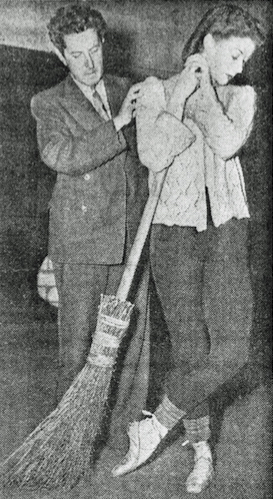
Fred Ashton rehearses Moira Shearer in her role of Cinderella, November 1948. Photographer unknown.
Tickets for all performances of Cinderella soon sold out through mid-January. One might speculate that this was because it was Ashton’s first full-length ballet. However, one newspaper article noted that many of the patrons for these early performances were “the younger crowd” which might have been code for Shearer’s fans.
Opening night was an unqualified success with the audience and Ashton and Shearer shared 14 curtain calls. One newspaper critic quipped that the curtain calls lasted almost as long as the performance itself.
The following day, December 24th the first critics’ reviews were published and, by and large, they were very favourable to Ashton as choreographer, to Shearer and to the major supporting cast of Elvin, Beryl Grey, Pamela May and to Ashton and Helpmann as the ugly sisters.

Moira Shearer as Cinderella, December 1948. Photographer Angus Mcbean. Photo reproduced by permission of the Houghton Library, Harvard University.
In The Evening Standard Caryl Brahms was more muted in her praise than most. She wrote, for example, that Moira Shearer was as “pretty as porcelain, if no more poignant” and that Ashton’s was “not inspired choreography”. Ashton himself later recalled that Shearer’s dancing was what he termed “brittle”.
The more popular press was almost universally captivated by Shearer’s interpretation. Cecil Wilson writing in The Daily Mail called Shearer “the loveliest and lightest-footed Cinderella imaginable”. The Liverpool Post, otherwise critical of the ballet itself, wrote of “Shearer’s exquisite and wistful Cinderella”.
Later reviews, sometimes of the performances in late December and early January, were more critical of Shearer’s performances. Some took issue with her acting, especially her ability to elicit the pathos needed in the kitchen scene in the first act; others, like the reviewer in the Dancing Times (February 1949), complained that “she has not yet the speed required for all the technicalities”. However, this same critic praised her acting.
The harshest criticism came from Iris Morley writing in The Daily Worker on December 30th. She wrote that Shearer was “as pretty as any fairy …. unfortunately, she is a long way from being a ballerina. She has little idea of how to phrase her dancing. Consequently, many important moments like the pas de deux with the broom showed a want of tenderness, feeling and artistry”. This theme of contrasting her beauty with her dancing and acting ability was to be repeated many times throughout her career in ballet.
Throughout late December 1948 and through mid-February, 1949 Shearer shared the lead role with Violetta Elvin. Thus, some on the critics focused on Elvin’s strengths and compared her to Shearer. In general, both dancers were the subject of praise although, sometimes, it was qualified.
Fonteyn, who perhaps had benefitted, not just from her forced holiday, but also from the opportunity to see some of the performances by Shearer and Elvin, returned to the role on February 25th. Her performance was met by rapturous applause, testament, as noted the critic in the magazine, “Ballet and Opera”, to “the devotion of Fonteyn’s London public”. The same writer felt “her Cinderella seemed more deeply felt and conceived more “in the round” than the renderings of the other dancers”.
Thus, Fonteyn’s twin concerns of, initially, having to share the lead in Cinderella with Shearer, and, after her serious injury, that Shearer might be presented with an opportunity to challenge her at Sadler’s Wells, were not, in fact, borne out. Nor did the events damage her working relationship with either Shearer or Elvin that were to endure for many years.
Sources.
The Daily Graphic, November 6th 1948, writer unknown.
The Sphere, November 20th, 1948, writer unknown.
The Daily Express, December 24th, 1948, Express Theatre Critic.
The Evening Standard, December 24th, 1948, Caryl Brahms.
The Daily Mail, December 24th, 1948, Cecil Wilson.
The Times, December 24th, 1948, writer unknown.
The Daily Worker, December 30th 1948, Iris Morley.
The Stage, December 31st, 1948, writer unknown.
The Spectator, December 31st, 1948, writer unknown.
The Stage, January 5th, 1948, writer unknown.
The New Statesman, December 31st, 1948, writer unknown.
The Liverpool Post, date and writer unknown.
The Queen, January 19th, 1949, writer unknown.
Punch, January 1949, writer unknown.
Ballet and Opera, News, April 1949, writer unknown.
The Dancing Times, February 1949, writer unknown.
 Moira Shearer
Leave a comment