As quoted in several sources, including The New York Times in April 1951, Moira Shearer stated she had “one cardinal aim in her dancing career: “to dance Giselle really well”.
Between 1942 and 1953 Shearer made her way up the rankings of the roles in Giselle at Sadler’s Wells. Initially, in 1942 and 43, she danced as either a peasant or as a Wili, or, in some cases, as both. She graduated to the more demanding role of Zulme or Moyna between 1944 and 1947 and on July 13th, 1948, at age 21, she danced in the title role for the first time.
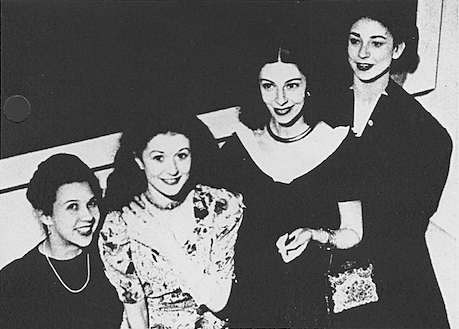
“Four English Giselles”. From left to right, Beryl Grey, Moira Shearer, Alicia Markova and Margot Fonteyn. Covent Garden July 13th, 1948., Photographer unknown.
On that same date she was photographed on the stairs at Covent Garden with the three other “English” Giselles, Markova, Margot Fonteyn and Beryl Grey. Perhaps they had been in the stalls to witness her premiere in the role.
Prior to her premiere in this role Shearer had consulted with the former Russian ballerina Karsavina, who was then teaching in London but, who had danced as Giselle starting in 1910. In her interview with Dale Harris, Shearer insisted that her sole intent in the consultation was to get Karsavina’s advice on how to portray Giselle in the “mad” scene but Ninette de Valois believed that Shearer had also used Karsavina’s version of some important steps in first act. This was the first of many confrontations that Shearer had with De Valois over interpretation.
Subsequently Shearer danced the title role in Giselle at least a further 14 times between 1948 and 1953. Several of these performances were during the 1950-51 tour of North America with the venues including the Metropolitan Opera House in New York City and the opera houses in San Francisco and Chicago.
On September 13th,1951 she danced as Giselle in the gala at Covent Garden. After a prolonged injury in 1952 she danced the title role again on February 13th, 1953, once more at Covent Garden, and was due to give several more performances. However, she strained a tendon during rehearsals and was unable to dance again. This injury marked the end of Shearer’s 11-year career at Sadler’s Wells.
Perhaps, as Shearer danced the lead role so rarely, she seems to have often attracted the attention of the ballet critics in British newspapers and dance magazines when she did. By and large, over the 5-year span, she received good, if not rave, reviews.
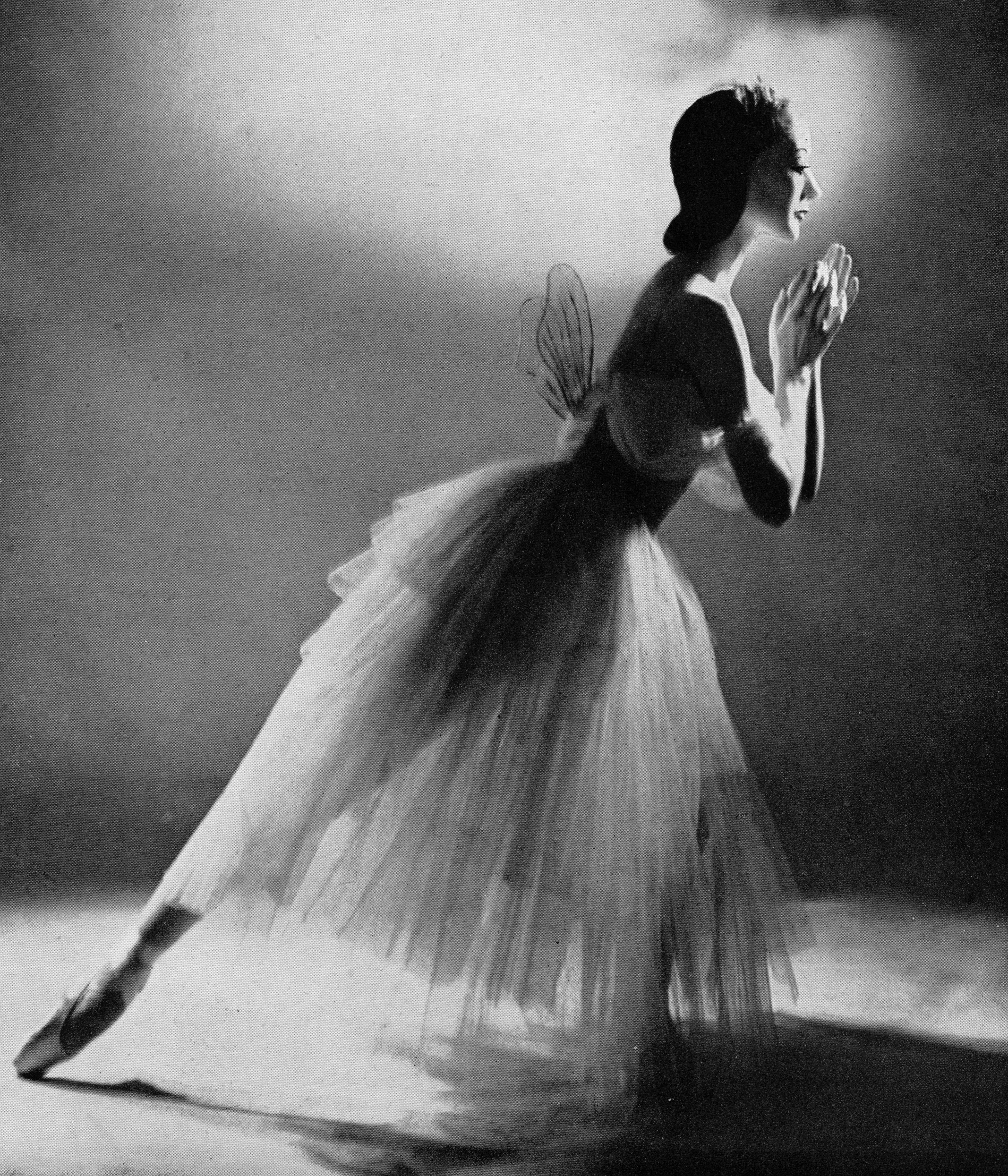
Moira Shearer, Giselle, Act II. Date not known. Photographer, Duncan Melvin.
Typical of the press for her first attempt in the lead role is a review by Caryl Brahms writing in the Evening Standard in July, 1948. While, tongue in cheek, comparing Shearer’s acting unfavourably to that of the great nineteenth century tragedian, Sarah Siddons, Brahms praises her dancing in multiple ways. This dichotomy between her dancing and acting skills is expressed by Brahms as Shearer being “bewildered rather than frantic in her mad scene” but the elegance of her dancing “achieves a pearly poetry”.
C.V. Coton, dance critic for The Daily Telegraph, says of this same performance that it was “a combination of the wistful, charming and the tender”. The writer in the August issue of Theatre World praised her performance, while noting it lacked “the depth of interpretation revealed by Margot Fonteyn and Markova.
The writer in “The Times” (March 21st, 1950) commented on how Shearer’s confidence in interpreting the part had greatly increased since she first appeared in it 1948. Like other subsequent commentators, the unnamed critic, while not wholeheartedly going to bat for her, focused on how well Shearer brought her personality to bear on the interpretation of the role. “Her Giselle lacked nothing in dramatic power, for her stage personality suffuses the parts she plays with sympathy and conviction”.
Audrey Williamson writing in a similar vein in The Tribune on April 14th, 1950, says of Shearer’s Giselle that she “starts with the initial advantage of genuine youth and lightness; her gaiety brightens the stage, but is now pierced by a deeply moving emotional power”. She later tempers her praise by saying that Shearer does not yet possess “the balance and lyrical fire for a great second act”.
Shearer felt confident enough of her abilities at this stage to allow her parents and husband to see her March 1950 performance that was her third time in the role.
When Shearer danced the lead role again in 1953 the critic for “The Guardian” (February 14th) gave her an almost unequivocably postive appraisal, noting that the performance was marked by her great technical ability, her grace and her unique interpretation of the role. Of some significance was the fact that the writer also praised her acting, especially in the “mad scene”. Perhaps Karsavina’a advice had borne fruit.
When Shearer danced Giselle with Sadler’s Wells at The Metropolitan Opera House in New York on September 24th, 1950, the great American modern dancer, Ruth St. Denis, was in the audience. Arthur Todd, the dance critic, writing in the December issue of the magazine, Ballet Today, said that the finest compliment one could pay the British ballet company was to repeat the remark that St. Denis made as the curtain descended on Moira Shearer’s Giselle, that “the Sadler’s Wells Ballet is the flower of British civilisation”.
Sources.
Caryl Brahms, review in the Evening Standard, July 14th, 1948.
C.V. Coton, review in the Daily Telegraph, July 14th, 1948.
The Times, article, July 14th, 1948.
The Stage (trade journal), review, February 15th, 1948.
The Times, article, March 21st, 1950.
Audrey Williamson, review, The Tribune, April 14th, 1950.
Arthur Todd, article, Ballet Today, December 1950.
The New York Times, article, April 1951.
The Guardian, article, February 14th, 1953.
Moira Shearer, Portrait of a Dancer, Pigeon Crowle, Faber and Faber, 1954.
Moira Shearer interviewed by Dale Harris in Edinburgh, August 29th, 1976 and September 1st, 1978. Transcript of an audiotape available at the New York City Library, Lincoln Center.
 Moira Shearer
Leave a comment