As recounted by Alastair Macaulay, the former dance critic for the New York Times, Beryl Grey and Moira Shearer approached Ninette de Valois to pay their respects to her after the memorial service for Marie Rambert in 1975.
After they had left to have lunch together de Valois turned to her companion, the dance critic, Clement Crisp, and remarked that Grey and Shearer hadn’t always been so friendly to each other and that, in fact, when they were younger, at rehearsals at the barre, they would kick at each other in their grands battements. De Valois’s comments speak to the great rivalry that existed between Grey and Shearer at Sadler’s Wells in the late 1940s. However, despite this, they eventually became friends and in her autobiography Grey makes reference to this friendship. Shearer did not write an autobiography and her only comments regarding Grey are in the interview with the dance historian, Dale Harris, where she talks at length about her dancing in Quest, Swan Lake and Giselle. She says of Grey’s role as Duessa in Quest that it was best part ever written for her. In the interview Shearer makes no mention of friendship with Grey at this time. Macaulay notes that this was to develop much later and after both had left the ballet.
This is hardly surprising as, in a 1974 article, Shearer related that life as a professional ballet dancer didn’t allow for such luxuries as reflection or friendship. She recalls, “I had few friends. I met few people. I did few other things …. It was a highly technical and very physical life… that is what happens with dancers”.
Beryl Grey was a pupil at the Vic-Wells school from 1937 and joined the Sadler’s Wells company early in 1941 at age 14. Shearer followed over a year later by which time Grey, despite her youth, was well established.
There is a photograph of them, probably taken at some date in 1942, where they are relaxing at the barre along with other dancers. Grey appears smiling, confident and totally at ease. Shearer, by contrast, seems serious and tentative.
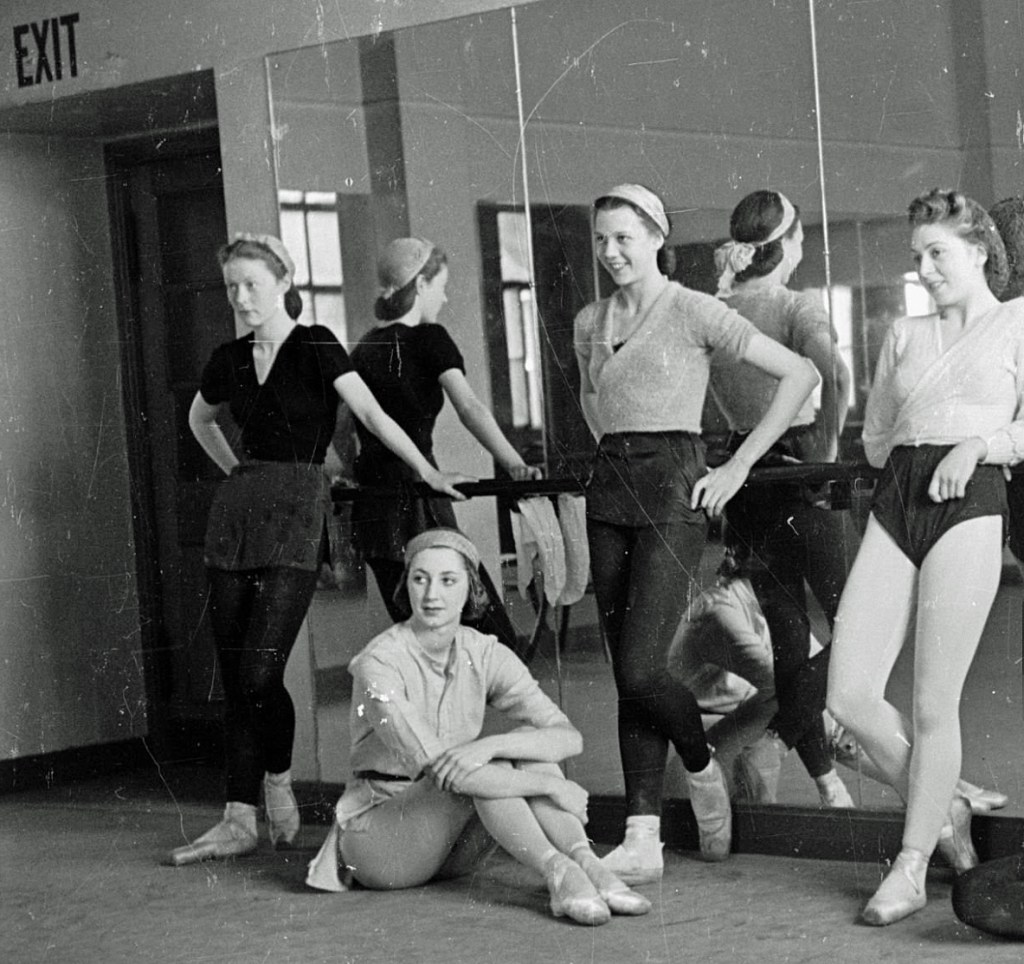
Margaret Dale, at right, Moyra Fraser, seated, Beryl Grey, centre and Moira Shearer, at left, observing apractice at Sadler’s Wells Ballet, probably in 1942. Photographer unknown.
They appear to be observing other dancers at practice and perhaps under the direction of de Valois. Having been schooled in the Vic-Wells methods since she was 10 years old Grey would have been quite at home by what she observed. Shearer on the other hand was trained in the “Russian school” and would have had to learn to adapt. In the Dale Harris interview, Shearer alludes to this challenge.
Shearer’s first recorded performances for the Sadler’s Wells Ballet, at the New Theatre, London, were in early May 1942. She danced minor roles in Sylphides, The Prospect before Us and Rendezvous. She first danced with Grey, probably on December 4th, in The Birds, one of the short ballets produced to showcase the talents of younger dancers. Grey danced the major role of the Nightingale opposite Alexis Rassine while Shearer was one of four “attendant doves”. There are a number of photographs by an unknown photographer that have survived of this ballet although, given their composition, they were probably shot at a rehearsal.
Grey had first danced the lead role of Odette/Odile in Lac des Cygnes (Swan Lake) on her 15th birthday, June 11th, 1942. Later that year at a matinee performance on December 16th at the New Theatre she performed the role once more while Shearer and Lorna Mossford danced in Act II as two swans.
During the Second World War the American photographer, Lee Miller, lived in London and worked both for British Vogue (magazine) and for Conde Nast. Most of her assignments concerned documentation of the impact of war on Britain but she also focused on fashion. In this latter regard, in 1944, she photographed Margot Fonteyn, Beryl Grey and Moira Shearer at the Vogue studios. Some of these photographs have survived.
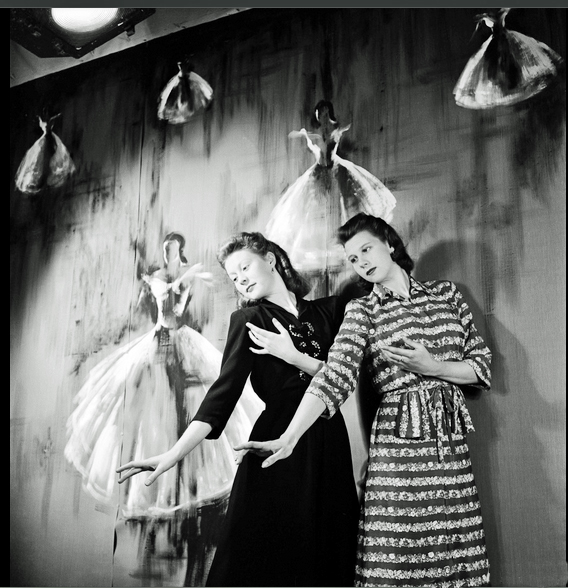
Beryl Grey and Moira Shearer at the Vogue studio, London, 1944. Photograph by Lee Miller.
Two of the photographs taken of Grey and Shearer are quite similar and are obviously from the same shoot. One survives in Beryl Grey’s archives and she discusses it on camera in the 2006 Scottish TV documentary on Shearer titled “The Reluctant Star”. The ballerinas are probably wearing clothes provided to them by Vogue as these appear to be far more elegant and costly than they could have afforded on their bare-bones, wartime Sadler’s Wells salaries.
Early in 1947 the director of the Sadler’s Wells Ballet, Ninette de Valois invited the Russian dancer and choreographer Leonard Massine to produce and appear in several of the ballets that he had originally created in 1919 for Diaghilev’s company. He arrived in Britain, accompanied by Alexandra Danilova, probably in January 1947 and began rehearsals with the leading Sadler’s Wells dancers including Margot Fonteyn, Beryl Grey, Violetta Elvin and Moira Shearer. One the ballets was The Three-Cornered Hat (Tricorne) that premiered at Covent Garden on February 6th. Massine danced the lead role of the miller; Fonteyn danced the role of his wife and Grey and Shearer appeared in the jota in the finale. Shearer danced in a dozen performances of the ballet in February and May but not always with Grey. The attached photo of the three dancers dancing the jota indicates how much taller than Massine and Shearer that Grey was!
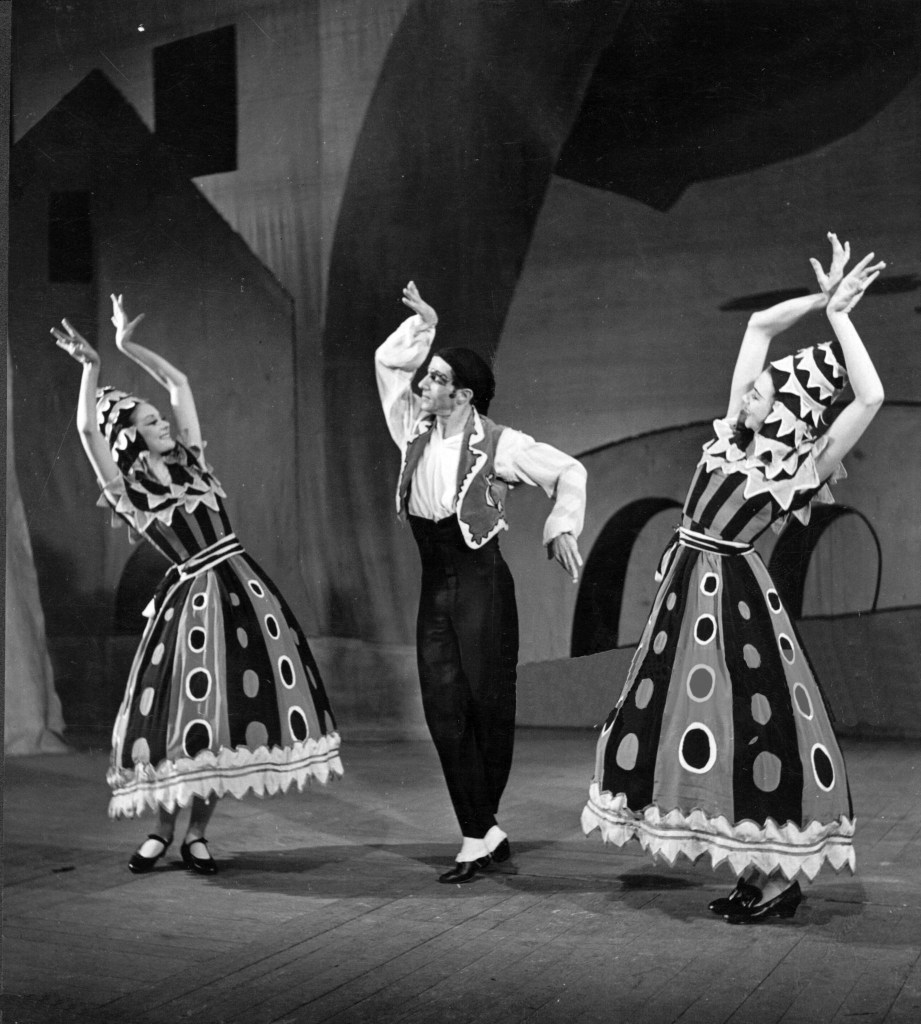
Leonide Massine dances the jota in his ballet, The Three-cornered Hat, at Covent Garden in February 1947 with Beryl Grey at right and Moira Shearer at left. Photograph by Baron.
During their second North American tour in 1950-51 the Sadler’s Wells Ballet travelled between venues by a specially commissioned train and also lived and ate on board. The dancers and staff were allocated cabins each of which had upper and lower bunk beds. As the senior ballerinas, Margot Fonteyn and Pamela May were bunked together; Beryl Grey and Moira Shearer also shared a cabin and agreed they would alternate between upper and lower bunks on a daily basis. Another photo in Grey’s archive shows Shearer in the ascendency. The snapshot itself and Grey’s description of it in “The Reluctant Star” seems to attest to the warmth of their relationship at the time.
When Pamela May was injured during the tour and had to return to Britain for treatment Moira Shearer was moved to share a cabin with Margot Fonteyn. There is no record of who replaced her in Grey’s cabin.
At one point during the tour near Bloomington, Indiana, the locomotive pulling their train developed an overheating problem and the train was forced to stop for several hours. There are several photos of Grey and Shearer kicking their heels on the tracks and enjoying some fresh air with the rest of the company.
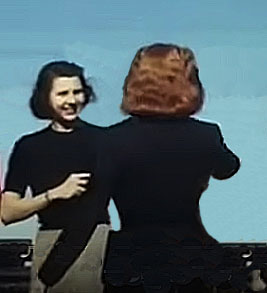
Beryl Grey and Moira Shearer enjoying an unscheduled break from their rail journey across the USA in 1950 and 1951. Screencap from a film by an unknown photographer.
The last occasion on which Grey and Shearer danced together was during George Balanchine’s 1950 tenure at the Sadler’s Wells Ballet when his ballet, Ballet Imperial, was staged. Balanchine was allocated the services of all top four ballerinas …. Fonteyn, Shearer, Grey and Elvin. Fonteyn, in the role of the ballerina, found it difficult to adapt to Balanchine’s unconventional choreography but the other ballerinas embraced it more fully. Shearer, in particular, seems to have been energized by it. However, the critics generally agreed that Grey’s interpretation of her role as the soloist was the most successful.
Grey admired Shearer’s dancing and speaks of her with great affection in “The Reluctant Star”.
“She had this beautiful Russian training which demands a pure line and a very strong technique, and she had both of those”.
“You put her into a wonderful magical setting like Sleeping Beauty and she was just…. magic…. very light…. so perfect”.
“She’d done Red Shoes and she was a great success, so she could have been very sort of snooty, but she never had a swollen head, never changed”.
“Moira was always very modest, very quiet, very retiring, very dignified”.
She concludes with this description of Shearer’s dancing.
“Light, beautiful, shimmering”.
Sources.
Frank Entwisle, Sunday Express Magazine, 1974. “Things I wish I had known at 18”.
Beryl Grey, For the Love of Dance: My Autobiography. Oberon Books Ltd. 2018.
Dale Harris, interviews with Moira Shearer in Edinburgh, August 29th, 1976, and August 31st and September 1st, 1978.
Alastair Macaulay, Notes on Moira Shearer (2013), New York Public Library, Dance Collection, Lincoln Center, New York and personal communication.
The Reluctant Star, Artworks Scotland for the BBC, 2006.
 Moira Shearer
Leave a comment