One of the remarkable or, perhaps, significant facts about Moira Shearer’s 11-year career at the Sadler’s Wells Ballet is that she rarely danced in the full-length classic ballets such as Lac des Cygnes (Swan Lake) and Sleeping Beauty. She appeared only 21 times in the lead role in Swan Lake and, of those performances the majority were in the abridged format of Act II in which only Odette appears.
In addition, several of these appearances occurred as a result of illness or injury to Margot Fonteyn where Shearer danced as her substitute.
Two of the 21 performances involved Shearer as dancing the role of Odile where either Pamela May or Pauline Clayden danced the role of Odette.
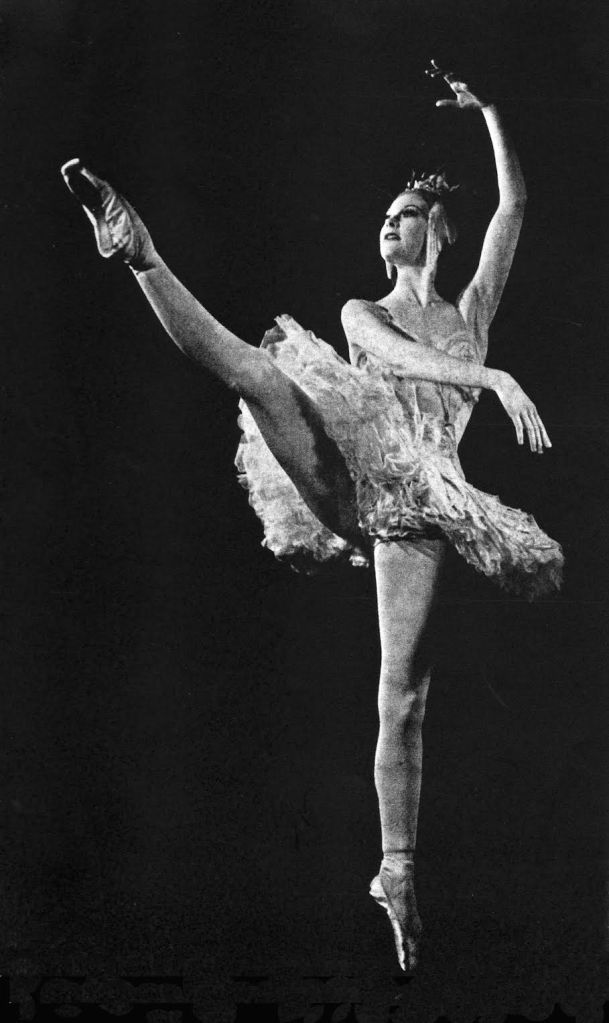
Shearer dancing in the role of Odette. Neither photographer nor date known.
In her interview with Dale Harris Shearer explained that Ninette de Valois never favoured her in Swan Lake as she had the wrong “colouring” and was too small and light. The reference to colouring was obviously code for the fact that Shearer was a redhead and had a very pale complexion.
Beryl Grey, a tall brunette, on the other hand, was often chosen for the dual role beginning with an appearance in 1942 when she was just 15 years old.
Shearer’s discussion with Dale Harris makes no reference to the fact that Margot Fonteyn, who was a little shorter than her, danced the twin roles more times than Grey and Shearer combined (starting November 15th, 1938). Although Fonteyn occasionally shared the lead role with Mary Honer in the 30s and with Pamela May, Beryl Grey and Alicia Markova in the 40s, she probably danced it well over 300 times between 1938 and 1952, and, by the time that MS joined SWB in 1942 she had already appeared in it almost a hundred times.
Moira Shearer’s first published performances were on May 15th and 18th, 1944 when the Sadler’s Wells Ballet were appearing at The King’s Theatre, Hammersmith. She danced in Act III in the role of Odile while Pamela May danced as Odette. Audrey Williamson, the dance critic for the magazine, Theatre World wrote, in June 1944, that “The part of Odile in the third act was brilliantly danced and acted by Moira Shearer, who took the stage with the resilient poise of the ballerina and a bright burnished beauty that made the audience gasp. (She is) a 17-year-old dancer who has every natural gift of the ballerina except only the generous classical line of the arms”.
She added that she has poise, precision, superb line and balance. magnificent command of the stage, and “classical purity”. She again faulted Shearer’s tendency to bend at the elbow in the 2nd and 4th position of the arms but praised her use of her hands and concluded by noting she has rare musicality and grace.
This generous evaluation of her talent boded well for Shearer but there was only one more opportunity for her dance in the role of Odile in 1944, in a matinee on October 25th.
Ninette de Valois, as director of the Sadler’s Wells Ballet, had at her disposal the talent and experience of her senior ballerinas, Fonteyn and May and those of the precocious Beryl Grey. Thus, Shearer was relegated to minor roles in the ballet. However, Fonteyn was injured on September 12th, 1945, and was replaced by Clayden as Odette and Shearer as Odile. There is no known account of her performance, however, at some point around this time, Shearer had caught the eye of the dance critic for The Times, John Percival and in his column of June 1945 Percival shares much of Williamson’s assessment of her talents.
He writes, “She is that rarity, the pure ballerina type, with a glowing beauty and intelligence of her own, and her classicism merits more opportunities for development in a company where the dancer without classical style is too often seen in roles where it should be an absolute”. He continues, (she has) “fair colouring and certain softness of gesture and expression which made her a Swan Queen who was half angel and half bird … at once tender and aloof”
In a more general view Percival writes that “the title of ballerina is earned over many years …. Moira Shearer has musicality, lightness, speed in turns, high arabesque, dramatic power and graceful line. She has already contributed these assets. Physical beauty, determination, personality and radiant charm are all adjuncts in her case”
But Percival wonders if the young dancer will be able to live up to his expectations of her and concludes that in Shearer’s case the answer is surely to be found “in her own stern criticism, her intelligence, the will to determine between true encouragement and false praise. In light of these, together with her very considerable talent, it is highly probable that she will surpass expectations”.
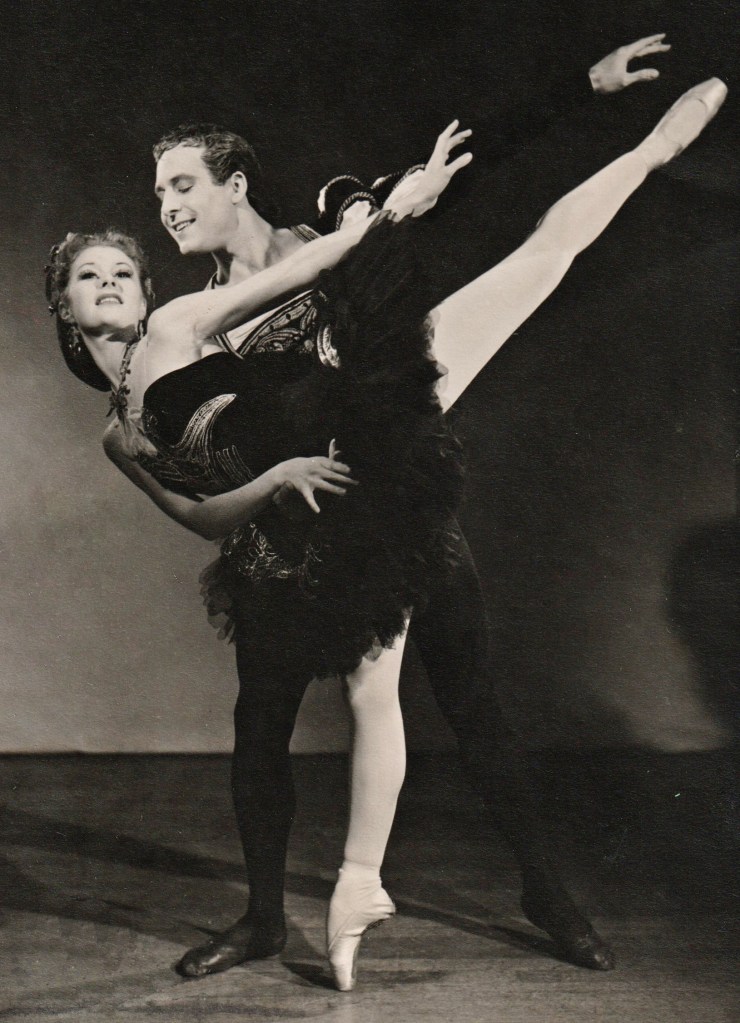
Shearer and David Paltenghi in the roles of Odile and Siegfried in 1946. Photo by Baron.
Shearer first danced the role of Odette with any regularity in 1946 when she shared the 24 performances with Fonteyn and Grey between December 21st and March 22nd, 1947. As the junior member of the trio, inevitably her first performance was in a matinee. Her partner for all performances was David Paltenghi. Her second appearance was on the evening of the 27th and her third on January 10th, 1947. She danced the role 6 or 7 times during that run.
Cyril Beaumont, the then independent dance critic, recording his observations of the three ballerinas in Swan Lake during this season writes of the roles of Odette and Odile that “In a difficult part of this kind experience is invaluable for, it is not until steps and mime and movements become second nature, that the dancer can use the choreography to structure as a means of expression and infuse the dance with light and shade, and poetry and drama”.
He continued, “To achieve distinction in the role of Odette/Odile is the touchstone of the genuine ballerina. Roles of this quality whose infinite variety of emotional content is so frequently linked to difficulties in expression, are not to created overnight. Faultless technical expression is much but not all. It is imperative to create an artistic and convincing portrait. Such double laurels are not easily gathered; that is what makes them so coveted – and so elusive of attainment”
Thus, he concluded, Grey and Shearer were hopelessly outclassed by Fonteyn.
Between 1946 and 1949 at the Royal Opera House, Covent Garden, Shearer periodically danced the role of Odette in Act II and, occasionally, in the full ballet, the dual roles of Odette and Odile. In 1950, during the Sadler’s Wells Ballet second tour of North America, she also danced the dual roles in Los Angeles, Oklahoma City and Chicago.
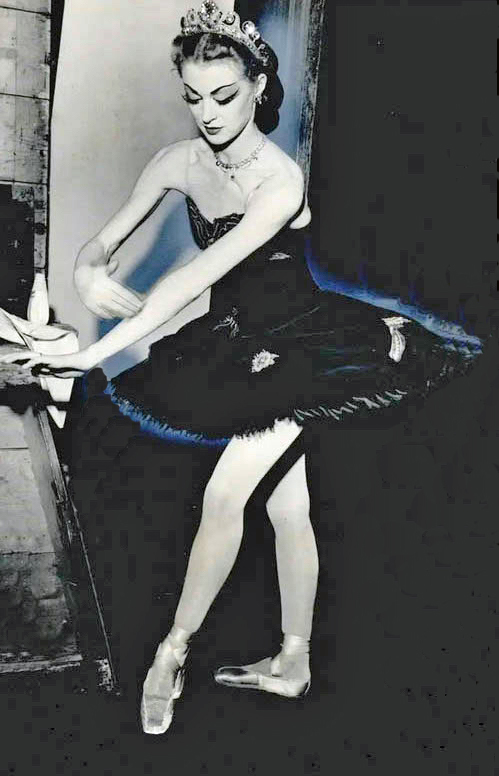
Shearer prepares to dance as Odile in Oklahoma City, November 27th, 1950
The photo appeared in the Daily Oklahoman. Photograher unknown.
She made further appearances in Swan Lake between 1950 and 1952 although these were usually on the road … in Edinburgh, Liverpool and Blackpool. She sometimes caught the attention of the critics. On July 26th, 1951, the dance critic of The Stage commented somewhat archly on one of her performances at Covent Garden earlier that month.
“There is a remote icy enchantment about her dancing, and even the brilliant acrobatics of Odile are performed without a breath of excitement, though her slow movements have a graceful allure of their own”
The same critic reporting on her August 23rd, 1951 performance in Edinburgh was more generous, commenting on her “brilliant technique and polished artistry”. He continued, “The precision of her dancing as Odette is delightful and her wistful charm is expressively displayed. Her portrait of the evil Odile has a brilliance and intense force which are exciting”.
Shearer’s final appearances in Swan Lake were on March 14th and 19th, 1953 at Covent Garden. Commenting on the earlier performance JHM, the dance critic for The Manchester Guardian wrote the following damning review.
“Miss Shearer’s technique has, in the past, been sound enough to sustain her through the most arduous classical roles, but her distinction has depended less of her technique than on the natural gifts of dazzling good looks, hair of Venetian blondness, lightness of movement and the elegance of long graceful limbs; she has started, it might be said, with unfair advantages. Her dancing of Odette-Odile has been remarkable not for any outstanding skill in interpretation or in technique but because her highly individual grace and charm were bestowed with a generous lack of discrimination on both parts of the dual role”. With regard to the March 14th appearance, he continued, “With the unobtrusive help of her excellent partner, Michael Somes, she first “got away with” Odette-Odile in her performance last night though neither her partner nor her own grace and charm could hide a number of mistakes. She will, before long, return to form. In the meantime, her natural gifts are not quite enough”.
Sadly, this was not to be the case as Shearer, a few weeks later, strained her tendon in practice and retired from the Sadler’s Wells Ballet.
In his obituary of Shearer in 2006 John Percival writing in the magazine, Dancing Times, had the last word. While he believed she had been an outstanding dancer he concluded that “she lacked emotional depth”.
Sources:
Audrey Williamson, Theatre World, June 1945.
Cyril Beaumont, ‘Le Lac des Cygnes’ at Covent Garden, December 1946, neither exact date nor publication known.
Dale Harris, transcript of an interview of Moira Shearer in Edinburgh, August 29th, 1976 and September 1st, 1978. New York City Library Archives, Lincoln Plaza, NYC.
John Percival, The Times, June 1945, exact date not known.
Rose Tenent, Moira Shear, A Ballet Albumn with a Biographical Study. The Albyn Press, Edinburgh, 1947.
The Manchester Guardian, JHM, March 16th, 1953.
The Stage, August 23rd, 1951 (reviewer not known).
The Stage, March 19th, 1953 (reviewer not known).
 Moira Shearer
Leave a comment