When Moira Shearer was with the Sadler’s Wells Ballet in New York in 1950 a reporter asked her if she was pursued by “stage door Johnnies”. She laughed and replied that, thankfully, they were a thing of the past. But there were still fans and, while she didn’t go on record about her obligations to them, there are a number of indications that suggest she appeared to take them very seriously. There are instances, for example, when she even corresponded with them. However, in this regard, she may not have been any different than her contemporaries.
Where there were fans there were autographs.
Shearer’s first known autograph was included in a page containing those for the whole company of the International Ballet in either 1941 or 1942, during the year she danced with them. Although she would have been only 15 or 16 years old the signature seems to be very assured.
Shearer joined the Sadler’s Wells Ballet in the spring of 1942 and danced minor, support roles for most of that year. On October 31st she partnered Margot Fonteyn for the first time, in Sylphides, and on November 24th she danced her first “solo” as a serving maid in Ninette de Valois’s ballet, The Gods go a-begging. This increased exposure would have brought her to the attention of the audiences at the New Theatre in London and with it, perhaps, came the first requests for her autograph. The earliest but undated example in my collection is of her in a photo of her in her solo in the “Gods”. It came from the collection of a ballerina in the Anglo-Polish Ballet. As with other early autographs it was signed in ink and included a “sentiment”. As she continued to dance in “Gods” until the summer of 1945 it is not possible to date the signature with any certainty.
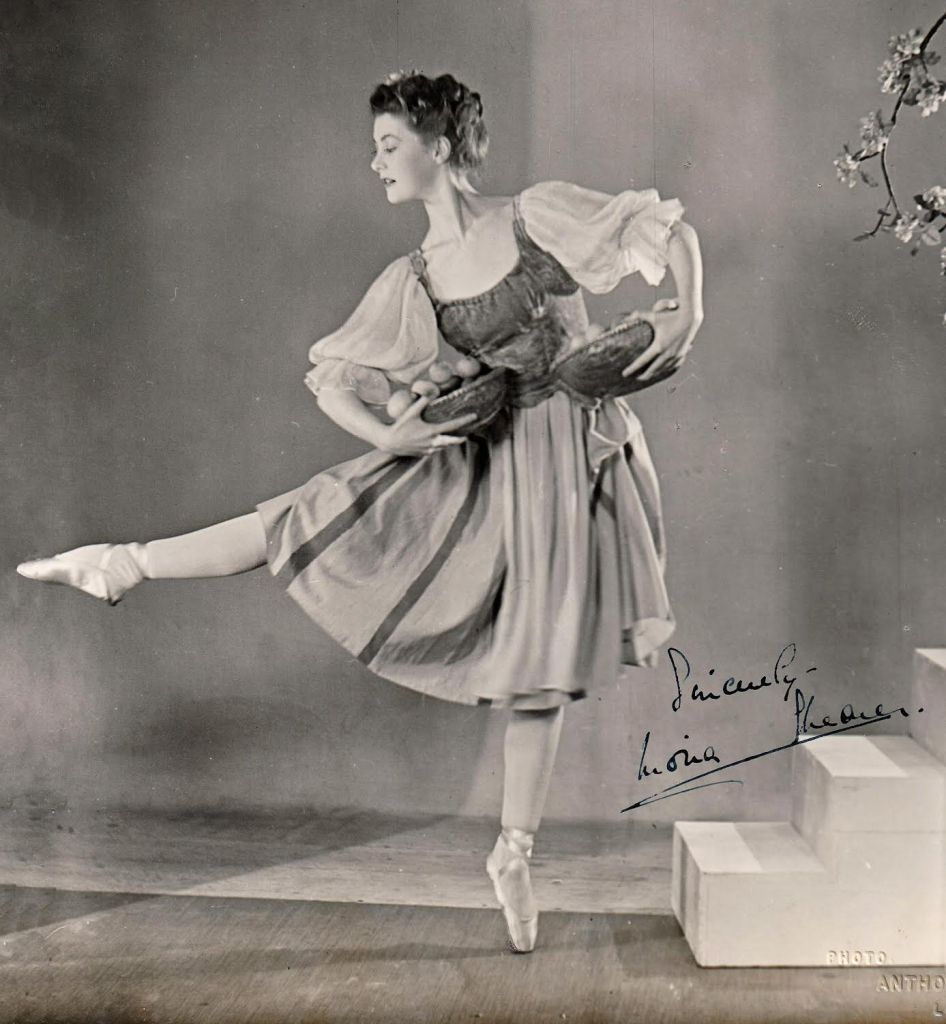
Moira Shearer in the role of the serving maid in the ballet, The Gods go a-begging, circa 1943. Photo by Anthony.
The style of Shearer’s signature would later change considerably but this early example is what was described, in 1950, as balanced, with “delicately poised rhythm” and with individual letters small and round. Her later signatures are made up of far more elongated and vertical letters and seem to be characterised by greater energy. There is no known reason for this change, but it may have been the result of her abandoning the fountain pen for the biro or ballpoint pen. As her signature evolved there was considerable overlap in the use of the styles.
The demand for her autograph probably increased after the 1948 release of the film, “The Red Shoes”, and there is little doubt that Shearer would have been flooded with fan mail. Images taken by the American photographer, William Sumits, of Shearer at home in Kensington in 1949 show her surrounded by both opened and unopened mail and by photos waiting to be signed. She was probably also tasked with getting signatures and photos to the post office and, perhaps even for paying for postage.
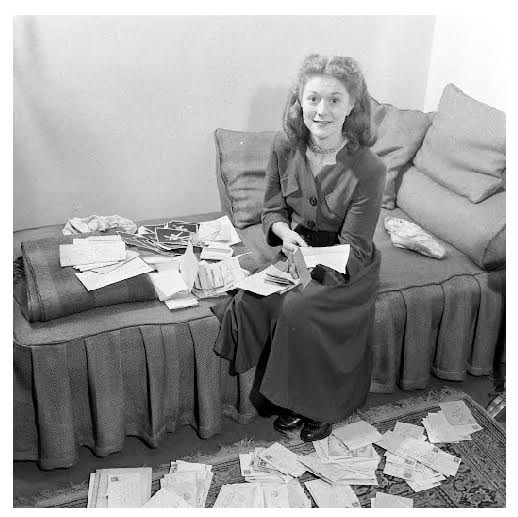
Moira Shearer confronts her fanmail, circa 1949. Photo by William Sumits
It appears that at this time of high demand that Shearer entered into an agreement with the British photographer, Baron, to allow him to copy her signature onto a rubber stamp that was used on copies of images shot by him. As Shearer probably received no income from other photos signed by her, it seems unlikely she would have profited in any way from the sale of these images either.
The requests for autographs at the stage door of Covent Garden and other theatres likewise increased throughout the late 1940s into the early 1950s. A photo by Louis Klemantaski taken at Covent Garden in 1948 or 1949 shows Shearer, pen in hand, mobbed at the stage door by about 40 people, primarily young women, clutching programmes.
After the publication of the several books on Shearer in the late 1940s and early 1950s there was also a demand for signed copies of these. A photo of Shearer with the novelist Nevil Shute shows them at a book-signing event at Harrods in May 1953. Several copies of the book about Shearer, “Portrait of a Dancer”, by the author Pigeon Crowle, sit on the table in front of her, ready to be signed.
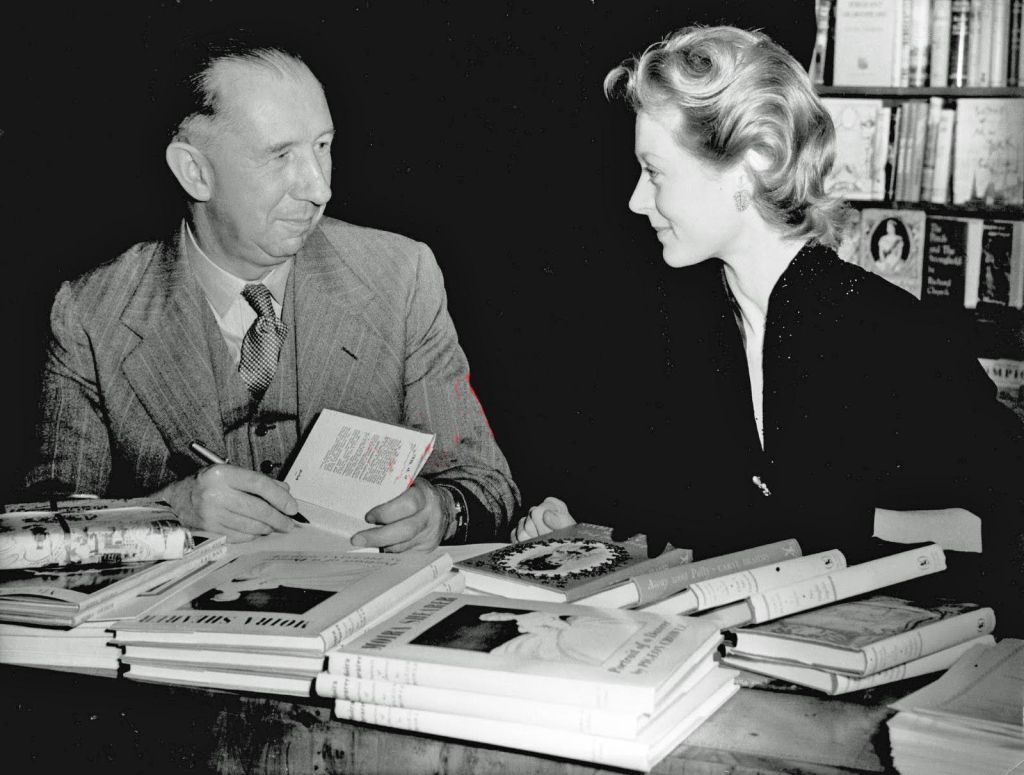
Moira Shearer and Nevil Shute at a book-signing event at Harrods, London in May 1953. Photographer not known.
Following her retirement from ballet in 1953 Shearer trained as an actress with the repertory company, the Bristol Old Vic, and appeared in a number of plays in the mid 1950’s. These appearances kept her very much in the public’s eye and consequently demand for her autograph continued up until about 1960. There are numerous examples of signed programmes from this period.
After she quit the stage Shearer devoted most of her time to her family and her writing. Thus, she slowly disappeared from the spotlight and there are very few examples of autographs after 1960.
Sources
Anthony; photo of MS in the ballet, The Gods go a begging. Signed by MS in blue ink. Date unknown.
Basildon Bond. Advertisement for notepaper featuring Shearer’s handwriting, circa 1950. Publication unknown.
Louis Klemantaski, photographer, The Klemantaski Archive.
The Philadelphia Enquirer, September 1st,1950. “Stage Door Johnnies Gone, Sadler’s Wells Star Reports”.
 Moira Shearer
Leave a comment