At one point in his interview with her Dale Harris reminded Moira Shearer that she had once said that she had a gift for comedy and should have been a clown. Harris continued, “we’ve never mentioned Swanhilda”.
Shearer responded, “I hated it …. from beginning to end. I was so successful in it and people would … say, ‘Oh, we’re coming to see in you in Coppelia … you’re so marvellous in Coppelia’. It … was totally two-dimensional… although it’s a very charming score for the ballet, the Leo Delibes music. It sort of maddened me”.
There are very few reviews of Shearer’s appearances in Coppelia but in those that survive the critics agreed with audiences that she made a very good Swanhilda.
Coppelia also had an earlier significance in Shearer’s career. On April 15th and 27th, 1940, age 14, while she was attending The Vic-Wells Ballet school, she appeared in the corps de ballet in the Dance of the Hours. This was her first appearance for the company and she was even noted in the programme. That evening Pamela May danced as Swanhilda.
Shearer’s next appearances in the ballet were soon after she joined the Sadler’s Wells in the spring of 1942. On August 10th at the King’s Theatre, Edinburgh, on August 24th and September 5th at the Royal Theatre, Newcastle and at the Manchester Opera House on September 21st she danced, probably in the work, spinning song. This was a role that she would take a number of times over the next few months. In 1943 she graduated to a more challenging role in the mazurka and between 1943 and 1946 danced many times in both these roles and that of Prayer.
In either late October or early November, 1946, at The Royal Opera House, Convent Garden she danced the role of Swanhilda for the first time. According to a report in The Stage, Pamela May, who had alternated in the role with Margot Fonteyn, injured her knee and on October 26th Shearer stepped in to replace her on very short notice. However the Royal Opera House records Shearer first danced the role in a scheduled performance in a matinee on November 2nd.
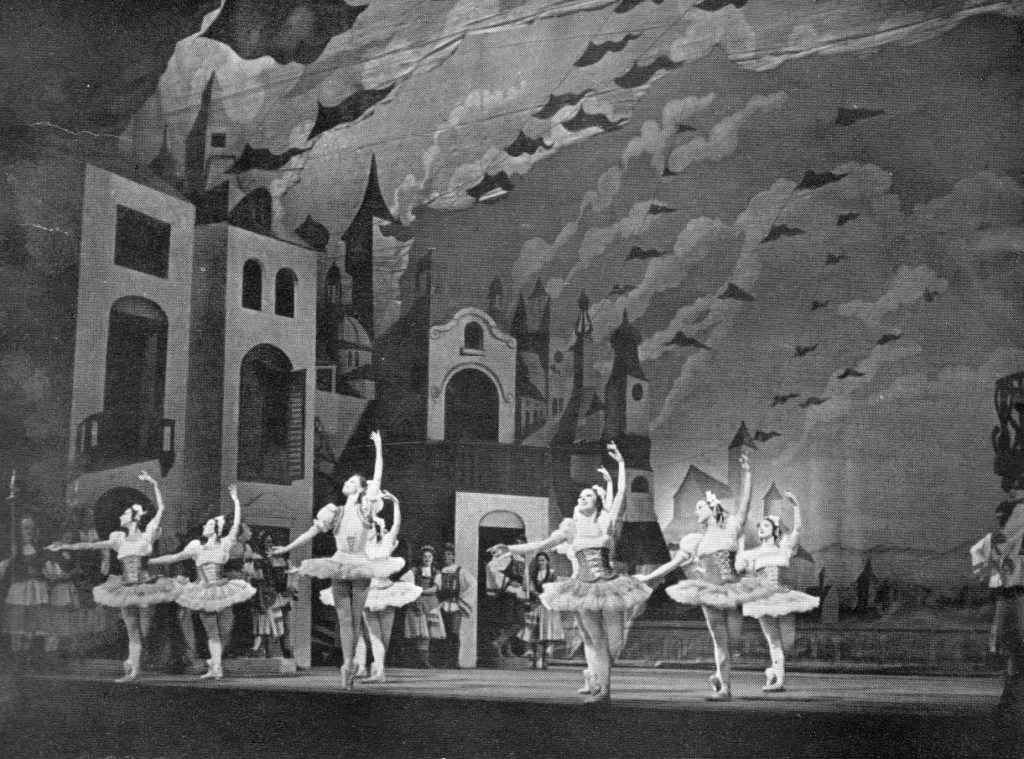
Shearer, centre, dancing in Coppelia, Act I, in 1946 at Covent Garden.
The few critics who witnessed Shearer’s premiere performance seemed taken aback by it and universally praised her interpretation of the role. Contemporary photos also capture her seemingly giving vent to her comic abilities.
The reviewer for ‘The Stage’ wrote of the performance that, “At forty-eight hours notice Moira Shearer danced Swanhilda at Covent Garden, giving a performance memorable in her own career as well as in the annals of British ballet …. It is a joy to watch her pale, mask-like face reflecting the sparkling gaiety of Delibes’ music. The mischievous twinkle in her eye is sufficient to tell us she is out for a lark…. Miss Shearer enters the spirit of comedy delightfully”.
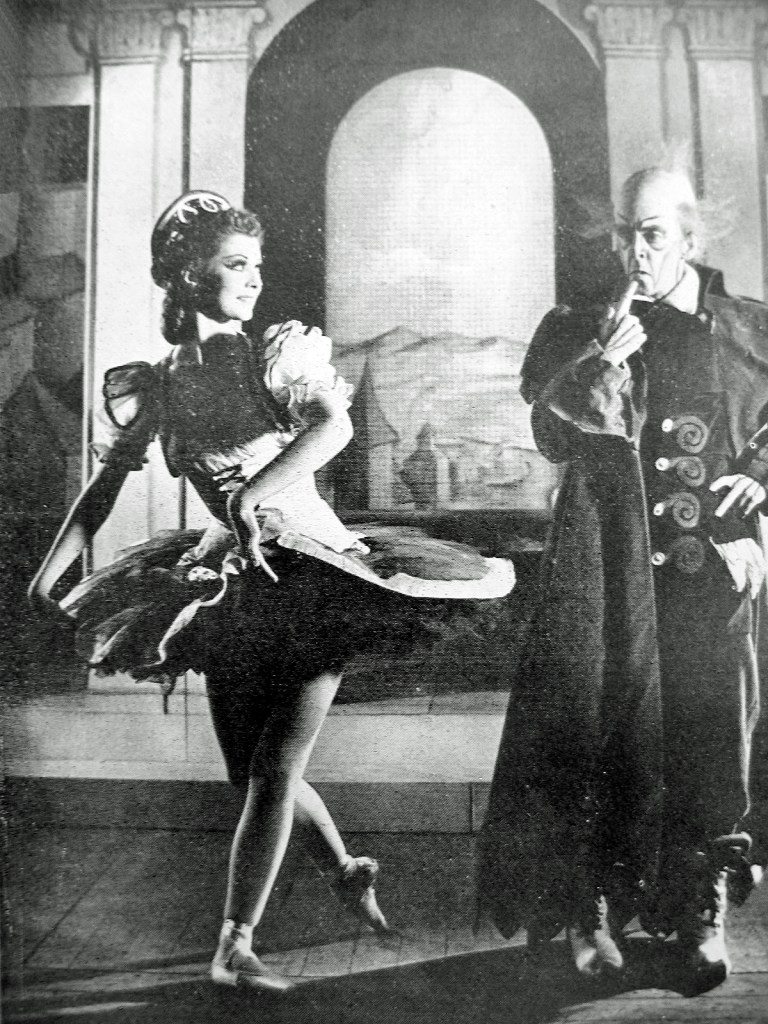
Shearer dancing as Swanhilda in October 1946 at Covent Garden. Robert Helpmann appeared as Dr. Coppelius, the toy-maker. Photo by Mandinian.
‘P.B.’, the reporter for the Observer, on November 3rd wrote in a similar vein of Shearer’s performance, “She was dancing at very short notice but her interpretation had such sparkle, attack and individuality that it will clearly settle into one of the outstanding performances of the season”. John Russell, writing in the magazine, ‘The Sketch’ on November 13th was equally effusive. The article included a photo of Shearer as Swanhilda.
Shearer again appears in the programme is on November 5th and 11th. This suggests that May continued to be indisposed or that Ninette de Valois recognized Shearer’s suitability for the role.
In the period between 1946 and 1951 there are records for Shearer having danced as Swanhilda around 20 times, some of which were on the road in, for example, Edinburgh, Glasgow and Croydon. The performances at Covent Garden include, in March 1948, when Shearer replaced the injured Danilova. The Russian ballerina and her partner Leonide Massine were at Covent Garden for the Spring season.
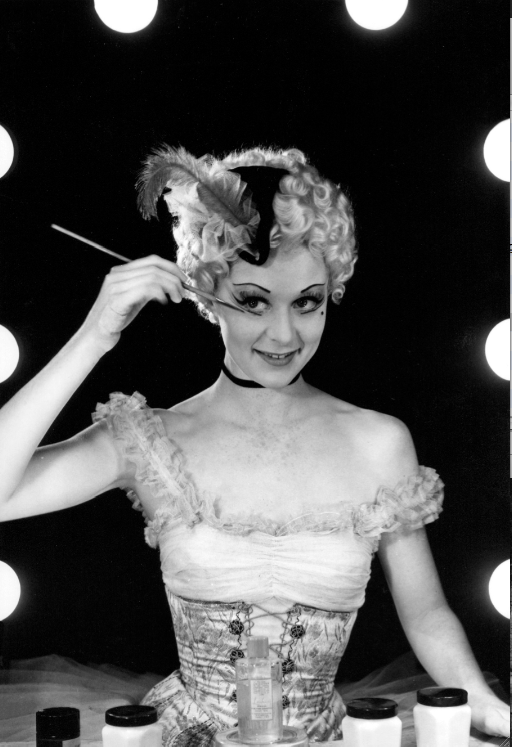
Moira Shearer making up for the role of Swanhilda in a performance of Coppelia. Location, date and photographer are not known. Photo courtesy of the Moira Shearer Archive.
The London newspapers, The Star and The Evening News reported on Shearer stepping in the breach, once again. The Evening News of March 31st, under the headline, ‘But the Show went on’ reported that “Ballet fans attending last night’s performance of Coppelia at Covent Garden were surprised to see Moira Shearer taking the role of Swanhilda. She was taking the place of Madame Danilova … who had been forbidden to dance by her doctor because of a strain. Moira Shearer rehearsed with Frederick Franklin until a few minutes before the curtain went up”.
Shearer’s last appearance as Swanhilda was on October 31st 1951 in Glasgow. Shortly afterwards she resigned as a full time dancer at Sadler’s Wells but returned in 1952 as a ‘guest artist’ to the company.
Sources
Dale Harris, transcript of an interview of Moira Shearer in Edinburgh, August 29th, 1976 and September 1st, 1978. New York City Library Archives, Lincoln Plaza, NYC.
‘P.B’, The Observer, November 3rd, 1946.
The Royal Opera House Archives, Covent Garden.
John Russell, ‘Stage Cameos’, The Sketch, November 13th, 1946
The Evening News, March 30th, 1948, ‘Danilova Indisposed’
March 31st, 1948, ‘But the Show went on’
The Sketch, October 31st, 1946, ‘Coppelia’. Reviewer not identified.
The Star, March 30th, 1948, ‘Moira Stands In’.
 Moira Shearer
Leave a comment