Ninette de Valois and Moira Shearer rarely saw eye to eye. Their differences as to how Shearer should dance began almost from the moment she joined the Vic Wells school in 1940. Under Nicholas Legat Shearer had been trained in the so-called “Russian” style while de Valois taught the “Italian” style that had been developed by Cecchetti, with whom she trained. Shearer also bridled at the regimented way in which the dancers were instructed at Sadler’s Wells Ballet under Nicholas Sergeyev, Ursula Moreton, another Cecchetti student, and de Valois herself.
In her first few years at Sadler’s Wells Shearer apparently conformed as best she could. However, once her confidence and status grew, she began to increasingly assert her “style” on her dancing. Shearer believed that de Valois was well aware of this and thus, she, as the perceived outsider, became even more so. Almost inevitably de Valois tended to sideline her in favour of other more compliant dancers. Beryl Grey saw herself as one of the “good girls”. Shearer knew she was one of the “bad”. To her it didn’t matter. She continued to strive for excellence irrespective as to how others judged her.
Much of the following account is derived from Shearer’s interviews with the American dance historian, Dale Harris. The interviews were conducted in 1976 and 1978 fully 25 years after Shearer quit the ballet. Thus, her recall of events may not be perfect. However, her evaluation of the participants is probably unchanged from the years when she was still dancing.
Shearer’s association with de Valois actually began on a very optimistic note. At some point soon after the start of World War 2, in September 1939, when Shearer had moved from London to Scotland with her parents, Fred Ashton, one of the Sadler’s Wells choreographers, met with Shearer and her mother and recommended that Shearer return to London to enrol in the Vic Wells Ballet School. As this time during the so-called “phony war” the school remained open.
Shearer joined the Vic Wells probably in early 1940 but according to her she was there for only 6 weeks. It was during this time that de Valois saw her for the first time and commented, Shearer later remembered, on what she thought to be her “weak” ankles. Shearer also remarked that it was at the Vic Wells “that … I first sampled those (British) dancing classes”.
When the Blitz began in the autumn of 1940, Shearer once again returned to Scotland with her mother. While there, Mona Inglesby, founder and director of the International Ballet asked Shearer to join her newly formed company.
Shearer recalled that “Inglesby had been a pupil at Legat and had seen me there…. I was up in Scotland clicking (kicking) my heels …. Then this letter came. I was supposedly fully trained; I had 5 years of training but, goodness, you begin to learn when you join a company … but I was adequately equipped technically”.
The premiere International Ballet season began in Glasgow in March 1941. Shearer was present from the start and remained with the company for a full year. It was a baptism of fire. She danced almost every performance often in multiple roles. However, as the most junior member almost all of her roles were minor.
During 1941, while Shearer was dancing with the International Ballet, de Valois wrote to her mother to offer her daughter a place in the Sadler’s Wells Ballet for the 1942 season that began in March. Thus, Shearer completed her year at the International Ballet and in the early part of 1942 the King family returned to live in London. The Sadler’s Wells season began at their new home, the New Theatre, in London’s West End, in March. It is probable that Shearer joined the company at that date although she recalls that she had to spend 2 weeks at the Vic Wells school under the tutelage of Sergeyev. Subsequently, it is likely that she participated in several weeks of rehearsals and practice before appearing on stage.
Shearer recalls that in the autumn of 1942, “I did the Gods Go a-Begging which was a ballet by de Valois. That was important … as it was the principal solo part. I don’t know why de Valois gave this to me or whether it was unusual. Beryl (Grey) certainly did the same kind of thing but she was very exceptional, and she had been trained entirely in the (Vic Wells) school. De Valois was, I think, training her up for a particular position in the company”.
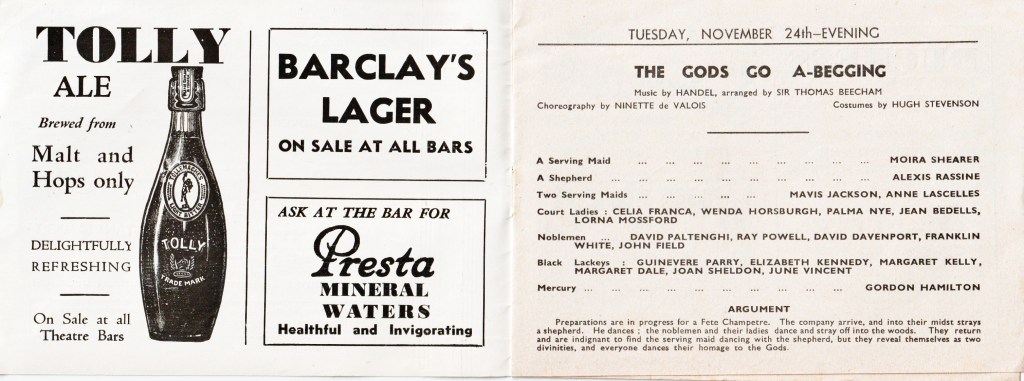
A programme for November 14th, 1942 at the New Theatre when Shearer made her first “solo” appearance as a serving maid in Ninette de Valois’ ballet, The Gods Go a-Begging.
Starting on October 21st, Grey, Julia Farron and Shearer alternated the role of the serving maid in the 10 performances of “Gods” in 1942. Shearer’s first appearance was on November 24th. As Grey had first danced it in the previous year she was probably considered the most accomplished of the dancers in the role. Nonetheless, as Shearer had been with the company for only 6 months it was an important step up for her. At around the same time Shearer also danced for the first time in Les Sylphides alongside Margot Fonteyn, Celia Franca and Grey, rather than, as she had until then, just in the “corps”.
Many years of research have uncovered only one photograph of de Valois and Shearer working together on stage. It is of them in December 1948 at Covent Garden during the rehearsals for the upcoming production of Cinderella. Ashton was the choreographer and after the unexpected serious injury to Fonteyn, the first cast, he had worked for about 2 weeks recreating the role for Shearer. Thus, in the photo de Valois and Shearer would probably not having been discussing specifics of the ballet. This stands in contrast to earlier photographs of de Valois working with other ballerinas like Grey, especially on ballets choreographed by her, which were undoubtedly focused on technical issues.
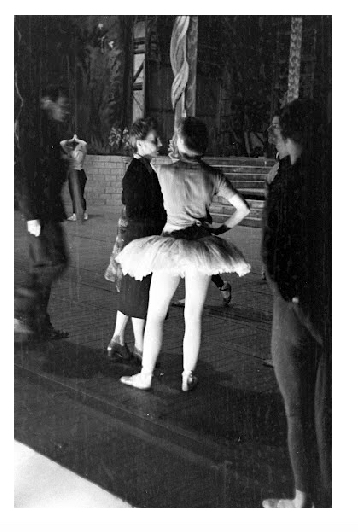
Ninette de Valois and Shearer in discussion on stage at Covent Garden early in December 1948 when the company were in rehearsals for Frederick Ashton’s ballet, Cinderella. Photo by William Sumits.
While there are no other photos of her working with de Valois we have Shearer’s vivid recollections to inform us of their relationship. They remained so in 1976 when she was interviewed by Dale Harris and Shearer was not averse to sharing them with him. In the interview she commented once again on how rigid and regimented de Valois was in her lessons and how committed she was to her Cecchetti methods. For a while Shearer bridled at the discipline and, what appeared to her, unfair criticism she received from de Valois but she devised a simple strategy to cope with it. She appeared to conform to de Valois’ directives in class and rehearsals but would not hesitate to express her individuality in actual performances.
In this regard, Harris asked Shearer about de Valois’ attitude to what he termed “performance”. Shearer replied, “yes, sadly, de Valois actively disliked it ….. one or two of us had individuality, which was inevitable; it was going to come over (through) … even in the most technical things you did …. It is something which some people have and can do nothing to alter”.
When Shearer would change the footwork or some other aspect of a performance de Valois would often notice and a reprimand would ensue. As Shearer was determined and because de Valois obviously came to recognize this, it was hardly surprising that de Valois consciously or unconsciously decided to sideline her. As the prima ballerina Fonteyn went on dancing the roles she would have been given anyway but Grey and, especially, Violetta Elvin, were often favoured over Shearer. This was particularly evident in late 1949 at the beginning of the first North American tour by Sadler’s Wells in the appearances at the Metropolitan Opera House in New York. Although she was billed as the most senior ballerina after Fonteyn, Shearer was not given a lead role until the 10th performance.
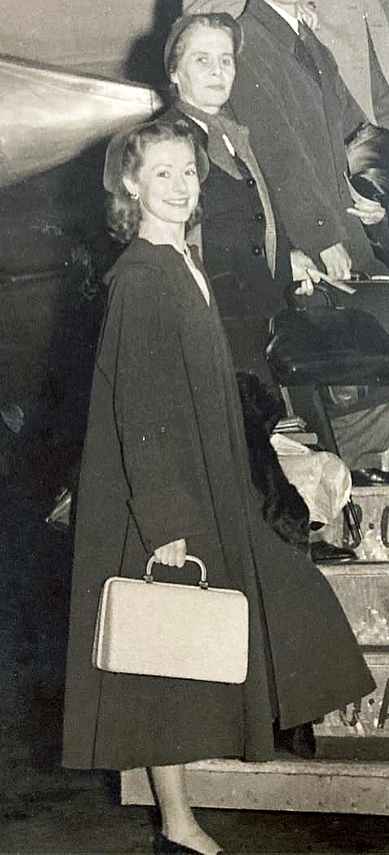
Ninette de Valois and Shearer boarding a plane at London Airport en route to New York early in October 1949. Photographer not known.
In her appearances at Covent Garden Shearer occasionally took on major roles or danced alongside Fonteyn, as in Symphonic Variations and Don Juan. There were even instances in which the critics believed she outshone Fonteyn, as in Scenes de Ballet. When George Balanchine, the American choreographer, joined Sadler’s Wells for a season in 1950 and produced his ballet, Ballet ImperiaI, Shearer was third cast after Fonteyn and Grey. Balanchine’s choreography didn’t suit Fonteyn but it appealed to both Grey and Shearer. They both gave standout performances. Shearer later wistfully lamented the fact that she could not further her cooperation with Balanchine further.
A combination of factors, including injuries, meant that Shearer’s participation with Sadler’s Wells tailed off dramatically after 1950 although she continued to dance the major roles in Lac des Cygnes, Coppelia and Giselle, ballets in which she excelled.
After Shearer retired from ballet in 1953 and began her career on the straight stage, she saw little of de Valois although it’s apparent that they stayed in touch. When de Valois decided, in 1990, to publish an anthology of short stories of her early life in Ireland, called The Path of Morning, she chose Shearer to narrate the audio version. Shearer had a commanding stage voice and had performed in London as the narrator to Prokofiev’s music in Peter and The Wolf in 1953 and 1954, so she was a logical choice.
In 1978, Shearer along with many other former Sadler’s Wells ballerinas attended de Valois’ 80th birthday lunch at the Dorchester Hotel in London. Shearer remembers it thus, “I saw old friends, but didn’t know how they would greet me. De Valois was not exactly wild about me. Anyway, I waited my turn (to be introduced to her). As we were going up to speak to her, she seemed nonplussed (but said) ‘Oh, Moira’ and embraced me. Then she said to her husband, ‘Arthur, look, your favourite, the only one you wanted to come and see’”.
Thus, obviously tongue in cheek, Shearer wondered if the animosity that de Valois bore toward her was tinged by jealousy. Quite apart from her “Titian” hair and green eyes Shearer was considered a real beauty and would have been used to turning men’s heads.
Sources.
Dale Harris, transcript of interviews of Moira Shearer in Edinburgh, August 29th, 1976 and September 1st,1978. New York City Library Archives, Lincoln Plaza, New York City.
 Moira Shearer
Leave a comment