Symphonic Variations was the first ballet created after World War 2 by the choreographer, Frederick Aston. Its genesis was Cesar Franck’s concerto of the same name. Ashton had listened to the music a number of times during the war and decided to produce a ballet based on it.
The dance critic, Stephen Williams, writing in the journal, The Stage, of the success of the ballet’s premiere wrote, “Symphonic Variations is pure ballet – Franck’s …. “Concerto” expressed in terms of absolute dancing. There is no “story”, no drama, no characterisation”. He goes on to describe it as, “a shaping of the visions and the movements which the music evokes in the mind”.
The premiere was on April 24th 1946 at Covent Garden; it was originally planned for March but the lead male dancer, Michael Somes, had injured his knee earlier in the season and thus it was postponed
The ballet employs six dancers; three female and three male; for the first performance Margot Fonteyn was the lead ballerina and was supported by Pamela May and Moira Shearer. Somes was supported by Henry Danton and Brian Shaw. An article in Ballet Today suggested that the six dancers were chosen for their “musicality”, their ability to interpret Franck’s music as much for their technical prowess.
There was no orchestra; the music was played on the piano by Angus Morrison.
The ballet lasted 17 minutes during which time all the dancers remained on stage although sometimes were motionless. Margaret Dale, another Sadler’s Wells ballerina, later commented that, though the ballet is brief, the demands of the choreography on the dancers are exhausting.
The curtain rises to silence, to the six dancers standing motionless, the three ballerinas in front. Fonteyn was at the centre, flanked by May and Shearer. There were six “variations” some of which were duets while others focused on groups of four or on all the dancers. There is no visual record of the premiere but film footage of a rehearsal gives some sense of the elements of the performance.
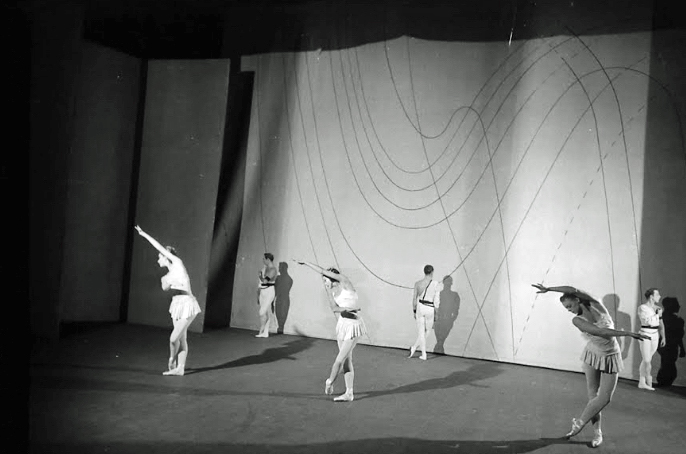
Rehearsal of Symphonic Variations at the Metropolitan Opera House, New York City, October 1949. Photo by Gjon Mili.
One of the initial reviews was published in the Manchester Guardian on April 26th 1946.
The writer is not identified by was probably the dance critic, P.W. Manchester.
“Only a very musical or a very unmusical choreographer would make a ballet to Cesar Franck’s Symphonic Variations ….. Frederick Ashton has done this dangerous thing. His ballet, bluntly called Symphonic Variations was performed by the Sadler’s Wells Ballet Company last night at Covent Garden. Happily, no choreographer, except perhaps Balanchine, is more musical than he.
As with the title, so with the ballet itself: it is a straight issue between composer and choreographer. Sophie Fedorovitch’s backcloth is a terse abstraction; her costumes are plain and functional; there is no story and there are only 6 dancers, who remain on the stage throughout. They either dance or stand still; they do not mime at all. But the ballet is no mere string of divertissements. It is, on the contrary, tightly woven. It is a classical ballet in a true but not quite orthodox use of the term. Mr. Ashton, in fact, set himself a musical problem and has sought no adventitious aid in trying to solve it. That is rare, brave and stimulating.
There are 6 variations …… he has not at all kept the music’s pattern. He has made his own pattern, and kept …. the music’s sense of a single flowing series.
Last night his ballet was performed brilliantly by Margot Fonteyn, elegantly by Moira Shearer, and very competently by Pamela May and the 3 male dancers. The result was almost entirely successful. The reason for the “almost” is – the piano. In these variations the piano is the soloist, the star, the ballerina …. Mr. Ashton’s pattern does not quite account for this soloist”.
The ballet was very well received and remained in the Sadler’s Wells repertoire for many years. Between 1946 and 1953 Moira Shearer danced in it for a remarkable 70 times. This included performances on tours of the British provinces and in Florence, Paris and the US. Occasionally substituting for Fonteyn she danced the “lead” at Covent Garden about half a dozen times.
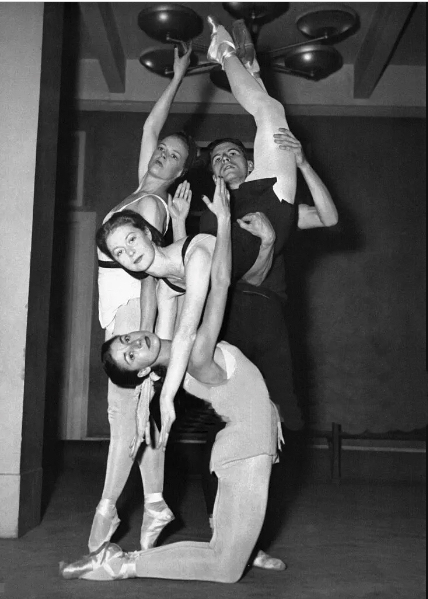
Rehearsal of Symphonic Variations in Paris, September 28th, 1948. Michael Somes lifts Moira Shearer. Margot Fonteyn kneels in the foreground and Pamela May is a pointe. Unknown photographer.
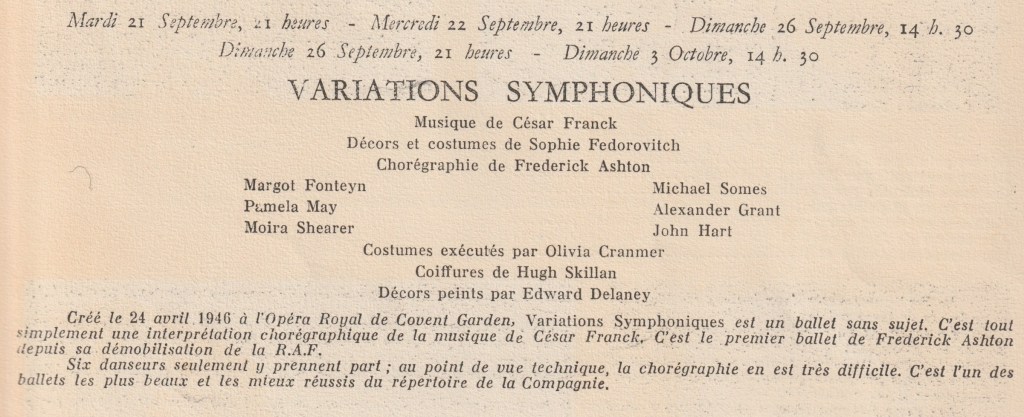
Programme for performances of Symphonic Variations at the Theatre des Champs Elysees, Paris in September and October 1948.
Due to her 1952 pregnancy Shearer was long absent from Covent Garden. On her return in 1953 she first danced the lead in Symphonic Variations.
The Stage for February 12th, reported on her performance under the headline,
“Covent Garden, Shearer’s Return”.
“On February 7th Moira Shearer returned to the Royal Opera House after an absence of 18 months….Miss Shearer …. made her appearance in Symphonic Variations, Frederick Ashton’s masterly abstract comment on Cesar Franck’s music. The dancer’s pale alabaster beauty makes her an ideal exponent of this choreography, which exploits in an exalted mood the beauty of movement for its own sake and is as detached from everyday life as pure mathematics. Michael Somes partnered Miss Shearer in masterly fashion, giving a feathery lightness to the lifts that did much to accentuate her wraithlike appearance. There could be no more suitable ballet to provide a vehicle for Miss Shearer’s stylish poise and quietly confident attack”.
The New York Times reported of this same performance that it was greeted by rapturous applause and that Shearer took 7 curtain calls. This over-the-top response must have been both unusual for a British audience at that time and embarrassing to Shearer. While she was dancing the central role there were no great solos, no touching duets with Somes and, thus, no reason to draw attention to her. But, if we are to take the review at face value, it is evidence of how the London ballet public had missed her. It was obviously a special occasion.
A few weeks later Shearer injured her tendon while she was rehearsing for Giselle and left the Sadler’s Wells Ballet after a career spanning 11 years.
Notes.
Angus Morrison was the pianist throughout 1946 and 1947. He was replaced subsequently by Jean Gilbert. Gilbert had joined Sadler’s Wells Ballet in 1944 and played both in rehearsals and performances. She toured with the company in the US and Canada in 1951.
Shearer, in her interview with Dale Harris in 1978 makes scant reference to Symphonic Variations but stresses the need for “musicality” in the dancers.
The four other dancers for the February 1953 performance were Nadia Nerina, partnered by Brian Shaw and Rosemary Lindsay partnered by John Hart.
Sources.
Ballet Today, July 1946. Editor P. W. Manchester.
The Manchester Guardian, April 26th, 1946, Ballet at Covent Garden.
The New York Times, February 8th, 1953. Moira Shearer Scores.
The Sphere, February 12th, 1953. Shearer’s Return.
David Vaughan, transcript of an interview with Margaret Dale, January 1975. New York Public Library, Lincoln Plaza, New York City.
Stephen Williams, The Stage, May 2nd, 1946, Covent Garden, “Symphonic Variations”.
 Moira Shearer
Leave a comment