On January 17th 1926 at 5.30 pm Moira Shearer was born in Morton Lodge, Dunfermline, Fife, Scotland.
Thus, today January 17th 2026 we celebrate her centenary.
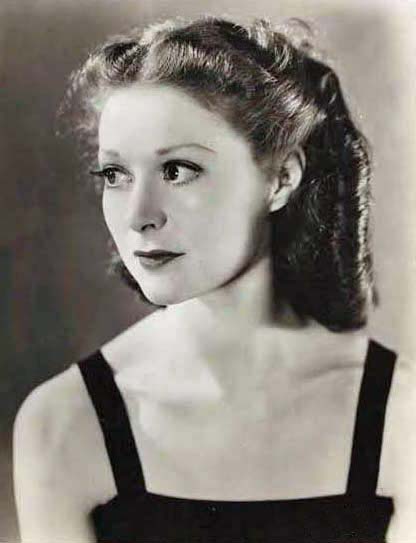
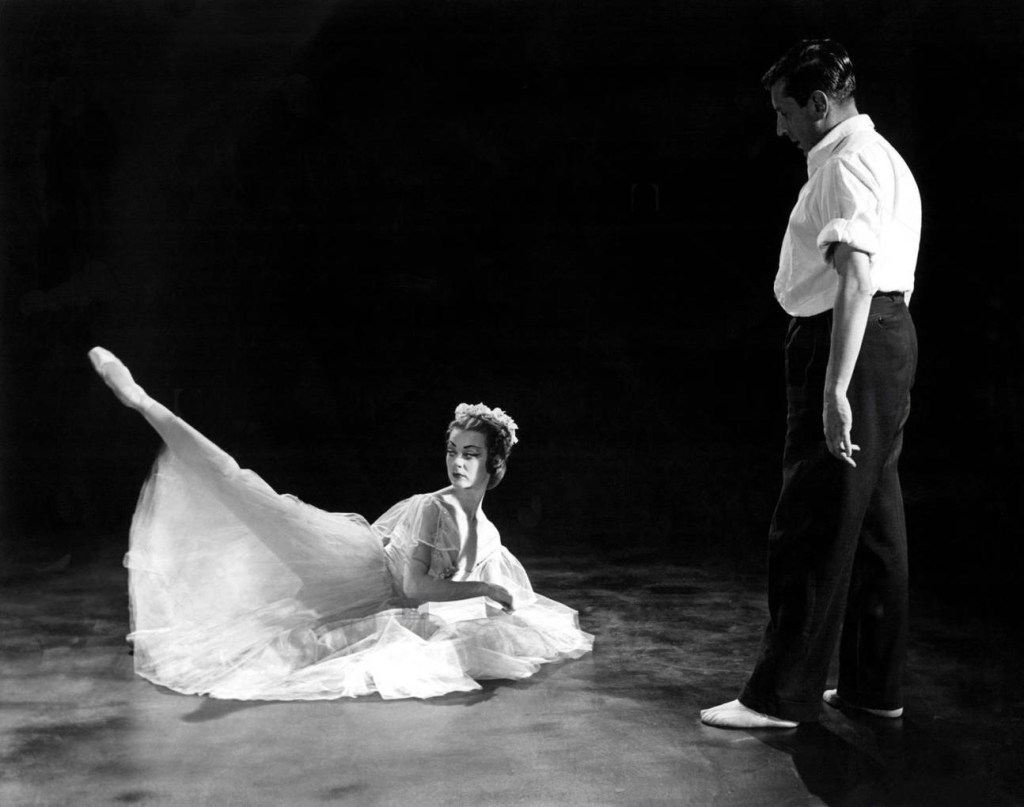
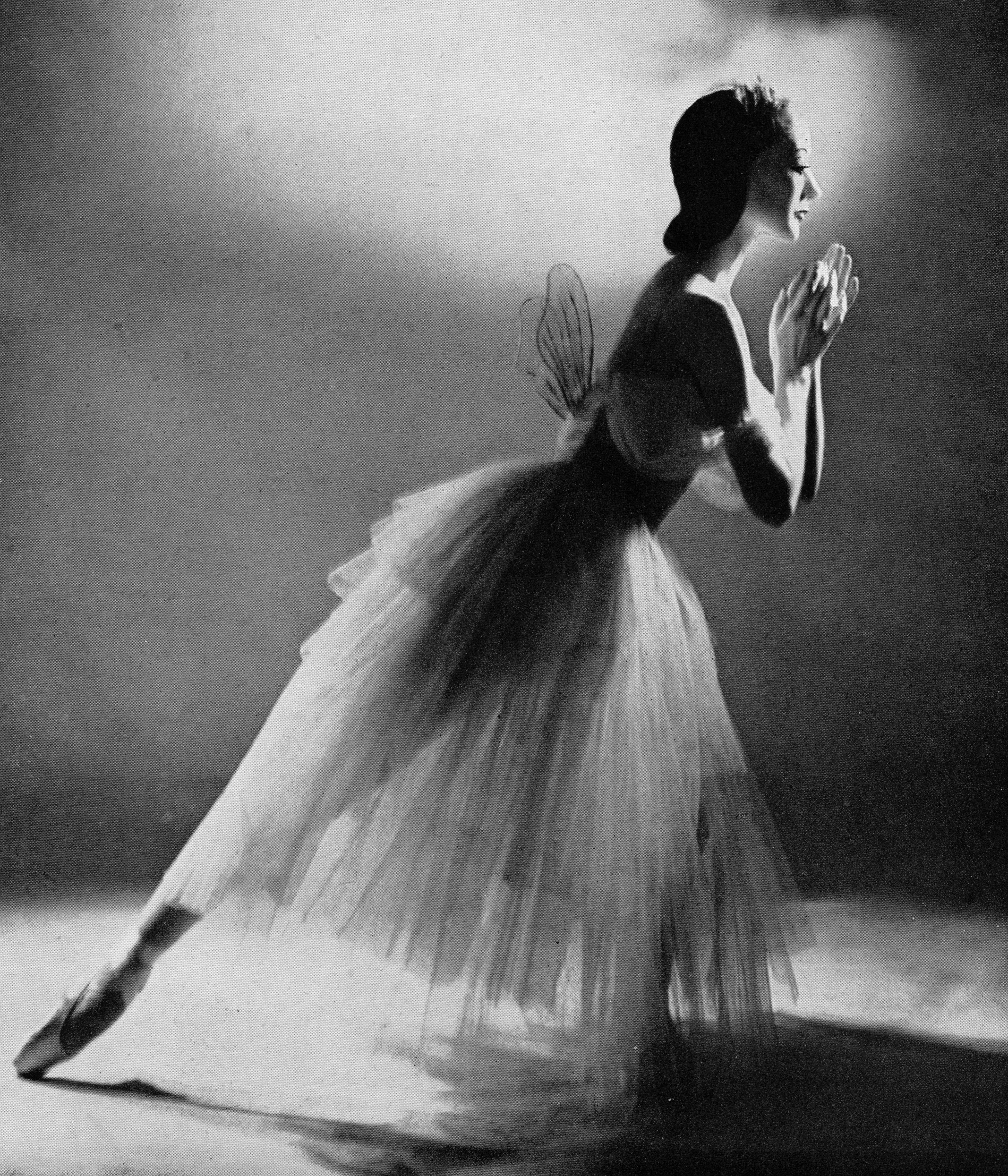
This portrait was taken by the British photographer Hans Wild in 1949 prior to Sadler’s Wells Ballet’s first tour of North America. It shows Moira Shearer in her simple practice dress.
As recounted by Alastair Macaulay, the former dance critic for the New York Times, Beryl Grey and Moira Shearer approached Ninette de Valois to pay their respects to her after the memorial service for Marie Rambert in 1975.
After they had left to have lunch together de Valois turned to her companion, the dance critic, Clement Crisp, and remarked that Grey and Shearer hadn’t always been so friendly to each other and that, in fact, when they were younger, at rehearsals at the barre, they would kick at each other in their grands battements. De Valois’s comments speak to the great rivalry that existed between Grey and Shearer at Sadler’s Wells in the late 1940s. However, despite this, they eventually became friends and in her autobiography Grey makes reference to this friendship. Shearer did not write an autobiography and her only comments regarding Grey are in the interview with the dance historian, Dale Harris, where she talks at length about her dancing in Quest, Swan Lake and Giselle. She says of Grey’s role as Duessa in Quest that it was best part ever written for her. In the interview Shearer makes no mention of friendship with Grey at this time. Macaulay notes that this was to develop much later and after both had left the ballet.
This is hardly surprising as, in a 1974 article, Shearer related that life as a professional ballet dancer didn’t allow for such luxuries as reflection or friendship. She recalls, “I had few friends. I met few people. I did few other things …. It was a highly technical and very physical life… that is what happens with dancers”.
Beryl Grey was a pupil at the Vic-Wells school from 1937 and joined the Sadler’s Wells company early in 1941 at age 14. Shearer followed over a year later by which time Grey, despite her youth, was well established.
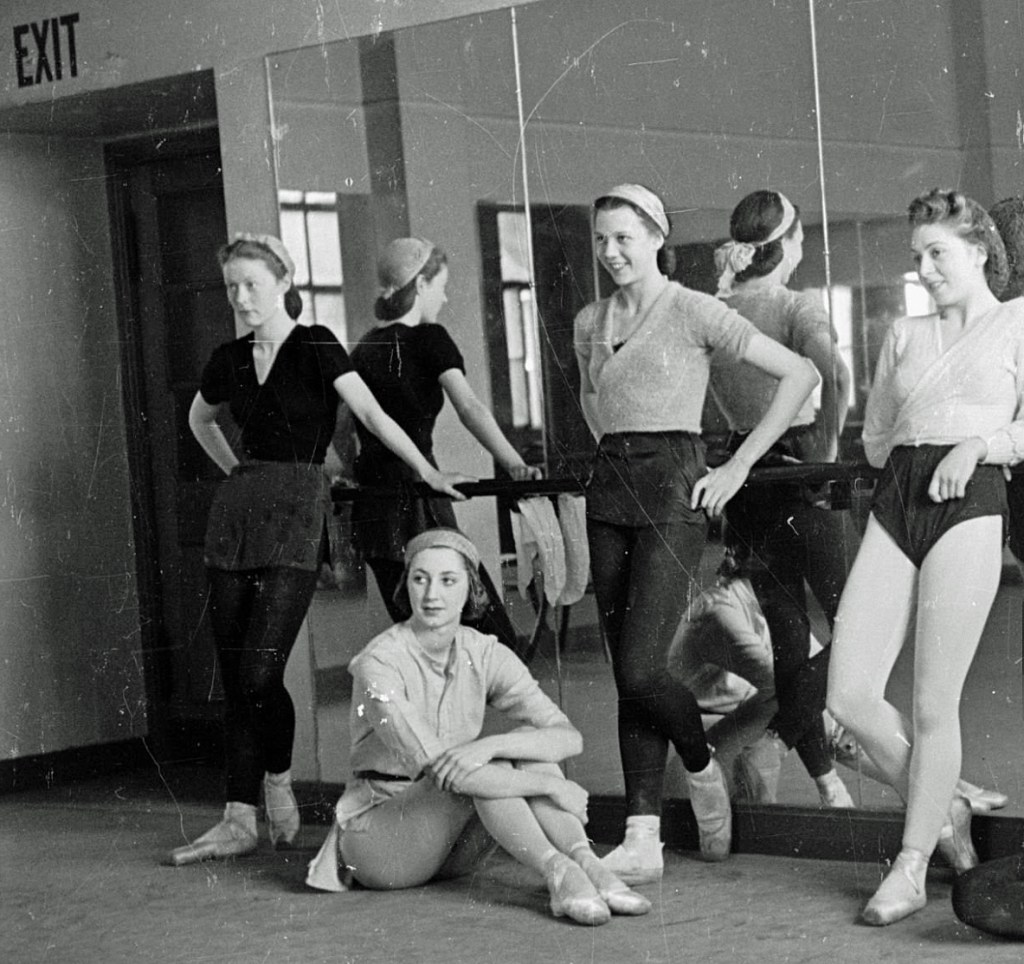
There is a photograph of them, probably taken at some date in 1942, where they are relaxing at the barre along with other dancers. Grey appears smiling, confident and totally at ease. Shearer, by contrast, seems serious and tentative.
Margaret Dale, at right, Moyra Fraser, seated, Beryl Grey, centre and Moira Shearer, at left, observing apractice at Sadler’s Wells Ballet, probably in 1942. Photographer unknown.
They appear to be observing other dancers at practice and perhaps under the direction of de Valois. Having been schooled in the Vic-Wells methods since she was 10 years old Grey would have been quite at home by what she observed. Shearer on the other hand was trained in the “Russian school” and would have had to learn to adapt. In the Dale Harris interview, Shearer alludes to this challenge.
Shearer’s first recorded performances for the Sadler’s Wells Ballet, at the New Theatre, London, were in early May 1942. She danced minor roles in Sylphides, The Prospect before Us and Rendezvous. She first danced with Grey, probably on December 4th, in The Birds, one of the short ballets produced to showcase the talents of younger dancers. Grey danced the major role of the Nightingale opposite Alexis Rassine while Shearer was one of four “attendant doves”. There are a number of photographs by an unknown photographer that have survived of this ballet although, given their composition, they were probably shot at a rehearsal.
Grey had first danced the lead role of Odette/Odile in Lac des Cygnes (Swan Lake) on her 15th birthday, June 11th, 1942. Later that year at a matinee performance on December 16th at the New Theatre she performed the role once more while Shearer and Lorna Mossford danced in Act II as two swans.
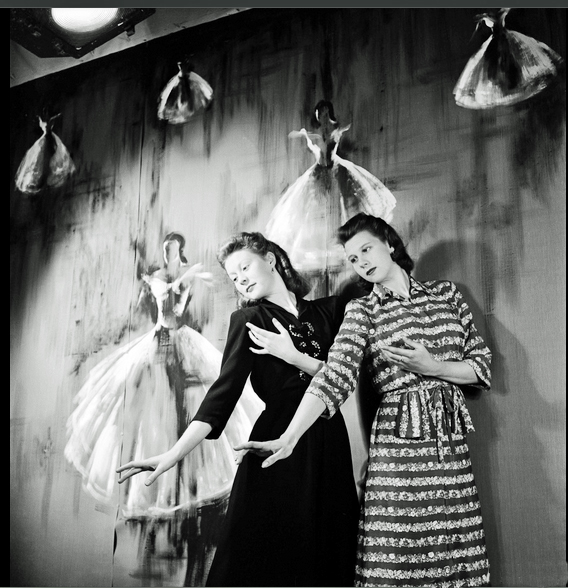
During the Second World War the American photographer, Lee Miller, lived in London and worked both for British Vogue (magazine) and for Conde Nast. Most of her assignments concerned documentation of the impact of war on Britain but she also focused on fashion. In this latter regard, in 1944, she photographed Margot Fonteyn, Beryl Grey and Moira Shearer at the Vogue studios. Some of these photographs have survived.
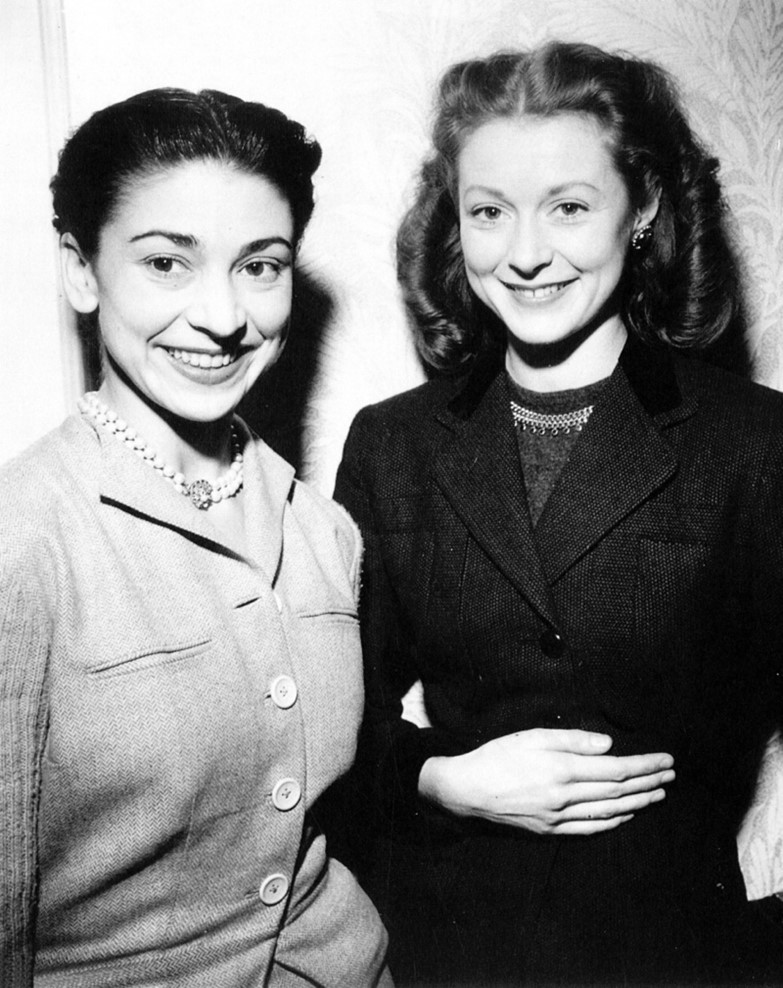
Beryl Grey and Moira Shearer at the Vogue studio, London, 1944. Photograph by Lee Miller.
Two of the photographs taken of Grey and Shearer are quite similar and are obviously from the same shoot. One survives in Beryl Grey’s archives and she discusses it on camera in the 2006 Scottish TV documentary on Shearer titled “The Reluctant Star”. The ballerinas are probably wearing clothes provided to them by Vogue as these appear to be far more elegant and costly than they could have afforded on their bare-bones, wartime Sadler’s Wells salaries.
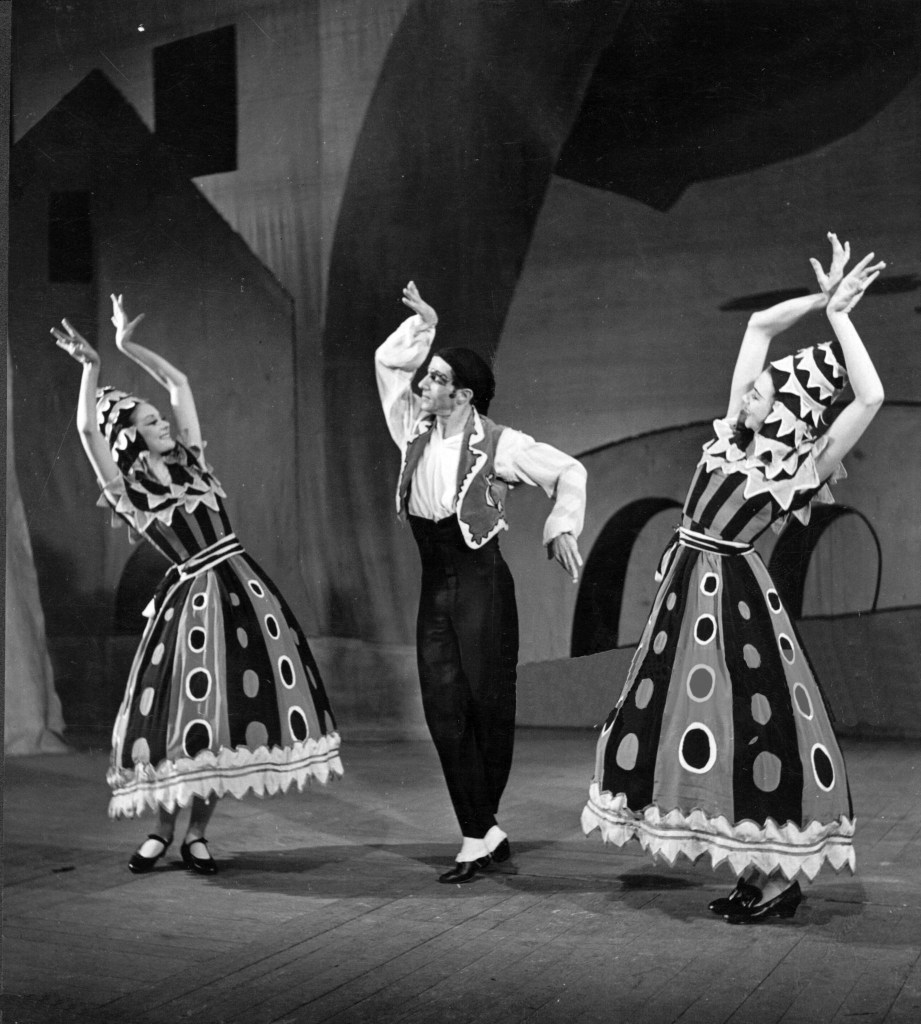
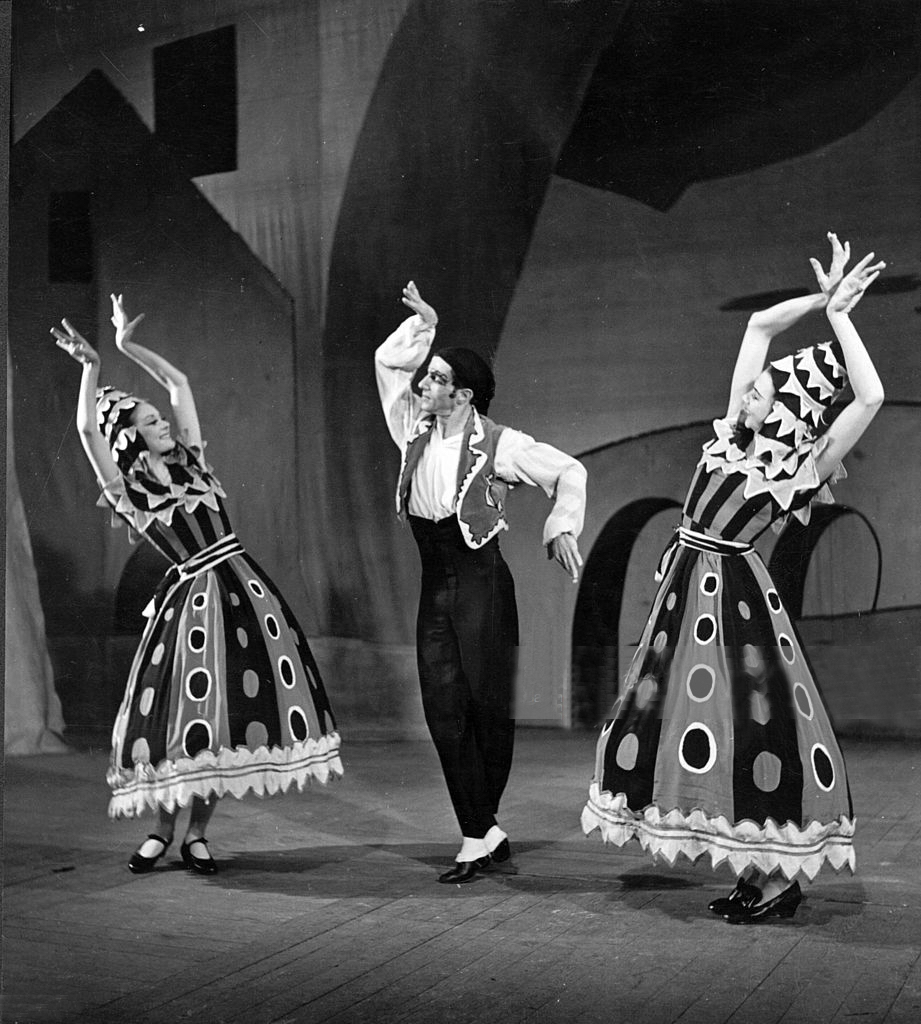
Early in 1947 the director of the Sadler’s Wells Ballet, Ninette de Valois invited the Russian dancer and choreographer Leonard Massine to produce and appear in several of the ballets that he had originally created in 1919 for Diaghilev’s company. He arrived in Britain, accompanied by Alexandra Danilova, probably in January 1947 and began rehearsals with the leading Sadler’s Wells dancers including Margot Fonteyn, Beryl Grey, Violetta Elvin and Moira Shearer. One the ballets was The Three-Cornered Hat (Tricorne) that premiered at Covent Garden on February 6th. Massine danced the lead role of the miller; Fonteyn danced the role of his wife and Grey and Shearer appeared in the jota in the finale. Shearer danced in a dozen performances of the ballet in February and May but not always with Grey. The attached photo of the three dancers dancing the jota indicates how much taller than Massine and Shearer that Grey was!
Leonide Massine dances the jota in his ballet, The Three-cornered Hat, at Covent Garden in February 1947 with Beryl Grey at right and Moira Shearer at left. Photograph by Baron.
During their second North American tour in 1950-51 the Sadler’s Wells Ballet travelled between venues by a specially commissioned train and also lived and ate on board. The dancers and staff were allocated cabins each of which had upper and lower bunk beds. As the senior ballerinas, Margot Fonteyn and Pamela May were bunked together; Beryl Grey and Moira Shearer also shared a cabin and agreed they would alternate between upper and lower bunks on a daily basis. Another photo in Grey’s archive shows Shearer in the ascendency. The snapshot itself and Grey’s description of it in “The Reluctant Star” seems to attest to the warmth of their relationship at the time.
When Pamela May was injured during the tour and had to return to Britain for treatment Moira Shearer was moved to share a cabin with Margot Fonteyn. There is no record of who replaced her in Grey’s cabin.
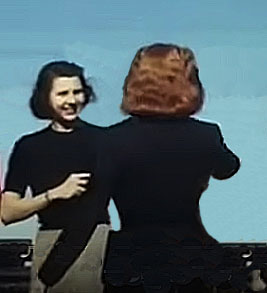
At one point during the tour near Bloomington, Indiana, the locomotive pulling their train developed an overheating problem and the train was forced to stop for several hours. There are several photos of Grey and Shearer kicking their heels on the tracks and enjoying some fresh air with the rest of the company.
Beryl Grey and Moira Shearer enjoying an unscheduled break from their rail journey across the USA in 1950 and 1951. Screencap from a film by an unknown photographer.
The last occasion on which Grey and Shearer danced together was during George Balanchine’s 1950 tenure at the Sadler’s Wells Ballet when his ballet, Ballet Imperial, was staged. Balanchine was allocated the services of all top four ballerinas …. Fonteyn, Shearer, Grey and Elvin. Fonteyn, in the role of the ballerina, found it difficult to adapt to Balanchine’s unconventional choreography but the other ballerinas embraced it more fully. Shearer, in particular, seems to have been energized by it. However, the critics generally agreed that Grey’s interpretation of her role as the soloist was the most successful.
Grey admired Shearer’s dancing and speaks of her with great affection in “The Reluctant Star”.
“She had this beautiful Russian training which demands a pure line and a very strong technique, and she had both of those”.
“You put her into a wonderful magical setting like Sleeping Beauty and she was just…. magic…. very light…. so perfect”.
“She’d done Red Shoes and she was a great success, so she could have been very sort of snooty, but she never had a swollen head, never changed”.
“Moira was always very modest, very quiet, very retiring, very dignified”.
She concludes with this description of Shearer’s dancing.
“Light, beautiful, shimmering”.
Sources.
Frank Entwisle, Sunday Express Magazine, 1974. “Things I wish I had known at 18”.
Beryl Grey, For the Love of Dance: My Autobiography. Oberon Books Ltd. 2018.
Dale Harris, interviews with Moira Shearer in Edinburgh, August 29th, 1976, and August 31st and September 1st, 1978.
Alastair Macaulay, Notes on Moira Shearer (2013), New York Public Library, Dance Collection, Lincoln Center, New York and personal communication.
The Reluctant Star, Artworks Scotland for the BBC, 2006.
Moira Shearer’s mother took her daughter to see the ballet company, Les Ballets Russes, when they appeared at Covent Garden in 1935. There she saw Leonide Massine dance in “La Boutique Fantasque”; she was nine years old and he was 39. When he came to dance with the Sadler’s Wells Ballet early in 1947 at the invitation of Ninette de Valois he was 51 and Shearer was 21.
As he was a guest artist (along with Danilova) he featured only occasionally in programmes that Spring 1947 season. Thus, although the ballets Massine brought with him were strenuously rehearsed under his direction, Shearer had limited opportunities to actually dance with him….. perhaps only 6 or 7 times in his ballet, “La Boutique Fantasque”, and, 12 times in “The Three-Cornered Hat” (Tricorne), also choreographed by him. Immediately following their final performance together (in Boutique) on June 21st they both flew to Nice to begin filming of “The Red Shoes” in Monte Carlo.
Moira Shearer, left and Beryl Grey dance with Leonide Massine in the “jota” in his ballet “La Boutique Fantasque” at Covent Garden in February 1947. Photographer, Baron, Getty Images.
Massine looms large in Shearer’s decision to appear in “The Red Shoes”. When one of the directors and producers, Michael Powell, first approached her in 1946 to take part in the film as an aspiring ballerina, she turned him down. Thus, he cast about for an alternative to her but was unable to find a dancer that met all his requirements. In the meantime, he set about hiring the rest of the cast. This included Anton Walbrook who was to play the lead as Boris Lermontov, the impresario, Robert Helpmann, Ludmilla Tcherina and Massine. Massine shared responsibility for the choreography with Helpmann and played the dual role of Grischa Ljubov, the dance director at the fictitious ballet company and as the shoemaker in the ballet that was central to the film’s story.
Powell approached Shearer again in 1947, nine months after his first attempt and, this time, she agreed to appear in the film. Along with de Valois’s urging to Shearer that she make a decision, the proposed participation of Massine was probably critical to Shearer’s change of heart. The filming was timed to take place during the summer break in the Sadler’s Wells schedule and would not impede Shearer’s return to the company in the autumn.
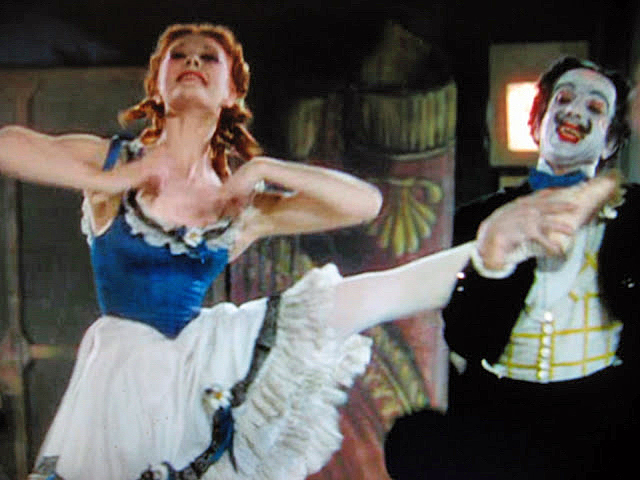
Besides the ballet choreographed by Helpmann and Massine, “The Red Shoes” featured several short excerpts of the classical ballets such as Swan Lake, Sylphides and Coppelia and of La Boutique Fantasque. Robert Helpmann accompanied Shearer in Coppelia and Massine joined her the can-can in Boutique that is illustrated in the screencap, below. When asked about these performances by Dale Harris, Shearer was very critical of the end product claiming that Michael Powell was “ignorant of ballet technique”. She felt that a lot of good dancing ended up on the cutting-room floor.
Moira Shearer and Leonide Massine dance the can-can in his ballet “La Boutique Fantasque” in an excerpt shown in the film, “The Red Shoes”, 1948. Photographer unkno In an interview she had with Brian McFarlane in July 1994 Shearer also took issue with Powell and Pressburger’s portrayal of the ballet company as a whole and particularly of Massine as the dance director of the fictitious Lermontov Ballet. She complained that “there was never a ballet company anywhere which was like that” and that the characterisation of Massine as a manic director was completely false. Powell had Massine behaving like a mad jumping bean”. Instead, the man with whom she had worked at Sadler’s Wells that Spring was, in her words, “courteous, friendly and reserved”.
The success of “The Red Shoes”, in Britain, Europe and North America was the basis, in 1951, of Powell and Pressburger’s next venture into ballet on film, “The Tales of Hoffmann”. The idea was first proposed to them by the eminent British musician and conductor, Sir Thomas Beecham. The cast and production crew were similar to that for The Red Shoes although, in this case, Fred Ashton was commissioned to create the choreography.
The story is in three major chapters to which Powell added a prologue and epilogue, both featuring Shearer’s dancing.
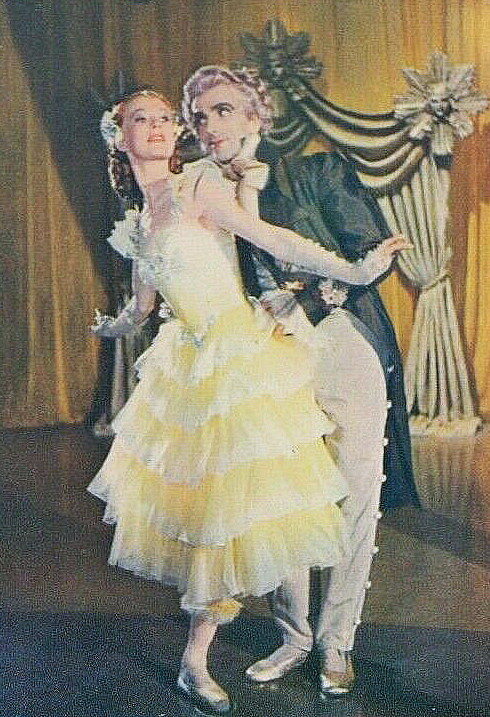
Moira Shearer portrays the mechanical doll, Olympia and Leonide Massine one her creators, Splanzani in the film, “The Tales of Hoffmann”, 1951. Photographer unknown.
All the major dancers … Shearer, Massine and Helpmann …. assumed multiple roles. Shearer portrayed a dragonfly in the prologue with the French dancer, Edmund Audran. In the following act she danced as a mechanical doll, Olympia, with her squabbling creators played by Massine, Helpmann and Ashton; subsequently she danced as Helpmann’s lover and finally, in the epilogue she partnered Audran again in a pas de deux.
Unlike The Red Shoes the dance sequences were shot in long takes and Shearer recounts that dancing to Ashton’s choreography was a great pleasure. Both she and Massine invested long hours in the production, often appearing on the set several hours before the majority of the other dancers, actors and production crew. During the filming of “The Red Shoes”, as both of them lived in west London Massine and Shearer would occasionally share a taxi to the film studios. During the filming of The Tales of Hoffmann Shearer’s husband, Ludovic Kennedy, would provide that service.
By 1951 Massine was in his mid 50s. Shearer’s career at Sadler’s Wells was winding down. Thus, The Tales of Hoffmann was the last opportunity for them to dance together.
Sources.
Moira Shearer interviewed by Dale Harris in Edinburgh, August 29th 1976 and September 1st 1978. Transcript of an audiotape held at the New York City Library, Lincoln Center.
Moira Shearer; Portrait of a Dancer, Pigeon Crowle, Faber & Faber, London 1950.
An Autobiography of British Cinema, Brian McFarlane, 1997.
Pitch Weekly, January 22nd, 1999, Dan Lybarger, An Interview with Moira Shearer and Jack Cardiff.
Royal Opera House, Covent Garden, Database.
Sadler’s Wells Ballet, programmes for individual performances, 1947.
The director Michael Powell, in discussing the evolution of his film, ‘The Red Shoes”, stated that its “salient feature …. is simply Moira Shearer. Before this film could be started it was necessary to find a dancer on the brink of becoming a (prima) ballerina, about 20 years of age; beautiful; exquisite figure and legs; strength of character, who could dance all the classical parts; and finally, a dancer who could act and not an actress who pretended to dance. If we had not found Moira Shearer, we could not have made the film”.
He found her in 1946, when Shearer was, in fact, just 20 years old. The discovery, some recall, was due, in part, to the intervention of the actor, Stewart Granger, who, at the time was employed by The Rank Organization, who were funding the film and by the Sadler’s Wells dancer Robert Helpmann.
Powell went to the ballet at Covent Garden and saw Shearer dance … and act. Shearer recalled that it was probably in the lead in Giselle, a role that requires the skills of both a dancer and an actor. However, although she had had minor roles in Giselle since 1942, she didn’t dance this leading role for the first time until July 1948. Others speculate that Powell saw her in her role as a lover in a ballet choreographed by Helpmann, Miracle in the Gorbals.
Powell was completely taken by Shearer. He said of her that “she had a cheeky face, (was) well bred and full of spirit. She had a magnificent body. She wasn’t slim, she just didn’t have an ounce of superfluous flesh”.
Powell and Shearer met for the first time, probably in the spring of 1946 and he handed her a copy of the script of “The Red Shoes”. Upon reading it she rejected the idea of her appearing in the film. She said of it, “I … hated the dialogue and the story because I felt it was so corny…. It’s such a sort of woman’s magaziny angle of the whole thing and no ballet would ever have been like that”
But Powell refused to give up on Shearer. He took a different tack. Shearer recalls that Powell and, presumably his business partner, Emeric Pressburger, “hovered around, came to the stage door (at Covent Garden) and dressing room – really a bore – wearing us down”.
There is no record of Powell directly approaching Ninette de Valois but she was obviously aware of his presence at Covent Garden and his interest in hiring Shearer. De Valois called Shearer to her office one day and demanded that she “get this off your chest and ours because I can’t stand these men bothering all of us any longer”.
Once Shearer had expressed her deep concern about the impact of making the film would have on her dancing career and once she had received assurances from de Valois that there would be none, Shearer agreed to sign a contract with Powell and Pressburger. Also critical in her decision to do this was the knowledge that the experienced and talented dancers, Leonide Massine and Helpmann, both would be involved in the production.
Shearer hired an agent and negotiated a contract worth £5000 + expenses for three months work. Her participation in the film had to be completed by the autumn. The Sadler’s Wells ballet season began with “Mamzelle Angot” on November 26th 1947 and Shearer was to dance in it. The spring season at Covent Garden concluded on June 21st with Shearer and Massine dancing in “La Boutique Fantasque”. The next day, Sunday, they both flew to Nice and filming of “The Red Shoes” began in Monte Carlo on June 23rd.
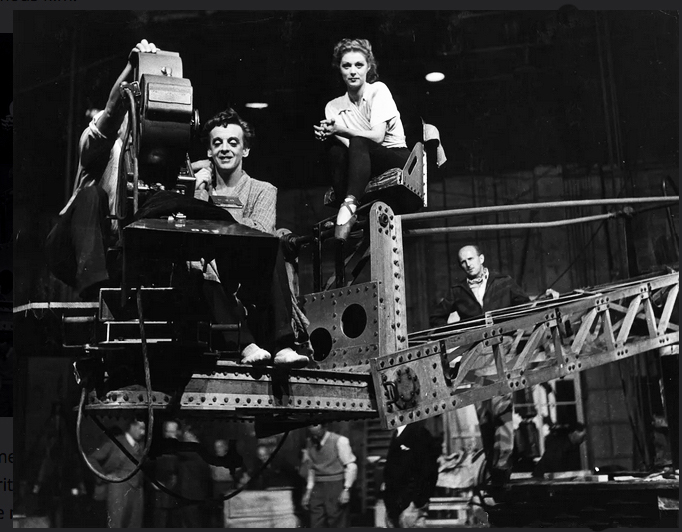
Production of “The Red Shoes” in 1947 at Pinewood Studios. Moira Shearer, wearing her red pointe shoes sits on a movie camera gantry with Robert Helpmann. Behind them stands, the director, Michael Powell and in the background is J. Arthur Rank whose company funded the film.. Photographer unknown.
Shearer did not get along with Powell during the filming although, apparently that didn’t prevent them, later, becoming friends. She conceded that he was a good director with regard to the “technical” aspects of film-making but that was inept in his relationships with the actors. She recalled that his inability to communicate with them drove them into themselves “rather than drawing them out”. In addition, he had no understanding of ballet. This was compounded by the fact that dancing on the concrete floors of the studio was extremely difficult and often resulted in injuries. The 15-minute ballet that is at the heart of the film was comprised of hundreds of takes of just a few seconds each. Staying warmed up ready to dance was a constant preoccupation for all the dancers.
Shearer’s 3-month commitment grew to four months and eventually to six. There is a photo of her in costume at Pinewood talking to Dirk Bogarde in the spring of 1948 when she was probably asked to come in to film minor revisions. Nonetheless, even if it was not renegotiated and supplemented, Shearer’s contract represented an enormous step-up in her income at the time. Her pay as one of the leading dancers at Sadler’s Wells in 1947 was between £30 to £50 a week.
Powell and Pressburger’s next film, “The Tales of Hoffmann”, was produced in the summer and autumn of 1950. In addition to Powell and Pressburger, each as the producer and director, the cast of characters was similar to that for “The Red Shoes”. However, there was one major change. The Rank Organization was replaced by Alexander Korda’s Film Finance Corporation as the source of funding. A central requirement of Korda’s financial backing was that Shearer play one of the lead roles. Powell approached Shearer and she agreed to take on the commitment as long as, as with “The Red Shoes”, the timing of the production fitted into her schedule at Sadler’s Wells. Thus, filming began at the Shepperton studio on July 1st, 1950, immediately after the spring ballet season ended. By mid August, Shearer’s work was done and she was able to go on holiday with her husband, Ludovic Kennedy.
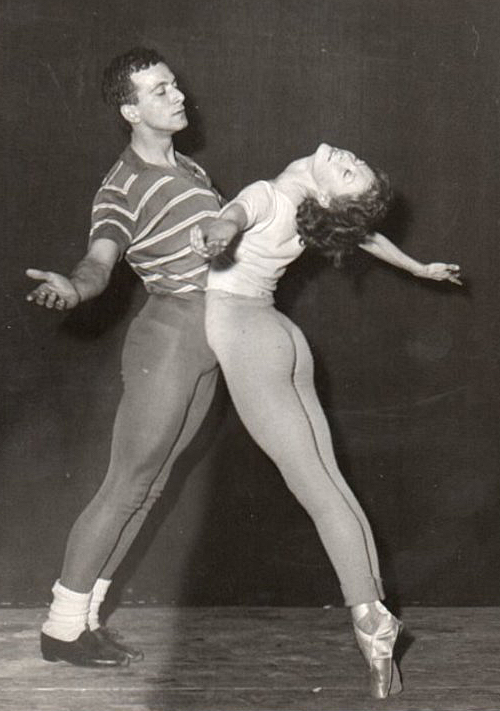
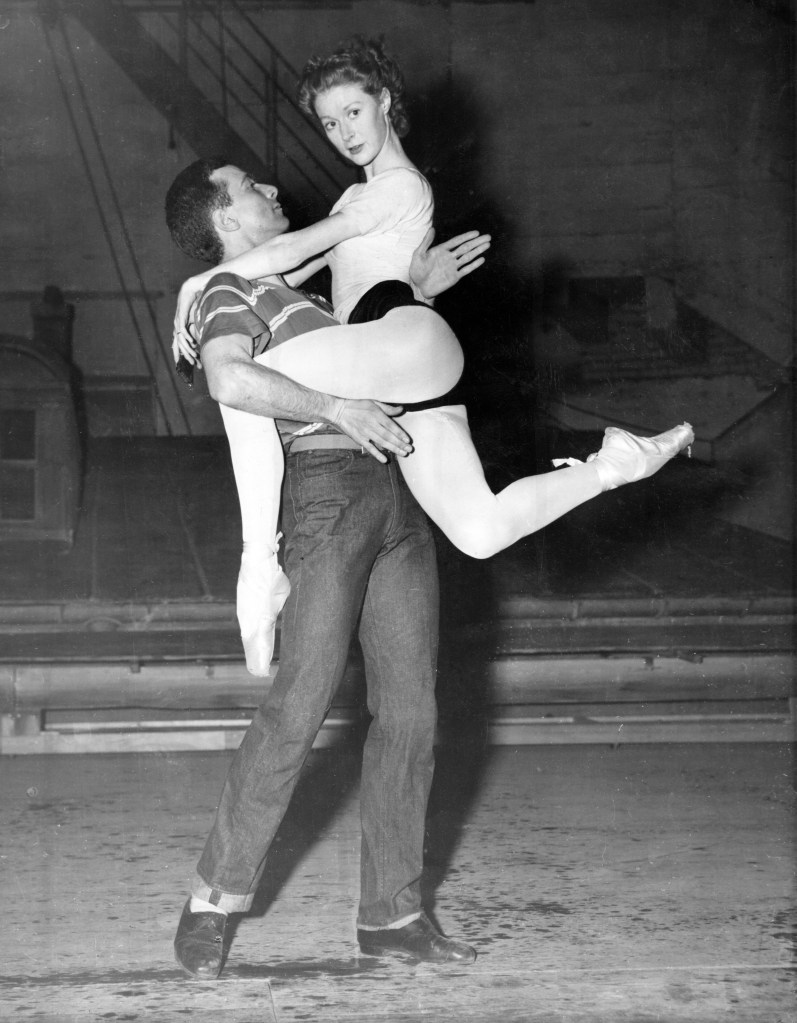
Shearer’s working relationship with Powell was much happier than it had been in “The Red Shoes”. As there was no dialogue, filming largely followed Offenbach’s libretto as modified by the music director, Sir Thomas Beecham. Even more critical from Shearer’s point of view was that Fred Ashton was brought on board as choreographer. She found working with him “such a pleasure”. There are no photographs of Shearer working with Powell but a number of her rehearsing a pas de deux with Ashton. Powell had also undoubtedly taken note of the dancers’ complaints of working on a concrete floor in “The Red Shoes”. At Shepperton a special surface consisting of cork, felt and paint was applied to the studio floor. It was renewed each day.
Fred Ashton coaching Moira Shearer during the filming of a ballet sequence in “The Tales of Hoffmann” at Shepperton Studios in the summer of 1951.. Photographer not known.
Powell’s more “hands-off” direction and innovative use of multiple cameras meant, for example, that Shearer’s lengthy dance as the doll in Olympia was shot in only two takes.
Shearer became heavily invested in the production and like Massine, who would arrive at the studio at 6 am each day to warm up, she put in long arduous hours. She also worked with Hans Heckroth, the set and costume designer, on the production of her extensive wardrobe. She assumed multiple personalities in the film each of which required a specific costume in whose design and execution she was involved.
In the prologue she dances as a dragonfly in a tightly-fitting bodysuit that highlights her magnificent ballerina’s body; in Act 1 she plays the role of Olympia, the mechanical doll, resplendent in her yellow tutu and pantalettes; later she reappears as a haughty medieval beauty and finally dances a pas-de-deux in a dress copied from one worn by the 19th century ballerina, Maria Taglione.
The prologue was added to Offenbach’s original score as a way of “introducing” Shearer and that, in reality, gave her an opportunity to do what she had been hired for – to dance. Because of this role and that as Olympia, Shearer dominates the first half of the film. In the final analysis Powell must have felt he had made a good investment in her.
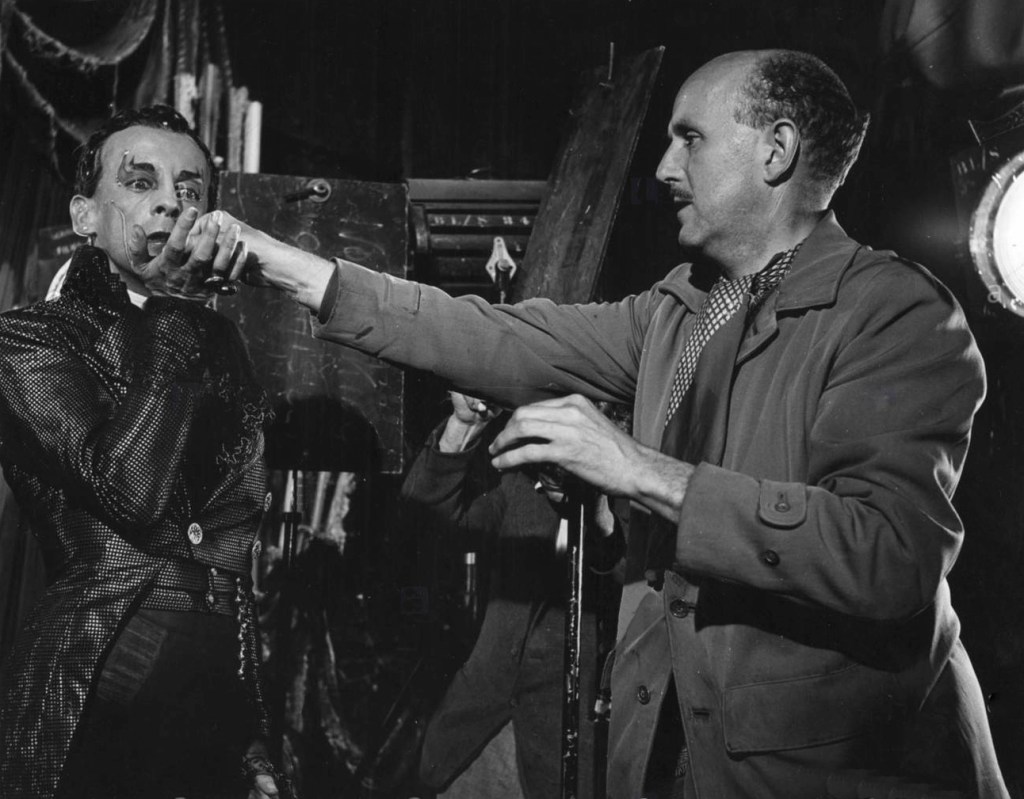
Michael Powell directs Robert Helpmann in a scene in the prologue of The Tales of Hoffmann at Shepperton Studios in the summer of 1951. Photographer not known.
The British and American critics had altogether diverse evaluations of “The Tales of Hoffmann”. Some loved it; for others it was lifeless, cold and flat. It did not achieve the same commercial success as “The Red Shoes”. However, it probably represents the best and happiest collaboration between Powell and Shearer.
Powell and Pressburger produced just a handful of films in the mid to late 1950s and after the release of the unsuccessful film, “Ill-met by Moonlight”, in 1957 they decided to dissolve their 18- year partnership. However, Powell determined to continue producing and directing films. He was still living in a large Victorian house on Melbury Road in Kensington, west London and, perhaps with an eye on limiting production costs, decided to use the house and neighbourhood for the setting of a romance titled “The Loving Eye”. It was to star the then virtually unknown actor, Paul Scofield and Moira Shearer. The film never came to fruition because Powell failed to raise funding for it so all that remains of his idea are a few polaroids that Powell took of Scofield and Shearer in situ and which he might have used to tempt would-be investors. This episode and the photos are the subject of a British Film Institute feature by Sam Wigley that draws the photos from the Michael Powell archive and is referenced in a link below.
However, as Wigley points out, the idea of using Melbury Road as a backdrop reemerged in Powell and Shearer’s final collaboration, “Peeping Tom”, that was produced in 1959. Powell had not originally intended to cast Shearer as the naïve stand-in to Shirley Ann Field but his original choice, Natasha Parry, was unexpectedly whisked off to New York to appear in a play produced by her husband, Peter Brook.
As Shearer recalled Powell appeared on her doorstep one evening and thrust a script into her hands, imploring her to, at least, read it, which she did. As it required only 4 days of her time, and as she considered him a friend, she agreed to take up the challenge. Numerous photos of Shearer with her co-star, Karl-Heinz Boehm, appear to show his discussing the script with her on the set. Her part must have been rewritten to allow Powell to exploit her dancing talents prior to her demise at the hands of the maniacal photographer played by Boehm.
Michael Powell directs Moira Shearer and Karl-Heinz Boehm on the set of “Peeping Tom” in 1959.. Photographer unknown.
Although she appears in several earlier scenes, including one with Shirley Ann Field, Shearer claims she was largely unaware of the overall plot. Thus, the final product came as quite a shock to her; as she put it, she had completely forgotten Powell’s “sadistic streak”.
Nonetheless Shearer attended the premiere of the film and, presumably, her friendship with Powell survived.
Sources.
Moira Shearer interviewed by Dale Harris in Edinburgh August 29th, 1976 and September 1st, 1978. Transcript of an audiotape held at the New York City Library, Lincoln Center.
powell-pressburger.org/Reviews_TRS/Critics2.html
David Thomson, The Independent, February 12th, 2006. What made Moira a Star?
Fred Ashton, the principal choreographer for the Sadler’s Wells Ballet, created the three-act ballet, Cinderella, in 1948. It was originally designed to be danced by Sadler’s Wells prima ballerina, Margot Fonteyn, but, when she communicated to Ashton that she would not be able to dance every night of the planned rigorous schedule of performances, Ashton, presumably with Ninette de Valois’ approval, began working with the second-cast ballerina, Moira Shearer, as well.
The first performance was to be at Covent Garden on December 23rd, 1948. Ashton began rehearsing the opening kitchen scene in early November. There are several newspaper accounts (including photographs) dating from early to mid-September in which Ashton is noted as working with Shearer. Somewhat strangely, these accounts do not mention Fonteyn. This omission is made all the more mysterious by the fact that the male lead in the ballet, Michael Somes recalls the kitchen scene being created with Fonteyn specifically in mind.
On the opening night of the Sadler’s Wells autumn season, November 25th, at Covent Garden, Fonteyn and Shearer shared the major roles in the new ballet, Don Juan. Robert Helpmann played the title role, Fonteyn played La Morte Amoureuse and Shearer the “young wife”. About 20 minutes before the end of the ballet Fonteyn sustained what was originally thought to be a sprained ankle. Despite the injury she completed the ballet.
A subsequent trip to Saint Bartholomew’s Hospital revealed that she had a torn ligament and would not be able to dance again for 3 months.
Thus, as the second cast Shearer was told she would assume the lead in Cinderella. Her second cast would be Violetta Elvin.There is no record of it but, presumably after she completed her involvement in Don Juan on December 6th, Shearer and Ashton rehearsed the 2nd and 3rd acts of Cinderella on those occasions when she wasn’t appearing in other ballets such as Giselle, Symphonic Variations and Sleeping Beauty then being performed as part of Sadler’s Wells autumn season.
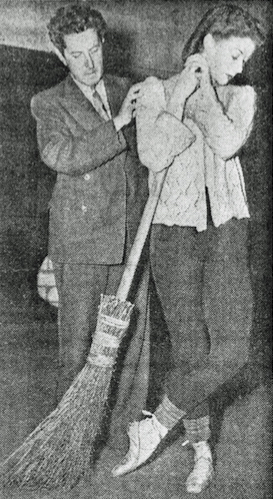
Fred Ashton rehearses Moira Shearer in her role of Cinderella, November 1948. Photographer unknown.
Tickets for all performances of Cinderella soon sold out through mid-January. One might speculate that this was because it was Ashton’s first full-length ballet. However, one newspaper article noted that many of the patrons for these early performances were “the younger crowd” which might have been code for Shearer’s fans.
Opening night was an unqualified success with the audience and Ashton and Shearer shared 14 curtain calls. One newspaper critic quipped that the curtain calls lasted almost as long as the performance itself.
The following day, December 24th the first critics’ reviews were published and, by and large, they were very favourable to Ashton as choreographer, to Shearer and to the major supporting cast of Elvin, Beryl Grey, Pamela May and to Ashton and Helpmann as the ugly sisters.
Moira Shearer as Cinderella, December 1948. Photographer Angus Mcbean. Photo reproduced by permission of the Houghton Library, Harvard University.
In The Evening Standard Caryl Brahms was more muted in her praise than most. She wrote, for example, that Moira Shearer was as “pretty as porcelain, if no more poignant” and that Ashton’s was “not inspired choreography”. Ashton himself later recalled that Shearer’s dancing was what he termed “brittle”.
The more popular press was almost universally captivated by Shearer’s interpretation. Cecil Wilson writing in The Daily Mail called Shearer “the loveliest and lightest-footed Cinderella imaginable”. The Liverpool Post, otherwise critical of the ballet itself, wrote of “Shearer’s exquisite and wistful Cinderella”.
Later reviews, sometimes of the performances in late December and early January, were more critical of Shearer’s performances. Some took issue with her acting, especially her ability to elicit the pathos needed in the kitchen scene in the first act; others, like the reviewer in the Dancing Times (February 1949), complained that “she has not yet the speed required for all the technicalities”. However, this same critic praised her acting.
The harshest criticism came from Iris Morley writing in The Daily Worker on December 30th. She wrote that Shearer was “as pretty as any fairy …. unfortunately, she is a long way from being a ballerina. She has little idea of how to phrase her dancing. Consequently, many important moments like the pas de deux with the broom showed a want of tenderness, feeling and artistry”. This theme of contrasting her beauty with her dancing and acting ability was to be repeated many times throughout her career in ballet.
Throughout late December 1948 and through mid-February, 1949 Shearer shared the lead role with Violetta Elvin. Thus, some on the critics focused on Elvin’s strengths and compared her to Shearer. In general, both dancers were the subject of praise although, sometimes, it was qualified.
Fonteyn, who perhaps had benefitted, not just from her forced holiday, but also from the opportunity to see some of the performances by Shearer and Elvin, returned to the role on February 25th. Her performance was met by rapturous applause, testament, as noted the critic in the magazine, “Ballet and Opera”, to “the devotion of Fonteyn’s London public”. The same writer felt “her Cinderella seemed more deeply felt and conceived more “in the round” than the renderings of the other dancers”.
Thus, Fonteyn’s twin concerns of, initially, having to share the lead in Cinderella with Shearer, and, after her serious injury, that Shearer might be presented with an opportunity to challenge her at Sadler’s Wells, were not, in fact, borne out. Nor did the events damage her working relationship with either Shearer or Elvin that were to endure for many years.
Sources.
The Daily Graphic, November 6th 1948, writer unknown.
The Sphere, November 20th, 1948, writer unknown.
The Daily Express, December 24th, 1948, Express Theatre Critic.
The Evening Standard, December 24th, 1948, Caryl Brahms.
The Daily Mail, December 24th, 1948, Cecil Wilson.
The Times, December 24th, 1948, writer unknown.
The Daily Worker, December 30th 1948, Iris Morley.
The Stage, December 31st, 1948, writer unknown.
The Spectator, December 31st, 1948, writer unknown.
The Stage, January 5th, 1948, writer unknown.
The New Statesman, December 31st, 1948, writer unknown.
The Liverpool Post, date and writer unknown.
The Queen, January 19th, 1949, writer unknown.
Punch, January 1949, writer unknown.
Ballet and Opera, News, April 1949, writer unknown.
As quoted in several sources, including The New York Times in April 1951, Moira Shearer stated she had “one cardinal aim in her dancing career: “to dance Giselle really well”. Between 1942 and 1953 Shearer made her way up the rankings of the roles in Giselle at Sadler’s Wells. Initially, in 1942 and 43, she danced as either a peasant or as a Wili, or, in some cases, as both. She graduated to the more demanding role of Zulme or Moyna between 1944 and 1947 and on July 13th, 1948, at age 21, she danced in the title role for the first time.
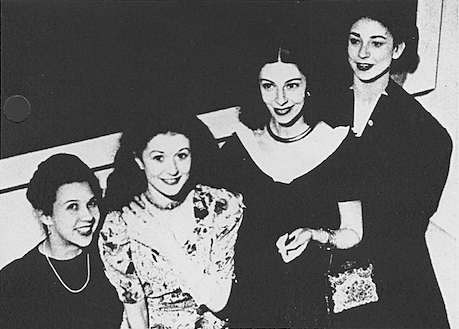
“Four English Giselles”. From left to right, Beryl Grey, Moira Shearer, Alicia Markova and Margot Fonteyn. Covent Garden July 13th, 1948., Photographer unknown.
On that same date she was photographed on the stairs at Covent Garden with the three other “English” Giselles, Markova, Margot Fonteyn and Beryl Grey. Perhaps they had been in the stalls to witness her premiere in the role.
Prior to her premiere in this role Shearer had consulted with the former Russian ballerina Karsavina, who was then teaching in London but, who had danced as Giselle starting in 1910. In her interview with Dale Harris, Shearer insisted that her sole intent in the consultation was to get Karsavina’s advice on how to portray Giselle in the “mad” scene but Ninette de Valois believed that Shearer had also used Karsavina’s version of some important steps in first act. This was the first of many confrontations that Shearer had with De Valois over interpretation.
Subsequently Shearer danced the title role in Giselle at least a further 14 times between 1948 and 1953. Several of these performances were during the 1950-51 tour of North America with the venues including the Metropolitan Opera House in New York City and the opera houses in San Francisco and Chicago.
On September 13th,1951 she danced as Giselle in the gala at Covent Garden. After a prolonged injury in 1952 she danced the title role again on February 13th, 1953, once more at Covent Garden, and was due to give several more performances. However, she strained a tendon during rehearsals and was unable to dance again. This injury marked the end of Shearer’s 11-year career at Sadler’s Wells.
Perhaps, as Shearer danced the lead role so rarely, she seems to have often attracted the attention of the ballet critics in British newspapers and dance magazines when she did. By and large, over the 5-year span, she received good, if not rave, reviews.
Moira Shearer, Giselle, Act II. Date not known. Photographer, Duncan Melvin.
Typical of the press for her first attempt in the lead role is a review by Caryl Brahms writing in the Evening Standard in July, 1948. While, tongue in cheek, comparing Shearer’s acting unfavourably to that of the great nineteenth century tragedian, Sarah Siddons, Brahms praises her dancing in multiple ways. This dichotomy between her dancing and acting skills is expressed by Brahms as Shearer being “bewildered rather than frantic in her mad scene” but the elegance of her dancing “achieves a pearly poetry”.
C.V. Coton, dance critic for The Daily Telegraph, says of this same performance that it was “a combination of the wistful, charming and the tender”. The writer in the August issue of Theatre World praised her performance, while noting it lacked “the depth of interpretation revealed by Margot Fonteyn and Markova.
The writer in “The Times” (March 21st, 1950) commented on how Shearer’s confidence in interpreting the part had greatly increased since she first appeared in it 1948. Like other subsequent commentators, the unnamed critic, while not wholeheartedly going to bat for her, focused on how well Shearer brought her personality to bear on the interpretation of the role. “Her Giselle lacked nothing in dramatic power, for her stage personality suffuses the parts she plays with sympathy and conviction”.
Audrey Williamson writing in a similar vein in The Tribune on April 14th, 1950, says of Shearer’s Giselle that she “starts with the initial advantage of genuine youth and lightness; her gaiety brightens the stage, but is now pierced by a deeply moving emotional power”. She later tempers her praise by saying that Shearer does not yet possess “the balance and lyrical fire for a great second act”.
Shearer felt confident enough of her abilities at this stage to allow her parents and husband to see her March 1950 performance that was her third time in the role.
When Shearer danced the lead role again in 1953 the critic for “The Guardian” (February 14th) gave her an almost unequivocably postive appraisal, noting that the performance was marked by her great technical ability, her grace and her unique interpretation of the role. Of some significance was the fact that the writer also praised her acting, especially in the “mad scene”. Perhaps Karsavina’a advice had borne fruit.
When Shearer danced Giselle with Sadler’s Wells at The Metropolitan Opera House in New York on September 24th, 1950, the great American modern dancer, Ruth St. Denis, was in the audience. Arthur Todd, the dance critic, writing in the December issue of the magazine, Ballet Today, said that the finest compliment one could pay the British ballet company was to repeat the remark that St. Denis made as the curtain descended on Moira Shearer’s Giselle, that “the Sadler’s Wells Ballet is the flower of British civilisation”.
Sources.
Caryl Brahms, review in the Evening Standard, July 14th, 1948.
C.V. Coton, review in the Daily Telegraph, July 14th, 1948.
The Times, article, July 14th, 1948.
The Stage (trade journal), review, February 15th, 1948.
The Times, article, March 21st, 1950.
Audrey Williamson, review, The Tribune, April 14th, 1950.
Arthur Todd, article, Ballet Today, December 1950.
The New York Times, article, April 1951.
The Guardian, article, February 14th, 1953.
Moira Shearer, Portrait of a Dancer, Pigeon Crowle, Faber and Faber, 1954.
Moira Shearer interviewed by Dale Harris in Edinburgh, August 29th, 1976 and September 1st, 1978. Transcript of an audiotape available at the New York City Library, Lincoln Center.
Moira Shearer had an extremely busy schedule at Covent Garden in April and early May of 1950. She danced in 8 performances of Cinderella and 14 of George Balanchine’s Ballet Imperial. Her final performance of Ballet Imperial was a matinee on Saturday May 6th.
Then, the following day, she took a train called The Golden Arrow from London to Paris where she was to join Roland Petit’s company, Les Ballets de Paris, for a short season of his ballet, Carmen.
Petit had put in an urgent request to Ninette de Valois that Shearer be permitted to replace the injured Rene (Zizi) Jeanmaire. Jeanmaire was the lead ballerina in Petit’s small company. She had danced the lead in Carmen throughout its highly successful tours of London, New York and Canada in 1949. However, she injured a leg late in 1949, was forced to undergo an operation and then rest for 6 months.
Both she and Petit appear to have anticipated her return to her role by the spring of 1950 but this was not to be. Shearer was asked to replace her at short notice and the already-printed programmes were modified to include her.
The caption to one of the photographs showing Petit and Shearer rehearsing in Paris on May 10th notes that Jeanmaire had undergone a recent operation. Thus, it seems that she may have re-injured her leg or that she had recovered from the operation more slowly than hoped. Shearer arrived in Paris on May 7th. Several photographs show her rehearsing with Petit during the following week. In her interview with Dale Harris, the dance historian, Shearer recalls that she danced every night for three weeks. As she was scheduled to dance with the Sadler’s Wells in Giselle at Covent Garden on June 1st, the performances for Carmen must have begun early in the week that she arrived in Paris. Shearer indicates that, as the role of Carmen had originally been choreographed for Jeanmaire, it presented her with difficulties. Thus, she and Petit continued to rehearse even after the performances had begun.
Moira Shearer and Roland Petit rehearsing Carmen in Paris in May 1950. Photographer unknown.
She writes “I never thought that I’d attempt to dance this ballet. It was marvellous to do. I was slashed by the French critics but I was pretty good by the end of the season”. Not all the French critics attacked Shearer’s performance. One, addressing the obvious comparison to Jeanmaire and the fact that Petit had choreographed the ballet for her, wrote of Shearer’s first night performance that Petit had chosen well in her. She was “the perfect dancer, expressive, with a fine sensibility which created a Carmen less earthy and impulsive than Jeanmaire’s but which was just as feminine and “frémisante”. He was confident that Shearer would soon make the role her own and dispel any need for comparison to Jeanmaire.
Moira Shearer and Roland Petit rehearsing Carmen in Paris, May 1950. Photographer unknown.
Shearer was impressed by “Petit’s crazy undisciplined company, free and easy”. She added, “Carmen was a wonderful ballet”.
The Illustrated London News ran a story on Shearer’s brief sojourn in Paris and noted that “The Red Shoes”, which had been released in France in 1949. had “brought her a strong Continental following”. Picking up on this theme, in his 1976 interview of Shearer Dale Harris asked her whether Petit had chosen her because of the success of “The Red Shoes”. Very gracefully, in light of this impertinent, insensitive question, she replied that she thought he might have done so.
However, Petit would have been well aware of Shearer’s true abilities for some time. There is a photo of him probably taken on November 26th, 1947, where he is backstage with de Valois, Fred Ashton, Margot Fonteyn and the French actress, Arletty. To one side in the same photo stand Moira Shearer and Michael Somes in their costumes for the premiere of the ballet, Mamzelle Angot. Petit and Arletty had probably been watching this from the stalls a short time earlier.
Arletty, Roland Petit, Margot Fonteyn, Ninette de Valois, Fred Ashton, Moira Shearer and Michael Somes backstage at Covent Garden, November 26th 1947. Photographer Mandinian. Published in “Moira Shearer, Portrait of a Dancer”, 1950.
Sources.
Moira Shearer interviewed by Dale Harris in Edinburgh August 29th 1976 and September 1st 1978. Transcript of an audiotape held at the New York City Library, Lincoln Center.
Moira Shearer, Portrait of a Dancer, Pigeon Crowle, London, 1950.
There has been a great deal of speculation that a rivalry developed between Margot Fonteyn and Moira Shearer during the time that they both danced at the Sadler’s Wells Ballet, i.e. between 1942 and 1953.
Fonteyn wrote in her autobiography that she once felt threatened by Shearer’s meteoric rise within the company. As well she might. Shearer was a very gifted dancer, and Fonteyn may have believed that Shearer was capable of challenging her dominant position at Sadler’s Wells.
However, research into Moira Shearer’s career at Sadler’s Wells yields scant evidence of any actual rivalry. In fact, in as far as the demanding schedule of the ballet allowed for the development of friendships among the dancers, it seems that Fonteyn and Shearer were friends. It was not a deep friendship perhaps but one that lasted.
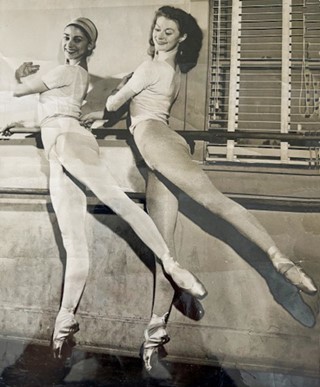
The attached undated photo of Fonteyn and Shearer seemingly enjoying practicing at the barre together surely speaks to that friendship.
Margot Fonteyn and Moira Shearer practicing at the barre. Date and location unknown. Photographer unknown. Reproduced with permission of Ailsa Kennedy.
Fonteyn joined the (then) Vic-Wells Ballet in 1935 and soon became its leading ballerina. Shearer, seven years her junior, danced briefly with the Vic-Wells (while she was a student there in 1940) and joined the newly-named Sadler’s Wells Ballet in the spring of 1942. Thus, at any given time while they were dancing in the same company, Fonteyn enjoyed the dual advantages of maturity and experience. Shearer was intelligent and sensitive enough to recognize this.
Throughout Shearer’s brief tenure at Sadler’s Wells, Ninette de Valois, its director would call upon Fonteyn for almost all the major roles, particularly in the “classical” ballets like Sleeping Beauty and Swan Lake. Early in the 1940’s Shearer would be assigned leading roles in the minor ballets like Quest or The Clock Symphony. By the mid 1940s Shearer had eclipsed other ballerinas like Pamela May and Beryl Grey in a number of roles and became Fonteyn’s “deputy”. Fonteyn would always dance the opening night of a new production and would then share the role with Shearer and, sometimes with May, Grey or Violetta Elvin on subsequent dates.
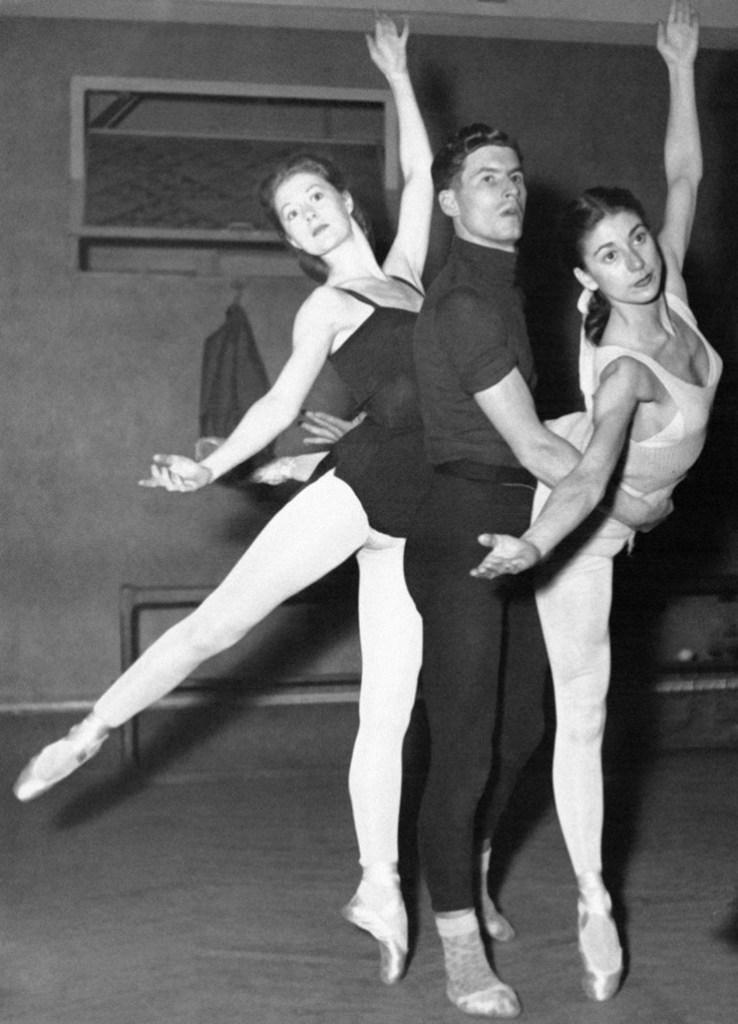
There were some ballets, however, where Fonteyn and Shearer danced together. One example of this is Ashton’s ballet, Symphonic Variations. The attached photo of Fonteyn, Shearer and Michael Somes at practice was taken in Paris prior to a performance of Symphonic Variations.
Moira Shearer, Michael Somes and Margot Fonteyn rehearsing Symphonic Variations in Paris, October 1948. Photographer unknown.
Another ballet in which they danced together is Don Juan which, in the autumn of 1948, was chosen to open the season at Covent Garden. In one of those strange turns of fate Fonteyn was seriously injured opening night on November 25th. Not only did this rule out her continued participation in Don Juan but also prevented her from rehearsing Fred Ashton’s new ballet, Cinderella which was to premiere a few weeks later.
Margot Fonteyn, Robert Helpmann and Moira Shearer during rehearsals for Don Juan at Covent Garden, November 23rd 1948. Photographer Jimmy Sime, Central Press Agency.
As the “second cast” ballerina for Cinderella, Shearer stepped into the breech. Ashton, who had designed the ballet to highlight Fonteyn’s abilities, was then forced to adapt it for Shearer, who was a completely different kind of dancer.
The ballet opened at Covent Garden on December 23rd and was a great success. Shearer had been presented her opportunity and took full advantage of it. She danced to packed houses from late December through early February. Violetta Elvin danced as Shearer’s alternate and she too enjoyed great success in the role.
When Fonteyn had recovered by mid February 1949, she took over the role and made it her own. This, once again, showed her pre-eminence among Sadler’s Wells’ dancers and Shearer would have immediately recognized and accepted this fact.
In her February 1991 obituary of Fonteyn, Shearer says of their relationship, “Margot was a kind and generous friend” and one she came to know and understand, although slowly. In the 1940s, as a result of sharing roles at Sadler’s Wells, Shearer remembered that she got to know Fonteyn a little better but “just a little”. However, Shearer wrote, Fonteyn’s “reserved nature made her almost enigmatic, and I never felt genuinely at ease with her”.
However, that was to change when Sadler’s Wells made their second tour of North America in 1950-51. The entire company travelled between venues by a special sleeper train and the dancers were bunked in pairs. Fonteyn initially shared her compartment with Pamela May but when May was injured, she left the tour to return to the U.K. and Shearer was then moved to share the compartment with Fonteyn. Once at the theatre they would also share a dressing room.
The shared experience of life on the road strengthened the bond between them and the friendship that resulted endured despite Shearer leaving the ballet in 1953 while Fonteyn continued to dance for many years. The fact that they both married and lived in different worlds also must have taken its toll on the friendship, but it didn’t end it.
Margot Fonteyn and Moira Shearer, Ottowa in 1951. Location unknown. Photographer Bill and Jean Newton.
Several years after their marriage Shearer and Ludovic Kennedy moved from London to Amersham where she raised several of her children throughout the 1950s. Fonteyn, who married in 1956 and her husband, Tito Arias, visited Shearer and her family there.
In his 1978 interview with Shearer the British-American dance historian and critic Dale Harris remarked that Margot Fonteyn’s autobiography did not really reveal her. Shearer responded, “because she’s like that as a person”.
Shearer picks up this theme in the beautifully written and affectionate obituary of Fonteyn written in February 1991 and which she titles, “Margot: the modesty of true greatness”. Of Fonteyn, Shearer writes that “her greatest charm, both on the stage and off, was her quiet calm and modesty. And her control was of iron. In decades of performances, it gave her the ability to keep a standard of excellence which never wavered”. She goes on to say that Fonteyn “was never a virtuoso ballerina but brought something else to the stage, a wonderfully unbroken flow of movement that lulled audiences into that happy state of illusion which is the hallmark of ballet”. Shearer might have added that she, as the quintessential virtuoso ballerina, did not have those same qualities.
Shearer’s forthright evaluation of Fonteyn and some of the attached photos seem to speak eloquently of their relationship and friendship.
Sources.
Moira Shearer interviewed by Dale Harris in Edinburgh, August 29th 1976 and September 1st, 1978. Transcript of an audiotape held at the New York City Library, Lincoln Center.
Margot: the modesty of true greatness. Obituary of Margot Fonteyn written by Moira Shearer. Actual date not known but circa February 22nd, 1991. Publication unknown but possibly The Times (London) or The Guardian (London).
Margot Fonteyn: Autobiography. Random House Inc., London, published May 1st, 1976.
Various newspaper and magazine articles published in the UK, USA and Canada between 1943 and 1953.
Between May 19th, 1941, when Moira Shearer joined The International Ballet in Glasgow for its premiere performance and February 8th ,1942 when she left the company as it completed a week of performances in Sheffield, she probably danced at every performance if not in every ballet. I have records (programmes and newspaper accounts) for 181 performances by her. At some theatres where the company is known to have appeared, for example, the Theatre Royal in Norwich, there are no day-to-day records. If such locations are taken in account Shearer probably danced in more than 200 performances over the 10-month period. At many theatres the company would dance every night and there might be between 2 to 4 matinee performances each week.
However, there was some occasional respite and on July 12th, 1941, after the final appearance at the Hippodrome in Brighton, the company took a 5-week holiday. Shearer probably returned to her parent’s home that, at the date, was probably in Scotland.
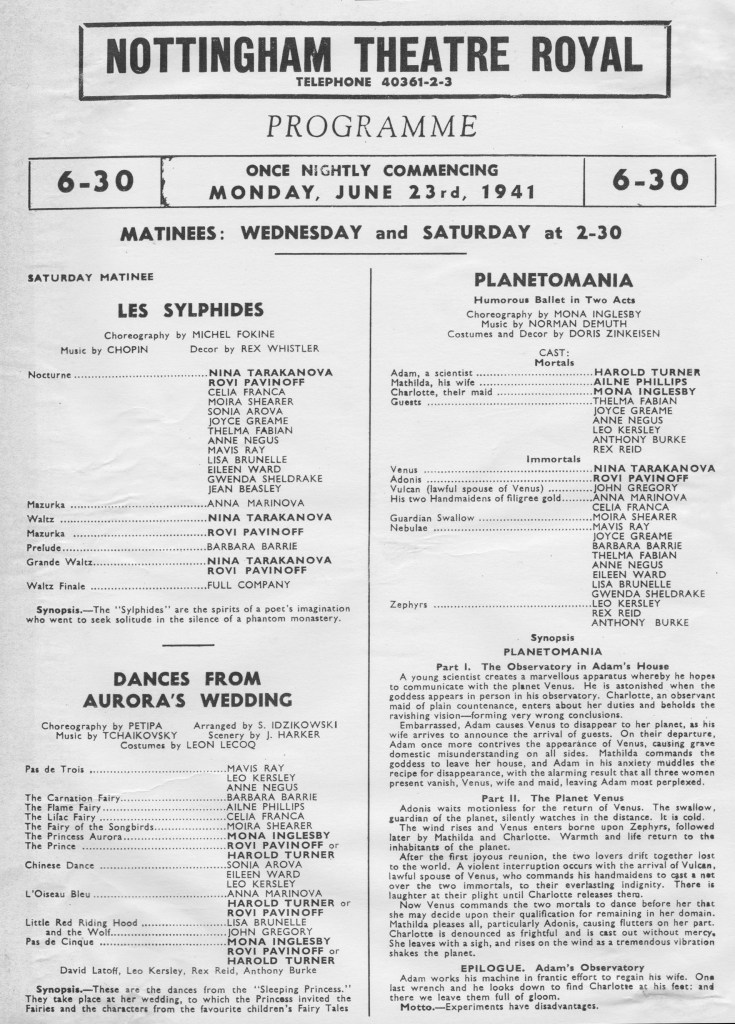
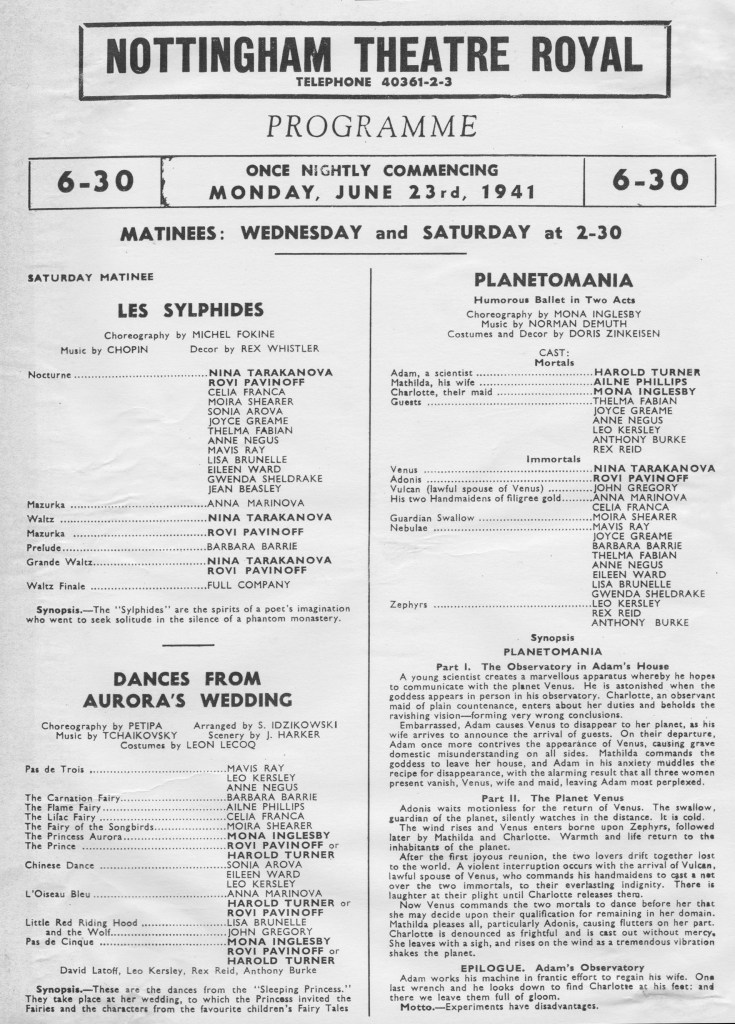
Programme for The International Ballet performances at The Lyric Theatre, Shaftesbury Avenue, London for September 25th 1941. Moira Shearer danced in three of the four ballets.
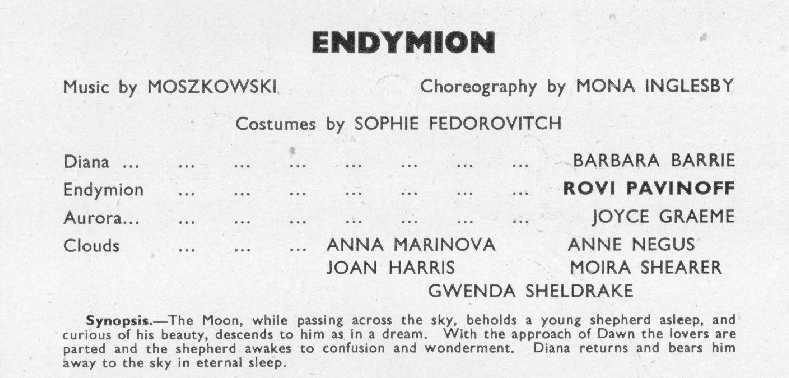
The Lyric Theatre, September 25th, 1941. The cast for Endymion, a ballet choreographed by the director, Mona Inglesby. Moira Shearer danced as one of five “clouds”.
The typical week for the company ran from either Monday or Tuesday to Saturday. Sunday and sometimes Monday were set aside for travel.
In 1941 the season began in May in Glasgow and after a week’s performances moved to Birmingham, then Edinburgh, Manchester, Liverpool, Nottingham, Bradford and Brighton. After the summer break the company opened in the West End at the Lyric Theatre for a 6-week run. After a short break in early October, it moved onto Norwich, Leamington Spa and Stratford, then to Harrow, Glasgow, Oxford, Cardiff, Northampton, Nottingham, Aberdeen and Coventry. The final three week-run was at the Manchester Opera House. It extended through Christmas and the New Year.
This was followed by a 2 week break in January 1942, after which the company opened in Blackpool for a 2-week run. On February 1st, they moved on to Harrogate, and then to Sheffield, where the season ended on February 28th.
All of Shearer’s roles were minor, for example, as above, as a cloud in Endymion, but she was on stage for much of each performance. In addition to Endymion she danced roles in Aurora’s Wedding, Lac des Cygnes, Planetomania, Carnaval, Fete Boheme and Les Sylphides. The company was very small and thus, in the case of some ballets such as Les Sylphides and Fete Boheme every dancer was involved.
As can be readily appreciated, especially when the longer train journeys between venues is taken into account, it was a demanding schedule for all involved.
Shearer’s mother was sometimes on hand to give her daughter support but she was usually in the capable hands of Mona Inglesby who led the company and was the principal dancer. Inglesby probably provided what limited instruction was available to Shearer. For the most part, however, she probably learned by performing.
In her 1976 (1978) interview with the American dance historian, Dale Harris, Shearer makes scant reference to the year of her life spent at The International Ballet. However, what little she says reveals two issues that characterize much of her ballet career.
“Although my time at International Ballet wasn’t particularly happy …. I was so much younger than anyone else and was of slight build. But it was still good for me and knocked me into shape. Planetomania was where I got my chance, as they say. The guardian swallow is a tiny little solo. (I had) a black sleek headdress like a swallow’s head. Thank goodness all my hair was covered up, not a wisp showing, so if anybody thought I danced well they couldn’t say “her success is only because of her red hair”. Because that is something I have died a thousand deaths over”.
Programme for The International Ballet on June 23rd, 1941 at The Nottingham Theatre Royal.. Moira Shearer danced her first solo as a “guardian swallow”.
Sources.
Moira Shearer interviewed by Dale Harris in Edinburgh, August 29th 1976 and September 1st 1978. Transcript of an audiotape held at the New York City Library, Lincoln Center.
Various theatre programmes including the Lyric Theatre, London and provincial venues such as Birmingham, Aberdeen, Glasgow and Nottingham.
Probably at some time in 1948, The Sadler’s Wells Ballet, under the auspices of The British Council, received an invitation to participate in the Music Festival to be held in Florence in May 1949.
Ninette de Valois, the Sadler’s Wells director accepted the invitation and set about creating the programme. The company would be in Florence from May 20th to 30th, would perform 16 times and present 8 ballets. These included Cinderella, created by Fred Ashton in 1948, Symphonic Variations (also choreographed by Ashton), A Rake’s Progress, Hamlet and Checkmate.
Cinderella was to be performed 4 times, initially with Margot Fonteyn in the lead role. Moira Shearer danced the lead role twice.
The company was at full strength with the three other prima ballerina, Beryl Grey, Pamela May and Violetta Elvin all assuming major roles. May joined Fonteyn and Shearer in Symphonic Variations.
The company left London by train on May 15th for a journey to Florence via Paris and Milan that probably required most of the day and might have been by an overnight train. The photo of some of the company at Victoria Station prior to departure includes Shearer, May and Elvin.
Moira Shearer, Pamela May, Violetta Elvin and other members of The Sadler’s Wells Ballet at Victoria Station, May 16th, 1949 prior to their departure for Florence. Photographer unknown. Source Sadler’s Wells Archives; Islington Library.
As the first performance was not until May 20th the company would have had a few days to settle and to rehearse.
According to the Italian dance critic, Ferdinando Reyna, writing in the July-August issue of the magazine “Ballet Today”, the performances were very well received by what he describes as a discriminating Florentine audience. Picked out for particular praise were Fonteyn for her “technique, elegance and expressiveness” and Shearer for the “grace and freshness” of her performance.
Perhaps inevitably, as a result of the 1948 release of the film “The Red Shoes”, Shearer was showered with attention. In the attached photo her admirers surround the somewhat amused, somewhat bemused “star” of the film. Shearer would have to learn to live with this kind of unwanted attention for many years to come.
Moira Shearer surrounded by a few fans in Florence in May 1949. Photographer unknown. Source: Ballet Today July-August 1949.
With the conclusion of their participation in the festival most of the company returned to Britain. However, four dancers, Michael Somes, Anne Heaton, Alexander Grant and Shearer travelled on to Turkey where they were to give demonstrations and performances in Istanbul and in the capital, Ankara.
De Valois had developed a deep interest and commitment to help create a school for ballet in Turkey and in 1947 spent three weeks there sponsored by the British Council.
The visit of the four dancers was also backed by the British Council that assumed overall care of the dancers while they were in Turkey. By 1949 De Valois had sent two teachers from the Sadler’s Wells Ballet to assist in setting up the Turkish school. Thus, they would have probably been responsible for the dancers while they were rehearsing and performing.
The journey to Istanbul was by air from Rome probably on May 31st; travel between Istanbul and Ankara was via the night train.
The dancers made no public appearances in Turkey, instead performing to an audience made up of the students of the newly formed ballet school and their parents. Beyond Moira Shearer’s brief article in the August issue of “The Dancing Times” there appears to be no other record of the performances.
They gave 4 performances in the small but newly-built opera house in Ankara. Dances performed by them were supplemented by those of the more advanced Turkish students. Shearer writes that the most enthusiastically received ballet was John Cranko’s “Trisch-Trasch” that was danced by her accompanied by Michael Somes and Alexander Grant.
After 4 days in Ankara the dancers flew to Istanbul for 3 performances in a large open-air theatre with a wooden stage erected over the stone base. Apparently the weather cooperated. Shearer doesn’t mention the repertoire but it was presumably similar to that given in Ankara.
Moira Shearer and Michael Somes rehearsing in Istanbul. Anne Heaton is in the background. Photographer Sidney Nowill. Photo reproduced with permission of Edward Nowill.
After their final performance the Sadler’s Wells dancers visited the ballet school in Istanbul before flying to London.
The photos of the dancers rehearsing in Istanbul were taken by Sidney Nowill of the British Council. Like many others before and after him he writes of his admiration for Shearer because, as he puts it, she was both charming and unaffected.
The Sadler’s Wells season ended on June 20th and immediately afterwards Shearer and her fiancé Ludovic Kennedy travelled to Grasse in southern France where they had rented a villa for two weeks.
Sources.
The Star (newspaper), published in London, May 16th, 1949
Ballet Today, July-August 1949. Article by Ferdinando Reyna.
The Dancing Times, August 1949. “Turkish Delight”, article by Moira Shearer.
Constantinople and Istanbul, Ashenden (Sidney Nowill), Biography and Autobiography, Troubador Press, 2011.





 Moira Shearer