In the late 1930s Fred Ashton choreographed The Wedding Bouquet based on a play by Gertrude Stein with music by Lord Berners. The ballet was, in fact, the result of a collaboration between Ashton, Berners and Constant Lambert, musical director of the Vic-Wells Ballet.
The plot of the ballet concerns a wedding reception at a French country house around 1900. Various intrigues, focused on the bridegroom’s numerous infidelities, play out during the ballet as his former lovers comprise many of the guests. Chief among these is the “forlorn” Julia.
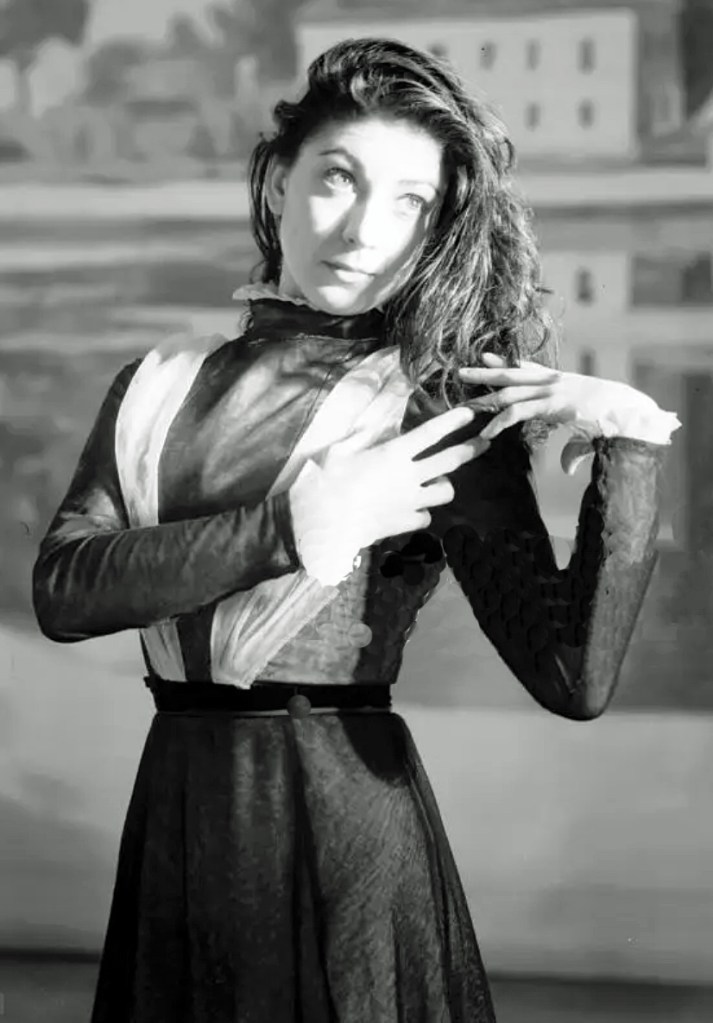
Margot Fonteyn portrays Julia in the 1943 production of The Wedding Bouquet.
It was first performed at the Sadler’s Wells Theatre by the Vic-Wells on April 27th, 1937 with the 18-year-old Margot Fonteyn dancing the role of Julia. Ninette de Valois, director of the Vic-Wells and a former dancer, was cast as Webster, the organizer of the wedding, and Robert Helpmann was cast as the bridegroom. There appears to be no critical record of this performance. However there is a wonderful amateur film of a rehearsal where all three principals appear.
On the June 14th 1943, the Sadler’s Wells Ballet mounted a revival of the ballet at The New Theatre in London’s West End. Palma Nye took replaced de Valois as Webster but Fonteyn and Helpmann retained their roles. Moira Shearer, in her second year at Sadler’s Wells, danced as one of the guests. The performance did not seem to generate much press. The August 25th edition of the magazine, The Tatler, ran a very brief byline to a series of photos of Fonteyn, Helpmann, Margaret Dale (as the bride) and Alexis Rassine. However, it commented favourably on the range of Ashton’s choreographic talents.
When the ballet was again performed at the Royal Opera House, Covent Garden on February 17th, in 1949 Helpmann once again played the bridegroom but Shearer replaced Fonteyn as Julia. She danced the role several times over the following weeks and months.
Once again, the ballet generated very little contemporaneous comment or criticism in the British press. The correspondent in the February 18th Daily Express panned it, saying that the performance that he saw fell well short of the “charm and the humour of the original 1937 version, this despite the brilliance of Robert Helpmann and Moira Shearer”. On the other hand, the February issue of the specialist magazine, The Dancing Times, saw much to be admired in it and considered the performance to be a success. It commented that “each character appears as painted in Gertrude Stein’s words” and that “the ruined Julia (is) beautifully played by Moira Shearer”.
As far as Shearer’s performance is concerned the most positive reaction came in the publication, The Stage, in February 1949. “So ideally cast is Moira Shearer in the revival of this humorous Lord Berners ballet that one could almost imagine that it had been written round her forlorn red tresses, as she danced the distraught tragedy queen at the French provincial wedding”. For once Shearer’s colouring was seen to act in her favour. Shearer garnered other good reviews. “JHM”, the dance critic for the Manchester Guardian, while giving the ballet itself lukewarm praise, felt that “the company …. certainly played it for all it was worth; the lovely Moira Shearer, for instance, bravely disguised herself as a kind of Pre-Raphaelite caricuture …. and … (the company) did all the bright, satiric things that the Ashton-Stein-Berners combination had devised for them”. The correspondent for the Birmingham Post was similarly upbeat, calling the revival “triumphant” and singling out Shearer’s performance. He wrote, “it was Moira Shearer’s Julia that made the deepest – and ….. the most lasting impression”.
Other critics viewing the same 1949 production were less generous. Caryl Brahms, the dance critic for the London newspaper, The Evening Standard” under the headline, “The Wit was Lost”, panned the production and felt that, compared to Fonteyn’s 1937 interpretation, “Moira Shearer made too faint an inprint on the role” of Julia.
The Wedding Bouquet was part of the repertoire during both the 1949 and the 1950-51 Sadler’s Wells Ballet tours of the US and Canada. Shearer danced the role of Julia and Helpmann of the bridegroom at the Metropolitan Opera House in New York on September 21st and 23rd, 1949. During the 1950-51 tour both Helpmann and John Hart danced the role of the bridegroom. On October 27th, 1950, in Los Angeles, Helpmann took the role while on November 29th in Memphis and on January 2nd, 1951, in Winnipeg, Hart assumed it. This Winnipeg performance appears to be the last time that Shearer danced as Julia.
Sol Hurok, the American entrepreneur who was instrumental in bringing the Sadler’s Wells Ballet to North America, writes in his memoirs a paean to Moira Shearer. He describes her as “cultured and highly intelligent”, “intensely musical both in life and in the dance”, a talent particularly evident in her performances in Swan Lake and in Ashton’s ballet, Façade. He concludes by saying “she is well-nigh indispensable to Wedding Bouquet”.
There is a single set for Wedding Bouquet that features a backdrop of a French provincial house and grounds and two tables filled with champagne bottles and glasses. For much of the ballet the stage is filled with wedding guests dancing together. At other times the bride and groom are featured with and without guests. However, the central character is the distraught Julia who is shown, at one point and, much to his horror, clutching the groom’s leg and later pursuing him in a wild dance across the stage. In the final scene all the guests and the bride and groom have departed and Julia is left alone in the centre of the stage seeking solace in her dog, Pepe.
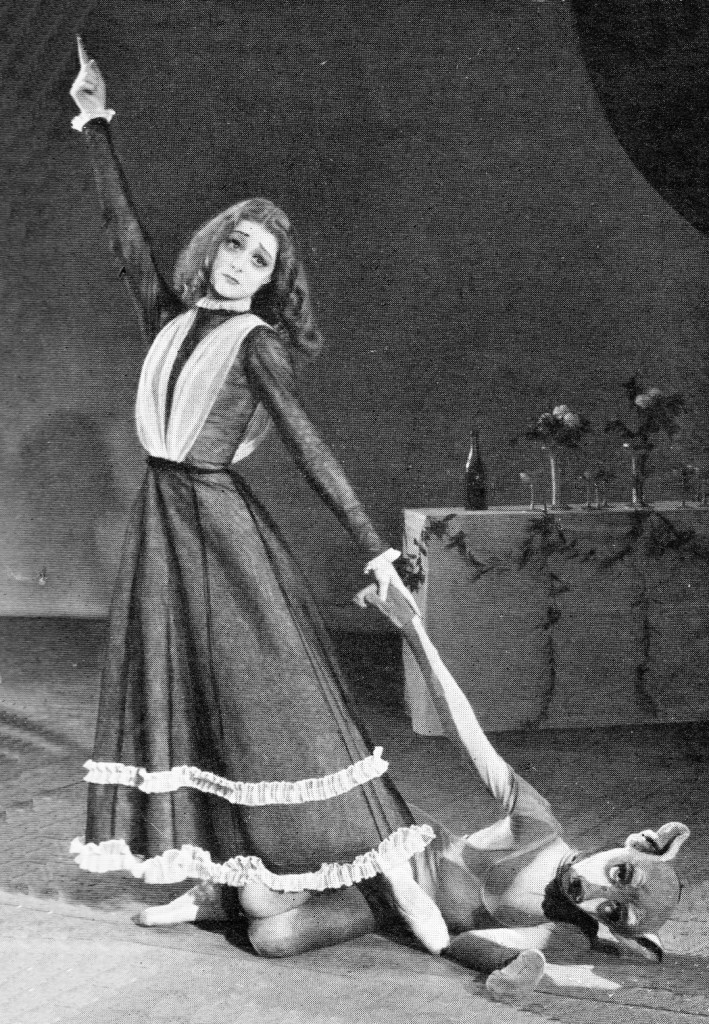
Moira Shearer as Julia in the 1949 production of The Wedding Bouquet. Her dog Pepe is played by Annette Page.
Notes.
The ballet is about 30 minutes long.
Sources.
Birmingham Post, “Ballet Revival at Sadler’s Wells, A Wedding Bouquet”, February 18th, 1949.
Caryl Brahms, Evening Standard, February 18th, 1949.
Daily Express, February 18th, 1949. “Covent Garden Wake up!”
Sol Hurok, S. Hurok Presents, Memoir of the Dance World, 2022, 2025.
Manchester Guardian (JHM), February 19th, 1949, “Ballet at Covent Garden”.
The Dancing Times, February, 1949
The Stage, February 24th, 1949. “A Wedding Bouquet”.
The Tatler, August 25th, 1943. “A Wedding Bouquet”.
 Moira Shearer
Leave a comment