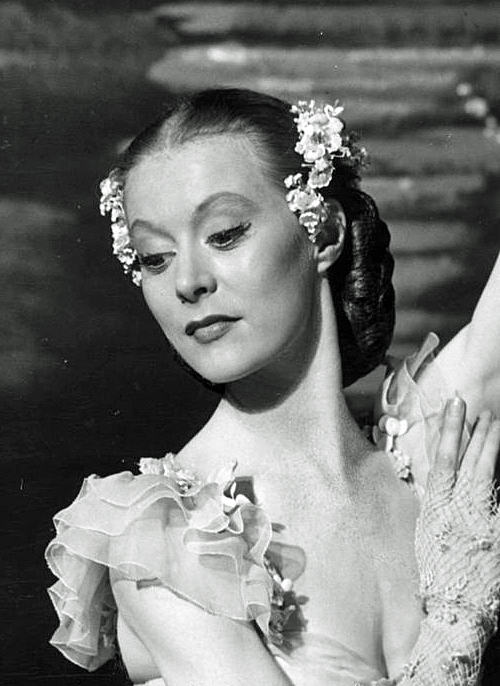
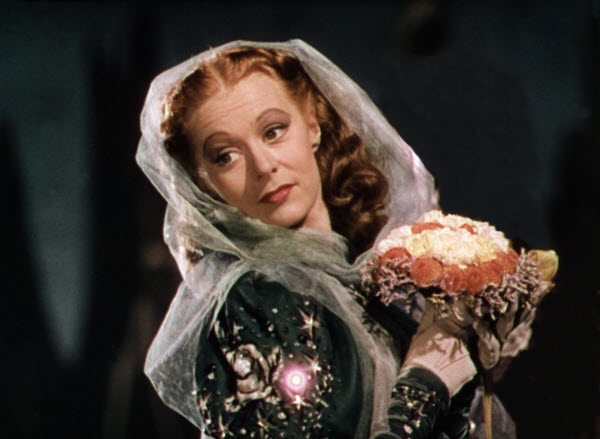
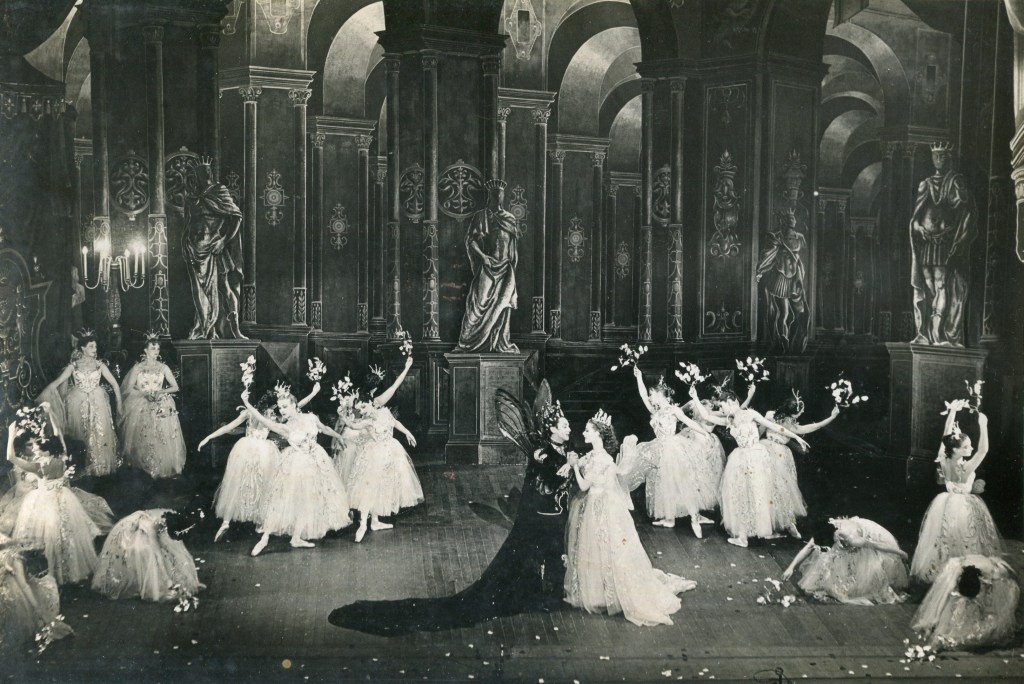
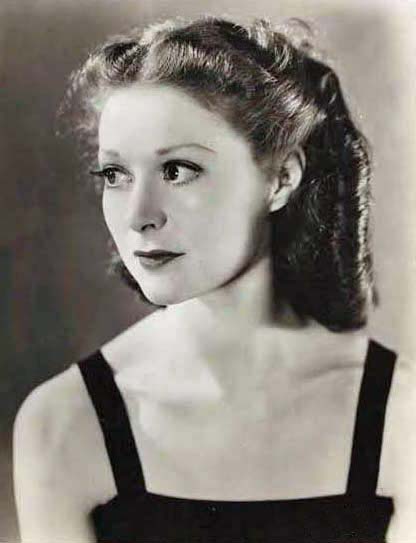
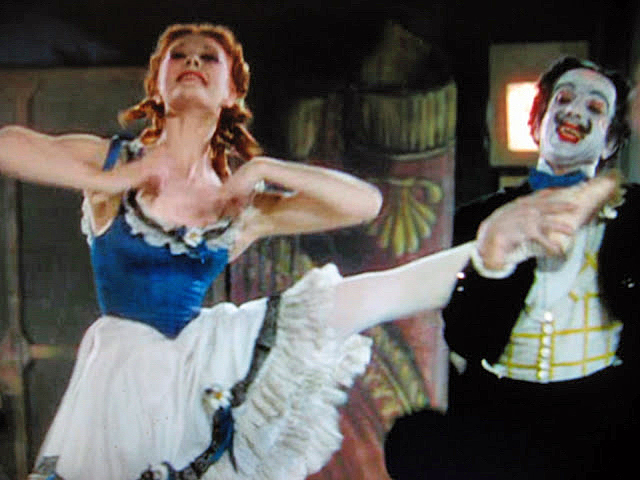
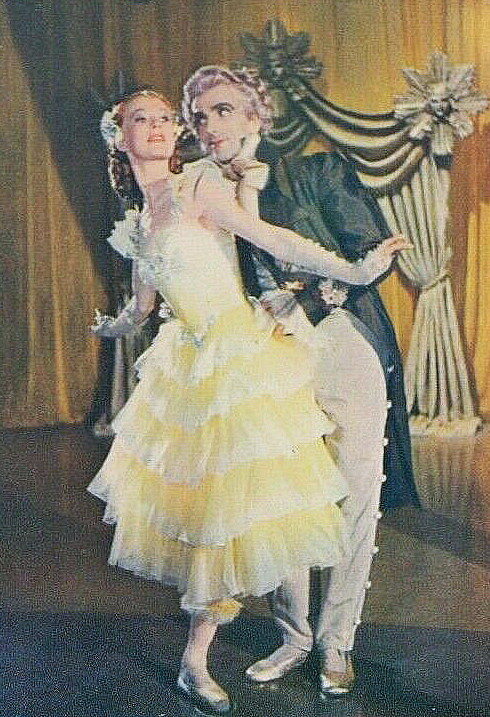
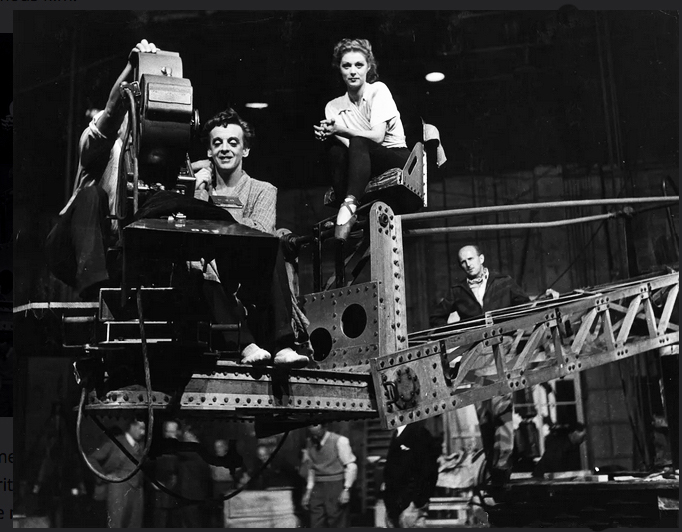
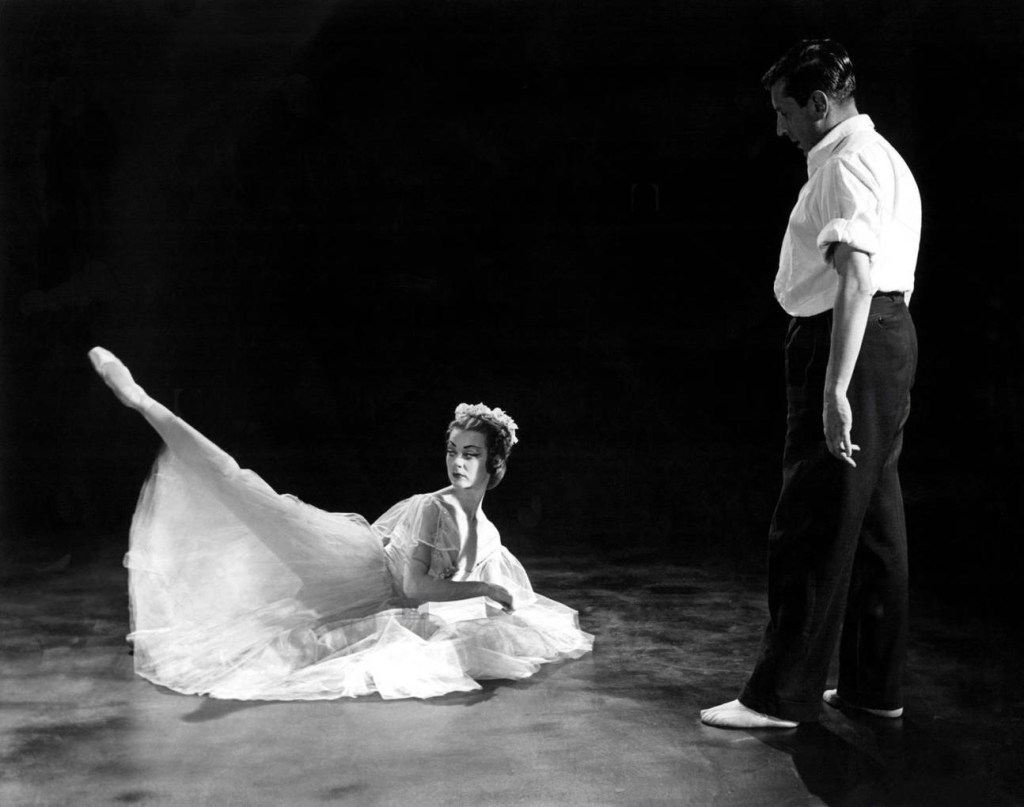
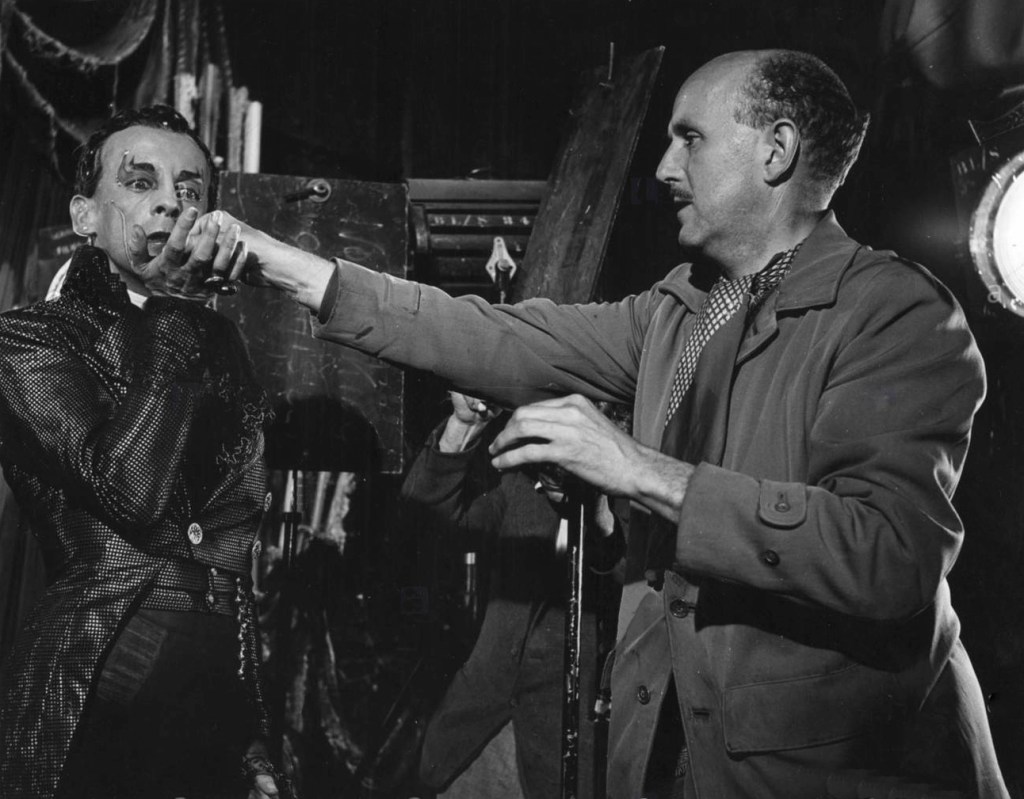
In the 1948 film, The Red Shoes, the director Michael Powell sets out to take full advantage of two of Moira Shearer’s many talents, most specifically her brilliant dancing and her beauty. His goal was to create of her a fairytale princess.
This is most obviously apparent in the scenes depicting the arrival in Monte Carlo of Victoria Page or, Vicky, the ballerina that Shearer depicts. Her impresario, Boris Lermontov puts her up in the Hotel de Paris, where, he assures her, she’ll be “most comfortable”. Lermontov and his team including the ballet master, the music director and conductor and the stage designer are staying at a villa down the coast in Cap Ferrat.
When, in London, Lermontov announced to Vicky that he had selected her to travel with his company to Monte Carlo, he didn’t divulge to her what role she might dance in his new ballet. However, once she was settled in at the hotel, he summons her to the villa to tell her of his decision.
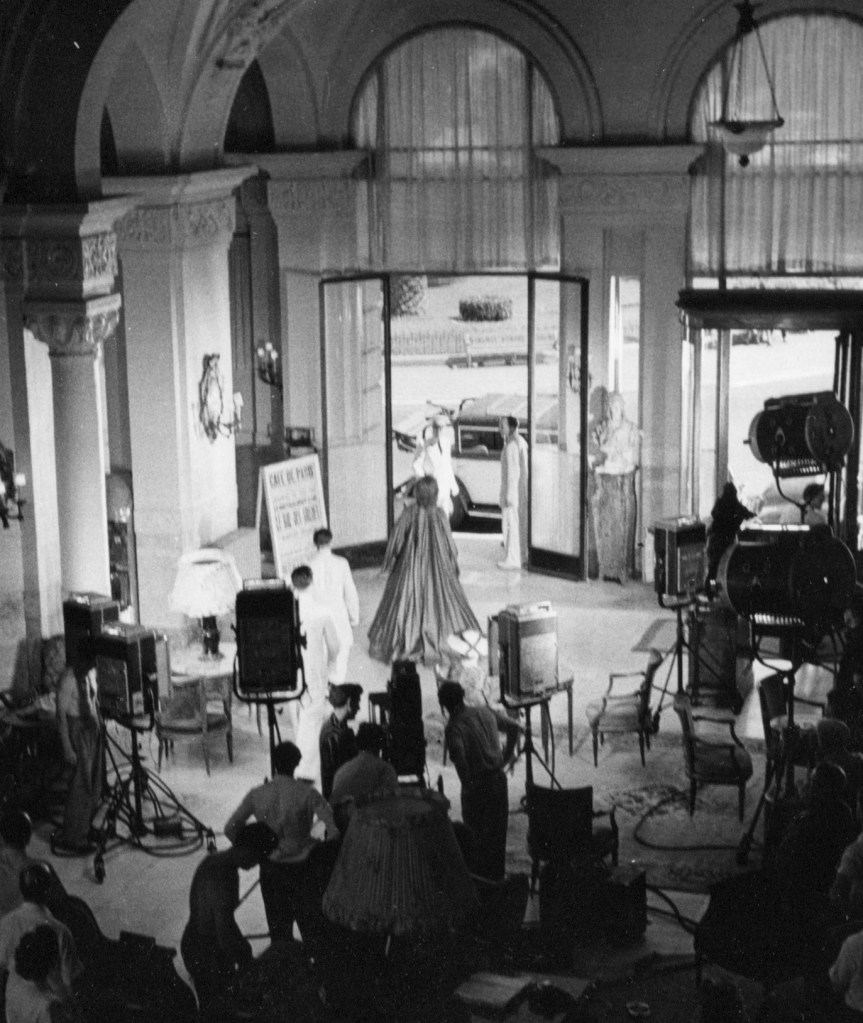
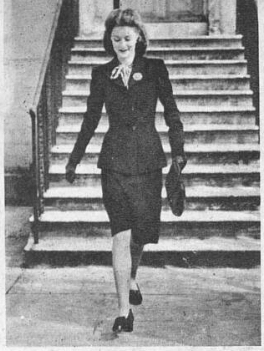
Michael Powell directs the scene in The Red Shoes, where Vicky, played by Moira Shearer, leaves the Hotel de Paris for her meeting with Boris Lermontov, director of the ballet company. Lermontov’s limousine can be seen through the front door. Photographer unknown.
He sends his chauffeur to pick her up in his Hispano-Suiza landaulet. Vicky, as she later explains to Lermontov, was about to go out to dinner with friends in her sumptuous full-length Jacques Fath gown, a diamond tiara perched atop her Titian hair. In response to Lermontov’s summons she changes her plans and leaves the hotel. We see her cross the lobby and, displaying a fine ankle, daintily descend the front steps to be shown to the car by the chauffeur.
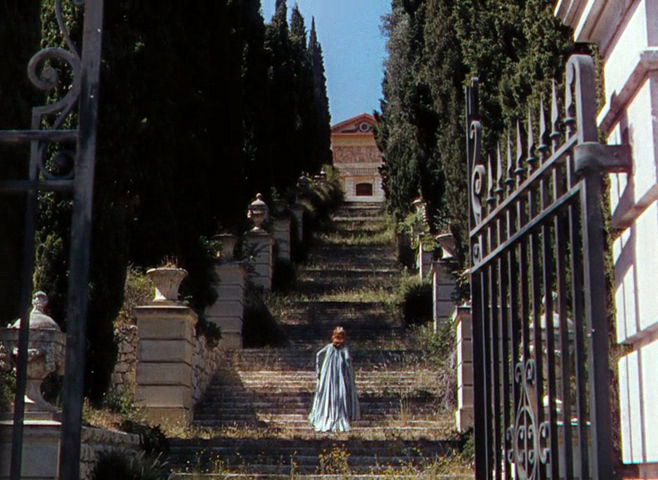
He drives her along the Corniche to an entry to the steps leading up to the villa, helps her out of the car and says to her, “Montez, Mamzelle”(climb up, Miss). As he leaves, Vicky pushes open the massive iron gates and begins her ascent of the 150 weed-strewn steps on this warm Mediterranean evening. A few frames later we are shown her arriving at the top with not a trace of perspiration on her beautiful brow.
Vicky begins her long climb to Lermontov’s villa. Screenshot from The Red Shoes.
This is, of course, all the stuff of fantasy. Even though it has already been established that Vicky is a socialite and, perhaps a well-healed one, it seems unlikely that she would have packed that bulky Jacques Fath dress for her debut appearance in Monte Carlo. No impresario, however maniacal, would have subjected his prima ballerina-to-be to that treacherous climb especially as the main entry to house had a driveway leading up to the main door.
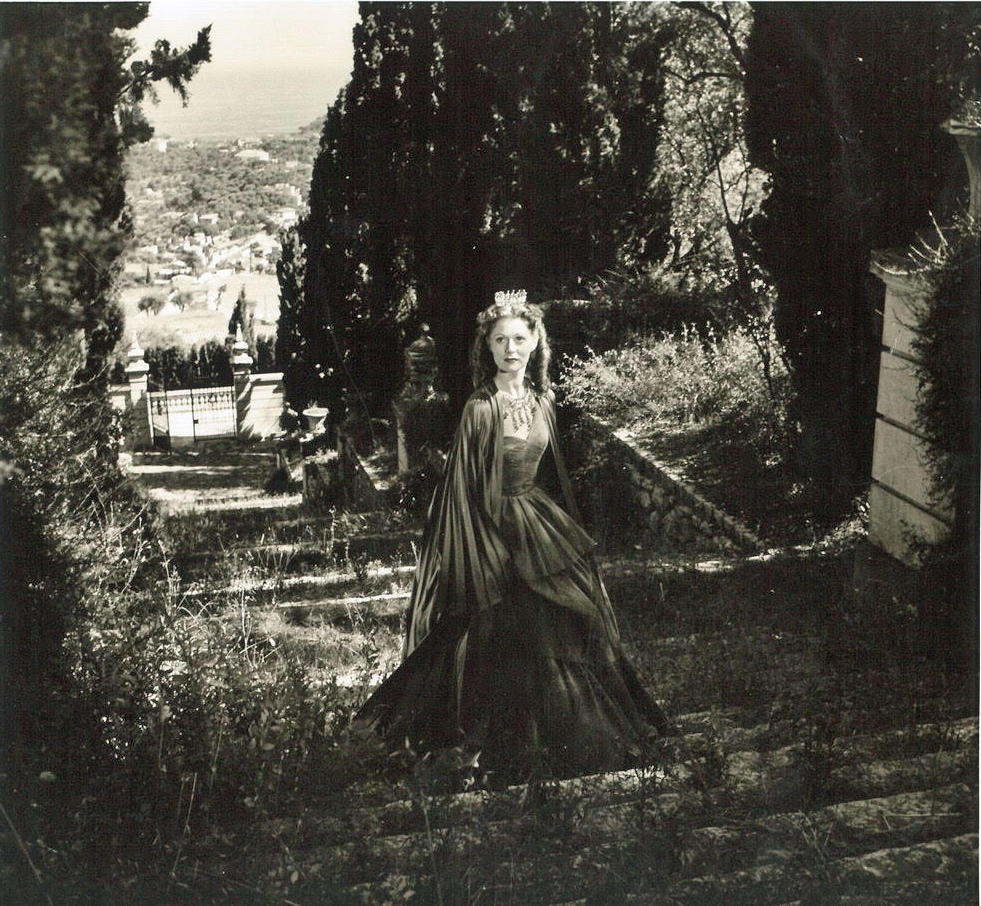
Vicky nears the top of the steps to Lermontov’s villa. Cap Ferrat and the Mediterranean are in the background. Photographer unknown.
Instead, Powell was intent on creating of this scenario an image of fantasy in as many ways he could. In addition to highlighting Shearer’s beauty, Powell sets out to augment it with the allure of the Riviera and the quality of the evening light. He has created his fairytale princess.
When she reaches the villa Vicky is welcomed by Lermontov who, in due course, offers her the job. He then sends her home for an early night, apparently, without any dinner.
Moira Shearer, ballerina, had begun to see the writing on the wall as early as 1948. In 1949, when asked what she wanted to do after leaving the ballet she replied, “straight dramatic acting …. that’s why I’m taking drama lessons now, in my spare time – what there is of it”. This is probably a reference to the Central School of Speech and Drama in London. Although she does not specify a date, Gwynneth Thurburn, the principal, recalls Shearer taking lessons with her.
The realisation that she would have to move on from her career in ballet sprung from a number of sources. First, by her own admission, she knew she would never challenge the pre-eminence of Margot Fonteyn at Sadler’s Wells Ballet. By 1948, she was resigned to the reality of being number two. The bigger problem was her place in the “ballet world”. She found it very “narrow” and, thus, ultimately, unfulfilling. In addition, Sadler’s Wells was an hostile environment starting at the top with the director, Ninette de Valois, with whom Shearer often clashed.
This tension came to a head in late 1948 when Fonteyn was injured and Shearer replaced her in the lead of Fred Ashton’s ballet, Cinderella. Consciously or unconsciously many of the members of Sadler’s Wells resented Shearer’s success in the role. This resentment dissipated when Fonteyn returned to dance after 2 month’s absence. Yet, the damage had been done. Shearer’s perceived ambition, it seems, was proven on the basis of a chance event that had advanced it.
Another source of Shearer’s impending decision to quit ballet for acting was, of course, The Red Shoes. While very little acting was required of her in that film, she was exposed to other actors with whom she had to interact. Chief among these were Anton Walbrook who played, Lermontov, the director of the ballet company and Marius Goring who played Julian Crastner, her lover and, later, her husband. With barely a moment of preparation or any training Shearer was forced to “act” and thereby, how to act. From the point of view of dancing the making of The Red Shoes was extremely disappointing and frustrating to Shearer but the film had made her aware of a world beyond ballet that was potentially open to her. This would have been reinforced by the eventual success of the film. She could not yet act but her obvious “star appeal” led audiences to believe she could.
Shearer continued to labour at Sadler’s Wells for a further 5 years. In that time she enjoyed continued success, as Giselle, for example. She travelled with the company to North America in both 1949 and 1950 and consolidated her position as “number two”. However, illness and injury began to have its impact and she was often out of commission for months on end. Gradually her position at Sadler’s Wells was seriously eroded and she was replaced by other developing ballerinas like Violetta Elvin and Nadia Nerina.
She married Ludovic Kennedy in 1951 and therefore marriage and, later, pregnancy also had to be factored into her decision-making process. Also, in 1951 she appeared in another Powell and Pressburger film, The Tales of Hoffmann although she was not required to act.
After a further injury in the Spring of 1953 Shearer hung up her point shoes at Sadler’s Wells and her final ballet performance was as a guest with The Festival Ballet in January 1954.
Meanwhile the stage and film producers had been circling, waiting for an opportunity to exploit her talents. Thus, in April 1954, she was persuaded to “star” in a British film called “The Man who loved Redheads”, that was based on a Terrence Rattigan play called “Who is Sylvia”. With Rattigan’s approval the title was changed and the script was modified to ensure that the four characters portrayed by Shearer were “front and centre”. She was to play, in quick succession, a teenage girl, a gullible cockney lass, a Russian ballerina and a middle-age social butterfly. The film was panned by most critics as were Shearer’s performances. However, A.H. Weller, the film critic for The New York Times was seduced by Shearer’s charm and noted that she “has developed acting talents that are both surprising and refreshing”.
Michael Benthall, director of The Old Vic Theatre in London, also apparently believed in Shearer’s potential acting abilities and invited her to join his upcoming production of A Midsummer Night’s Dream that would open at the Edinburgh Festival in August 1954 and then tour North America. Shearer would play a major role as Titania. She accepted the invitation and began rehearsals in July.
Benthall’s confidence in her appeared justified by Shearer’s performance at the microphone when the cast and orchestra recorded the play’s soundtrack in August. On the recording, she was a confident and authoritative Titania.
However, her subsequent performances on the Edinburgh stage were another matter. The critics roundly criticised the production as a whole and many singled-out Shearer’s acting. They concluded that her voice was too small and did not project to the audience; many of her lines were lost. Her dancing was impeccable, as always, but the majority of the audience had come to hear Shakespeare’s prose and not to see her dance.
The production fared no better on the other side of the Atlantic. The review of the New York opening night in The Stage for October 7th concluded that “while Miss Shearer’s exquisite beauty and grace comes close to being worshipped, her reading of Titania disappointed even her greatest admirers”. Walter Kerr, reporting in The New York Herald Tribune labelled the production as “tedious”. Of Moira Shearer he wrote, “when lovely Moira Shearer is distracting you from the language by weaving her enchanting arms through the air, you forgive a lot. (Miss Shearer must move to be arresting though; her diction is faulty, her delivery all on one key)”. The correspondent for The Brooklyn Daily Eagle echoed this criticism, saying that Titania “simply isn’t up to her lines”.
In the American press it was rare to find a positive review of Dream. The critic in the Oakland Tribune had a great deal to say that was positive but judged Shearer’s performance on her “grace of movement and elegance of posture and gesture”. He said nothing of her acting. Thus, it seems, he witnessed the ballerina and not the actress.
When interviewed late in the tour Moira Shearer was put on the defensive by being asked to address the consistently bad reviews. Her assertion that the tour had been a commercial success rang hollow and her final lament that the bad reviews “stuck in the craw” must have reflected her disappointment at the negative reaction to her best efforts. She must have left Dream realising that she still had much to learn of acting and when, subsequently, Benthall offered more opportunities at The Old Vic she turned them down, choosing, instead, to spend a year in repertory at The Bristol Old Vic where she hoped to learn her craft.
Dream closed in Montreal on December 18th and Shearer flew back to London. After a 6-week break, early in February she began rehearsals in Oxford for a play called I am a Camera. Camera was written by John van Druten and was based on Christopher Isherwood’s novel about life in Berlin in the 1930s. The play was originally produced in New York in 1951. When it opened in London in 1953 Dorothy Tutin played the lead role of Sally Bowles. As it was successful in the West End, the producer, Donald Albery, booked it for an extended tour of the British “provinces”. However, Tutin was not available for the tour and had to be replaced. Albery asked Shearer to take on the lead role and, despite her misgivings, she took up the challenge.
Camera opened at the New Theatre, Oxford on February 7th, 1955. John Barber, the drama critic for The Daily Express was in attendance and wrote a gushing review of Shearer’s performance. While she still lacked craft and skill of Tutin, he had, he claimed, witnessed the birth of an actress.
Moira Shearer as Sally Bowles in I am a Camera, February 1955. Photo by Angus McBean and used by permission of the Houghton Library, Harvard University.
Like the West End run Camera played to packed audiences at every venue. One member of the cast, John Gale, suspected that a considerable portion of the audience was there primarily to see Shearer who had, of course, star billing.
A very deferential article in the June 1955 issue of Theatre World addressed on the problems Shearer confronted in the transition from ballet to acting. Focusing on her success in Camera the writer concluded that it had been an ideal vehicle by which Shearer could improve her acting. “Each scene in the play reveals a different facet of Sally’s character and so provides Miss Shearer with an opportunity to acquire a wealth of experience in a short space of time”.
Perhaps because appearances at each theatre were limited to a week Camera didn’t generate much press either locally or nationally. Thus, the critics were essentially silent.
Shearer left the play in May 1955, probably at the end of an appearance at The Theatre Royal in Nottingham. In August she moved to Bristol and began rehearsals at the Bristol Old Vic. Her first appearance was on October 18th in the title role in Giraudoux’s play called Ondine. This was followed in quick succession by roles in Uncle Vanya and Volpone. As a repertory company the Bristol Old Vic had only 15 permanent actors at its disposal. This meant that each actor would be expected to participate in almost every production. Shearer was no exception and in early 1956 she was exceptionally busy. On February 14th she opened in King Lear as Cordelia; on March 6th she was Miranda in Don Juan or The Love of Geometry and on April 17th she was Lily Sabina in The Skin of our Teeth. On June 19th she was photographed at London Airport en route to Zurich where she was to appear in The Rivals and on June 26th she was back in Bristol to appear in Shaw’s Major Barbara.
A few years later, when discussing her decision to quit the stage, she admitted that she had grave doubts her acting ability from the very beginning of her tenure at Bristol. She stated in a 1994 interview that she was fully aware that she had to rid herself of all the techniques that she had been trained to perform as a dancer. Gwynneth Thurburn remarked on the tension in Shearer’s posture and movements when she first came to her and thus lessons focused how to breathe and relax as well as how to walk. However, most importantly of all Shearer had to learn how to use her voice. “After being mute for all those years”, she said, “I had to force my voice into a new mould when I started acting”.
Thus, when she opened in Ondine, she was still a work-in-progress and was filled with self-doubt. After the first night she told her interviewer that “If I could give it all up tomorrow I would”. Reflecting previous criticism of her acting, a reviewer wrote of her performance that “naturally Miss Shearer is graceful but vocally the part is above her”.
A review in The Stage for February 23rd, 1956, is very critical of the Bristol Old Vic’s production of King Lear and says of Shearer’s performance that she “makes little impression as Cordelia”.
Moira Shearer as Cordelia in the Bristol Old Vic’s production of King Lear in February 1956. Photographer unknown.
The poor reviews were hardly unanticipated. She was, after all, in Bristol to learn her craft and she had given herself a year to do so. Major Barbara, her final role with the company, would be the acid test. The drama critic Caryl Brahams was at the opening night and wrote a lengthy review of Shearer’s performance. She began by saying that “there can be no doubt that Miss Moira Shearer is a star – whether she is an actress or not is perhaps another matter”. Brahms is gently critical of Shearer’s voice and her movements on stage but highly praises her skill as a satirist. She concludes by asking the question, “but is she that hard-working … hard-hitting Major Barbara? No – or, at least, not yet. At the moment she must gives us, not what the part requires of her, but what she can, and that is her intelligent, sweet-natured and touchingly hopeful imitation of an efficient young actress playing Major Barbara – a performance at one remove from the part and without much contact with the audience”.
If Shearer had read Brahms’s review it would be little wonder that she was again discouraged. Yet it undoubtedly echoed her own evaluation of her status.
Major Barbara ended its brief run at The Old Vic in late July 1956 and Shearer, about 5 months pregnant, took a break.
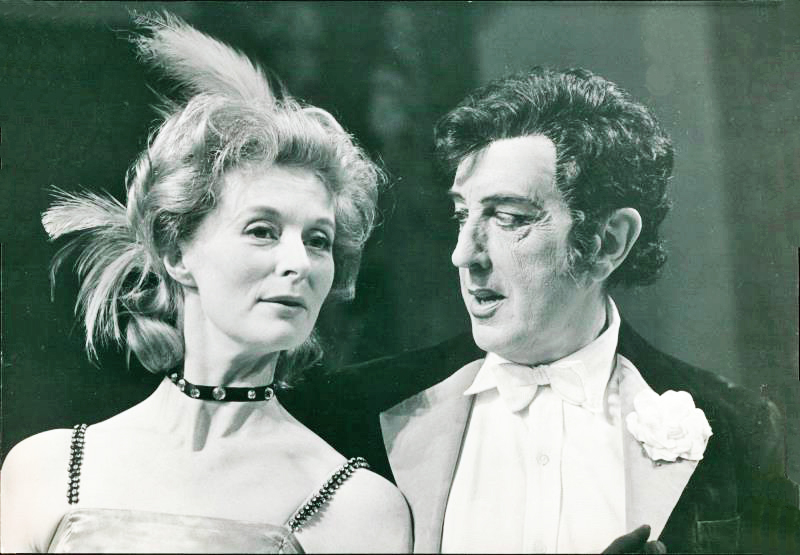
In the summer of 1957 Shearer was persuaded to return to the stage by the prolific producer Henry Sherek. The play was Man of Distinction, a comedy by Walter Hansenclever set in Berlin in the 1930s. Shearer played the role of Lia Compass, Eric Porter was her father, and Anton Walbrook was Hugo Mobius. It was to prove to be a disaster.
Moira Shearer as Lia Compass in Man of Distinction, August 1957. Photographer unknown.
Rehearsals began in London in early August and the play opened at the Edinburgh Festival on the 14th. In September it moved to Manchester, Leeds, Newcastle and Blackpool, each for a one-week run and on October 15th opened at the Princes Theatre in the West End. A review in the magazine Plays and Players noted that Shearer “brought the only touches of distinction” to an outdated play. John Barber, writing in The Daily Express also praised her performance but advised his readers to not see the play. It closed two weeks later, on October 28th. On the same date an unhappy Moira Shearer told Barber that she would quit the stage. This was to be her only appearance as an actress in the West End.
Shearer briefly returned to the stage in 1977 and 1978 at the Royal Lyceum Theatre in Edinburgh. She played Yelena Renevskaya in The Cherry Orchard and Judith Bliss in Hay Fever and received good reviews in the local press. The drama critic for The Glasgow Herald praised Shearer’s Renevskaya as “wonderfully elegant, charming and in several senses, light; she almost seems to float through the play”.
Her final stage appearance was in Glasgow in 1994, when aged 68 she appeared as the crone, Juliana Bordereau, in The Aspern Papers. The review in The Stage praised her performance. “Moira Shearer is splendid as the aunt and her caustic conversations with Dibbens have an expressive clarity”.
Sources.
John Barber, The Daily Express, February 7th, 1955 and October 28th, 1957.
The Brooklyn Daily Eagle, September 22nd, 1954.
Clifford Gessler, The Oakland Tribune, October 28th, 1954.
Walter Kerr, The New York Herald Tribune and Post Dispatch, October 3rd, 1954
Jackie McGlone, The HeraldScotland (The Herald/Sunday Herald), Beyond the Aspic Papers, September 10th, 1994.
The Stage, October 7th, 1954 and September 29th, 1994.
A.H. Weller, “Four of a Kind: Moira Shearer plays Air in “Redheads”, New York Times, July 26th, 1955
In 1957 Moira Shearer’s husband Ludovic Kennedy was a newscaster for the British TV network Independent Television News (ITN). Kennedy had been a long-standing supporter of the Conservative or Tory Party, then led by Anthony Eden. However, Kennedy became increasingly disenchanted with the Tories particularly over their inept handling of the “Suez Crisis” in 1956. In addition, he had moved to the left politically because of his growing interest in the abolition of capital punishment.
Thus, in 1957 when Kennedy met with Jo Grimmond, the newly appointed leader of the left-of-centre party, the Liberals, and Grimmond encouraged him to join him in his efforts to rejuvenate the party, Kennedy was ready to take up the challenge. However, as ITV did not allow politicians to be employed in the newsroom, Grimmond and Kennedy decided to wait for the right moment to come when Kennedy might have the opportunity to seek office. They didn’t have to wait long.
The standing minister of parliament (MP), a Conservative, for the town of Rochdale in Lancashire, suddenly died and, by law, in order to replace him, a by-election was required. The Liberals had rarely fared well in Rochdale with most elections contested between the Conservative and Labour parties. However, with Kennedy as his candidate, Grimmond sensed an opportunity to win the seat for the Liberals.
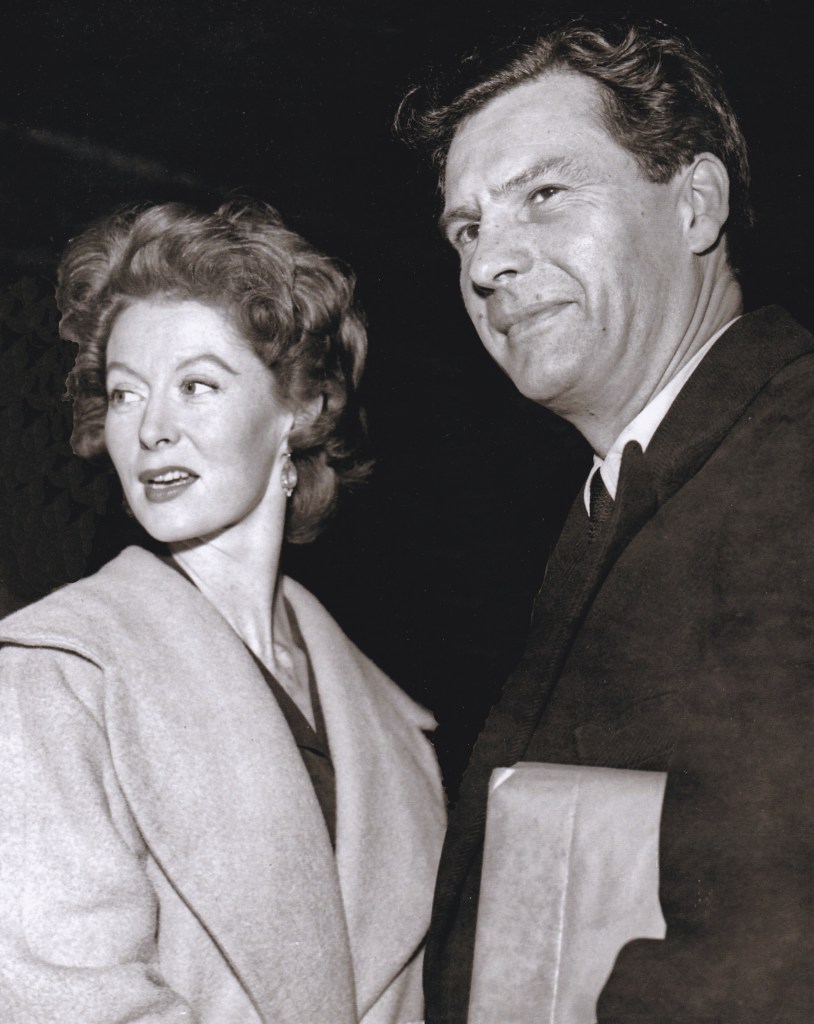
Grimmond proposed Kennedy as his choice for the party’s candidate to the election committee of the Rochdale Liberals and it agreed to consider him. Thus, on January 6th, 1958, he travelled with his wife, Moira Shearer, to Manchester by train. There is a press photo of him sitting in his compartment on the train and typing the speech he would give before the committee. In Manchester the Kennedys were met by a member of the committee and driven to Rochdale where Kennedy would attend an interview.
Ludovic Kennedy and Moira Shearer en route to Rochdale, Manchester, January 6th, 1958. Photographer unknown.
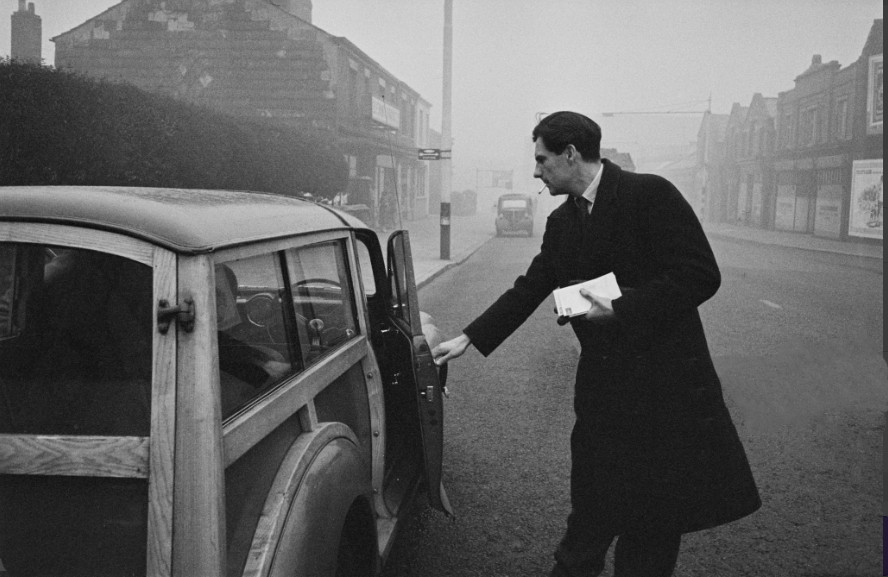
After the committee’s approval the Kennedys immediately returned to Amersham in Bucks where they had just moved. Kennedy tendered his resignation to ITV. Within a few days he drove back to Rochdale in his Morris Minor 1000 “Traveller” to find a place to live and to meet with the team that the party had assembled to support him. They didn’t have much time. The election would take place of February 13th.
Ludovic Kennedy on a grey, cold January morning in Rochdale. Photographer unknown.
Up until late October Moira Shearer had been appearing in a production of the play, A Man of Distinction, in London. She would commute to the theatre from Amersham by train each afternoon and return late at night. By now she was also the mother of two young daughters, the younger, Rachel, being barely a year old. So, with the help of a fulltime nanny she was juggling her children’s care with her acting commitments.
Man of Distinction was a flop and folded after only a three-week run in the West End. This failure and the brutal realisation that her brief acting career was essentially over was a considerable blow to Shearer. The silver lining of this sudden change in her plans was that she was available to help her husband with his election campaign, and she apparently did so with enthusiasm.
This decision became an important element in Kennedy’s preparation. As a TV “personality” Kennedy enjoyed broad recognition but with his equally famous wife by his side it was likely that his appeal to voters would inevitably increase. Nonetheless, Rochdale was a gritty, working class “mill town” and, thus, fertile ground for the Labour party. It was still going to be an uphill battle for the Liberal candidate.
Grimmond, of course, also realized this and thus he directed an experienced team led by Edward Wheeler to support Kennedy. This support included the provision of campaign literature and the organization of canvassing and public appearances and speeches by both Mr and Mrs. Kennedy. Shearer had not anticipated taking an important role in the campaign and in an article in the newspaper, the Daily Express, she had explained her view of what her part would be. “I am going to Rochdale as Mrs. Kennedy”, she said, “not as Miss Twinkle Toes. I shan’t make speeches. I shall lick stamps if necessary”.
Nonetheless, Jo Grimmond’s man decided she should make a speech. Thus, a month later, on February 6th, she spoke to an audience primarily made up of middle-aged women (and a few, male, reporters) and told them she knew nothing of politics but that her years as a ballerina on the road had put her in the company of many Lancastrian landladies. She went on to say that she might be the Prime Minister yet, the reporter adding that she was, of course, joking.
There were many hurdles to confront in the campaign, chief among them that Kennedy was not a Lancastrian and that both he and his wife spoke a patrician tongue. As there was nothing to be done to deny this, Kennedy’s strategy was to energetically reach out to voters and to “press the flesh” at every opportunity. He was perhaps aided by the fact that the national press had picked up on the election as newsworthy. Thus, there were many paparazzi ready to record the Kennedys at work. There are numerous photos of them canvassing door to door, engaging in conversation would-be voters, including shopkeepers, elderly ladies and manual workers.
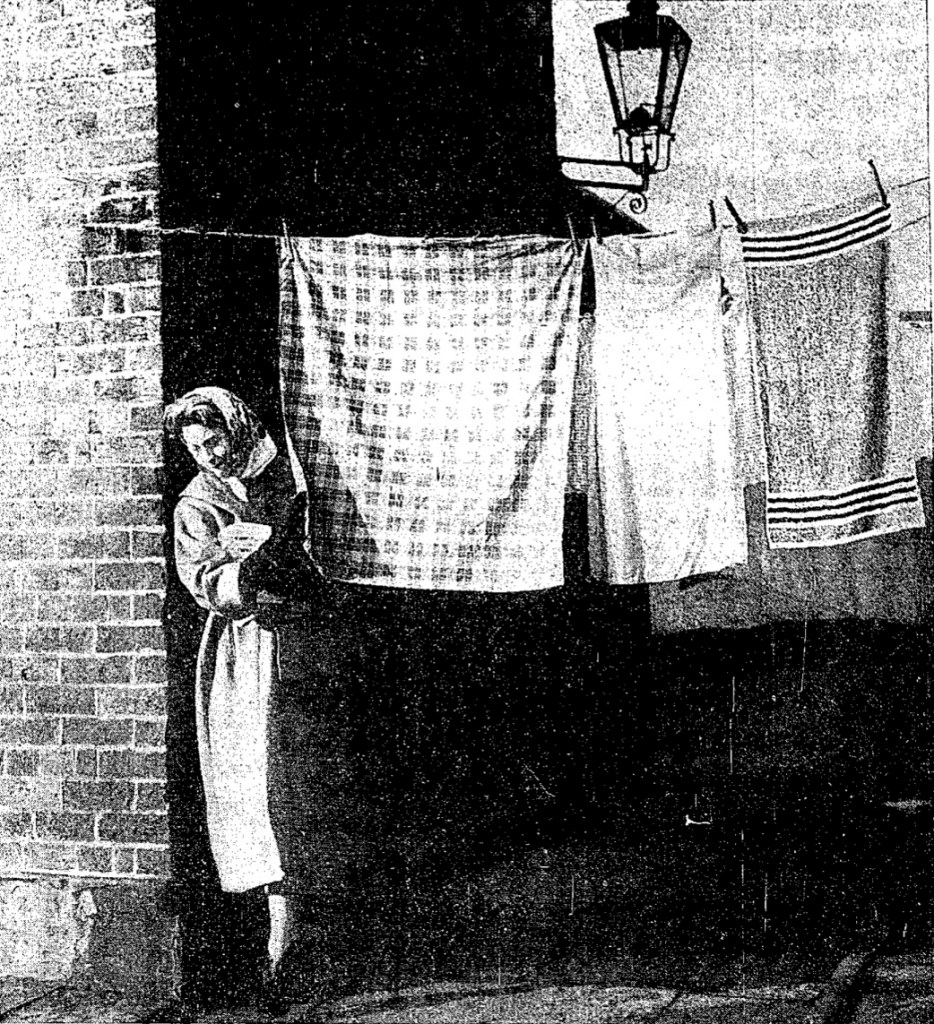
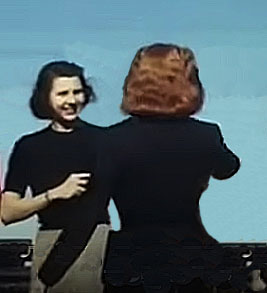
In one image published in the Daily Express that a somewhat skeptical reporter suspected was a staged “photo op”, Shearer emerges from an alley behind some washing drying on a line. Was there, he implied, no limit to what Grimmond’s crew was prepared to try for their cause? Or, perhaps, the reporter concluded, it was simply an opportunity that the alert photographer could not pass up.
Moira Shearer campaigning for her husband in Rochdale. January or February 1958. Photographer unknown. Published in the Daily Express.
Kennedy’s campaign was vigorous and effective, but he did not win the election. Instead, he came in a respectable second to the Labour candidate. A few days after his concession speech the Kennedys returned to Amersham to plan their holiday in the sun at a rented villa in Nice in the South of France.
A year later Kennedy was to run for the same seat in the General Election. Once again, he was second to the Labour candidate but, this time, by a tighter margin. This loss represented the end of his political career, and he returned to writing and campaigning for more personal causes.
Later in 1958 Moira Shearer briefly returned to the stage appearing in a Royal Command Performance of A Midsummer Night’s Dream at The Old Vic in London and in a short run in Oxford of a play titled Triangle. In 1959 she appeared briefly in a film, Peeping Tom, directed by Michael Powell and, in 1960, danced again in a French film, Black Tights. She took the role of Roxane to Roland Petit’s Cyrano in a ballet choreographed by him. Subsequently she returned to private life in Amersham and had two more children while living there. She quietly disappeared from the spotlight.
Sources.
The Daily Express, January 7th, 1958
“The Candidate’s Wife …. or a Picture for Cynics”. The Daily Express, PhotoNews, January or February 1958. Exact date unknown.
The Guardian.com/politics/the-northerner/2016/jan/02/ludovic-kennedy
In 1954 the British impresario Donald Albery produced the play “I am a Camera” for London’s West End stage. It was based on John van Druten’s play that had been staged in New York in 1951 and that, in turn, was based on Christopher Isherwood’s novel about life in Berlin in the 1930s, titled “Goodbye Berlin”.
The London production was given at the New Theatre and starred the very accomplished Dorothy Tutin in the lead role of Sally Bowles. John van Druten acted as the director. It was a major success, especially for Tutin, and ran from May through January 8th, 1955.
Subsequently Albery assembled a different cast for a projected 6-month season in the British provinces. For the week of performances at the Theatre Royal, Brighton starting on January 10th, 1955, the role of Sally Bowles was played by the RADA-trained actress Jocelyn James, who had been Tutin’s understudy, but when the play opened in Oxford on February 7th Moira Shearer had assumed the lead. As, in late December 1954, Shearer had just returned from a long tour of the U.S. and Canada with The Old Vic’s production of A Midsummer Night’s Dream, she may not have been available for the Brighton engagement. Many in the support cast used in Brighton were also replaced but some, like Marianne Deeming, Anton Diffring and John Gale, were retained.
It is not known why these changes took place but it seems that Albery very much had his eye on the box-office in casting Shearer.
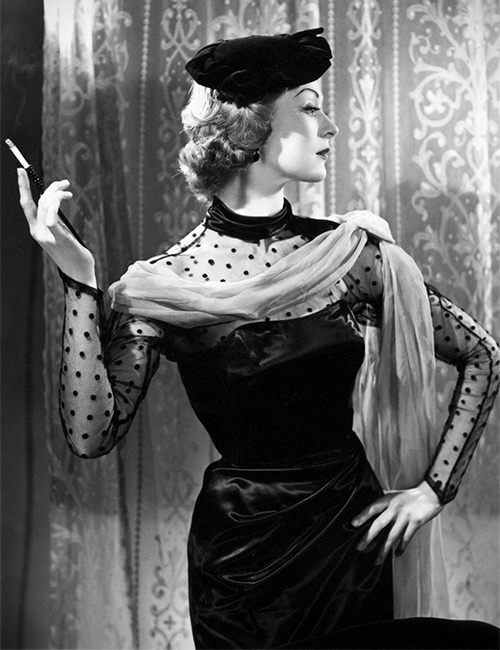
When Tutin was in rehearsals in 1954 it was probably Albery who commissioned the well-known theatre photographer, Angus Mcbean, to take publicity shots of her that were used to advertise the play outside the theatre and in newspapers and magazines. Similarly, it is likely that he asked Mcbean to photograph Shearer as Sally Bowles in early 1955.
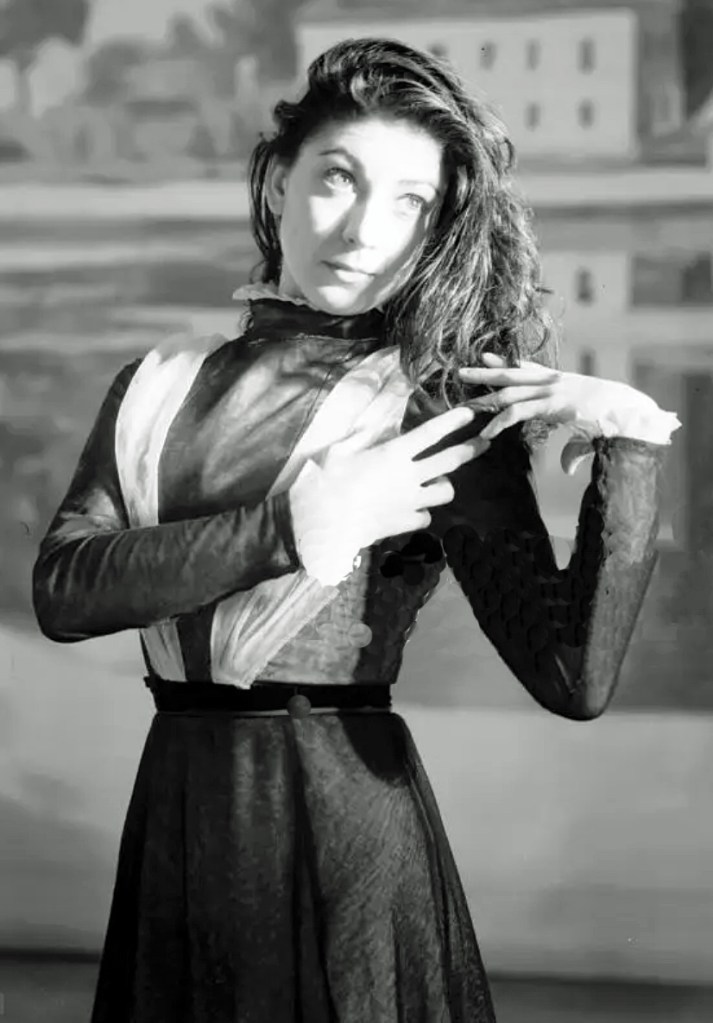
Moira Shearer as Sally Bowles in I am a Camera. Photo by Angus McBean, 1955. Photo reproduced by permission of the Houghton Library, Harvard University.
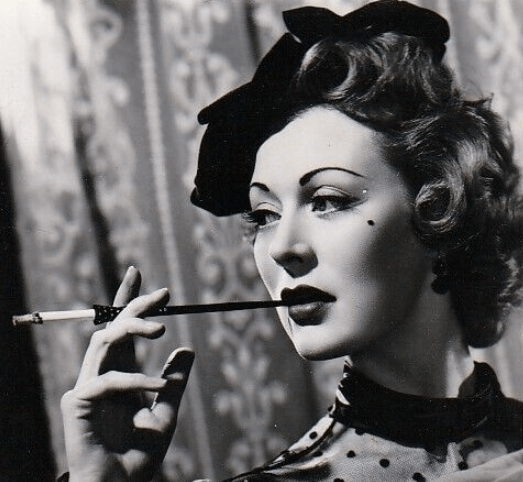
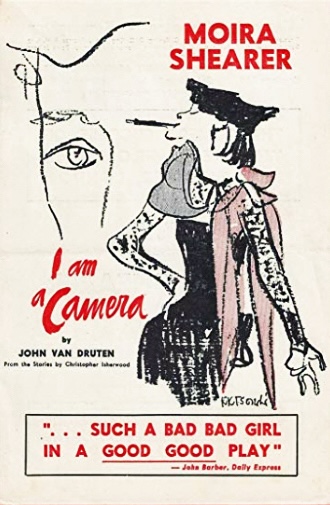
The cover of the programme used for the London production was an almost exact copy of that used in New York in 1951 and featured a cartoon of Sally Bowles with a cigarette holder to her lips. When it came time to design the cover for the provincial run the same image was used but, added to it, in large red letters was “Moira Shearer”. It seems as though Albery anticipated her to be the draw as much as than the play itself.
The cover for the programme for the appearance of I am a Camera in Birmingham.
John Barber, the drama critic for the Daily Express, had reviewed the West End production and his evaluation of it was also added in a box on the cover. It read, “such a bad, bad girl in a good, good play”.
Barber reviewed Shearer’s opening night in Oxford , where the tour began, and gave her a rave review. He concluded that, in terms of craft and skill, that, while she was no Tutin, he felt that he had witnessed the birth of an actress.
The play dealt with the themes of promiscuity and sexuality, so it was bound to attract the attention of the then highly sensitive censors and both they and the Lord Chamberlain reviewed the script. In addition, at some date before opening in the West End, Albery met with the censors to put his case that the script not be expurgated. However, changes were required. John Gale, a member of the cast for the provincial tour, reporting on the performance in Eastbourne in the summer of 1955, noted the presence of the local police throughout the show.
Gale also expressed his opinion that a good part of the audience in any venue was there primarily to witness the beauty of the leading lady and in the north of England, far from the glare and glamour of the West End ,the advance notices for the play in the local newspapers advertised “the personal visit of Moira Shearer”.
Shearer received very mixed reviews. The correspondent in the Birmingham Weekly Post gave her a “thumbs up”. “Moira Shearer is all exquisite grace and beauty; and she has a voice of unexpected depth and proves herself an actress of considerable ability”. The critic in the Eastbourne Gazette was not impressed by the play or by Shearer’s portrayal of Sally Bowles. “She overacted. Her attractive lisp was lost in an avalanche of words and only occasionally did she come over naturally”. In the opinion of this same critic Michael Gwynn as Christopher Isherwood didn’t fare any better.
Like the West End run, the provincial tour, primarily in towns and cities like Nottingham, Bournemouth, Cardiff and Leeds in England, Scotland and South Wales, was a great financial success. Thus, Albery’s optimism in his venture was apparently borne out.
For Shearer the tour appears to have ended in Southsea in June and she began her acting career at the Bristol Old Vic at some time between August and October.
Sources.
John Barber, The Daily Express, February 8th, 1955.
Birmingham Weekly Post, February 18th, 1955
Eastbourne Gazette, June 15th, 1955.
John Gale, Theatre Archive Project (online resource), no date.
Glasgow Herald, April 1st, 1955. “Moira Shearer in New Role”.
Michael Powell and Emeric Pressburger brought in Sir Thomas Beecham, the British conductor and impresario, to conduct the music for the ballet sequence that was the centrepiece of their 1948 film, The Red Shoes. The music was written by Brian Easedale who also served as conductor for the balance of the film.
After The Red Shoes was released, Beecham suggested that Powell and Pressburger consider the opera The Tales of Hoffmann as the subject of their next film. The opera was created by Jacques Offenbach in 1880. Beecham also offered his services as conductor and those of The Royal Philharmonic, the orchestra he had founded.
Powell and Pressburger enthusiastically accepted his offer and in 1950 Beecham created the score and commissioned the English libretto which were to become the basis for the film. Beecham worked with the Royal Philharmonic to make a recording of the opera sung in English. The voiced parts were sung by a number of established opera singers like Dorothy Bond and by the Sadler’s Wells Chorus. In the film itself, with the exception of Anne Ayars and Robert Rounseville, who actually sang their parts, the other actors and dancers would lip-sync theirs’s to Beecham’s recording.
Before the opera itself begins, Hoffmann, the poet, who is the subject of the piece, and his current love interest, Stella, are introduced. In the original opera Hoffmann is in the audience at the theatre where Stella is singing. In the film Stella becomes a ballerina who is played by Moira Shearer and Powell and Pressburger create an epilogue as a way to showcase her dancing talents. As William Germano expresses in his book on the film, the creators “give the audience a view of Moira Shearer doing what they came to see her do: dance”.
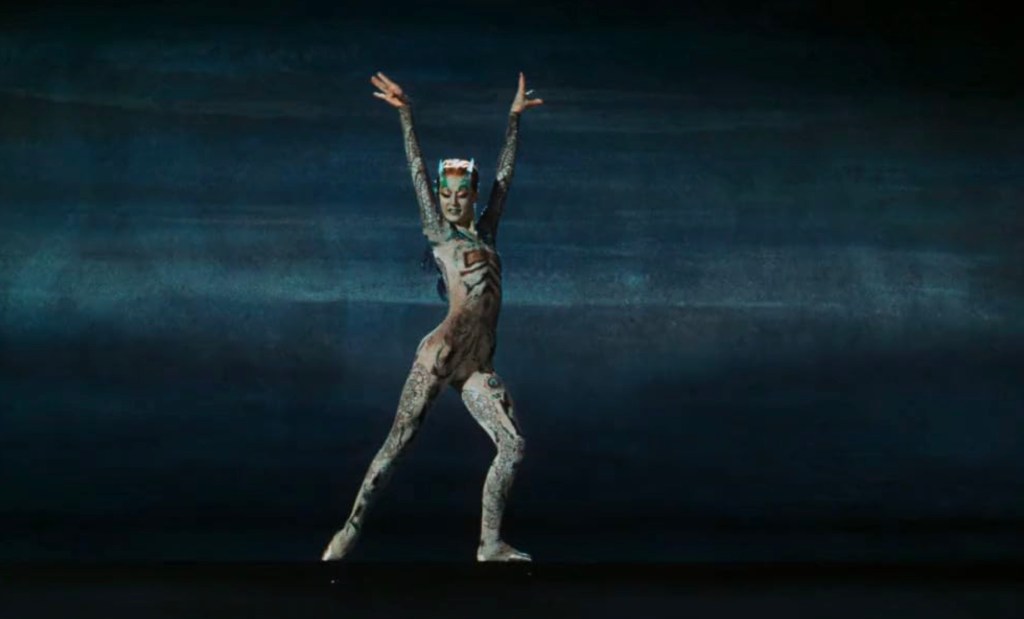
This addition, titled The Enchanted Dragonfly, in which Shearer dances with and, eventually, consumes her partner, Edmond Audran, was choreographed by Fred Ashton to match Shearer’s dancing style. Many of the critics praised the ballet and Shearer’s execution of her role while others objected to it as being superfluous and, thus, an empty exercise. An article in the July 1951 issue of Ballet Today wrote of the ballet itself that it had “undistinguished choreography which is acrobatic in movement and curiously static in design”. The critic in the Paris Review focused on Shearer’s performance and wrote, “her adamantine, technically flawless executions in the “Enchanted Dragonfly Ballet” … are bloodless perfection”.
Moira Shearer as a dragonfly in The Tales of Hoffmann. Photographer unknown.
Hoffmann is stricken by desire for Stella at her performance. Stella obviously returns his affection as she writes him a love note on a handkerchief and encloses her room key. This she gives to Andreas, her perfidious servant, in a break in the performance and instructs him to deliver it to Hoffmann. It is, however, intercepted by Hoffmann’s rival, Lindorf, who bribes Andreas and, thus Hoffmann is left unaware of Stella’s interest.
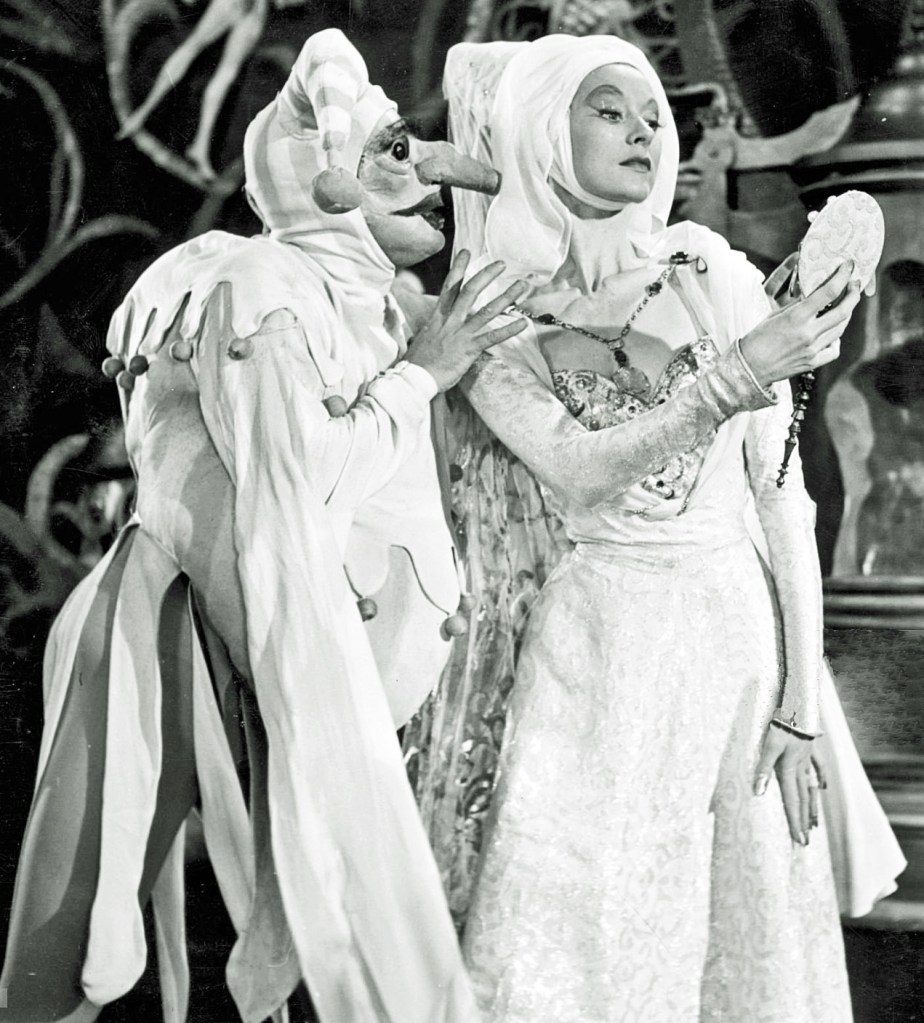
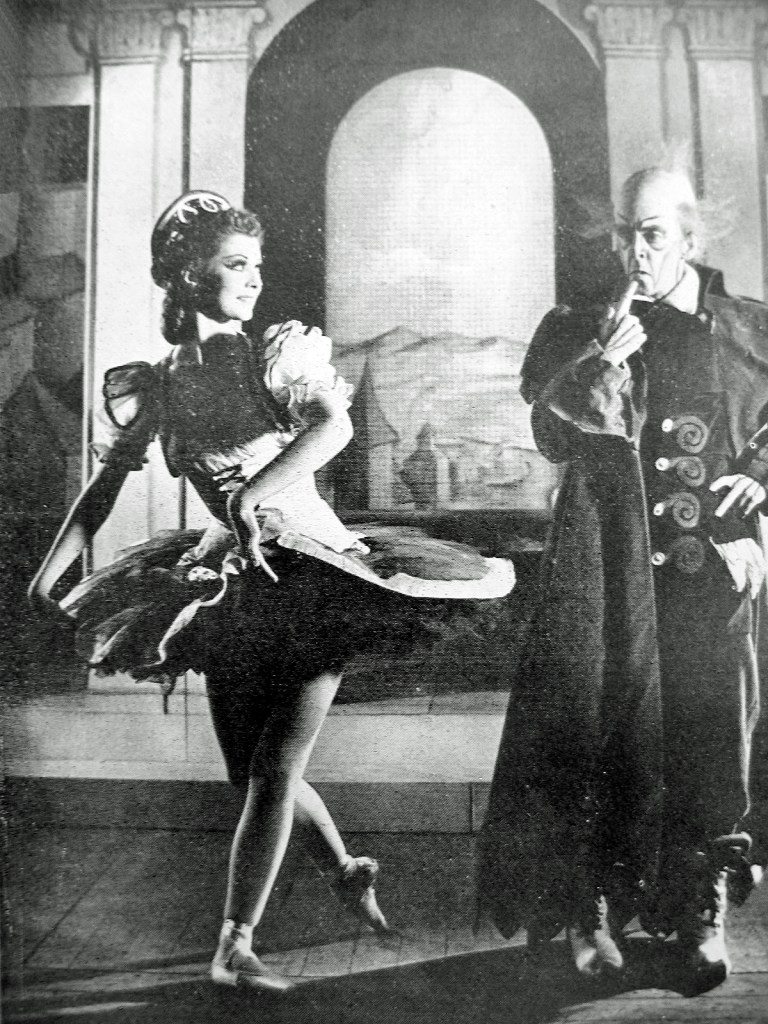
Hoffmann leaves the theatre and enters Luther’s Tavern to drink and regale his friends with “tales” of his many loves. While there and perhaps already drunk Hoffmann imagines a hunchback named Kleinzach, portrayed on one of the beer steins displayed in the tavern, coming to life. The hunchback emerges from the front face of the stein and attempts to woo a beautiful young woman dressed in a medieval costume. Kleinzach is played by Ashton and the object of his love by Moira Shearer. However, she appears to be more intent on regarding her reflection in her mirror than on his advances and summarily spurns him. Hoffmann’s story of Kleinzach seems to unconsciously mirror his own rejection at the hands of his lovers. In the original opera Kleinzach has no love interest and Powell and Pressburger appear to have inserted this to reinforce the parallels between the hunchback and the unrealistic Hoffmann. The change also gives them another opportunity to utilize Shearer’s talents. While the vignette makes no demands on Shearer’s dancing skills her miming forcefully portrays her character’s arrogance.
Fred Ashton as Kleinzach and Moira Shearer as his “lady love” in The Tales of Hoffmann. Photographer unknown.
Shearer returns to dance (and sing!) in the first act of the opera itself. Here she plays the part of Olympia, the animated doll created by the inventor Spalanzani played by the Russian dancer Leonide Massine. Spalanzani is aided and abetted by Dr. Coppelius, played by Robert Helpmann, who creates magic eyeglasses that complete the deceit. Together they dupe an unsuspecting Hoffmann into believing that Olympia is real. When he realizes that she is an illusion, Hoffmann is both crestfallen and out of pocket.
Many of the critics expressed that they considered Shearer’s portrayal of Olympia as her most successful foray into films. She was generally praised for her lightning-fast footwork, for her mime and her humour. Bosley Crowther wrote in the New York Times that “(her dance numbers) are cinematic gems, combining a rare and thrilling fusion of pantomime, music and dance”.
Moira Shearer in her role of Olympia in The Tales of Hoffmann. Detail of a photo by Baron.
Shearer confessed to Dale Harris that she generally disliked portraying dolls like Swanhilda in ballet but enjoyed dancing as Olympia and especially liked working with Ashton.
In addition to dancing with Shearer in his role as Spalanzani, Massine was also involved in its choreography and often arrived early at the studios at Shepperton to prepare. Shearer sometimes shared his taxi from west London to rehearse with him and to participate in production of the many costumes she would use.
Shearer is absent from Acts 2 and 3 that concern two of Hoffmann’s other lovers. She returns in the epilogue which again takes place at Luther’s Tavern.
However, before this final scene Powell and Pressburger inserted another vignette that was intended to showcase Shearer’s talents. It opens with Shearer dancing alone on stage where she creates the image of Stella embodying all of Hoffmann’s lovers. She is then joined by Audran to dance a thoroughly romantic duet in which she wears a reproduction of the calf-length tulle skirt worn by the renowned 19th Century ballerina Marie Taglioni. Finally, she and Audran appear together dancing in a churrigueresque landscape dominated by four massive pillars. As they finish their dance, they disappear into the sunset and the curtain is shown falling on their performance.
This image then dissolves to one of Hoffmann and his companions in the tavern. Shearer suddenly reappears as Stella, this time wearing a sumptuous fur-trimmed gown. Having completed her performance at the theatre next door she rushes to find Hoffmann. As the tavern is in a cellar she enters from the street above, stands atop the steps and, according to the original libretto, “gushing with excitement”, proclaims to Hoffmann, “My darling! What a night! I have never sung better. The ovations!” She pauses as she sees her would-be lover slumped over and exclaims, “Hoffmann! Asleep?”
Nicklaus, Hoffmann’s companion and muse, informs her, “No, ma’am”, “Passed out. You have come too late”
In the original libretto Stella expresses her anger and frustration at Hoffmann, “Asino! Porcaccio!” (“ass, dirty pig”) but in the film Powell or, perhaps, Ashton instead shows her looking at Hoffmann with sadness and disappointment. As she does so Lindorf enters to present her a small bouquet, wrap her in his cloak and lead her away up the steps to some unknown destination. His triumph over his love rival, Hoffmann, is complete.
Moira Shearer in her role as Stella at the conclusion of The Tales of Hoffmann. Photographer unknown.
However, this is not quite the end of the film. Instead, Beecham, in a final vignette, is shown energetically conducting the last few phrases of Offenbach’s music and then laying down his baton on the lectern. One suspects that Powell and Pressburger intended this postscript acknowledge Beecham’s central role in creating the film.
Sources.
Ballet Today, July 1951.
Pigeon Crowle, Our Star Ballerina: Moira Shearer. Woman’s Own magazine, September 1950.
Bosley Crowther, New York Times, April 5th, 1951.
William Germano, The Tales of Hoffmann, BFI Classics, 2013.
Dale Harris, transcript of interviews conducted with Moira Shearer in Edinburgh, August 29th,1976, August 31st and September 1st, 1978. New York City Library Archive, Lincoln Center, New York City.
In 1937 an 18-year-old Michael Benthall, who was then an undergraduate at Oxford, went to see a production of Shakespeare’s A Midsummer Night’s Dream staged by Tyrone Guthrie at the Old Vic Theatre in London. Vivien Leigh played the part of Titania and Robert Helpmann was Oberon.
The production included music that Mendelssohn had written for the play in the 19th Century. Unlike most previous 20th Century interpretations of A Dream, Guthrie’s was designed as a spectacle. One critic termed it “neo Victorian”, a reference to the way it had been presented in London by Charles Kean and Beerbohm-Tree in the previous century.
Benthall was impressed by what he saw and apparently carried the memory of Guthrie’s interpretation forward to 1954 when he was established as director of the Old Vic and was considering staging a new production of the play. In cooperation with the Edinburgh Festival, it was decided to present the play at the festival in August and September of that year. Subsequently Benthall negotiated with the American impresario, Sol Hurok, for a 9-week tour of the U.S. and Canada, beginning with 29 performances in New York at Metropolitan Opera House in late September.
A Dream ran at the Empire Theatre in Edinburgh from August 23rd to September 8th, 1954.
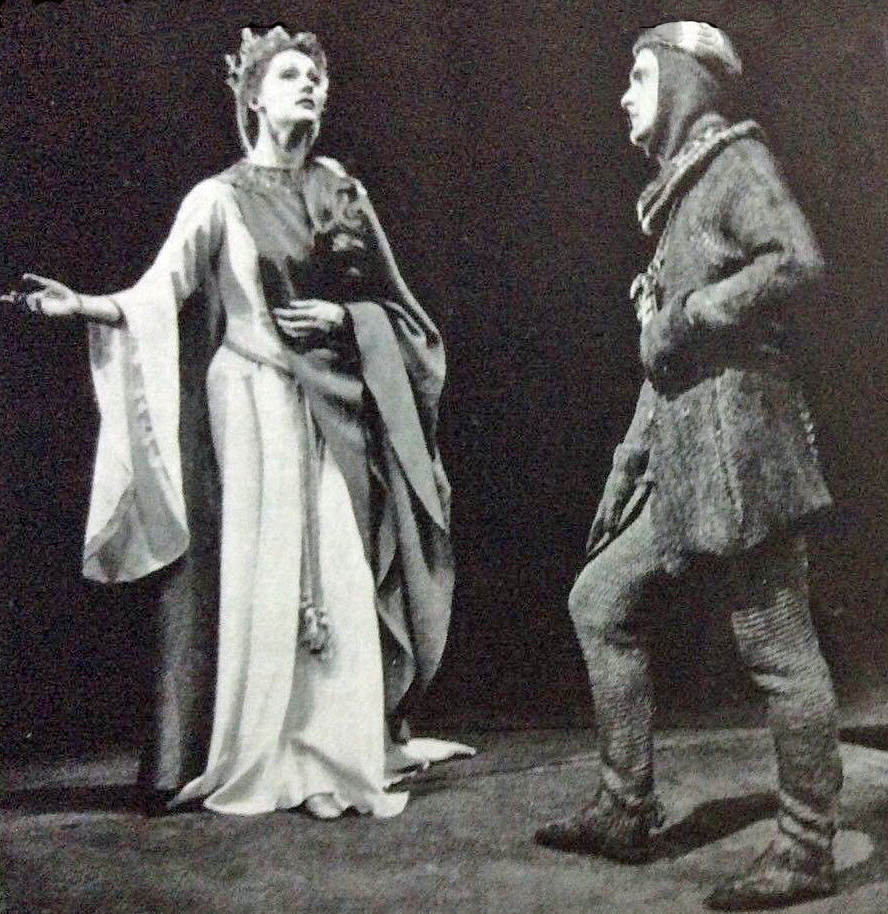
Robert Helpmann as Oberon and Moira Shearer as Titania in a performance of A Midsummer Night’s Dream in Edinburgh in August 1954. Photographer unknown. Photo published in The Scotsman.
The drama critic for the Glasgow Herald on September 2nd published a review under the headline “Shakespeare with all the Trappings”. It was highly critical of the production. For example, of Shearer’s performance the critic wrote, “Moira Shearer looked ideal as Titania but her voice is too small and one missed some of her words”. While largely unimpressed by the acting he conceded that “the choreography is exquisite, especially the nocturne ballet danced by Moira Shearer, Robert Helpmann and the corps de ballet”. The nocturne was choreographed by Fred Ashton; the balance of the play by Helpmann.
J.C. Trewing, writing in the Illustated London News for September 1954 seemed reluctant to either praise or damn the production and Shearer’s part in it.
“Agreed, the ballets are the best things in this evening. Moira Shearer, as we all know, is a snowflake-dancer. The pas de deux with Robert Helpmann is a pleasure. But we do go, or should we …. to A Midsummer Night’s Dream for the sake of the verse”. He then places Shearer’s acting performance in true perspective. “Moira Shearer, delicate, auburn-haired, is a ballerina for our affection; but she speaks Titania thinly, without apparent zest”.
The day after the last performance in Edinburgh, the cast and 30 tons of props were loaded onto a charter plane for the journey across the Atlantic. On arrival of the company at Idlewild Airport in New York on September 18th, Benthall was interviewed by a New York Times correspondent.
When asked about the genesis of the production Benthall said, “I can compare the production with nothing I know in the straight classical theatre; what I think it’s really most like is the great court masques of the 17th and 18th Centuries. This all started 6 years ago, at Stratford on Avon, when I put on a production of “The Dream” using a recorded bit of the Mendelssohn score as background ……. That production was presented entirely for the play alone, the music being just incidental; but I fell in love with the music, which I thought brought the play marvellously alive. By some miracle, Mendelssohn managed to weave into his score the same kind of color and magic that Shakespeare had written in verse more than 200 years before”.
Benthall continued, “the logical next step was visual …. the sprites played by dancers, for … only then would they be given the ethereal lightness to set them on a plane far removed from the mortals of the play. I realize the play is beautiful by itself, but I became convinced that if presented in combination with Mendelssohn’s full score, it would make and evening so full and rich as is rarely found in the classical theatre today”.
The Times correspondent interjected “perhaps his dream of The Dream would have remained a dream … without Robert Helpmann and Moira Shearer” and Benthall added that “in a musical-ballet version you needed dancers who could also act…. I knew Moira Shearer could act….”
Benthall’s evaluation of Shearer’s acting skills was somewhat ingenuous. By 1954 she had had virtually no training in acting. That would have to wait until she joined the repertory company, The Bristol Old Vic, in the summer of 1955.
When asked about preparations for her “acting” role in the 1948 film, The Red Shoes, Shearer told Dale Harris that the director, Michael Powell, had provided her with the services of a young actor but all they achieved was a brief discussion about “The Importance of Being Earnest”. Powell, in fact, cautiously shielded her from exposure to any demanding dialogue. Her most memorable lines, beginning with “I am that horror”, were mercifully brief. In her next film, The Tales of Hoffmann (1951), Shearer utters not a word. In A Story of Three Loves (1953) her conversations with James Mason were dominated by him.
Thus, by 1954, Shearer would have been the first to concede that she could not act. However, she had a beautiful voice. Prior to the Edinburgh Festival premiere between August 16th and 20th the full cast and orchestra recorded the play for a long-playing record. In front of the microphone, according to one critic, Shearer’s Titania is “powerful and convincing”.
A Dream opened on September 23rd at the Metropolitan Opera House in New York to a packed audience and overwhelmingly negative reviews. The general consensus of these was that the actors were not “first rate” and that spectacle drowned out Shakespeare’s wonderful verse. Shearer received the lion’s share of adverse criticism but she was not alone. Stanley Holloway’s Bottom was hardly convincing. Only Helpmann escaped the critics’ wrath.
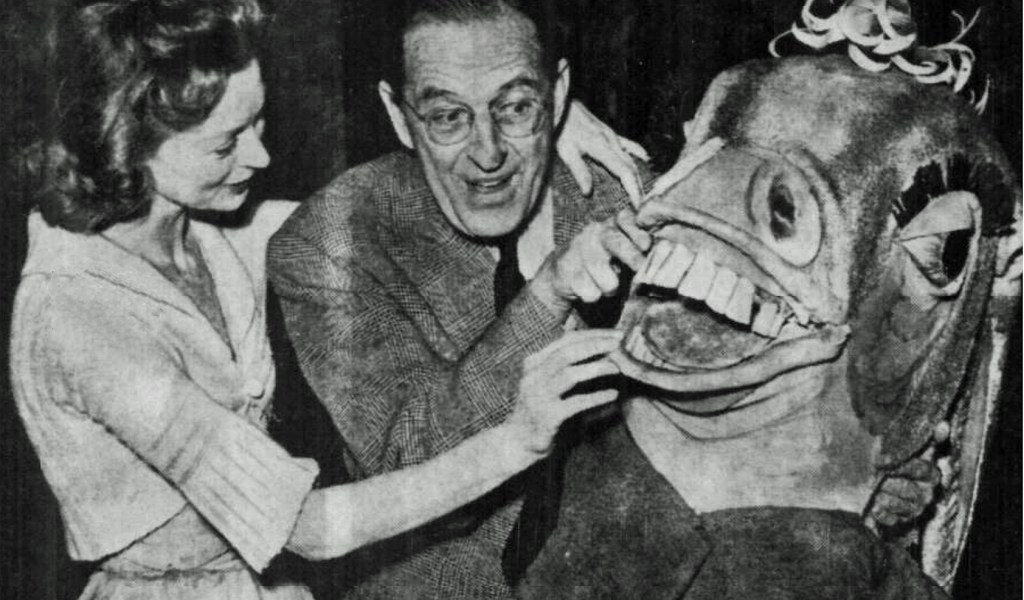
The review in the magazine, Time, for October 4th, 1954, was kinder than most but still damning. For that reviewer the Old Vic version of A Dream was “lovely” and “fairylike” and Mendelssohn’s score was enchanting; it was A Dream “employing the classic patterns of romantic ballets, A Dream mounted with lush moonlit décor”. However, the review continued, Mendelssohn was the hero of the evening rather than Shakespeare and “Moira Shearer’s dancing far surpasses any actor’s speech; the ass’s head that Bottom wears is far more entertaining than Stanley Holloway’s Bottom”.
Stanley Holloway, who played Bottom, explains the animated ass’s head he wears in the production to Moira Shearer, August 1954. Photographer unknown. Photo published in The Scotsman.
The reviewer characterised the overall performance by saying, “ultimately the worst defect …. is that by using an almost uncut text it makes matters too sluggish and protracted for a musical spectacle while so much dancing and music are fatal to a true unfolding of the play”. In sum, it is only ”a medley of impressions (and) much that is unmercifully dull”.
John Gassner, reporting in the Educational Theatre Journal for December 1954 under the heading “Broadway in Review”, was one of the more virulent critics. He writes that “The marriage of Shakespeare’s words to Mendelssohn’s music was more conducive to boredom than bliss. The intercession of Moira Shearer’s loveliness and of the painstaking choreography was futile. The production was ill-conceived … everything was lovely, everything proficient” but, he concludes, mightily boring.
After the performances in New York and Philadelphia on October 18th the company set off on a tour of the US and Canada that included cities like Los Angeles, San Francisco and Montreal but also venues on university campuses like the University of Minnesota and Michigan State.
The criticism in the local newspapers that evaluated the overall production largely reflected that in the New York press. The exception was the reviewer in the Oakland Tribune who had seen the production in San Francisco and felt it was a successful amalgam of verse, music and dance.
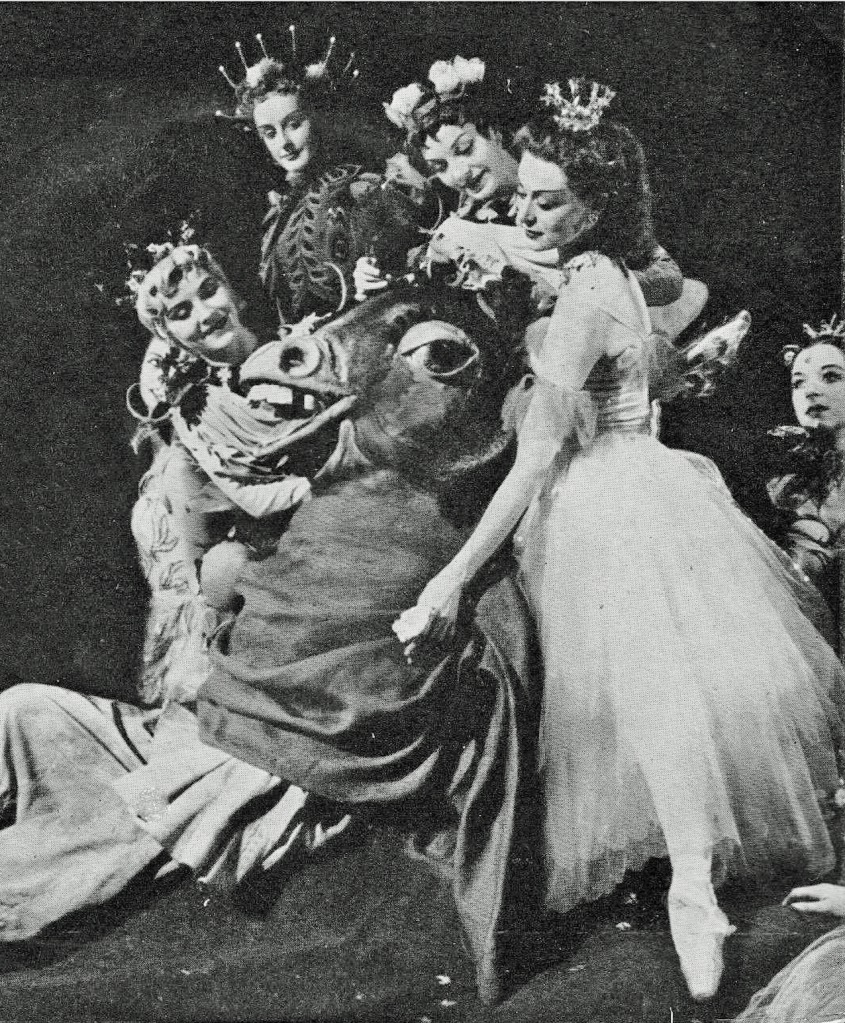
Moira Shearer as Titania professes her love of the ass to the assembled fairies. Neither date nor photographer known. Photo published as a cover to a record of Mendelssohn’s music.
Much of the local press focused on Shearer, partly because she had just announced her intention to quit ballet. These critics, too, concluded that, while she looked the part, she didn’t deliver her lines.
When interviewed for the Minneapolis Star Tribune Shearer was asked for her reaction to the widespread criticism of the production. She felt that much of it was misguided and was at pains to stress the fact that the production was more elaborate than any “Metropolitan” opera; there was a huge cast of 42, a ballet corps of 28, a 60-member orchestra and all those props. To her the sold-out performances indicated that the public response was positive. Yes, she conceded, there had been mixed reviews from the critics. The reporter wrote, “Miss Shearer offered a few flatfooted comments on some of the critics”. “Really”, she said, “you’ve got to approach this as a spectacle. Some of them (the critics) are disturbed because they expect this bare stage and lectern business …. The public ultimately is the final judge and they’ve been most enthusiastic… they wouldn’t sit through it if they were bored”. She concluded, “I suppose you always remember the bad reviews. They stick in your craw”.
Sources.
Glasgow Herald, September 2nd, 1954.
Dale Harris, transcript of an interview made on August 31st, 1976, and September 1st, 1978 in Edinburgh, New York City Library Archive, Lincoln Centre, New York.
Minneapolis Star-Tribune, October 23rd, 1954.
New York Times, “Extravagant Dream, Old Vic to open at Met.”, September 21st, 1954.
Oakland Tribune, October 28th, 1954.
Time Magazine, “Old Play in Manhattan”, October 4th, 1954.
J.C. Trewing, Illustrated London News, September 11th, 1954.
Moira Shearer and Fred Ashton, one of the principal choreographers for the Sadler’s Wells Ballet, had a long professional relationship that extended from 1943 to 1967. In that timeframe, he created several ballets that drew upon her extensive and remarkable ballet skills.
Moira Shearer and Fred Ashton at Covent Garden in 1967. Photographer not known.
In the autumn of 1943, while he was on leave from service in the Royal Air Force, Ashton choreographed a ballet called The Quest. He created the central roles for Margot Fonteyn and Robert Helpmann but also those for the two teenage ballerinas in the Sadler’s Wells Ballet. Beryl Grey played Duessa and Moira Shearer was cast as Pride. Shearer had been with the company for about 18 months, and Pride was her first important role.
In his 1976 interview with Shearer, Dale Harris made the assertion that Ashton chose her for the role of Pride because of her beauty because the “role required it”; Shearer didn’t respond perhaps because this assumption would have made have made her bristle; she spent the majority of her life in ballet trying to get her audience to judge her on her performance rather than on her striking appearance, her “beauty”. When the production of Quest moved from the New to the Princes Theatre in November 1944. Pamela May assumed the role of Pride.
Shearer went on to appear in several of Ashton’s ballets, the most significant of which were the full-length ballet, Cinderella, and, of the shorter ballets, Symphonic Variations. She also had roles Les Patineurs, Scenes de Ballet, Apparitions and A Wedding Bouquet.
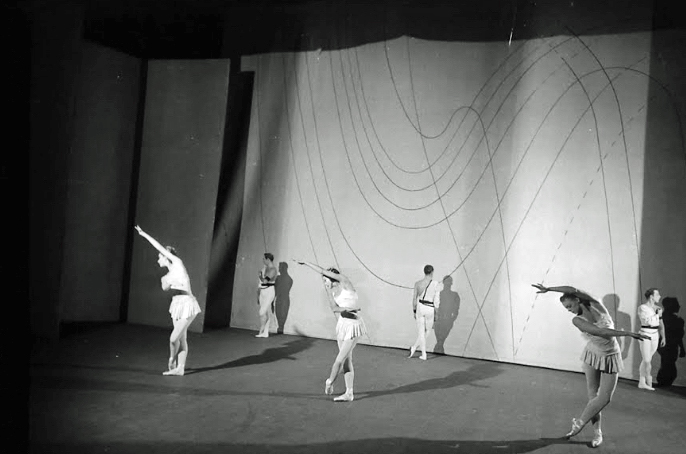
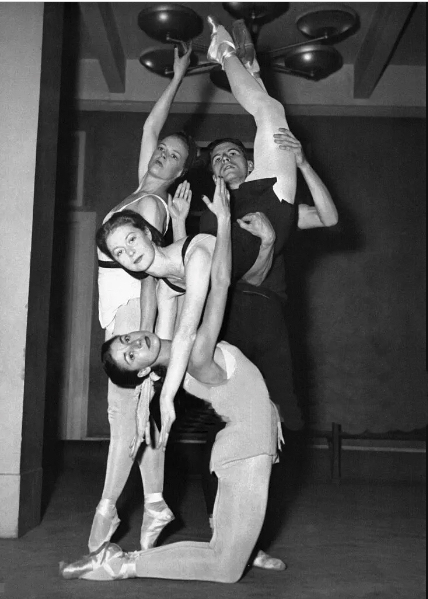
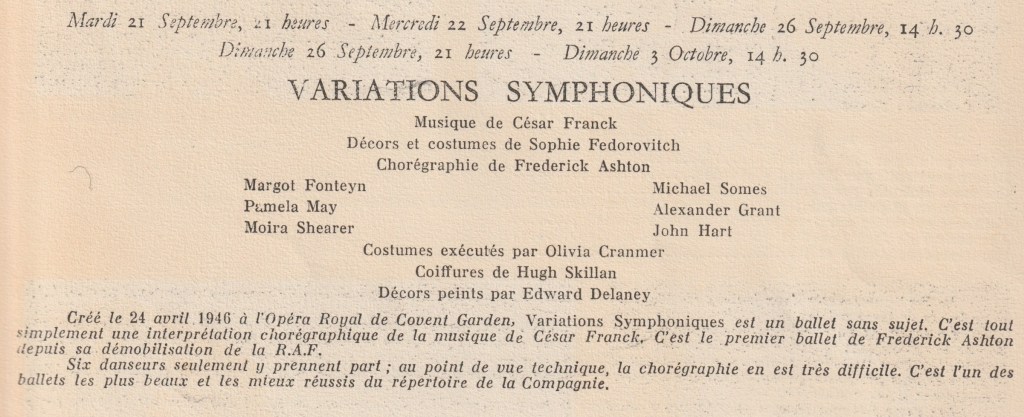
Symphonic Variations was the first ballet created after World War 2 by Ashton. The ballet employs six dancers; three female and three male; for the first and for most of the subsequent performances Margot Fonteyn was the lead ballerina and was supported by Pamela May and Shearer. Michael Somes was Fonteyn’s partner and was supported by Henry Danton and Brian Shaw. An article in Ballet Today in 1946 suggested that the six dancers were chosen for their “musicality”, their ability to interpret Franck’s music, as much for their technical prowess.
In Symphonic Variations the curtain rises to silence, to the six dancers standing motionless, the three ballerinas in front. Fonteyn was at the centre, flanked by Pamela May and Shearer. There were six “variations” some of which were duets while others focused on groups of four or on all the dancers. Fonteyn and Somes danced the more demanding duets. The ballet lasted 17 minutes during which time all the dancers remained on stage.
One of the reviews of the premiere performance was published in the Manchester Guardian on April 26th, 1946. “Last night his ballet was performed brilliantly by Margot Fonteyn, elegantly by Moira Shearer, and very competently by Pamela May and the three male dancers”
The ballet remained in the Sadler’s Wells repertoire for many years. Between 1946 and 1953 Moira Shearer danced in it for a remarkable 70 times. This included performances on tours of the British provinces and in Florence, Paris and the US. Occasionally substituting for Fonteyn, she danced the “lead” at Covent Garden about half a dozen times.
Following her 1952 pregnancy Shearer returned to dance at Covent Garden in February 1953. Her first performance was as the lead in Symphonic Variations.
The magazine, The Sphere, reported on her performance. “On February 7th Moira Shearer returned to the Royal Opera House and made her appearance in Symphonic Variations….. The dancer’s pale alabaster beauty makes her an ideal exponent of this choreography, which exploits in an exalted mood the beauty of movement for its own sake and is as detached from everyday life as pure mathematics. Michael Somes partnered Miss Shearer in masterly fashion, giving a feathery lightness to the lifts that did much to accentuate her wraithlike appearance. There could be no more suitable ballet to provide a vehicle for Miss Shearer’s stylish poise and quietly confident attack”.
Scenes de Ballet, Ashton’s next ballet, premiered at Covent Garden on February 11th, 1948. In the lead roles were Fonteyn and Somes. Ashton had written it for Fonteyn and, according to Royal Opera House Archives she danced in it at the premiere and for a further 11 times, most of them in 1948.
Shearer took over as the lead dancer on February 25th, with Somes as her partner, and Grey danced it on February 26th. In the period that Shearer was at Sadler’s Wells she appeared in Scenes about 20 times. Her fInal appearance was on September 21st, 1951, when John Hart partnered her.
Moira Shearer in Scenes de Ballet, 1948. Photographer not known.
Macaulay writes that Scenes was one of the few ballets where Shearer challenged Fonteyn’s pre-eminence at Sadler’s Wells. Nonetheless, Fonteyn danced at the majority of the first season’s performances while Shearer dominated those in 1949, 1950 and 1951.
The journal, The Stage, for March 16th, 1950, reviewed Shearer’s performance in her March 14th appearance in Scenes. “In her elegant lime green costume, she brought a glamorous sophistication to the brilliant glitter of Ashton’s choreography”.
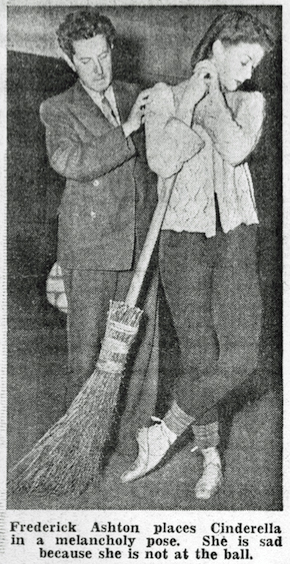
Also in 1948 Ashton created his first full-length ballet, Cinderella. The lead and title role was again created for Margot Fonteyn. However, Fonteyn decided that she did not want to dance the role at every performance thus Ashton and the director of Sadler’s Wells Ballet, Ninette de Valois, decided that Shearer would share the “first cast” with Fonteyn. Typically, Shearer as second cast would have had no first-hand direction from Ashton. Instead, she would have been expected to learn what she needed simply by observing Fonteyn’s rehearsals and performances.
In this unusual case, when rehearsals began in the autumn both Fonteyn and Shearer received Ashton’s direction.
Fred Ashton rehearsing Moira Shearer in Act l of Cinderella. Early November 1948. Photographer unknown.
In late November both Fonteyn and Shearer appeared in the premiere of the ballet, Don Juan, that was choreographed by Robert Helpmann. Toward the end of the final act Fonteyn was injured but managed to complete the performance. However, what she had thought was a slight sprain turned out to be a torn ligament. Fonteyn was taken to hospital, examined and her ankle placed in a cast.
Her injury would require 6 weeks of rest thus Fonteyn was ruled out of the December 23rd premiere of Cinderella. Shearer would dance the lead and Violetta Elvin, the original third cast, was moved up the order to dance as Shearer’s deputy. There were 18 performances up until February 28th , 1949 when Fonteyn returned. Up until this time Shearer and Elvin danced the lead about the same number of times. After Fonteyn’s return Shearer didn’t dance in the ballet for the rest of this initial season.
While each ballerina had her individual strengths in the interpretation of the role, all three ballerinas received positive and, sometimes, rave, reviews from the dance critics. However, the general consensus was that Fonteyns interpretation of the role was the most successful. Ashton maintained that he had created the role for her. While Shearer was successful in her duets with Michael Somes several critics felt that she didn’t display enough pathos in her solo in the kitchen scene in Act I.
When asked about Shearer’s interpretation Ashton described Shearer’s dancing as “brittle” which perhaps implied that it lacked emotional depth. This was a criticism that was repeated often by other critics throughout Shearer’s career.
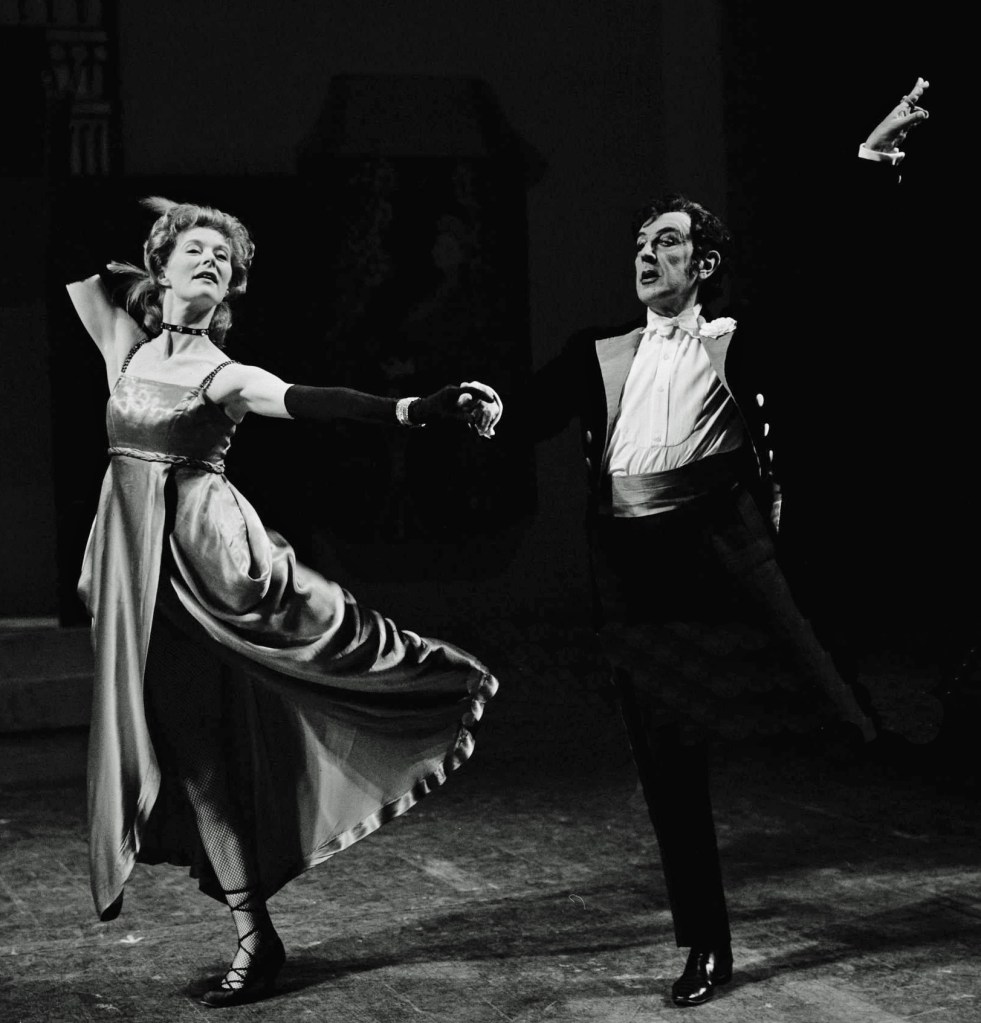
Shearer’s final stage collaboration with Ashton was in his ballet, Façade. Shearer’s first appearance was on October 31st, 1942, when she danced a minor role in the “valse”. Several years later Ashton took advantage of the elegance of her dancing to cast her as the naïve “debutante”, opposite his lascivious “dago” in the tango. They were to repeat this pairing several times, including during both tours of North America by Sadler’s Wells, in 1949 and 1951.
Moira Shearer and Fred Ashton dance the tango in his ballet, Facade, at Covent Garden on December 17th, 1967. Photographer not known.
Ashton and Shearer also gave charity performances of the tango, the first at The Opera Ball on March 22nd, 1950, in Stanhope Gate in London and subsequently in 1967 on December 17th, at The Friends of Covent Garden Ball. In the first case they had danced the role several times during that spring season. In the second, however, both came out of retirement. Ashton was 63 years old and Shearer a slim and youthful 41. She remarked after their brief rehearsal that even after 16 years that she remembered the steps but admitted that she lacked the stamina.
Sources.
John Amis, Notes on Covent Garden, Tempo, number 10, Winter 1948-49.
Ballet Today, July 1946. Edited by P.W. Manchester.
Dale Harris, transcript of an interview of Moira Shearer in Edinburgh, August 29th, 1976, and September 1st, 1978. New York City Library Archives, Lincoln Plaza, NYC.
“Ballet makes unceasing and exhausting demands on its votives…..a dancer often spends the whole day in the theatre and is never free from rehearsals, the daily classes and special classes, photo calls and dress fittings”.
Peter Craig Raymond, Ballet Today, December 1954.
Moira Shearer leaves her parent’s flat in west London and heads off for work at Covent Garden. Circa 1946. Photo by Gordon Anthony.
With the exception of the month-long summer holiday, Sundays and designated days off, and even on the days she was not dancing Shearer went to work at the Royal Opera House in Covent Garden. Depending on daily schedules she would have been expected to be there at sometime between 9 and 10 a.m. Classes or practice lasted until around 11.30 a.m. followed by short break; rehearsals began at noon and lasted until 2 or 3 p.m. Thus class, practice, rehearsals or dress rehearsals might require up to 6 hours in total. Matinees were usually staged at 2 p.m. so, in this case, the time for practice and rehearsal was limited to a couple of hours.
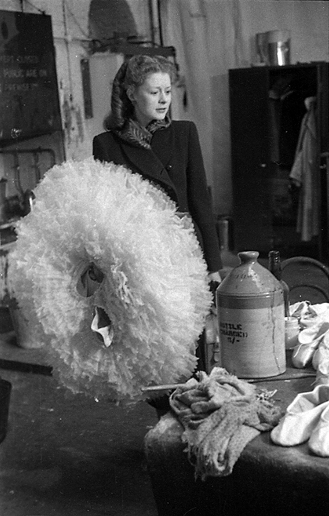
Shearer on her way to the wardrobe department at Covent Garden for adjustments to her tutu. Circa 1948. Photo by Louis Klemantaski.
Also on the schedule were fittings, repairs or adjustments to costumes and the occasional interview or photo shoot. As dancers rarely met with the ballet mistress or master, schedules and casting were posted on a bulletin board that had to be consulted daily. Assignments for the following day were often not known until after an evening’s performances. A dancer’s schedule might change suddenly if another dancer was ill or injured and had to be replaced.
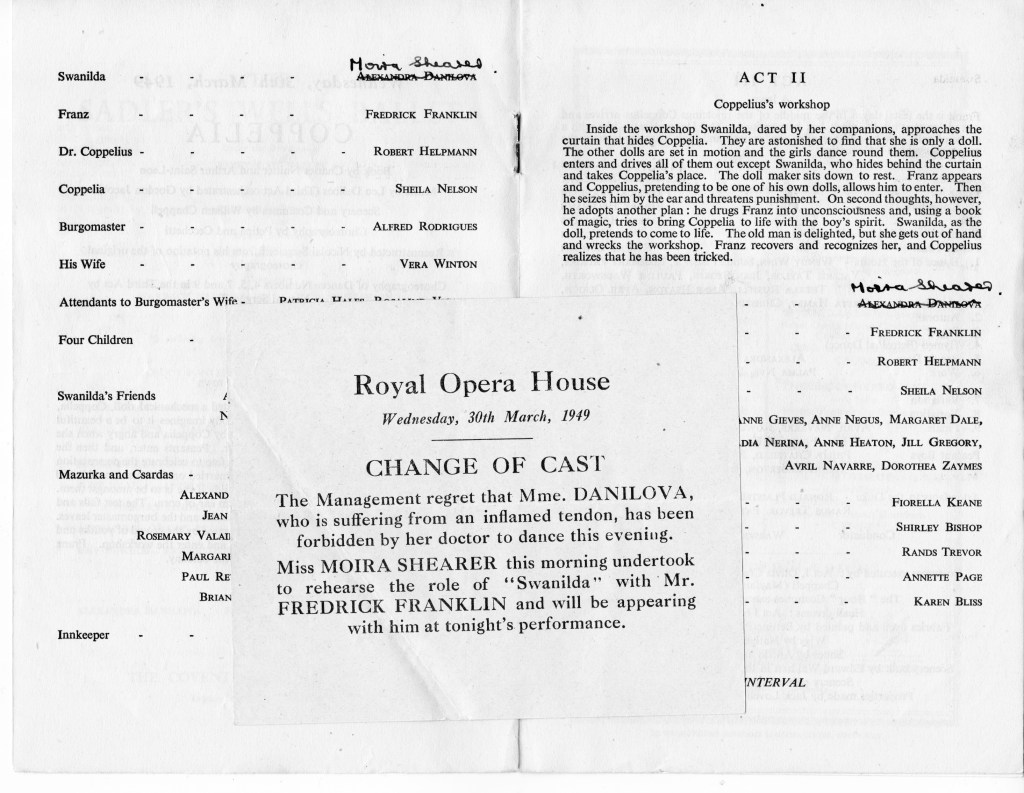
In Shearer’s case the most notable example of this was in 1949 when she was selected to replace Alexandra Danilova as Swanhilda in Coppelia. Danilova and Leonide Massine were dancing with the Sadler’s Wells Ballet for the spring season. Danilova was due to dance as Swanhilda on March 30th but inflamed her tendon in practice and Shearer was chosen to step in at very short notice, so short, in fact that, according to the popular press, she and her partner, Frederick Franklin were still practicing up until the time the curtain went up. The role was, of course, familiar to Shearer, although she hadn’t danced it many times and not for the preceding six months.
The Sadler’s Wells Ballet programme for March 30th, 1949, noting Alexandra Danilova’s injury and her replacement by Moira Shearer.
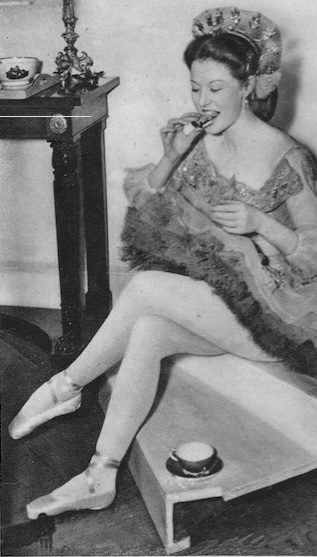
There was rarely time for lunch so dancers grabbed a bite whenever they had a spare moment. On nights when that they were dancing they might not eat anything for a number of hours beforehand. Dinner would have to wait until after a performance. Thus, Shearer would often eat at home.
Shearer in her costume as Aurora in Sleeping Beauty grabs a bite and a “cuppa”. Circa 1946. Photograph by Gordon Anthony.
According on the ballets scheduled, evening performances usually began at 6.45 or at 7.30 pm and might last for 2 to 2 1/2 hours.
Preparations for a performance, dressing and make-up might require an hour. Once the performance was complete and the dancer had left the stage, costumes were carefully shed and stored in the dressing room and makeup was removed. Then it was a matter of getting past the autograph hunters at the stage door.
On nights she was dancing she would be lucky to begin her journey home by 10 p.m. Thus, it was a 13 hour day when she was dancing and 10 when she was not.
Until Ludovic Kennedy came into her life in 1949 and offered her a ride home, Shearer would have had to rely on a London bus or the underground.
Sources.
Alan Ivimey, “Ballet Dancer” The Children’s Newspaper, Dec 9th, 1950.
Peter Craig Raymond, Ballet Today, Dec 1954, “The Career of Moira Shearer”.
John Speed, Background to Ballet, circa 1950. Photos by Louis Klemantaski.
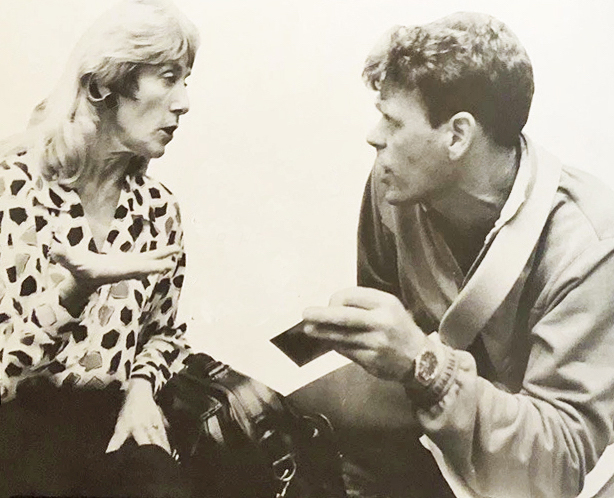
In 1987 BBC Northwest hired Gillian Lynne to choreograph and direct a ballet based on the life of the Salford-born painter L. S. Lowry. The ballet or, as Lynne preferred to call it, “dance drama”, was to be performed by the Northern Ballet, based in Manchester and directed by the former Royal Ballet dancer Christopher Gable. He would portray Lowry. The music was composed by Carl Davis. The BBC would record and air the performance before the company went on tour with the ballet.
Gillian Lynne and Christopher discuss “A Simple Man” in 1987. Photographer unknown.
Lynne wanted Moira Shearer to dance the role of Lowry’s mother, Elizabeth, and approached her with the proposal. Shearer initially resisted. She had not danced since 1967 when she and Fred Ashton appeared in Façade dancing the tango together. This was a single appearance at a Christmas show at Covent Garden after which Shearer returned to her family life. At the time of Lynne’s proposal, she was an “empty nester” living in Avebury with her husband, Ludovic Kennedy, and preoccupied with writing.
Despite her misgivings Shearer agreed to travel to Manchester for a filmed test. Lynne, who was an old friend, eventually persuaded Shearer to take the part. However, Shearer stipulated that she would only participate in the performance before the cameras and would not go on tour with the company. Thus, Gable asked Lynn Seymour to step into Shearer’s shoes on the road.
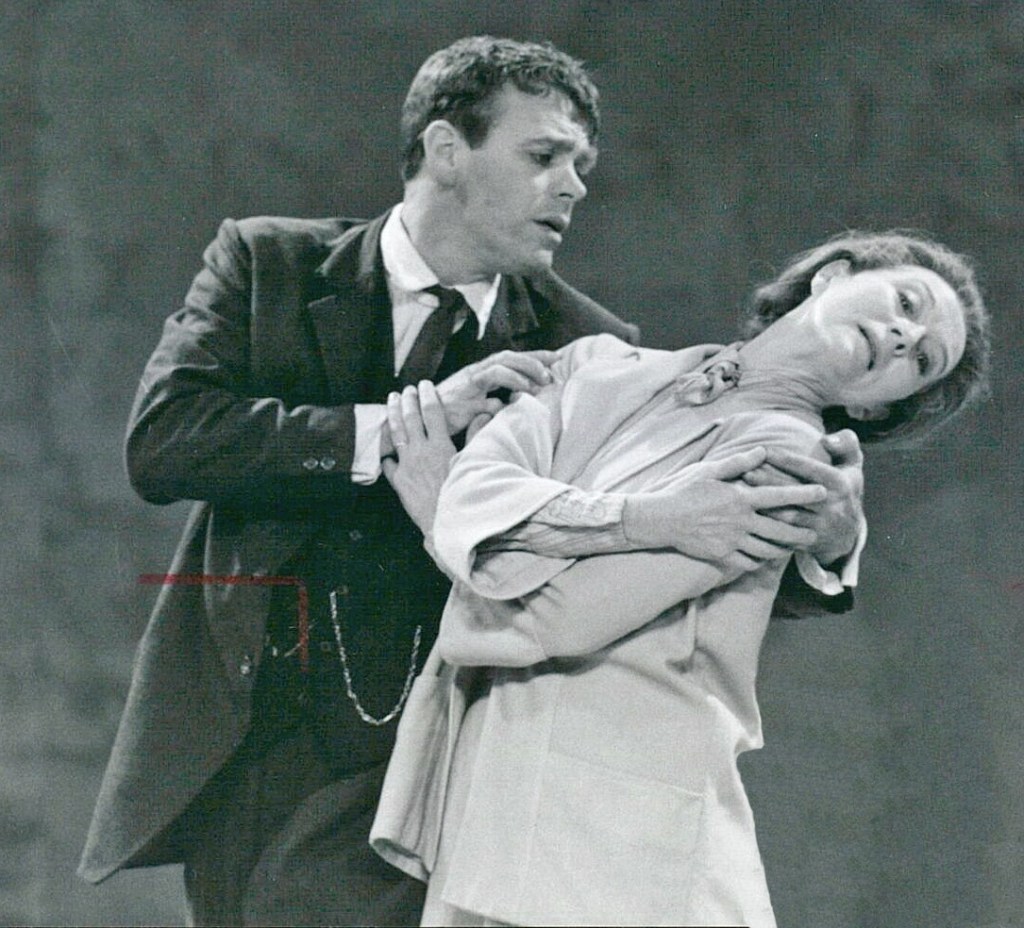
Rehearsals began in June 1987 and filming, which took place in November 1987, required 8 days. There is no record of when or how long Shearer spent in rehearsals or before the camera. The finished product, made up of 8 scenes, was about 40 minutes long. Shearer danced in 3 scenes and was on stage for probably around 10 minutes. Lynne’s direction explored the mother’s complex and controlling relationship with Lowry. In her final scene his mother dies in Lowry’s presence and we witness his profound anguish.
Christopher Gable as Lowry and Moira Shearer as his mother. Neither date nor photographer known.
Shearer had few opportunities to actually dance – just some fleeting solos and duets with Gable – but considerably more opportunity to use her miming skills. As the review in The Stage suggests, her portrayal of the mother’s “disapproving face and her principled, evangelical bearing tells us why” Lowry was so repressed.
As was typical of her, Shearer denigrated her performance, calling it an exercise in “geriatric movement”.
Perhaps because the ballet was produced initially for broadcast there seems to have been very limited contemporaneous critical review of the performance. However, in their evaluation of the DVD that was subsequently produced, a number of critics praised it, one writing to say that it was a “pleasure to see Shearer perform again in a fittingly impressive part”. Another wrote of the “gloriously moving performances from Gable and Shearer”.
During her tenure at the Sadler’s Wells Ballet Moira Shearer was partnered by numerous male dancers. These included Robert Helpmann and Michael Somes. However, as they were primarily matched with the prima ballerina, Margot Fonteyn, Shearer, as the second cast, was usually partnered by other dancers. Chief among them were Alexis Rassine, David Paltenghi and John Hart. These partnerships are explored below.
Alexis Rassine
In her 1978 interview with Dale Harris Moira Shearer recalls the first night at New York’s Metropolitan Opera House at the start of the first North American tour by the Sadler’s Wells Ballet in 1949. She remembers the night well because of her horror at having to dance in the Bluebirds suite in Sleeping Beauty, a role, she said, that she had not danced before.
In fact, this was not the case. She had danced it four times in the season of “rehearsals” for the American tour that was staged at Covent Garden from August 8th to 13th.
Shearer’s uncharacteristic lapse of memory probably resulted from a number of factors. First, although it obviously still irked her, it occured almost 30 years earlier. Second, she was extraordinarily busy for the week of August 8th, 1949. She danced in Sleeping Beauty either as a bluebird or in the lead role, as Aurora, every day. Then on August 16th she announced her engagement to Ludovic Kennedy.
In October 1949 at the premiere of Sleeping Beauty in New York she would have been forced to wait until Act 3 before she took the stage. She was always nervous before a performance and, having to wait that long, while she could hear the audience’s rapturous reception of Fonteyn’s dancing, would have undoubtedly heightened her anxiety.
At the time she was Sadler’s Well’s second ranked ballerina behind Fonteyn, a status that she both merited and fully accepted. Ninette de Valois, the director of the company had a strict policy that Fonteyn always dance the first night of a season or tour. Shearer or, occasionally, as, for example, in the case of Sleeping Beauty, Beryl Grey would dance on the 2nd night.
Thus, why was Shearer thrust into the first night lineup as a Bluebird? The answer is probably because Sol Hurok, the American promoter of the 1949 tour had asked de Valois to “load” the first night cast. Thus, for example, Violetta Elvin danced as the Fairy of the Crystal Fountain and Grey as the Lilac Fairy. From Hurok’s point of view, it was imperative that Shearer was included because, as a result of her success in the film, The Red Shoes, she was “box office” in the US.
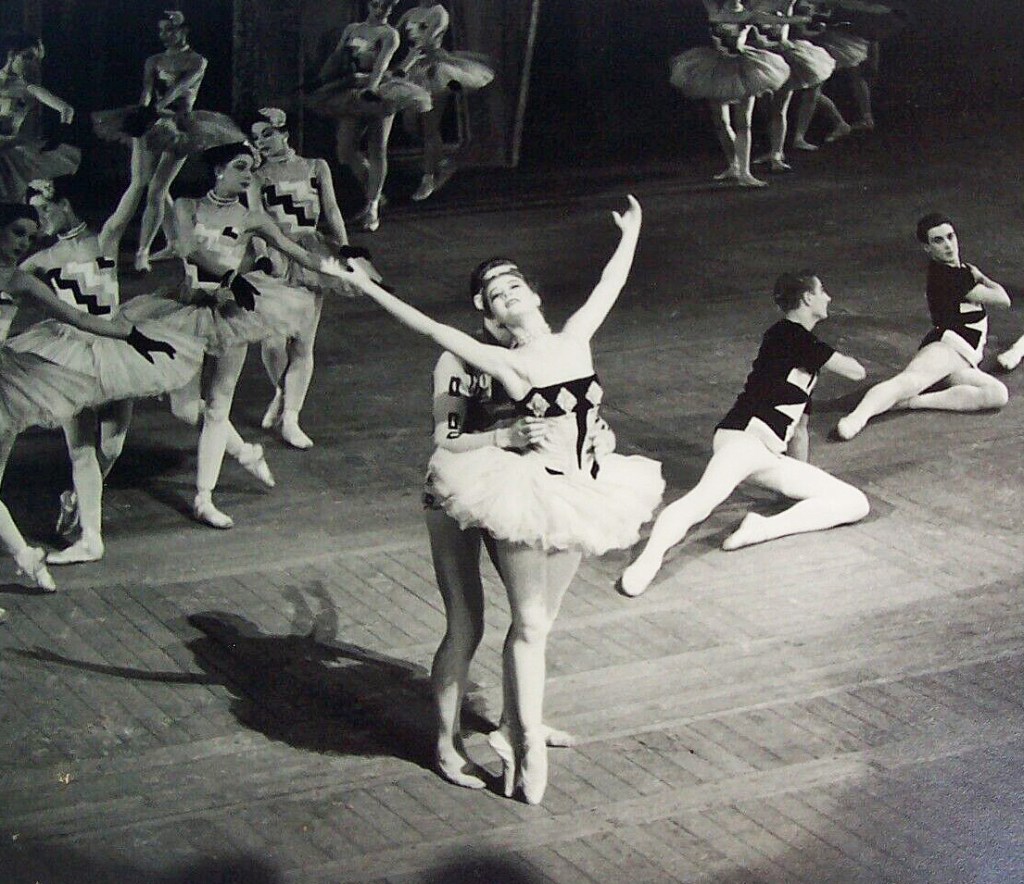
The other Bluebird, Shearer’s partner, was Alexis Rassine. He was another reason for Shearer’s concern. As the photo of them dancing together in the ballet, Promenade, shows, he was of slight build and little taller than Shearer. In her interview with Harris she said of him that, while she enjoyed dancing with him, he did not inspire confidence in a ballet that required big lifts. Nonetheless he was an experienced and sensitive dancer and had partnered Margot Fonteyn in Spectre de la Rose, Carnaval and Giselle. During World War 2, when many British male dancers were serving in the armed forces, Rassine was often called upon by de Valois. Shearer first danced with him in 1942 in The Birds. In 1944 she partnered him in Spectre when she took over from Fonteyn the role of the young girl. Subsequently she danced with him in Les Sylphides and in Coppelia in which he was Franz to her Swanhilda.
Moira Shearer and Alexis Rassine dancing a duet in the ballet Promenade circa 1943. Photo by Gordon Anthony.
Shearer and Rassine’s Bluebird, understandably, because it was almost always danced in the shadows of Fonteyn’s Aurora, didn’t get much contemporaneous press and what little was published, was, at best, lukewarm. For example, in Chicago in November 1949, Shearer, according to the dance critic for the Chicago Tribune, didn’t “have her heart in it” and Rassine was dismissed with faint praise as “a reasonably competent partner”. A Canadian critic concluded that, based on the October 1949 performances that he saw in New York, Rassine was a fine “soloist” but not a strong partner. This criticism seems to echo the consensus of a number of critics on Rassine’s abilities throughout his career.
After World War 2, with a return to the company of more powerful dancers like Michael Somes and John Hart, Rassine was increasingly consigned to less demanding roles and to appearances on the road. Thus, for example, on the second North American tour in 1950-51, in San Francisco and at Purdue University, he partnered Shearer as Albrecht in Giselle and, in 1951, was Siegfried to her Odette/Odile in a performance of Swan Lake in Blackpool.
Oher ballets in which Shearer and Rassine danced together included Rendezvous, in 1943, Spectre de la Rose, in 1944, and in Carnaval.
David Paltenghi
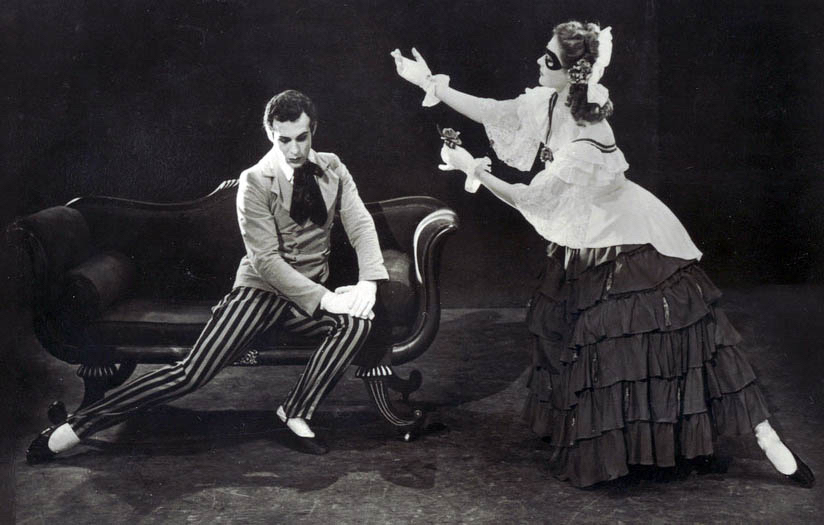
David Paltenghi was exempt from military service in World War 2. Therefore, like Rassine, he was much in demand at Sadler’s Wells during the war but less so after it. Between 1942 and 1945 he partnered Shearer several times in a pas de deux in Les Patineurs and danced the role of Eusebias to her Chiarina in Carnaval in which he is downhearted until he meets her, but she merely dallies with him, offering him a flower and then running away to hide.
Moira Shearer as Chiarina and David Paltenghi as Eusebias in the ballet, Carnaval, circa 1945. Photo by Edward Mandinian.
In 1946 Paltenghi was Siegfried to Shearer’s Odette in Lac and in 1947 he once danced as Florimund to Shearer’s Aurora in Sleeping Beauty. As this seems to have been the only occasion they danced together in Sleeping Beauty, he was perhaps substituting for John Hart, Shearer’s perennial partner.
Shearer considered Paltenghi to be a good partner but not a good dancer. In her 1976 interview with Dale Harris, she commented that she thought he’d taken up dancing too late in life. Other critics said he was weak technically. In Swan Lake he partnered Grey more frequently than Shearer. As he was tall, he was, in this respect, a good match for Grey.
As Paltenghi does not appear in programmes after his appearance in Adam Zero on February 18th, 1948, he appears to have left Sadler’s Wells around that time.
John Hart
In her interview with Dale Harris Shearer indicated that she partnered with John Hart many times and, because he was, what she described as “rock solid”, she enjoyed dancing with him. Their association at Sadler’s Wells Ballet extended from 1946 to 1951. As he was already an established member of the company when Shearer joined it in 1942, they might have partnered each other for even longer, however during World War 2 he served in the Royal Air Force.
Their first recorded partnership was on October 30th, 1946, when they appeared together in Symphonic Variations. On this occasion Hart replaced Shearer’s earlier partner, Henry Danton, who had left Sadler’s Wells to study in Paris.
Once she had recovered from a tendon injury Margot Fonteyn returned to the title role in Ashton’s ballet, Cinderella, on February 28th, 1949. Until that time Shearer had danced as Cinderella with Michael Somes as her Prince. On Fonteyn’s return Somes partnered Fonteyn and continued to do so when the ballet was staged again in April 1949. Shearer then became the second cast and John Hart took the role of the Prince.
There were numerous occasions where Shearer and Hart danced in the same ballet at the same performance but did not partner each other. This was the case, for example, for Tricorne where Shearer danced in the Jota, usually with Massine and Grey, while Hart danced as the Governor.
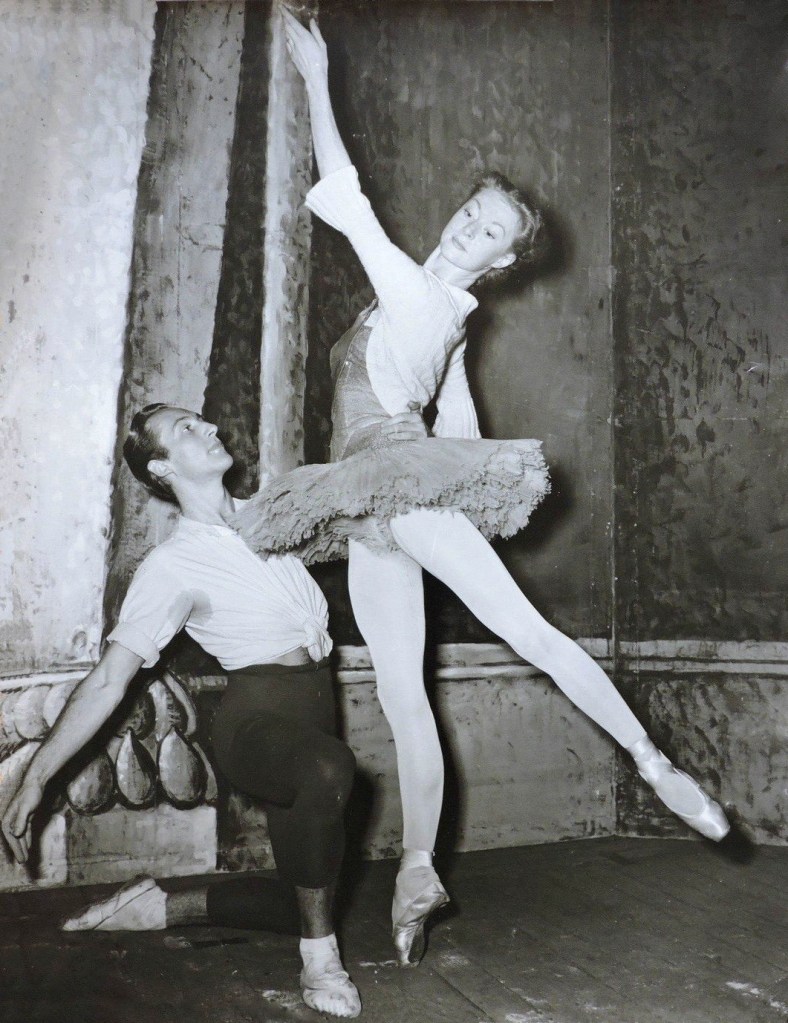
Moira Shearer and John Hart at practice. Date and photographer unknown.
Programmes and Royal Opera House archive records indicate that Shearer and Hart danced together at least 60 times between 1946 and 1951. They were most often partnered in Symphonic Variations but also in Sleeping Beauty, where Shearer danced as Aurora and Hart was Florimund, in Scenes de Ballet, Swan Lake and in Mamzelle Angot. In Ashton’s ballet, The Wedding Bouquet, in which Shearer took the role of the jilted Julia and Hart was the bridegroom, they danced a duet.
Sources.
Moira Shearer interviewed by Dale Harris in Edinburgh, August 29th,1976 and September 1st,1978. Transcript of an audiotape held at the New York City Library, Lincoln Centre.
Royal Opera House archives, Covent Garden, London.
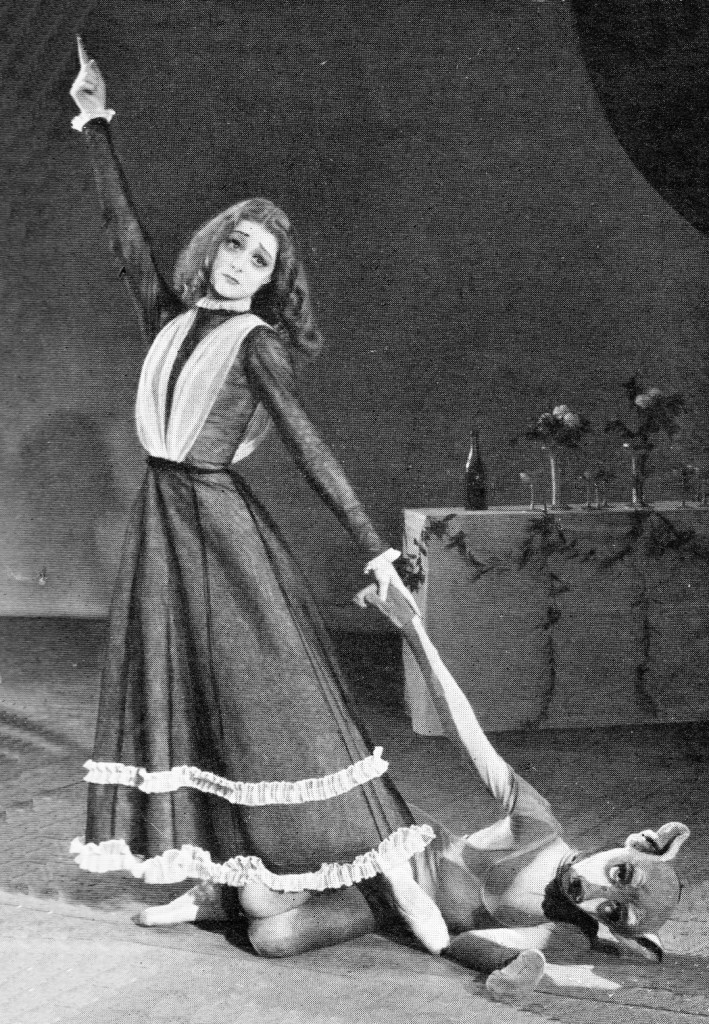
In the late 1930s Fred Ashton choreographed The Wedding Bouquet based on a play by Gertrude Stein with music by Lord Berners. The ballet was, in fact, the result of a collaboration between Ashton, Berners and Constant Lambert, musical director of the Vic-Wells Ballet.
The plot of the ballet concerns a wedding reception at a French country house around 1900. Various intrigues, focused on the bridegroom’s numerous infidelities, play out during the ballet as his former lovers comprise many of the guests. Chief among these is the “forlorn” Julia.
Margot Fonteyn portrays Julia in the 1943 production of The Wedding Bouquet.
It was first performed at the Sadler’s Wells Theatre by the Vic-Wells on April 27th, 1937 with the 18-year-old Margot Fonteyn dancing the role of Julia. Ninette de Valois, director of the Vic-Wells and a former dancer, was cast as Webster, the organizer of the wedding, and Robert Helpmann was cast as the bridegroom. There appears to be no critical record of this performance. However there is a wonderful amateur film of a rehearsal where all three principals appear.
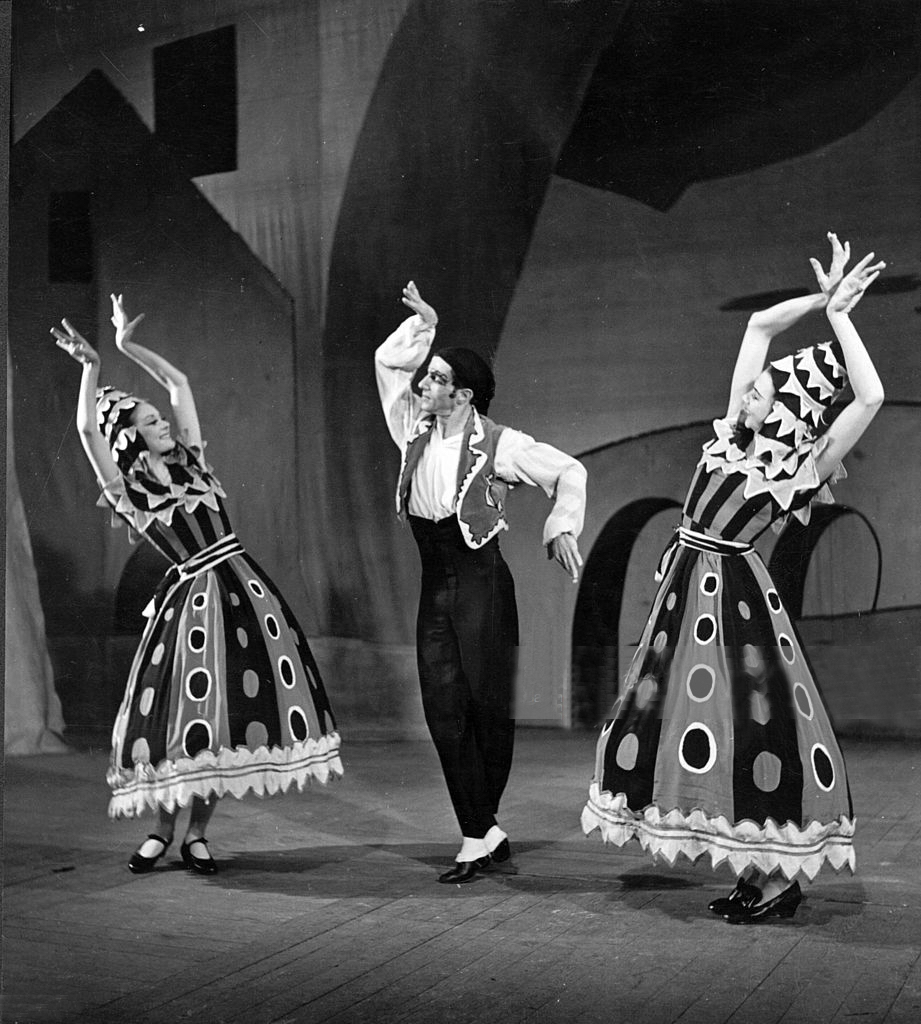
On the June 14th 1943, the Sadler’s Wells Ballet mounted a revival of the ballet at The New Theatre in London’s West End. Palma Nye took replaced de Valois as Webster but Fonteyn and Helpmann retained their roles. Moira Shearer, in her second year at Sadler’s Wells, danced as one of the guests. The performance did not seem to generate much press. The August 25th edition of the magazine, The Tatler, ran a very brief byline to a series of photos of Fonteyn, Helpmann, Margaret Dale (as the bride) and Alexis Rassine. However, it commented favourably on the range of Ashton’s choreographic talents.
When the ballet was again performed at the Royal Opera House, Covent Garden on February 17th, in 1949 Helpmann once again played the bridegroom but Shearer replaced Fonteyn as Julia. She danced the role several times over the following weeks and months.
Once again, the ballet generated very little contemporaneous comment or criticism in the British press. The correspondent in the February 18th Daily Express panned it, saying that the performance that he saw fell well short of the “charm and the humour of the original 1937 version, this despite the brilliance of Robert Helpmann and Moira Shearer”. On the other hand, the February issue of the specialist magazine, The Dancing Times, saw much to be admired in it and considered the performance to be a success. It commented that “each character appears as painted in Gertrude Stein’s words” and that “the ruined Julia (is) beautifully played by Moira Shearer”.
As far as Shearer’s performance is concerned the most positive reaction came in the publication, The Stage, in February 1949. “So ideally cast is Moira Shearer in the revival of this humorous Lord Berners ballet that one could almost imagine that it had been written round her forlorn red tresses, as she danced the distraught tragedy queen at the French provincial wedding”. For once Shearer’s colouring was seen to act in her favour. Shearer garnered other good reviews. “JHM”, the dance critic for the Manchester Guardian, while giving the ballet itself lukewarm praise, felt that “the company …. certainly played it for all it was worth; the lovely Moira Shearer, for instance, bravely disguised herself as a kind of Pre-Raphaelite caricuture …. and … (the company) did all the bright, satiric things that the Ashton-Stein-Berners combination had devised for them”. The correspondent for the Birmingham Post was similarly upbeat, calling the revival “triumphant” and singling out Shearer’s performance. He wrote, “it was Moira Shearer’s Julia that made the deepest – and ….. the most lasting impression”.
Other critics viewing the same 1949 production were less generous. Caryl Brahms, the dance critic for the London newspaper, The Evening Standard” under the headline, “The Wit was Lost”, panned the production and felt that, compared to Fonteyn’s 1937 interpretation, “Moira Shearer made too faint an inprint on the role” of Julia.
The Wedding Bouquet was part of the repertoire during both the 1949 and the 1950-51 Sadler’s Wells Ballet tours of the US and Canada. Shearer danced the role of Julia and Helpmann of the bridegroom at the Metropolitan Opera House in New York on September 21st and 23rd, 1949. During the 1950-51 tour both Helpmann and John Hart danced the role of the bridegroom. On October 27th, 1950, in Los Angeles, Helpmann took the role while on November 29th in Memphis and on January 2nd, 1951, in Winnipeg, Hart assumed it. This Winnipeg performance appears to be the last time that Shearer danced as Julia.
Sol Hurok, the American entrepreneur who was instrumental in bringing the Sadler’s Wells Ballet to North America, writes in his memoirs a paean to Moira Shearer. He describes her as “cultured and highly intelligent”, “intensely musical both in life and in the dance”, a talent particularly evident in her performances in Swan Lake and in Ashton’s ballet, Façade. He concludes by saying “she is well-nigh indispensable to Wedding Bouquet”.
There is a single set for Wedding Bouquet that features a backdrop of a French provincial house and grounds and two tables filled with champagne bottles and glasses. For much of the ballet the stage is filled with wedding guests dancing together. At other times the bride and groom are featured with and without guests. However, the central character is the distraught Julia who is shown, at one point and, much to his horror, clutching the groom’s leg and later pursuing him in a wild dance across the stage. In the final scene all the guests and the bride and groom have departed and Julia is left alone in the centre of the stage seeking solace in her dog, Pepe.
Moira Shearer as Julia in the 1949 production of The Wedding Bouquet. Her dog Pepe is played by Annette Page.
Notes.
The ballet is about 30 minutes long.
Sources.
Birmingham Post, “Ballet Revival at Sadler’s Wells, A Wedding Bouquet”, February 18th, 1949.
Caryl Brahms, Evening Standard, February 18th, 1949.
Daily Express, February 18th, 1949. “Covent Garden Wake up!”
Sol Hurok, S. Hurok Presents, Memoir of the Dance World, 2022, 2025.
Manchester Guardian (JHM), February 19th, 1949, “Ballet at Covent Garden”.
The Dancing Times, February, 1949
The Stage, February 24th, 1949. “A Wedding Bouquet”.
The Tatler, August 25th, 1943. “A Wedding Bouquet”.
Symphonic Variations was the first ballet created after World War 2 by the choreographer, Frederick Aston. Its genesis was Cesar Franck’s concerto of the same name. Ashton had listened to the music a number of times during the war and decided to produce a ballet based on it.
The dance critic, Stephen Williams, writing in the journal, The Stage, of the success of the ballet’s premiere wrote, “Symphonic Variations is pure ballet – Franck’s …. “Concerto” expressed in terms of absolute dancing. There is no “story”, no drama, no characterisation”. He goes on to describe it as, “a shaping of the visions and the movements which the music evokes in the mind”.
The premiere was on April 24th 1946 at Covent Garden; it was originally planned for March but the lead male dancer, Michael Somes, had injured his knee earlier in the season and thus it was postponed
The ballet employs six dancers; three female and three male; for the first performance Margot Fonteyn was the lead ballerina and was supported by Pamela May and Moira Shearer. Somes was supported by Henry Danton and Brian Shaw. An article in Ballet Today suggested that the six dancers were chosen for their “musicality”, their ability to interpret Franck’s music as much for their technical prowess.
There was no orchestra; the music was played on the piano by Angus Morrison.
The ballet lasted 17 minutes during which time all the dancers remained on stage although sometimes were motionless. Margaret Dale, another Sadler’s Wells ballerina, later commented that, though the ballet is brief, the demands of the choreography on the dancers are exhausting.
The curtain rises to silence, to the six dancers standing motionless, the three ballerinas in front. Fonteyn was at the centre, flanked by May and Shearer. There were six “variations” some of which were duets while others focused on groups of four or on all the dancers. There is no visual record of the premiere but film footage of a rehearsal gives some sense of the elements of the performance.
Rehearsal of Symphonic Variations at the Metropolitan Opera House, New York City, October 1949. Photo by Gjon Mili.
One of the initial reviews was published in the Manchester Guardian on April 26th 1946.
The writer is not identified by was probably the dance critic, P.W. Manchester.
“Only a very musical or a very unmusical choreographer would make a ballet to Cesar Franck’s Symphonic Variations ….. Frederick Ashton has done this dangerous thing. His ballet, bluntly called Symphonic Variations was performed by the Sadler’s Wells Ballet Company last night at Covent Garden. Happily, no choreographer, except perhaps Balanchine, is more musical than he.
As with the title, so with the ballet itself: it is a straight issue between composer and choreographer. Sophie Fedorovitch’s backcloth is a terse abstraction; her costumes are plain and functional; there is no story and there are only 6 dancers, who remain on the stage throughout. They either dance or stand still; they do not mime at all. But the ballet is no mere string of divertissements. It is, on the contrary, tightly woven. It is a classical ballet in a true but not quite orthodox use of the term. Mr. Ashton, in fact, set himself a musical problem and has sought no adventitious aid in trying to solve it. That is rare, brave and stimulating.
There are 6 variations …… he has not at all kept the music’s pattern. He has made his own pattern, and kept …. the music’s sense of a single flowing series.
Last night his ballet was performed brilliantly by Margot Fonteyn, elegantly by Moira Shearer, and very competently by Pamela May and the 3 male dancers. The result was almost entirely successful. The reason for the “almost” is – the piano. In these variations the piano is the soloist, the star, the ballerina …. Mr. Ashton’s pattern does not quite account for this soloist”.
The ballet was very well received and remained in the Sadler’s Wells repertoire for many years. Between 1946 and 1953 Moira Shearer danced in it for a remarkable 70 times. This included performances on tours of the British provinces and in Florence, Paris and the US. Occasionally substituting for Fonteyn she danced the “lead” at Covent Garden about half a dozen times.
Rehearsal of Symphonic Variations in Paris, September 28th, 1948. Michael Somes lifts Moira Shearer. Margot Fonteyn kneels in the foreground and Pamela May is a pointe. Unknown photographer.
Programme for performances of Symphonic Variations at the Theatre des Champs Elysees, Paris in September and October 1948.
Due to her 1952 pregnancy Shearer was long absent from Covent Garden. On her return in 1953 she first danced the lead in Symphonic Variations.
The Sphere for February 12th, reported on her performance under the headline,
“Covent Garden, Shearer’s Return”.
“On February 7th Moira Shearer returned to the Royal Opera House after an absence of 18 months….Miss Shearer …. made her appearance in Symphonic Variations, Frederick Ashton’s masterly abstract comment on Cesar Franck’s music. The dancer’s pale alabaster beauty makes her an ideal exponent of this choreography, which exploits in an exalted mood the beauty of movement for its own sake and is as detached from everyday life as pure mathematics. Michael Somes partnered Miss Shearer in masterly fashion, giving a feathery lightness to the lifts that did much to accentuate her wraithlike appearance. There could be no more suitable ballet to provide a vehicle for Miss Shearer’s stylish poise and quietly confident attack”.
The New York Times reported of this same performance that it was greeted by rapturous applause and that Shearer took 7 curtain calls. This over-the-top response must have been both unusual for a British audience at that time and embarrassing to Shearer. While she was dancing the central role there were no great solos, no touching duets with Somes and, thus, no reason to draw attention to her. But, if we are to take the review at face value, it is evidence of how the London ballet public had missed her. It was obviously a special occasion.
A few weeks later Shearer injured her tendon while she was rehearsing for Giselle and left the Sadler’s Wells Ballet after a career spanning 11 years.
Notes.
Angus Morrison was the pianist throughout 1946 and 1947. He was replaced subsequently by Jean Gilbert. Gilbert had joined Sadler’s Wells Ballet in 1944 and played both in rehearsals and performances. She toured with the company in the US and Canada in 1951.
Shearer, in her interview with Dale Harris in 1978 makes scant reference to Symphonic Variations but stresses the need for “musicality” in the dancers.
The four other dancers for the February 1953 performance were Nadia Nerina, partnered by Brian Shaw and Rosemary Lindsay partnered by John Hart.
Sources.
Ballet Today, July 1946. Editor P. W. Manchester.
The Manchester Guardian, April 26th, 1946, Ballet at Covent Garden.
The New York Times, February 8th, 1953. Moira Shearer Scores.
The Sphere, February 12th, 1953. Shearer’s Return.
David Vaughan, transcript of an interview with Margaret Dale, January 1975. New York Public Library, Lincoln Plaza, New York City.
Stephen Williams, The Stage, May 2nd, 1946, Covent Garden, “Symphonic Variations”.
Ninette de Valois and Moira Shearer rarely seemed to see eye to eye. Their differences as to how Shearer should dance began almost from the moment she joined the Vic Wells school in 1940. Under Nicholas Legat Shearer had been trained in the so-called “Russian” style while de Valois taught the “Italian” style that had been developed by Cecchetti, with whom she trained. Shearer also bridled at the regimented way in which the dancers were instructed at Sadler’s Wells Ballet under Nicholas Sergeyev, Ursula Moreton, another Cecchetti student, and de Valois herself.
In her first few years at Sadler’s Wells Shearer apparently conformed as best she could. However, once her confidence and status grew, she began to increasingly assert her “style” on her dancing. Shearer believed that de Valois was well aware of this and thus, she, as the perceived outsider, became even more so. Almost inevitably de Valois tended to sideline her in favour of other more compliant dancers. Beryl Grey saw herself as one of the “good girls”. Shearer knew she was one of the “bad”. To her it didn’t matter. She continued to strive for excellence irrespective as to how others judged her.
Much of the following account is derived from Shearer’s interviews with the American dance historian, Dale Harris. The interviews were conducted in 1976 and 1978 fully 25 years after Shearer quit the ballet. Thus, her recall of events may not be perfect. However, her evaluation of the participants is probably unchanged from the years when she was still dancing.
Shearer’s association with de Valois actually began on a very optimistic note. At some point soon after the start of World War 2, in September 1939, when Shearer had moved from London to Scotland with her parents, Fred Ashton, one of the Sadler’s Wells choreographers, met with Shearer and her mother and recommended that Shearer return to London to enrol in the Vic Wells Ballet School. As this time during the so-called “phony war” the school remained open.
Shearer joined the Vic Wells probably in early 1940 but according to her she was there for only 6 weeks. It was during this time that de Valois saw her for the first time and commented, Shearer later remembered, on what she thought to be her “weak” ankles. Shearer also remarked that it was at the Vic Wells “that … I first sampled those (British) dancing classes”.
When the Blitz began in the autumn of 1940, Shearer once again returned to Scotland with her mother. While there, Mona Inglesby, founder and director of the International Ballet asked Shearer to join her newly formed company.
Shearer recalled that “Inglesby had been a pupil at Legat and had seen me there…. I was up in Scotland clicking (kicking) my heels …. Then this letter came. I was supposedly fully trained; I had 5 years of training but, goodness, you begin to learn when you join a company … but I was adequately equipped technically”.
The premiere International Ballet season began in Glasgow in March 1941. Shearer was present from the start and remained with the company for a full year. It was a baptism of fire. She danced almost every performance often in multiple roles. However, as the most junior member almost all of her roles were minor.
During 1941, while Shearer was dancing with the International Ballet, de Valois wrote to her mother to offer her daughter a place in the Sadler’s Wells Ballet for the 1942 season that began in March. Thus, Shearer completed her year at the International Ballet and in the early part of 1942 the King family returned to live in London. The Sadler’s Wells season began at their new home, the New Theatre, in London’s West End, in March. It is probable that Shearer joined the company at that date although she recalls that she had to spend 2 weeks at the Vic Wells school under the tutelage of Sergeyev. Subsequently, it is likely that she participated in several weeks of rehearsals and practice before appearing on stage.
Shearer recalls that in the autumn of 1942, “I did the Gods Go a-Begging which was a ballet by de Valois. That was important … as it was the principal solo part. I don’t know why de Valois gave this to me or whether it was unusual. Beryl (Grey) certainly did the same kind of thing but she was very exceptional, and she had been trained entirely in the (Vic Wells) school. De Valois was, I think, training her up for a particular position in the company”.
A programme for November 24th, 1942 at the New Theatre when Shearer made her first “solo” appearance as a serving maid in Ninette de Valois’ ballet, The Gods Go a-Begging.
Starting on October 21st, Grey, Julia Farron and Shearer alternated the role of the serving maid in the 10 performances of “Gods” in 1942. Shearer’s first appearance was on November 24th. As Grey had first danced it in the previous year she was probably considered the most accomplished of the dancers in the role. Nonetheless, as Shearer had been with the company for only 6 months it was an important step up for her. At around the same time Shearer also danced for the first time in Les Sylphides alongside Margot Fonteyn, Celia Franca and Grey, rather than, as she had until then, just in the “corps”.
Many years of research have uncovered only one photograph of de Valois and Shearer working together on stage. It is of them in December 1948 at Covent Garden during the rehearsals for the upcoming production of Cinderella. Ashton was the choreographer and after the unexpected serious injury to Fonteyn, the first cast, he had worked for about 2 weeks recreating the role for Shearer. Thus, in the photo de Valois and Shearer would probably not having been discussing specifics of the ballet. This stands in contrast to earlier photographs of de Valois working with other ballerinas like Grey, especially on ballets choreographed by her, which were undoubtedly focused on technical issues.
Ninette de Valois and Shearer in discussion on stage at Covent Garden early in December 1948 when the company were in rehearsals for Frederick Ashton’s ballet, Cinderella. Photo by William Sumits.
While there are no other photos of her working with de Valois we have Shearer’s vivid recollections to inform us of their relationship. They remained so in 1976 when she was interviewed by Dale Harris and Shearer was not averse to sharing them with him. In the interview she commented once again on how rigid and regimented de Valois was in her lessons and how committed she was to her Cecchetti methods. For a while Shearer bridled at the discipline and, what appeared to her, unfair criticism she received from de Valois but she devised a simple strategy to cope with it. She appeared to conform to de Valois’ directives in class and rehearsals but would not hesitate to express her individuality in actual performances.
In this regard, Harris asked Shearer about de Valois’ attitude to what he termed “performance”. Shearer replied, “yes, sadly, de Valois actively disliked it ….. one or two of us had individuality, which was inevitable; it was going to come over (through) … even in the most technical things you did …. It is something which some people have and can do nothing to alter”.
When Shearer would change the footwork or some other aspect of a performance de Valois would often notice and a reprimand would ensue. As Shearer was determined and because de Valois obviously came to recognize this, it was hardly surprising that de Valois consciously or unconsciously decided to sideline her. As the prima ballerina Fonteyn went on dancing the roles she would have been given anyway but Grey and, especially, Violetta Elvin, were often favoured over Shearer. This was particularly evident in late 1949 at the beginning of the first North American tour by Sadler’s Wells in the appearances at the Metropolitan Opera House in New York. Although she was billed as the most senior ballerina after Fonteyn, Shearer was not given a lead role until the 10th performance.
Ninette de Valois and Shearer boarding a plane at London Airport en route to New York early in October 1949. Photographer not known.
In her appearances at Covent Garden Shearer occasionally took on major roles or danced alongside Fonteyn, as in Symphonic Variations and Don Juan. There were even instances in which the critics believed she outshone Fonteyn, as in Scenes de Ballet. When George Balanchine, the American choreographer, joined Sadler’s Wells for a season in 1950 and produced his ballet, Ballet ImperiaI, Shearer was third cast after Fonteyn and Grey. Balanchine’s choreography didn’t suit Fonteyn but it appealed to both Grey and Shearer. They both gave standout performances. Shearer later wistfully lamented the fact that she could not further her cooperation with Balanchine further.
A combination of factors, including injuries, meant that Shearer’s participation with Sadler’s Wells tailed off dramatically after 1950 although she continued to dance the major roles in Lac des Cygnes, Coppelia and Giselle, ballets in which she excelled.
After Shearer retired from ballet in 1953 and began her career on the straight stage, she saw little of de Valois although it’s apparent that they stayed in touch. When de Valois decided, in 1990, to publish an anthology of short stories of her early life in Ireland, called The Path of Morning, she chose Shearer to narrate the audio version. Shearer had a commanding stage voice and had performed in London as the narrator to Prokofiev’s music in Peter and The Wolf in 1953 and 1954, so she was a logical choice.
In 1978, Shearer along with many other former Sadler’s Wells ballerinas attended de Valois’ 80th birthday lunch at the Dorchester Hotel in London. Shearer remembers it thus, “I saw old friends, but didn’t know how they would greet me. De Valois was not exactly wild about me. Anyway, I waited my turn (to be introduced to her). As we were going up to speak to her, she seemed nonplussed (but said) ‘Oh, Moira’ and embraced me. Then she said to her husband, ‘Arthur, look, your favourite, the only one you wanted to come and see’”.
Thus, obviously tongue in cheek, Shearer wondered if any animosity that de Valois bore toward her was tinged by jealousy. Quite apart from her “Titian” hair and green eyes Shearer was considered a real beauty and would have been used to turning men’s heads.
However, as the American entrepreneur, Sol Hurok, wrote in his memoir, de Valois had the greatest respect for Shearer. She told Hurok that “anything that Moira has ever said or promised is a bond with her, and nothing of a confirming nature in writing is required”. Elsewhere she alluded to the event that perhaps drove the most significant wedge between them. “Moira Shearer is greatly admired by the company but she remains in personality and temperament a creature apart from all the others. She has that unconscious aloofness of one … who touches perfection. Perhaps the fact that she starred in a film has widened the distance between her and the others who have never sought any medium than their own”. It is characteristic that de Valois couches this comment in terms of “the company” and “the others” rather than of herself.
Sources.
Dale Harris, transcript of interviews of Moira Shearer in Edinburgh, August 29th, 1976 and September 1st,1978. New York City Library Archives, Lincoln Plaza, New York City.
Sol Hurok, S. Hurok Presents; A Memoir of the Dance World, Hermitage House (US), 1953
At one point in his interview with her Dale Harris reminded Moira Shearer that she had once said that she had a gift for comedy and should have been a clown. Harris continued, “we’ve never mentioned Swanhilda”.
Shearer responded, “I hated it …. from beginning to end. I was so successful in it and people would … say, ‘Oh, we’re coming to see in you in Coppelia … you’re so marvellous in Coppelia’. It … was totally two-dimensional… although it’s a very charming score for the ballet, the Leo Delibes music. It sort of maddened me”.
There are very few reviews of Shearer’s appearances in Coppelia but in those that survive the critics agreed with audiences that she made a very good Swanhilda.
Coppelia also had an earlier significance in Shearer’s career. On April 15th and 27th, 1940, age 14, while she was attending The Vic-Wells Ballet school, she appeared in the corps de ballet in the Dance of the Hours. This was her first appearance for the company and she was even noted in the programme. That evening Pamela May danced as Swanhilda.
Shearer’s next appearances in the ballet were soon after she joined the Sadler’s Wells in the spring of 1942. On August 10th at the King’s Theatre, Edinburgh, on August 24th and September 5th at the Royal Theatre, Newcastle and at the Manchester Opera House on September 21st she danced, probably in the work, spinning song. This was a role that she would take a number of times over the next few months. In 1943 she graduated to a more challenging role in the mazurka and between 1943 and 1946 danced many times in both these roles and that of Prayer.
In either late October or early November, 1946, at The Royal Opera House, Convent Garden she danced the role of Swanhilda for the first time. According to a report in The Stage, Pamela May, who had alternated in the role with Margot Fonteyn, injured her knee and on October 26th Shearer stepped in to replace her on very short notice. However the Royal Opera House records Shearer first danced the role in a scheduled performance in a matinee on November 2nd.
Shearer, centre, dancing in Coppelia, Act I, in 1946 at Covent Garden. Photo by Louis Klemantaski.
The few critics who witnessed Shearer’s premiere performance seemed taken aback by it and universally praised her interpretation of the role. Contemporary photos also capture her seemingly giving vent to her comic abilities.
The reviewer for The Stage wrote of the performance that, “At forty-eight hours notice Moira Shearer danced Swanhilda at Covent Garden, giving a performance memorable in her own career as well as in the annals of British ballet …. It is a joy to watch her pale, mask-like face reflecting the sparkling gaiety of Delibes’ music. The mischievous twinkle in her eye is sufficient to tell us she is out for a lark…. Miss Shearer enters the spirit of comedy delightfully”.
Shearer dancing as Swanhilda in October 1946 at Covent Garden. Robert Helpmann appeared as Dr. Coppelius, the toy-maker. Photo by Mandinian.
‘P.B.’, the reporter for the Observer, on November 3rd wrote in a similar vein of Shearer’s performance, “She was dancing at very short notice but her interpretation had such sparkle, attack and individuality that it will clearly settle into one of the outstanding performances of the season”. John Russell, writing in the magazine, ‘The Sketch’ on November 13th was equally effusive. The article included a photo of Shearer as Swanhilda.
Shearer again appears in the programme is on November 5th and 11th. This suggests that May continued to be indisposed or that Ninette de Valois recognized Shearer’s suitability for the role.
In the period between 1946 and 1951 there are records for Shearer having danced as Swanhilda around 20 times, some of which were on the road in, for example, Edinburgh, Glasgow and Croydon. The performances at Covent Garden include, in March 1948, when Shearer replaced the injured Danilova. The Russian ballerina and her partner Leonide Massine were at Covent Garden for the Spring season.
Moira Shearer making up for the role of Swanhilda in a performance of Coppelia. Location, date and photographer are not known. Photo courtesy of the Moira Shearer Archive.
The London newspapers, The Star and The Evening News reported on Shearer stepping in the breach, once again. The Evening News of March 31st, under the headline, ‘But the Show went on’ reported that “Ballet fans attending last night’s performance of Coppelia at Covent Garden were surprised to see Moira Shearer taking the role of Swanhilda. She was taking the place of Madame Danilova … who had been forbidden to dance by her doctor because of a strain. Moira Shearer rehearsed with Frederick Franklin until a few minutes before the curtain went up”.
Shearer’s last appearance as Swanhilda was on October 31st 1951 in Glasgow. Shortly afterwards she resigned as a full time dancer at Sadler’s Wells but returned in 1952 as a ‘guest artist’ to the company.
Sources
Dale Harris, transcript of an interview of Moira Shearer in Edinburgh, August 29th, 1976 and September 1st, 1978. New York City Library Archives, Lincoln Plaza, NYC.
‘P.B’, The Observer, November 3rd, 1946.
The Royal Opera House Archives, Covent Garden.
John Russell, ‘Stage Cameos’, The Sketch, November 13th, 1946
The Evening News, March 30th, 1948, ‘Danilova Indisposed’
March 31st, 1948, ‘But the Show went on’
The Sketch, October 31st, 1946, ‘Coppelia’. Reviewer not identified.
When Moira Shearer was with the Sadler’s Wells Ballet in New York in 1950 a reporter asked her if she was pursued by “stage door Johnnies”. She laughed and replied that, thankfully, they were a thing of the past. But there were still fans and, while she didn’t go on record about her obligations to them, there are a number of indications that suggest she appeared to take them very seriously. There are instances, for example, when she even corresponded with them. However, in this regard, she may not have been any different than her contemporaries.
Where there were fans there were autographs.
Shearer’s first known autograph was included in a page containing those for the whole company of the International Ballet in either 1941 or 1942, during the year she danced with them. Although she would have been only 15 or 16 years old the signature seems to be very assured.
Shearer joined the Sadler’s Wells Ballet in the spring of 1942 and danced minor, support roles for most of that year. On October 31st she partnered Margot Fonteyn for the first time, in Sylphides, and on November 24th she danced her first “solo” as a serving maid in Ninette de Valois’s ballet, The Gods go a-begging. This increased exposure would have brought her to the attention of the audiences at the New Theatre in London and with it, perhaps, came the first requests for her autograph. The earliest but undated example in my collection is of her in a photo of her in her solo in the “Gods”. It came from the collection of a ballerina in the Anglo-Polish Ballet. As with other early autographs it was signed in ink and included a “sentiment”. As she continued to dance in “Gods” until the summer of 1945 it is not possible to date the signature with any certainty.
Moira Shearer in the role of the serving maid in the ballet, The Gods go a-begging, circa 1943. Photo by Anthony.
The style of Shearer’s signature would later change considerably but this early example is what was described, in 1950, as balanced, with “delicately poised rhythm” and with individual letters small and round. Her later signatures are made up of far more elongated and vertical letters and seem to be characterised by greater energy. There is no known reason for this change, but it may have been the result of her abandoning the fountain pen for the biro or ballpoint pen. As her signature evolved there was considerable overlap in the use of the styles.
The demand for her autograph probably increased after the 1948 release of the film, “The Red Shoes”, and there is little doubt that Shearer would have been flooded with fan mail. Images taken by the American photographer, William Sumits, of Shearer at home in Kensington in 1949 show her surrounded by both opened and unopened mail and by photos waiting to be signed. She was probably also tasked with getting signatures and photos to the post office and, perhaps even for paying for postage.
Moira Shearer confronts her fanmail, circa 1949. Photo by William Sumits
It appears that at this time of high demand that Shearer entered into an agreement with the British photographer, Baron, to allow him to copy her signature onto a rubber stamp that was used on copies of images shot by him. As Shearer probably received no income from other photos signed by her, it seems unlikely she would have profited in any way from the sale of these images either.
The requests for autographs at the stage door of Covent Garden and other theatres likewise increased throughout the late 1940s into the early 1950s. A photo by Louis Klemantaski taken at Covent Garden in 1948 or 1949 shows Shearer, pen in hand, mobbed at the stage door by about 40 people, primarily young women, clutching programmes.
After the publication of the several books on Shearer in the late 1940s and early 1950s there was also a demand for signed copies of these. A photo of Shearer with the novelist Nevil Shute shows them at a book-signing event at Harrods in May 1953. Several copies of the book about Shearer, “Portrait of a Dancer”, by the author Pigeon Crowle, sit on the table in front of her, ready to be signed.
Moira Shearer and Nevil Shute at a book-signing event at Harrods, London in May 1953. Photographer not known.
Following her retirement from ballet in 1953 Shearer trained as an actress with the repertory company, the Bristol Old Vic, and appeared in a number of plays in the mid 1950’s. These appearances kept her very much in the public’s eye and consequently demand for her autograph continued up until about 1960. There are numerous examples of signed programmes from this period.
After she quit the stage Shearer devoted most of her time to her family and her writing. Thus, she slowly disappeared from the spotlight and there are very few examples of autographs after 1960.
Sources
Anthony; photo of MS in the ballet, The Gods go a begging. Signed by MS in blue ink. Date unknown.
Basildon Bond. Advertisement for notepaper featuring Shearer’s handwriting, circa 1950. Publication unknown.
Louis Klemantaski, photographer, The Klemantaski Archive.
The Philadelphia Enquirer, September 1st,1950. “Stage Door Johnnies Gone, Sadler’s Wells Star Reports”.
One of the remarkable or, perhaps, significant facts about Moira Shearer’s 11-year career at the Sadler’s Wells Ballet is that she rarely danced in the full-length classic ballets such as Lac des Cygnes (Swan Lake) and Sleeping Beauty. She appeared only 21 times in the lead role in Swan Lake and, of those performances the majority were in the abridged format of Act II in which only Odette appears.
In addition, several of these appearances occurred as a result of illness or injury to Margot Fonteyn where Shearer danced as her substitute.
Two of the 21 performances involved Shearer as dancing the role of Odile where either Pamela May or Pauline Clayden danced the role of Odette.
Shearer dancing in the role of Odette. Neither photographer nor date known.
In her interview with Dale Harris Shearer explained that Ninette de Valois never favoured her in Swan Lake as she had the wrong “colouring” and was too small and light. The reference to colouring was obviously code for the fact that Shearer was a redhead and had a very pale complexion.
Beryl Grey, a tall brunette, on the other hand, was often chosen for the dual role beginning with an appearance in 1942 when she was just 15 years old.
Shearer’s discussion with Dale Harris makes no reference to the fact that Margot Fonteyn, who was a little shorter than her, danced the twin roles more times than Grey and Shearer combined (starting November 15th, 1938). Although Fonteyn occasionally shared the lead role with Mary Honer in the 30s and with Pamela May, Beryl Grey and Alicia Markova in the 40s, she probably danced it well over 300 times between 1938 and 1952, and, by the time that MS joined Sadler’s Wells Ballet in 1942 she had already appeared in it almost a hundred times.
Moira Shearer’s first published performance was on May 18th, 1944, either in the matinee or the evening, or, possibly in both, when the Sadler’s Wells Ballet were appearing at The King’s Theatre, Hammersmith. She danced in Act III in the role of Odile while Pamela May danced as Odette. Audrey Williamson, the dance critic for the magazine, Theatre World wrote, in June 1945, that “The part of Odile in the third act was brilliantly danced and acted by Moira Shearer, who took the stage with the resilient poise of the ballerina and a bright burnished beauty that made the audience gasp. (She is) a 17-year-old dancer who has every natural gift of the ballerina except only the generous classical line of the arms”.
She added that she has poise, precision, superb line and balance. magnificent command of the stage, and “classical purity”. She again faulted Shearer’s tendency to bend at the elbow in the 2nd and 4th position of the arms but praised her use of her hands and concluded by noting she has rare musicality and grace.
This generous evaluation of her talent boded well for Shearer but there was only one more opportunity for her dance in the role of Odile in 1944, in a matinee on October 25th.
Ninette de Valois, as director of the Sadler’s Wells Ballet, had at her disposal the talent and experience of her senior ballerinas, Fonteyn and May and those of the precocious Beryl Grey. Thus, Shearer was relegated to minor roles in the ballet. However, Fonteyn was injured on September 12th, 1945, and was replaced by Clayden as Odette and Shearer as Odile. There is no known account of her performance, however, at some point around this time, Shearer had caught the eye of the dance critic for The Times, John Percival and in his column of June 1945 Percival shares much of Williamson’s assessment of her talents.
He writes, “She is that rarity, the pure ballerina type, with a glowing beauty and intelligence of her own, and her classicism merits more opportunities for development in a company where the dancer without classical style is too often seen in roles where it should be an absolute”. He continues, (she has) “fair colouring and certain softness of gesture and expression which made her a Swan Queen who was half angel and half bird … at once tender and aloof”
In a more general view Percival writes that “the title of ballerina is earned over many years …. Moira Shearer has musicality, lightness, speed in turns, high arabesque, dramatic power and graceful line. She has already contributed these assets. Physical beauty, determination, personality and radiant charm are all adjuncts in her case”
But Percival wonders if the young dancer will be able to live up to his expectations of her and concludes that in Shearer’s case the answer is surely to be found “in her own stern criticism, her intelligence, the will to determine between true encouragement and false praise. In light of these, together with her very considerable talent, it is highly probable that she will surpass expectations”.
Shearer and David Paltenghi in the roles of Odile and Siegfried in 1946. Photo by Baron.
Shearer first danced the role of Odette with any regularity in 1946 when she shared the 24 performances with Fonteyn and Grey between December 21st and March 22nd, 1947. As the junior member of the trio, inevitably her first performance was in a matinee. Her partner for all performances was David Paltenghi. Her second appearance was on the evening of the 27th and her third on January 10th, 1947. She danced the role 6 or 7 times during that run.
Cyril Beaumont, the then independent dance critic, recording his observations of the three ballerinas in Swan Lake during this season writes of the roles of Odette and Odile that “In a difficult part of this kind experience is invaluable for, it is not until steps and mime and movements become second nature, that the dancer can use the choreography to structure as a means of expression and infuse the dance with light and shade, and poetry and drama”.
He continued, “To achieve distinction in the role of Odette/Odile is the touchstone of the genuine ballerina. Roles of this quality whose infinite variety of emotional content is so frequently linked to difficulties in expression, are not to created overnight. Faultless technical expression is much but not all. It is imperative to create an artistic and convincing portrait. Such double laurels are not easily gathered; that is what makes them so coveted – and so elusive of attainment”
Thus, he concluded, Grey and Shearer were hopelessly outclassed by Fonteyn.
Between 1946 and 1949 at the Royal Opera House, Covent Garden, Shearer periodically danced the role of Odette in Act II and, occasionally, in the full ballet, the dual roles of Odette and Odile. In 1950, during the Sadler’s Wells Ballet second tour of North America, she also danced the dual roles in Los Angeles, Oklahoma City and Chicago.
Shearer prepares to dance as Odile in Oklahoma City, November 27th, 1950
The photo appeared in the Daily Oklahoman. Photograher unknown.
She made further appearances in Swan Lake between 1950 and 1952 although these were usually on the road … in Edinburgh, Liverpool and Blackpool. She sometimes caught the attention of the critics. On July 26th, 1951, the dance critic of The Stage commented somewhat archly on one of her performances at Covent Garden earlier that month.
“There is a remote icy enchantment about her dancing, and even the brilliant acrobatics of Odile are performed without a breath of excitement, though her slow movements have a graceful allure of their own”
The same critic reporting on her August 23rd, 1951 performance in Edinburgh was more generous, commenting on her “brilliant technique and polished artistry”. He continued, “The precision of her dancing as Odette is delightful and her wistful charm is expressively displayed. Her portrait of the evil Odile has a brilliance and intense force which are exciting”.
Shearer’s final appearances in Swan Lake were on March 14th and 19th, 1953 at Covent Garden. Commenting on the earlier performance JHM, the dance critic for The Manchester Guardian wrote the following damning review.
“Miss Shearer’s technique has, in the past, been sound enough to sustain her through the most arduous classical roles, but her distinction has depended less of her technique than on the natural gifts of dazzling good looks, hair of Venetian blondness, lightness of movement and the elegance of long graceful limbs; she has started, it might be said, with unfair advantages. Her dancing of Odette-Odile has been remarkable not for any outstanding skill in interpretation or in technique but because her highly individual grace and charm were bestowed with a generous lack of discrimination on both parts of the dual role”. With regard to the March 14th appearance, he continued, “With the unobtrusive help of her excellent partner, Michael Somes, she first “got away with” Odette-Odile in her performance last night though neither her partner nor her own grace and charm could hide a number of mistakes. She will, before long, return to form. In the meantime, her natural gifts are not quite enough”.
Sadly, this was not to be the case as Shearer, a few weeks later, strained her tendon in practice and retired from the Sadler’s Wells Ballet.
In his obituary of Shearer in 2006 John Percival writing in the magazine, Dancing Times, had the last word. While he believed she had been an outstanding dancer he concluded that “she lacked emotional depth”.
Sources:
Audrey Williamson, Theatre World, June 1945.
Cyril Beaumont, ‘Le Lac des Cygnes’ at Covent Garden. Ballet, February 1947, page 45 to 52.
Dale Harris, transcript of an interview of Moira Shearer in Edinburgh, August 29th, 1976 and September 1st, 1978. New York City Library Archives, Lincoln Plaza, NYC.
John Percival, The Times, June 1945, exact date not known.
Rose Tenent, Moira Shear, A Ballet Albumn with a Biographical Study. The Albyn Press, Edinburgh, 1947.
The Manchester Guardian, JHM, March 16th, 1953.
The Stage, August 23rd, 1951 (reviewer not known).
On January 17th 1926 at 5.30 pm Moira Shearer was born in Morton Lodge, Dunfermline, Fife, Scotland.
Thus, today January 17th 2026 we celebrate her centenary.
This portrait was taken by the British photographer Hans Wild in 1949 prior to Sadler’s Wells Ballet’s first tour of North America. It shows Moira Shearer in her simple practice dress.
As recounted by Alastair Macaulay, the former dance critic for the New York Times, Beryl Grey and Moira Shearer approached Ninette de Valois to pay their respects to her after the memorial service for Marie Rambert in 1975.
After they had left to have lunch together de Valois turned to her companion, the dance critic, Clement Crisp, and remarked that Grey and Shearer hadn’t always been so friendly to each other and that, in fact, when they were younger, at rehearsals at the barre, they would kick at each other in their grands battements. De Valois’s comments speak to the great rivalry that existed between Grey and Shearer at Sadler’s Wells in the late 1940s. However, despite this, they eventually became friends and in her autobiography Grey makes reference to this friendship. Shearer did not write an autobiography and her only comments regarding Grey are in the interview with the dance historian, Dale Harris, where she talks at length about her dancing in Quest, Swan Lake and Giselle. She says of Grey’s role as Duessa in Quest that it was best part ever written for her. In the interview Shearer makes no mention of friendship with Grey at this time. Macaulay notes that this was to develop much later and after both had left the ballet.
This is hardly surprising as, in a 1974 article, Shearer related that life as a professional ballet dancer didn’t allow for such luxuries as reflection or friendship. She recalls, “I had few friends. I met few people. I did few other things …. It was a highly technical and very physical life… that is what happens with dancers”.
Beryl Grey was a pupil at the Vic-Wells school from 1937 and joined the Sadler’s Wells company early in 1941 at age 14. Shearer followed over a year later by which time Grey, despite her youth, was well established.
There is a photograph of them, probably taken at some date in 1942, where they are relaxing at the barre along with other dancers. Grey appears smiling, confident and totally at ease. Shearer, by contrast, seems serious and tentative.
Margaret Dale, at right, Moyra Fraser, seated, Beryl Grey, centre and Moira Shearer, at left, observing a practice at Sadler’s Wells Ballet, probably in 1942. Photographer unknown.
They appear to be observing other dancers at practice and perhaps under the direction of de Valois. Having been schooled in the Vic-Wells methods since she was 10 years old Grey would have been quite at home by what she observed. Shearer on the other hand was trained in the “Russian school” and would have had to learn to adapt. In the Dale Harris interview, Shearer alludes to this challenge.
Shearer’s first recorded performances for the Sadler’s Wells Ballet, at the New Theatre, London, were in early May 1942. She danced minor roles in Sylphides, The Prospect before Us and Rendezvous. She first danced with Grey, probably on December 4th, in The Birds, one of the short ballets produced to showcase the talents of younger dancers. Grey danced the major role of the Nightingale opposite Alexis Rassine while Shearer was one of four “attendant doves”. There are a number of photographs by an unknown photographer that have survived of this ballet although, given their composition, they were probably shot at a rehearsal.
Grey had first danced the lead role of Odette/Odile in Lac des Cygnes (Swan Lake) on her 15th birthday, June 11th, 1942. Later that year at a matinee performance on December 16th at the New Theatre she performed the role once more while Shearer and Lorna Mossford danced in Act II as two swans.
During the Second World War the American photographer, Lee Miller, lived in London and worked both for British Vogue (magazine) and for Conde Nast. Most of her assignments concerned documentation of the impact of war on Britain but she also focused on fashion. In this latter regard, in 1944, she photographed Margot Fonteyn, Beryl Grey and Moira Shearer at the Vogue studios. Some of these photographs have survived.
Beryl Grey and Moira Shearer at the Vogue studio, London, 1944. Photograph by Lee Miller.
Two of the photographs taken of Grey and Shearer are quite similar and are obviously from the same shoot. One survives in Beryl Grey’s archives and she discusses it on camera in the 2006 Scottish TV documentary on Shearer titled “The Reluctant Star”. The ballerinas are probably wearing clothes provided to them by Vogue as these appear to be far more elegant and costly than they could have afforded on their bare-bones, wartime Sadler’s Wells salaries.
Early in 1947 the director of the Sadler’s Wells Ballet, Ninette de Valois invited the Russian dancer and choreographer Leonard Massine to produce and appear in several of the ballets that he had originally created in 1919 for Diaghilev’s company. He arrived in Britain, accompanied by Alexandra Danilova, probably in January 1947 and began rehearsals with the leading Sadler’s Wells dancers including Margot Fonteyn, Beryl Grey, Violetta Elvin and Moira Shearer. One the ballets was The Three-Cornered Hat (Tricorne) that premiered at Covent Garden on February 6th. Massine danced the lead role of the miller; Fonteyn danced the role of his wife and Grey and Shearer appeared in the jota in the finale. Shearer danced in a dozen performances of the ballet in February and May but not always with Grey. The attached photo of the three dancers dancing the jota indicates how much taller than Massine and Shearer that Grey was!
Leonide Massine dances the jota in his ballet, The Three-cornered Hat, at Covent Garden in February 1947 with Beryl Grey at right and Moira Shearer at left. Photograph by Baron.
During their second North American tour in 1950-51 the Sadler’s Wells Ballet travelled between venues by a specially commissioned train and also lived and ate on board. The dancers and staff were allocated cabins each of which had upper and lower bunk beds. As the senior ballerinas, Margot Fonteyn and Pamela May were bunked together; Beryl Grey and Moira Shearer also shared a cabin and agreed they would alternate between upper and lower bunks on a daily basis. Another photo in Grey’s archive shows Shearer in the ascendency. The snapshot itself and Grey’s description of it in “The Reluctant Star” seems to attest to the warmth of their relationship at the time.
When Pamela May was injured during the tour and had to return to Britain for treatment Moira Shearer was moved to share a cabin with Margot Fonteyn. There is no record of who replaced her in Grey’s cabin.
At one point during the tour near Bloomington, Indiana, the locomotive pulling their train developed an overheating problem and the train was forced to stop for several hours. There are several photos of Grey and Shearer kicking their heels on the tracks and enjoying some fresh air with the rest of the company.
Beryl Grey and Moira Shearer enjoying an unscheduled break from their rail journey across the USA in 1950 and 1951. Screencap from a film by an unknown photographer.
The last occasion on which Grey and Shearer danced together was during George Balanchine’s 1950 tenure at the Sadler’s Wells Ballet when his ballet, Ballet Imperial, was staged. Balanchine was allocated the services of all top four ballerinas …. Fonteyn, Shearer, Grey and Elvin. Fonteyn, in the role of the ballerina, found it difficult to adapt to Balanchine’s unconventional choreography but the other ballerinas embraced it more fully. Shearer, in particular, seems to have been energized by it. However, the critics generally agreed that Grey’s interpretation of her role as the soloist was the most successful.
Grey admired Shearer’s dancing and speaks of her with great affection in “The Reluctant Star”.
“She had this beautiful Russian training which demands a pure line and a very strong technique, and she had both of those”.
“You put her into a wonderful magical setting like Sleeping Beauty and she was just…. magic…. very light…. so perfect”.
“She’d done Red Shoes and she was a great success, so she could have been very sort of snooty, but she never had a swollen head, never changed”.
“Moira was always very modest, very quiet, very retiring, very dignified”.
She concludes with this description of Shearer’s dancing.
“Light, beautiful, shimmering”.
Sources.
Frank Entwisle, Sunday Express Magazine, 1974. “Things I wish I had known at 18”.
Beryl Grey, For the Love of Dance: My Autobiography. Oberon Books Ltd. 2018.
Dale Harris, interviews with Moira Shearer in Edinburgh, August 29th, 1976, and August 31st and September 1st, 1978.
Alastair Macaulay, Notes on Moira Shearer (2013), New York Public Library, Dance Collection, Lincoln Center, New York and personal communication.
The Reluctant Star, Artworks Scotland for the BBC, 2006.
Moira Shearer’s mother took her daughter to see the ballet company, Les Ballets Russes, when they appeared at Covent Garden in 1935. There she saw Leonide Massine dance in “La Boutique Fantasque”; she was nine years old and he was 39. When he came to dance with the Sadler’s Wells Ballet early in 1947 at the invitation of Ninette de Valois he was 51 and Shearer was 21.
As he was a guest artist (along with Danilova) he featured only occasionally in programmes that Spring 1947 season. Thus, although the ballets Massine brought with him were strenuously rehearsed under his direction, Shearer had limited opportunities to actually dance with him….. perhaps only 6 or 7 times in his ballet, “La Boutique Fantasque”, and, 12 times in “The Three-Cornered Hat” (Tricorne), also choreographed by him. Immediately following their final performance together (in Boutique) on June 21st they both flew to Nice to begin filming of “The Red Shoes” in Monte Carlo.
Moira Shearer, left and Beryl Grey dance with Leonide Massine in the “jota” in his ballet “La Boutique Fantasque” at Covent Garden in February 1947. Photographer, Baron, Getty Images.
Massine looms large in Shearer’s decision to appear in “The Red Shoes”. When one of the directors and producers, Michael Powell, first approached her in 1946 to take part in the film as an aspiring ballerina, she turned him down. Thus, he cast about for an alternative to her but was unable to find a dancer that met all his requirements. In the meantime, he set about hiring the rest of the cast. This included Anton Walbrook who was to play the lead as Boris Lermontov, the impresario, Robert Helpmann, Ludmilla Tcherina and Massine. Massine shared responsibility for the choreography with Helpmann and played the dual role of Grischa Ljubov, the dance director at the fictitious ballet company and as the shoemaker in the ballet that was central to the film’s story.
Powell approached Shearer again in 1947, nine months after his first attempt and, this time, she agreed to appear in the film. Along with de Valois’s urging to Shearer that she make a decision, the proposed participation of Massine was probably critical to Shearer’s change of heart. The filming was timed to take place during the summer break in the Sadler’s Wells schedule and would not impede Shearer’s return to the company in the autumn.
Besides the ballet choreographed by Helpmann and Massine, “The Red Shoes” featured several short excerpts of the classical ballets such as Swan Lake, Sylphides and Coppelia and of La Boutique Fantasque. Robert Helpmann accompanied Shearer in Coppelia and Massine joined her the can-can in Boutique that is illustrated in the screencap, below. When asked about these performances by Dale Harris, Shearer was very critical of the end product claiming that Michael Powell was “ignorant of ballet technique”. She felt that a lot of good dancing ended up on the cutting-room floor.
Moira Shearer and Leonide Massine dance the can-can in his ballet “La Boutique Fantasque” in an excerpt shown in the film, “The Red Shoes”, 1948. Photographer unkno In an interview she had with Brian McFarlane in July 1994 Shearer also took issue with Powell and Pressburger’s portrayal of the ballet company as a whole and particularly of Massine as the dance director of the fictitious Lermontov Ballet. She complained that “there was never a ballet company anywhere which was like that” and that the characterisation of Massine as a manic director was completely false. Powell had Massine behaving like a mad jumping bean”. Instead, the man with whom she had worked at Sadler’s Wells that Spring was, in her words, “courteous, friendly and reserved”.
The success of “The Red Shoes”, in Britain, Europe and North America was the basis, in 1951, of Powell and Pressburger’s next venture into ballet on film, “The Tales of Hoffmann”. The idea was first proposed to them by the eminent British musician and conductor, Sir Thomas Beecham. The cast and production crew were similar to that for The Red Shoes although, in this case, Fred Ashton was commissioned to create the choreography.
The story is in three major chapters to which Powell added a prologue and epilogue, both featuring Shearer’s dancing.
Moira Shearer portrays the mechanical doll, Olympia and Leonide Massine one her creators, Splanzani in the film, “The Tales of Hoffmann”, 1951. Photographer unknown.
All the major dancers … Shearer, Massine and Helpmann …. assumed multiple roles. Shearer portrayed a dragonfly in the prologue with the French dancer, Edmund Audran. In the following act she danced as a mechanical doll, Olympia, with her squabbling creators played by Massine, Helpmann and Ashton; subsequently she danced as Helpmann’s lover and finally, in the epilogue she partnered Audran again in a pas de deux.
Unlike The Red Shoes the dance sequences were shot in long takes and Shearer recounts that dancing to Ashton’s choreography was a great pleasure. Both she and Massine invested long hours in the production, often appearing on the set several hours before the majority of the other dancers, actors and production crew. During the filming of “The Red Shoes”, as both of them lived in west London Massine and Shearer would occasionally share a taxi to the film studios. During the filming of The Tales of Hoffmann Shearer’s husband, Ludovic Kennedy, would provide that service.
By 1951 Massine was in his mid 50s. Shearer’s career at Sadler’s Wells was winding down. Thus, The Tales of Hoffmann was the last opportunity for them to dance together.
Sources.
Moira Shearer interviewed by Dale Harris in Edinburgh, August 29th 1976 and September 1st 1978. Transcript of an audiotape held at the New York City Library, Lincoln Center.
Moira Shearer; Portrait of a Dancer, Pigeon Crowle, Faber & Faber, London 1950.
An Autobiography of British Cinema, Brian McFarlane, 1997.
Pitch Weekly, January 22nd, 1999, Dan Lybarger, An Interview with Moira Shearer and Jack Cardiff.
Royal Opera House, Covent Garden, Database.
Sadler’s Wells Ballet, programmes for individual performances, 1947.
The director Michael Powell, in discussing the evolution of his film, ‘The Red Shoes”, stated that its “salient feature …. is simply Moira Shearer. Before this film could be started it was necessary to find a dancer on the brink of becoming a (prima) ballerina, about 20 years of age; beautiful; exquisite figure and legs; strength of character, who could dance all the classical parts; and finally, a dancer who could act and not an actress who pretended to dance. If we had not found Moira Shearer, we could not have made the film”.
He found her in 1946, when Shearer was, in fact, just 20 years old. The discovery, some recall, was due, in part, to the intervention of the actor, Stewart Granger, who, at the time was employed by The Rank Organization, who were funding the film and by the Sadler’s Wells dancer Robert Helpmann.
Powell went to the ballet at Covent Garden and saw Shearer dance … and act. Shearer recalled that it was probably in the lead in Giselle, a role that requires the skills of both a dancer and an actor. However, although she had had minor roles in Giselle since 1942, she didn’t dance this leading role for the first time until July 1948. Others speculate that Powell saw her in her role as a lover in a ballet choreographed by Helpmann, Miracle in the Gorbals.
Powell was completely taken by Shearer. He said of her that “she had a cheeky face, (was) well bred and full of spirit. She had a magnificent body. She wasn’t slim, she just didn’t have an ounce of superfluous flesh”.
Powell and Shearer met for the first time, probably in the spring of 1946 and he handed her a copy of the script of “The Red Shoes”. Upon reading it she rejected the idea of her appearing in the film. She said of it, “I … hated the dialogue and the story because I felt it was so corny…. It’s such a sort of woman’s magaziny angle of the whole thing and no ballet would ever have been like that”.
But Powell refused to give up on Shearer. He took a different tack. Shearer recalls that Powell and, presumably his business partner, Emeric Pressburger, “hovered around, came to the stage door (at Covent Garden) and dressing room – really a bore – wearing us down”.
There is no record of Powell directly approaching Ninette de Valois but she was obviously aware of his presence at Covent Garden and his interest in hiring Shearer. De Valois called Shearer to her office one day and demanded that she “get this off your chest and ours because I can’t stand these men bothering all of us any longer”.
Once Shearer had expressed her deep concern about the impact of making the film would have on her dancing career and once she had received assurances from de Valois that there would be none, Shearer agreed to sign a contract with Powell and Pressburger. Also critical in her decision to do this was the knowledge that the experienced and talented dancers, Leonide Massine and Helpmann, both would be involved in the production.
Shearer hired an agent and negotiated a contract worth £5000 + expenses for three months work. Her participation in the film had to be completed by the autumn. The Sadler’s Wells ballet season began with “Mamzelle Angot” on November 26th 1947 and Shearer was to dance in it. The spring season at Covent Garden concluded on June 21st with Shearer and Massine dancing in “La Boutique Fantasque”. The next day, Sunday, they both flew to Nice and filming of “The Red Shoes” began in Monte Carlo on June 23rd.
Production of “The Red Shoes” in 1947 at Pinewood Studios. Moira Shearer, wearing her red pointe shoes sits on a movie camera gantry with Robert Helpmann. Behind them stands, the director, Michael Powell and in the background is J. Arthur Rank whose company funded the film.. Photographer unknown.
Shearer did not get along with Powell during the filming although, apparently that didn’t prevent them, later, becoming friends. She conceded that he was a good director with regard to the “technical” aspects of film-making but that he was inept in his relationships with the actors. She recalled that his inability to communicate with them drove them into themselves “rather than drawing them out”. In addition, he had no understanding of ballet. This was compounded by the fact that dancing on the concrete floors of the studio was extremely difficult and often resulted in injuries. The 15-minute ballet that is at the heart of the film was comprised of hundreds of takes of just a few seconds each. Staying warmed up ready to dance was a constant preoccupation for all the dancers.
Shearer’s 3-month commitment grew to four months and eventually to six. There is a photo of her in costume at Pinewood talking to Dirk Bogarde in the spring of 1948 when she was probably asked to come in to film minor revisions. Nonetheless, even if it was not renegotiated and supplemented, Shearer’s contract represented an enormous step-up in her income at the time. Her pay as one of the leading dancers at Sadler’s Wells in 1947 was between £30 to £50 a week.
Powell and Pressburger’s next film, “The Tales of Hoffmann”, was produced in the summer and autumn of 1950. In addition to Powell and Pressburger, each as the producer and director, the cast of characters was similar to that for “The Red Shoes”. However, there was one major change. The Rank Organization was replaced by Alexander Korda’s Film Finance Corporation as the source of funding. A central requirement of Korda’s financial backing was that Shearer play one of the lead roles. Powell approached Shearer and she agreed to take on the commitment as long as, as with “The Red Shoes”, the timing of the production fitted into her schedule at Sadler’s Wells. Thus, filming began at the Shepperton studio on July 1st, 1950, immediately after the spring ballet season ended. By mid August, Shearer’s work was done and she was able to go on holiday with her husband, Ludovic Kennedy.
Shearer’s working relationship with Powell was much happier than it had been in “The Red Shoes”. As there was no dialogue, filming largely followed Offenbach’s libretto as modified by the music director, Sir Thomas Beecham. Even more critical from Shearer’s point of view was that Fred Ashton was brought on board as choreographer. She found working with him “such a pleasure”. There are no photographs of Shearer working with Powell but a number of her rehearsing a pas de deux with Ashton. Powell had also undoubtedly taken note of the dancers’ complaints of working on a concrete floor in “The Red Shoes”. At Shepperton a special surface consisting of cork, felt and paint was applied to the studio floor. It was renewed each day.
Fred Ashton coaching Moira Shearer during the filming of a ballet sequence in “The Tales of Hoffmann” at Shepperton Studios in the summer of 1951.. Photographer not known.
Powell’s more “hands-off” direction and innovative use of multiple cameras meant, for example, that Shearer’s lengthy dance as the doll in Olympia was shot in only two takes.
Shearer became heavily invested in the production and like Massine, who would arrive at the studio at 6 am each day to warm up, she put in long arduous hours. She also worked with Hans Heckroth, the set and costume designer, on the production of her extensive wardrobe. She assumed multiple personalities in the film each of which required a specific costume in whose design and execution she was involved.
In the prologue she dances as a dragonfly in a tightly-fitting bodysuit that highlights her magnificent ballerina’s body; in Act 1 she plays the role of Olympia, the mechanical doll, resplendent in her yellow tutu and pantalettes; later she reappears as a haughty medieval beauty and finally dances a pas-de-deux in a dress copied from one worn by the 19th century ballerina, Maria Taglione.
The prologue was added to Offenbach’s original score as a way of “introducing” Shearer and that, in reality, gave her an opportunity to do what she had been hired for – to dance. Because of this role and that as Olympia, Shearer dominates the first half of the film. In the final analysis Powell must have felt he had made a good investment in her.
Michael Powell directs Robert Helpmann in a scene in the prologue of The Tales of Hoffmann at Shepperton Studios in the summer of 1951. Photographer not known.
The British and American critics had altogether diverse evaluations of “The Tales of Hoffmann”. Some loved it; for others it was lifeless, cold and flat. It did not achieve the same commercial success as “The Red Shoes”. However, it probably represents the best and happiest collaboration between Powell and Shearer.
Powell and Pressburger produced just a handful of films in the mid to late 1950s and after the release of the unsuccessful film, “Ill-met by Moonlight”, in 1957 they decided to dissolve their 18- year partnership. However, Powell determined to continue producing and directing films. He was still living in a large Victorian house on Melbury Road in Kensington, west London and, perhaps with an eye on limiting production costs, decided to use the house and neighbourhood for the setting of a romance titled “The Loving Eye”. It was to star the then virtually unknown actor, Paul Scofield and Moira Shearer. The film never came to fruition because Powell failed to raise funding for it so all that remains of his idea are a few polaroids that Powell took of Scofield and Shearer in situ and which he might have used to tempt would-be investors. This episode and the photos are the subject of a British Film Institute feature by Sam Wigley that draws the photos from the Michael Powell archive and is referenced in a link below.
However, as Wigley points out, the idea of using Melbury Road as a backdrop reemerged in Powell and Shearer’s final collaboration, “Peeping Tom”, that was produced in 1959. Powell had not originally intended to cast Shearer as the naïve stand-in to Shirley Ann Field but his original choice, Natasha Parry, was unexpectedly whisked off to New York to appear in a play produced by her husband, Peter Brook.
As Shearer recalled Powell appeared on her doorstep one evening and thrust a script into her hands, imploring her to, at least, read it, which she did. As it required only 4 days of her time, and as she considered him a friend, she agreed to take up the challenge. Numerous photos of Shearer with her co-star, Karl-Heinz Boehm, appear to show his discussing the script with her on the set. Her part must have been rewritten to allow Powell to exploit her dancing talents prior to her demise at the hands of the maniacal photographer played by Boehm.
Michael Powell directs Moira Shearer and Karl-Heinz Boehm on the set of “Peeping Tom” in 1959.. Photographer unknown.
Although she appears in several earlier scenes, including one with Shirley Ann Field, Shearer claims she was largely unaware of the overall plot. Thus, the final product came as quite a shock to her; as she put it, she had completely forgotten Powell’s “sadistic streak”.
Nonetheless Shearer attended the premiere of the film and, presumably, her friendship with Powell survived.
Sources.
Moira Shearer interviewed by Dale Harris in Edinburgh August 29th, 1976 and September 1st, 1978. Transcript of an audiotape held at the New York City Library, Lincoln Center.
powell-pressburger.org/Reviews_TRS/Critics2.html
David Thomson, The Independent, February 12th, 2006. What made Moira a Star?