Moira Shearer declined to write her autobiography. Probably at her publisher’s suggestion, later in life, she began to write one but after a few weeks gave up. She decided that she had no desire to reminisce on paper.
Since then and since her death in 2006 there has been no attempt at a biography of her either. Thus for Shearer’s insights into her long life in dancing we must rely on a number of interviews that she gave in the 1970s and 80s. Of these, those conducted by the American dance historian, Dale Harris, in 1976 and 1978 and those by Barbara Newman, recorded in Edinburgh in October 1979, offer us the best evaluation of Shearer’s career in ballet. Harris’ interviews were recorded on audiotapes which are now kept in the archives of the New York City Library. The Newman interview was published in her book, “Striking a Balance” in 1982. The book focused on 23 dancers, male and female, who spanned the 20th Century and included Shearer’s close contemporary, Beryl Grey.
There follows a series of annotated excerpts concerning Shearer from Newman’s book.
As Newman explains in her introduction the focus of all the interviews in her book is on the ballet Giselle. She states that each segment was based on a “conversation” with the dancer. However, Newman’s questions are absent and they can only be implied by the dancer’s “answers”. Given that Shearer’s statements were made in conversation they are sometimes disjointed and require context and clarification. The attached annotations and small additions to the syntax attempt to achieve this.
Newman’s first question probably asked Shearer how she began her life in ballet. She answered, “In my case it was absolutely my mother’s idea and I really did dislike it to begin with”. Referring to her early training, Shearer continued, “as one hadn’t chosen it for oneself it was dismal to go through these tortures daily. Like anything you try and try to do, the tears pour and you feel you’re never getting it; even a perfectly simple thing seems terribly difficult at the beginning. And then you suddenly master that particular thing and that is such an encouragement that after about 6 to 8 months, despite myself I began to enjoy it, simply because I realized I was – in a tiny way only – succeeding. Then you go on to all the other great difficulties.
That was at Legat’s studio, and one thing I’m terribly grateful for is to have been taught in the Russian style rather than any other. He (Nicolai Legat) had been premier danseur at the Marinsky before the Revolution, but he was also a good teacher, which is very unusual. Usually, the better the dancer, slightly less good the teacher. What age he was I can’t be sure, but he seemed about a thousand and two to me, with a tremendous shining bald head. He was a heavenly old boy and I enjoyed his classes immensely. OK, you have to do exercise, inevitably eight of this, 16 of something else but everything even at the barre, was arranged so that it gave the impression of doing a little sequence of steps. Not quite a dance but it was rounded off; you had a little ending. It wasn’t just bald, eight of one step, puff and blow, turn around, and 8 with the other leg, which was very much the case with British style. I found those (British) classes an absolute torture because of it; there was no question of dancing all all, even when you came into the centre. (On the other hand) Legat caused one to dance, literally dance, in his classes, right from the very beginning, Of course, I took that just as the normal way anybody would teach, because I’d no point of comparison. But, later on, one really appreciated Legat to the full because I saw that nobody else did this at all”.
After Legat’s death in January 1938, his wife Nadine Nicolaeva took over running his school and Shearer remained a pupil there until the outbreak of World War 2 in September 1939. With the threat of bombing looming Mme. Legat moved the school from London to rural Kent. Shearer’s father, Harold King, decided to move the family to Scotland and his daughter’s lessons temporarily ended. In Scotland Shearer’s mother met with Fred Ashton who persuaded her to enrol her daughter in the Vic-Wells School that was directed by Ninette de Valois. During the “phoney war” of late 1939 and early 1940 the school remained open. Thus, in the late winter or early spring of 1940 the King family returned to live in London and Shearer resumed her lessons.
Shearer immediately noted the difference between the training methods she had grown used to at the Legat Studio and those used at the Vic-Wells. While she was a pupil there for only 6 weeks, she soon decided that life was not going to be the same. She recalled, “A series of people were teaching at the School. Ursula Moreton, who been in Diaghilev’s corps de ballet in the 1920s gave a lot of classes, including special Cecchetti classes to which I said no firmly. I’d watched one or two of them through the glass door and thought, ‘this is terrible. I don’t want to do those’. Whether this was correct Cecchetti or what it had become – as it’s passed down and down, endless changes creep in without people intending it – it was so totally mechanical. All that happened was from the waist to the tip of the foot, and nobody was bothering at all about what was happening from the waist to the top of the head, which, funnily enough, was the bit of the body that Legat was much more interested in. Of course, you have to have technique from the waist down as second nature, but then he really got to work. He (Legat) was terribly anxious that your back and the carriage of your head were exactly right, and your arms and epaulement. You were expected to be proficient enough in all the leg work that you could concentrate on really dancing. It’s the top half that gives you the style, that makes people really enjoy what you’re doing. Someone can do …. oh, those terrible old fouettés, for instance – and if you do a thing often enough, it’s going to look terrific. But there’s nothing beautiful about that; it is purely a stunt, a trick. Any dancer with the right build and enough technique can do it. But that’s not what dancing’s all about.
Sergeyev was also at the (Vic-Wells) school when I was there. He was an enchanting old man, he couldn’t have been nicer, but the classes he gave were terrible. I just don’t think he had the gift of teaching. He would do the worst things for one’s leg muscles. He would give a very slow developpé at the barre, and then cause you to hold it for a very, very slow count of eight or ten. Then he would go round with his stick, hitting under the leg, harder than the dear old duck realised, to keep it up. In the end, the leg would just crash down; people would say, ‘We can’t take this anymore’ and he wouldn’t really mind. But then you had to turn around and do it on the other side. And he always gave us 32 battements to the front, another 32 to the side, ‘round to the other side, back again the same thing. One knew as one was struggling to do it that this was harming one rather than helping. Oh, he was awfully sweet; he called us his zoo and gave us all zoological names because we reminded him of certain animals. We loved him, but as one went into his class, I just felt, ‘Here is going to be a totally wasted hour and a quarter’. It was terribly depressing.
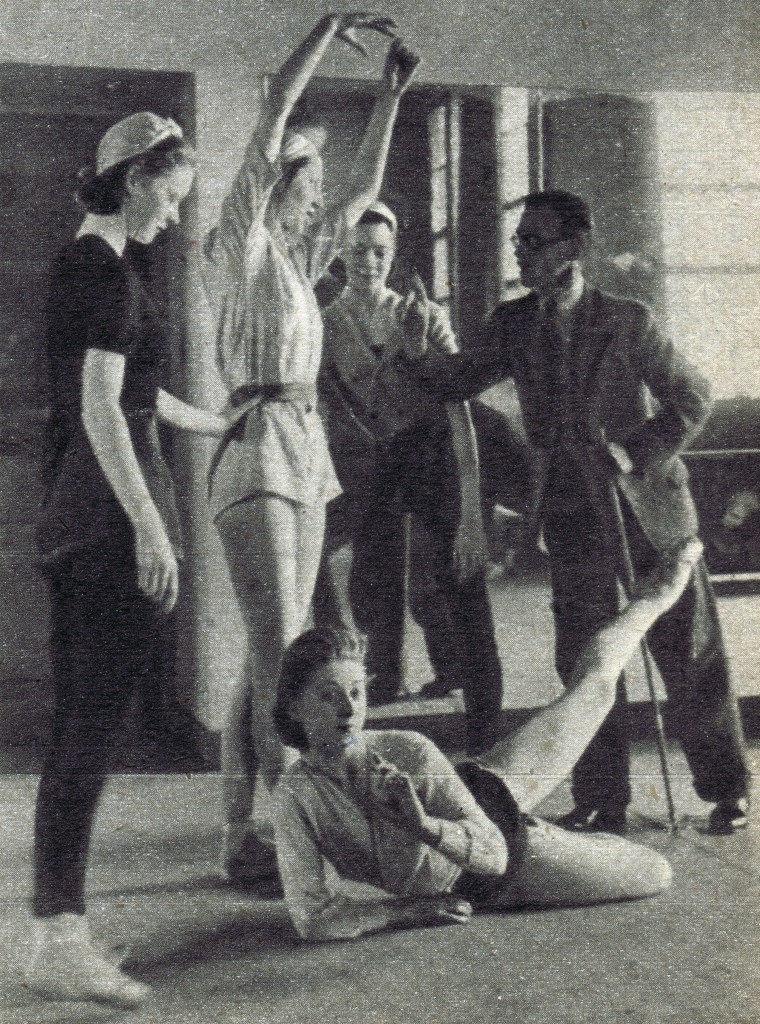
Sergeyev conducting a lesson at the Sadler’s Wells School in London in May, 1942. His students include Moyra Fraser and Moira Shearer. From an article in Picture Post, August 1st, 1942.
But once into the company (out of the school) we didn’t have classes with him because Ninette de Valois herself used to take class. And that was quite horrific in some ways because she wasn’t a natural teacher either. Everything was very busy and had to be done at twice the speed of light. She was a very fast, neat dancer herself and excelled in little batterie steps, and people always do hone, quite unknowingly I think, to the way they dance themselves. It’s inevitable. So, her classes were pretty frenetic, one way or another, but not quite so damaging as old Sergeyev’s.
I seem to be one of the only ones of my age to see the de Basil and Rene Blum companies. I was taken to Covent Garden to see them when I was 8, and I remember the program exactly. It was Sylphides, Boutique Fantasque with Massine and Danilova, and Contes Russes. And when I went down (from Scotland to London) in 1936 to start training properly, when I was 10, I saw quite a lot. The old Alhambra in Leicester Square was still a theatre then; (Vera) Nemtchinova was dancing and Eglevsky, very young. I remember being very enamoured, crazy about Eglevsky. All the dancers from those companies came to Legat’s studio when they were in London and did classes with all of us. So as a small girl, one had the opportunity of watching these, to me, gods, which was a very great help for the future.
So, I had seen all the Russians before I saw the English ballet – I think 1939 was the first time (that I saw it). Isn’t it strange? And still it wasn’t what I wanted to do. Music was what I wanted to do”.
Shearer’s criticism of the teaching methods and attitudes at Sadler’s Wells continued, “one spent so much time on classwork and endless rehearsing by comparison to the 2 ½ hours actually performing in front of an audience. One knew this was something one had to do, but I always wished that I genuinely loved that side of it the way some people did. It was their total life, but I was very slightly irked by the preoccupation with technique. In any company I was ever with, nobody ever talked to you or in any way helped you toward a greater understanding of all the other aspects of the theatre that go into a ballet performance. That was totally missing. I can’t think of any dancers I’ve known who were tremendously interested in painting or music or the whole mis-en-scene. All the preoccupation was on technique and more technique, purely the technical dancing of it. Few of them knew anything about the history of ballet, which I find fascinating. Maybe they did – maybe they just didn’t talk about it. I didn’t either because there was nobody to talk to. But if you didn’t have an instinctive feeling and hadn’t done a certain amount of work yourself, you just went on the stage to dance those big classical roles technically, and that was all”.
When the “Blitz” on London began in September 1940, Shearer returned to Scotland with her mother, where she recalled, “I kicked my heels for a bit. Then luckily at the beginning of 1941, a dancer called Mona Inglesby, whom I’d met at Legat’s studio, was forming a company of her own, and she remembered me and asked me to join it. That was (the) International Ballet.
International Ballet was my first professional thing, and I enjoyed a lot of it very much though I felt terribly aware of the amount there was to learn…… You can train for however many years but you get into a company, you go out onto the stage, whether it’s in the back row of the corps de ballet or a small solo, and then you start learning about real dancing, about how to put it across and how to place it well and make it look effortless.
I was only with (the) International Ballet for one year, 1941 to ’42, and I learned from everybody. I learned quite a lot from Mona Inglesby herself, especially about how to place one’s dancing. You never felt she was just doing a diagonal line from A to B and then then running up to the back corner. She used the stage very well, which is very important, and no one had ever taught one anything about this. Perhaps many people don’t remember her, but she was a lovely, very fluid, classical dancer, with a great flow of movement. She was a genuine pleasure to watch. But she had totally wrong appearance for a dancer ….. I just thought it was so wretched; with the great facility that she had, she’d worked to get a really lovely technique, and it was never going to look as it should because of her physical makeup”.
Shearer’s last performance with the International Ballet was in Sheffield on February 28th, 1942. She danced in the nocturne in Les Sylphides and as a cloud in Endymion. The exact date when she joined Sadler’s Wells is not known but the company returned from a brief road tour to their base, the New Theatre in London’s West End, on March 16th. Shearer recalls, “I didn’t audition for the Sadler’s Wells. Ninette de Valois remembered me from those 6 weeks at the beginning of the war, and I think she had seen some performances of the International when we were in London at the Lyric. She got in touch with my mother, because I was still 15 years old, and said she would like me in the company. And literally in my first week, I danced the waltz in Sylphides. Then I did the leading part in Gods go a-begging straightaway and then Freddie Ashton was writing The Quest and I was in that too”.
Understandably after 35 years Shearer’s memory was not perfect. The first programme listing for her in Sylphides was May 6th, 1942; Margot Fonteyn, Beryl Grey and Celia Franca danced the leads on that date; Shearer’s first appearance in The Gods go a-begging was on November 24thof that year. The Quest didn’t premiere until April 6th, 1943. Shearer omits to note that Pride was the first part choreographed specifically for her. Dale Harris speculated that the creator and choreographer, Fred Ashton, chose Shearer for the part of Pride based on her looks.
Shearer continued, “I did dance also in the corps, for 4 years. That was very much de Valois’s policy, that young dancers would be given solo things from time to time; but they would be right back in the corps, sometimes in the next ballet.
As it happened, I did one act of Swan Lake, in about 1943 or ’44. Poor Pamela (May) who was beset for years with terrible cartilage problems in her knees, was coming back into the company an de Valois wanted to get her back into Swan Lake. But Pamela wasn’t able to do the whole thing – we always did the full ballet, never just the second act – so because I was also roughly fair-haired I danced the black act (Odile) for her”. This was probably on May 18th, 1944, in Hammersmith.
Shearer continued the interview by discussing the internal politics of Sadler’s Wells.
“Now, I think this important to say. Sooner or later, particular people come along who the director particularly likes. It’s not absolute favouritism, but it does happen…. in all companies probably …. it’s only human. There were one or two (dancers), of my age or slightly older, who went through a phase of this, or de Valois, who went through a phase on them so to speak. To my great luck, she never had any phase on me at all, which I found a very good thing. Too much would be given to the dancer of the moment, and nobody could ever fulfil what was expected, whereupon they would be dropped. But, if you were never in this category, or sometimes used as a last resort when there was nobody else, if one was put on (the schedule) like that and was reasonably successful, it was a much more genuine way of arriving at something. I just am glad that I was never a particularly favoured one.
Mind you, I wasn’t necessarily aware at the time that this was happening in the company. It was just very hard work, and one was trying to get through it and not drop down with a broken leg oneself. There was a tremendous boom for the ballet during the war because it was the great escapist entertainment; it was so fantastic and unreal that it completely took people out of themselves. So, we worked 52 weeks a year, no holiday at all, and we toured terrifically. We did 8 shows a week, always, and then for two London seasons we did 9 shows a week, with 3 performances of the same programme every Saturday at 1.30, 4.45 and 8.30.
We had full houses every single day of the year. I didn’t know what it was like to be out of work. In fact there was too much. One was very cushioned and spoiled in that way, and one thought it was normal”.
Shearer went on to describe her history of dancing in the “classical” ballets.
“Of course, any classical dancer is aiming for those big classical roles because there isn’t anything like them. It would be crazy if you weren’t. I did Sleeping Beauty first (she first danced as Aurora, on March 2nd, 1946, at Covent Garden), then Swan Lake (she first danced the twin roles of Odette/Odile, on August 20th, 1946) and Coppelia (she first danced Swanhilda on November 11th, 1946), all within a year. But I only did Swan Lake for 3 years before de Valois removed me from it. She didn’t like me in it, that I was too lightweight in every way, so I didn’t ever dance it again. I was sad really, because it’s a marvellous part, but I’m sure I wasn’t ideal”. Actually, Shearer danced it again in 1951 and 1953.
“One role I never enjoyed at all, and unfortunately was always hideously successful in, was Swanhilda. I found it arch and pert, all the things I really don’t like, and terribly mock-jokey in the middle act. One was very lucky to be doing it at all, I suppose, but I could well have done without it occasionally.
But I was a classical dancer, and I was always a little bit ‘fish out of water’ when it came to real character things like the Spanish dance in the 3rd act of Swan Lake. I enjoyed doing it, but I probably looked like a classical dancer doing a Spanish dance, instead of doing it convincingly. You can’t help it if you’re like that. Even in the classical roles, to be perfectly honest, I never felt 100% happy technically, but that was because I had this ridiculously high standard. I never felt that technique was my strong point. It would be false modesty not to know what one’s very strong points were, and I knew that lightness and speed were really mine, and I (made do) with the technique I had. But I remember very well, before I started doing Aurora, standing at the back of the stage or in the wings watching Margot do it, and thinking how marvellous for her to have had a certain number of years of dancing these big, heavy, classical parts and knowing, absolutely, with rock solidity, that she could do them. She could almost relax on the top of the part, knowing she’d got all the nerves and initial worry over. And that showed how little I knew about anything.
When I started to do those roles, I was so nervous before going on that I could hardly put one foot in front of the other. But that, in fact, was the best time, which you only appreciate in retrospect. That was the time I had nothing to lose. I was a new, young one; everyone was with you, absolutely, longing for you to do well, and you had no reputation to make a mess of. You may think you are nervous, but it’s nothing to the kind of real nervous you get when you’re much older and start to get a little bit of reputation as being good in something. Then people start to come wondering, ‘Is she going off a bit?’ They’re so much more critical, and if you have done one very good performance, it’s got to be topped. It’s got to be better, better, better every single time. But it’s such a physical thing. You can’t always be better. All that nerve strain is very exhausting, and I think it gets worse. That’s why I’m so full of admiration for somebody like Margot who has been able to go on for years at that level, with people expecting so much more all the time. If I had wanted to very much, which I didn’t, I could have gone easily for another 10 years. I’d still have been only 38, and a great many dancers are that age and whirling away like mad. But people are temperamentally either suited to the ballet or they’re not, and I don’t think I was”.
Next, Shearer discussed the ballet Giselle and her meeting with Tamara Karsavina in 1948.
“I had always wanted to do Giselle, always. I suppose I saw Margot in it first. I was in the corps de ballet for a long time in it and I danced one of the two leading Wilis for a long time, mostly to Margot’s performance because she danced most of them, and sometimes to Beryl (Grey)…. Inevitably, it was Margot’s performance that was stamped on that production, and you were just put into it, because this almost “set” piece was there in your mind’s eye all the time. Seeing a great many people do a thing is not necessarily a great help.
When I discovered I was going to dance Giselle, I remembered that Karsavina lived in London. And I felt, ‘Here is somebody, still alive, who remembers how this was danced at the Marinsky and who had danced it herself many times. Really it is madness not to get in touch with this woman and find out some things about the part and what she feels about it’. So, I plucked up courage and I wrote to her. What I hadn’t realised was nobody was bothering about Karsavina at all, and she was very hurt by it. I heard afterwards that she had always felt ignored completely. I knew she had been there for the Spectre (de la Rose) rehearsals. She came to coach Margot and Alexis Rassine– but the whole thing was shut off”
Referring to herself, Shearer continued, “anybody else who was going to dance it never saw Karsavina at all – and that (consultation with Fonteyn) had just been a little isolated episode and never again. I’d never met her; I just wrote out of the blue and explained the situation. She replied at once and said she’d be delighted to see me and would I come for tea. She had a charming little apartment….. When I arrived, I just plunged straight in, and the dear old thing had the rug back and was demonstrating for me.
It was the first act particularly I wanted to ask her about because (I was unhappy with the Sadler’s Wells Ballet’s interpretation of it). You want some reality so you can feel for this girl in this situation.
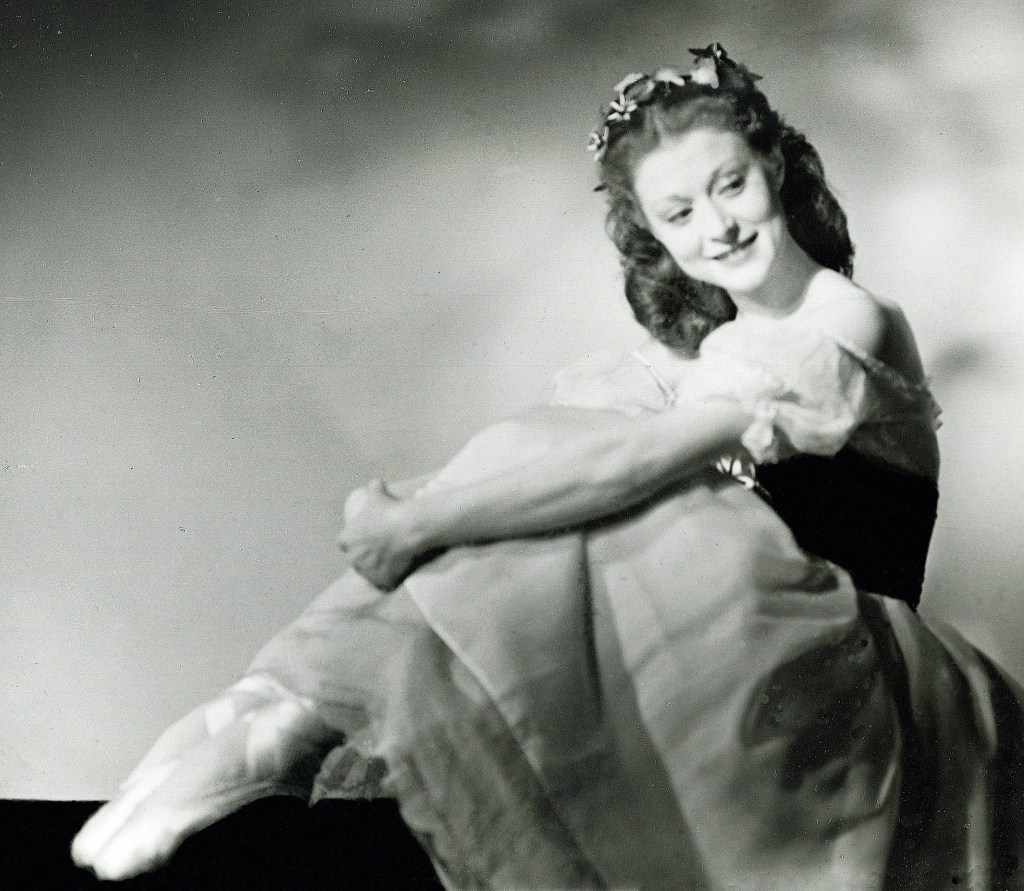
Moira Shearer in her costume for Act 1 of Giselle. Neither date nor photographer known. Photo used with the permission of the Moira Shearer Archive.
My problem then was that Karsavina showed me one or two of the mimed sections of that first act the way they had done them, which were quite different, and I realised I couldn’t possibly put them in. There were little, tiny things I could use, but I had to be terribly careful about not disturbing anybody else, since they were going to be exactly as they always were. Anything I could use must be something that concerned (just) myself, like the way Giselle moves forward when she encounters Bathilde…. The way Karsavina showed it was … less arch…
So, I had very few rehearsals … just with Alexis (Rassine) as Albrecht, and never on stage at all ….. you must make the best of it… de Valois didn’t see it (my interpretation of the role) till the matinee when she was in front. (At the end of the first act) she was round to my dressing room and she waded in…. where had I got these ludicrous ideas?
So, I said, ‘Anything that you find unacceptable I got from Madame Karsavina, whom I went to see because I was interested enough to find out her view of the part’.
That stopped her absolutely cold. She didn’t say another word; she marched out of my room.… then Karsavina was brought in to coach Margot …. I think it did improve certain aspects of that production”.
The interview continues as a lengthy, sometimes technical, discussion of Shearer’s experiences in dancing in Giselle. Her memory of details of the ballet is prodigious. She touches on, variously, the criticism of the reviewer, Cyril Beaumont, of her playing on the role, followed by long discussion about interpreting the character of Giselle; on dancing with Rassine, Robert Helpmann, Michael Somes, David Paltenghi and John Hart; on the music; on Ashton and Ninette de Valois as choreographers and teachers.
Shearer then addressed working with George Balanchine in the ballet, Ballet Imperial, and Margot Fonteyn’s struggles to dance to Balanchine’s choreography.
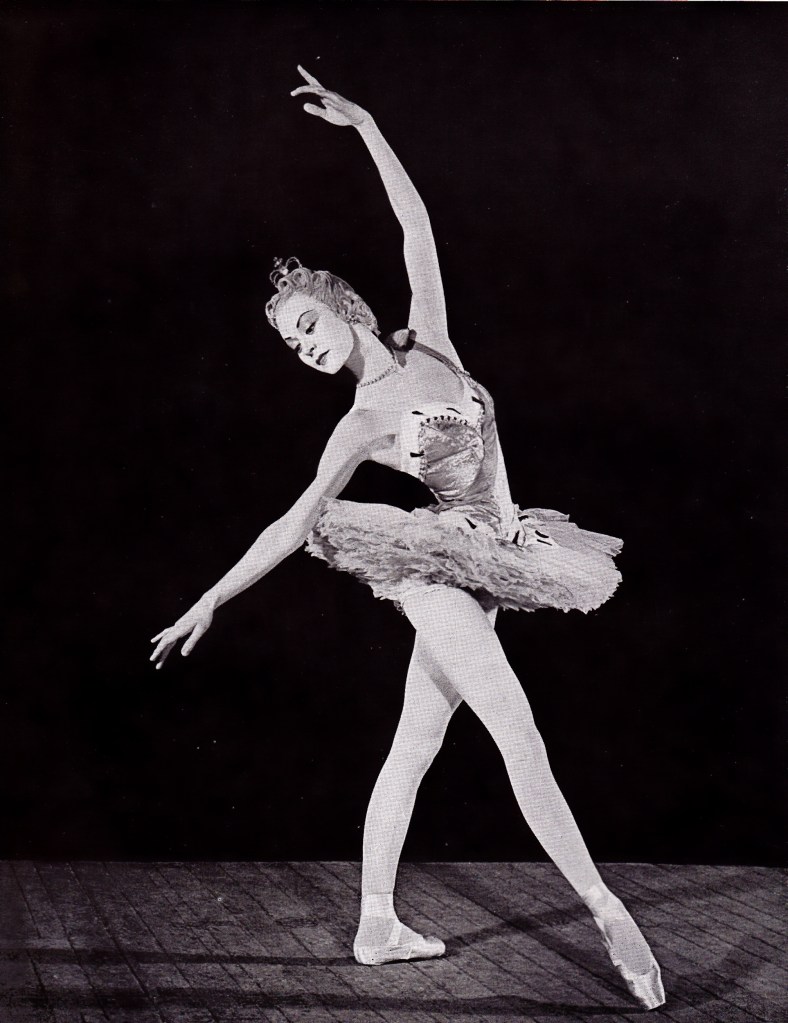
Moira Shearer in Ballet Imperial in 1950. Photograph by Roger Wood.
“This was the only time, apart from Cinderella, that I ever had a stage call and with the choreographer too. I think he (Balanchine) saw right away that I had got this point (regarding his unconventional choreography) and he worked on and on with me. He was there for my first performance, too, and I know he was pleased.
I am sure I reached a particular standard of technical dancing in Ballet Imperial that I never reached in anything else. He expected it, and you couldn’t let that man down”.
Shearer then moved on to discuss the impact of the critics and the role of the audience in influencing the dancer’s performance.
“There were always just a few people whose opinions one respected because they really knew about it. Quite frankly the critics never. If it doesn’t sound too patronizing, the majority of them do not know anything about ballet. They will try to be technical and pretend they know … this fearful peppering of reviews with little technicalities – which were almost invariably wrong – makes any dancer or choreographer reading it realize it isn’t worth tuppence.
The audience has no effect on the way you dance – none….. (dancing) is a totally self-contained thing…. You are creating something within the stage and the concentration has to be total on what you’re doing, all the way through…. You create an illusion and the audience receives it”.
Shearer summed up her dancing and acting careers in the following terms.
“Ballet is an intensely selfish career, and if you’re going to do it absolutely 100%, as you must, it’s a 24 hour day business and everything else takes second place. Well, if you’re going to be married successfully and have children, this is just not possible. This I felt was hopeless. So, (I quit ballet and) I did about 5 years of theatre, thinking it was perhaps a more reasonable career to pursue and still have some kind of marriage and life with the children, and I discovered it was not possible. To me there wasn’t really any question about the decision…… So, I just quietly removed myself into domesticity…”
Finally, Shearer wistfully confronted her unsuccessful attempt to become an actress by saying, “You are trying to do this very, very difficult art (theatre) and apparently failing dismally. But, of course, on you go because it is your work, it is what you know, and you must”.
Sources.
Dale Harris, transcript of an audiotape of interviews conducted with Moira Shearer, recorded in Edinburgh in August 29th, 1976 and August 31st and September 1st, 1978. The New York City Library Archive, Lincoln Center, New York.
Barbara Newman, Striking a Balance, Dancers Talking about Dancing, Elm Tree Books/Hamish Hamilton Ltd, London, 1982


Leave a Reply