During her tenure at the Sadler’s Wells Ballet Moira Shearer was partnered by numerous male dancers. These included Robert Helpmann and Michael Somes. However, as they were primarily matched with the prima ballerina, Margot Fonteyn, Shearer, as the second cast, was usually partnered by other dancers. Chief among them were Alexis Rassine, David Paltenghi and John Hart. These partnerships are explored below.
Alexis Rassine
In her 1978 interview with Dale Harris Moira Shearer recalls the first night at New York’s Metropolitan Opera House at the start of the first North American tour by the Sadler’s Wells Ballet in 1949. She remembers the night well because of her horror at having to dance in the Bluebirds suite in Sleeping Beauty, a role, she said, that she had not danced before.
In fact, this was not the case. She had danced it four times in the season of “rehearsals” for the American tour that was staged at Covent Garden from August 8th to 13th.
Shearer’s uncharacteristic lapse of memory probably resulted from a number of factors. First, although it obviously still irked her, it occured almost 30 years earlier. Second, she was extraordinarily busy for the week of August 8th, 1949. She danced in Sleeping Beauty either as a bluebird or in the lead role, as Aurora, every day. Then on August 16th she announced her engagement to Ludovic Kennedy.
In October 1949 at the premiere of Sleeping Beauty in New York she would have been forced to wait until Act 3 before she took the stage. She was always nervous before a performance and, having to wait that long, while she could hear the audience’s rapturous reception of Fonteyn’s dancing, would have undoubtedly heightened her anxiety.
At the time she was Sadler’s Well’s second ranked ballerina behind Fonteyn, a status that she both merited and fully accepted. Ninette de Valois, the director of the company had a strict policy that Fonteyn always dance the first night of a season or tour. Shearer or, occasionally, as, for example, in the case of Sleeping Beauty, Beryl Grey would dance on the 2nd night.
Thus, why was Shearer thrust into the first night lineup as a Bluebird? The answer is probably because Sol Hurok, the American promoter of the 1949 tour had asked de Valois to “load” the first night cast. Thus, for example, Violetta Elvin danced as the Fairy of the Crystal Fountain and Grey as the Lilac Fairy. From Hurok’s point of view, it was imperative that Shearer was included because, as a result of her success in the film, The Red Shoes, she was “box office” in the US.
The other Bluebird, Shearer’s partner, was Alexis Rassine. He was another reason for Shearer’s concern. As the photo of them dancing together in the ballet, Promenade, shows, he was of slight build and little taller than Shearer. In her interview with Harris she said of him that, while she enjoyed dancing with him, he did not inspire confidence in a ballet that required big lifts. Nonetheless he was an experienced and sensitive dancer and had partnered Margot Fonteyn in Spectre de la Rose, Carnaval and Giselle. During World War 2, when many British male dancers were serving in the armed forces, Rassine was often called upon by de Valois. Shearer first danced with him in 1942 in The Birds. In 1944 she partnered him in Spectre when she took over from Fonteyn the role of the young girl. Subsequently she danced with him in Les Sylphides and in Coppelia in which he was Franz to her Swanhilda.
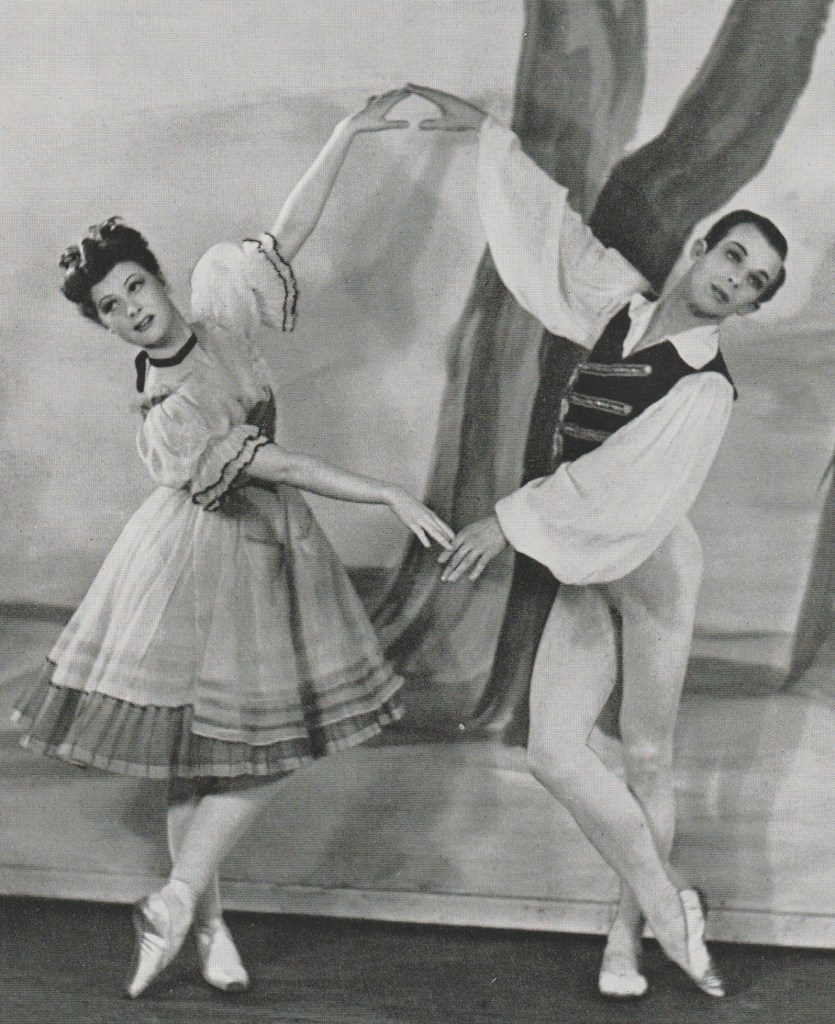
Moira Shearer and Alexis Rassine dancing a duet in the ballet Promenade circa 1943. Photo by Gordon Anthony.
Shearer and Rassine’s Bluebird, understandably, because it was almost always danced in the shadows of Fonteyn’s Aurora, didn’t get much contemporaneous press and what little was published, was, at best, lukewarm. For example, in Chicago in November 1949, Shearer, according to the dance critic for the Chicago Tribune, didn’t “have her heart in it” and Rassine was dismissed with faint praise as “a reasonably competent partner”. A Canadian critic concluded that, based on the October 1949 performances that he saw in New York, Rassine was a fine “soloist” but not a strong partner. This criticism seems to echo the consensus of a number of critics on Rassine’s abilities throughout his career.
After World War 2, with a return to the company of more powerful dancers like Michael Somes and John Hart, Rassine was increasingly consigned to less demanding roles and to appearances on the road. Thus, for example, on the second North American tour in 1950-51, in San Francisco and at Purdue University, he partnered Shearer as Albrecht in Giselle and, in 1951, was Siegfried to her Odette/Odile in a performance of Swan Lake in Blackpool.
Oher ballets in which Shearer and Rassine danced together included Rendezvous, in 1943, Spectre de la Rose, in 1944, and in Carnaval.
David Paltenghi
David Paltenghi was exempt from military service in World War 2. Therefore, like Rassine, he was much in demand at Sadler’s Wells during the war but less so after it. Between 1942 and 1945 he partnered Shearer several times in a pas de deux in Les Patineurs and danced the role of Eusebias to her Chiarina in Carnaval in which he is downhearted until he meets her, but she merely dallies with him, offering him a flower and then running away to hide.
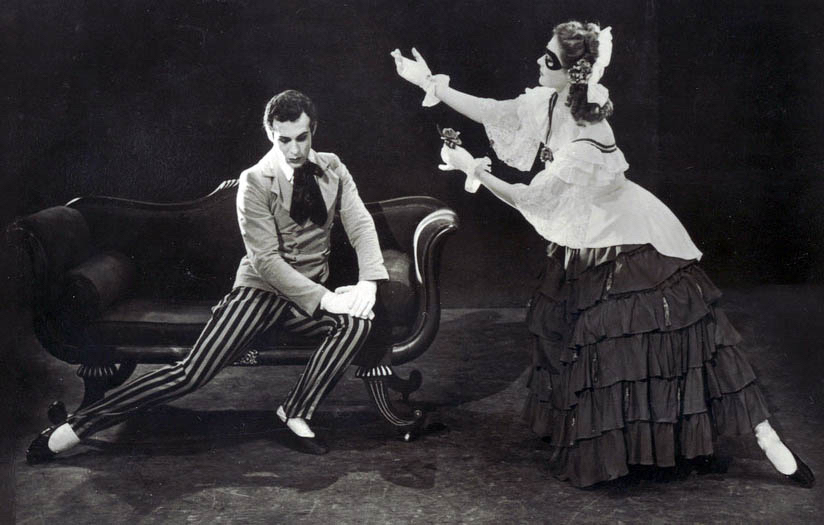
Moira Shearer as Chiarina and David Paltenghi as Eusebias in the ballet, Carnaval, circa 1945. Photo by Edward Mandinian.
In 1946 Paltenghi was Siegfried to Shearer’s Odette in Lac and in 1947 he once danced as Florimund to Shearer’s Aurora in Sleeping Beauty. As this seems to have been the only occasion they danced together in Sleeping Beauty, he was perhaps substituting for John Hart, Shearer’s perennial partner.
Shearer considered Paltenghi to be a good partner but not a good dancer. In her 1976 interview with Dale Harris, she commented that she thought he’d taken up dancing too late in life. Other critics said he was weak technically. In Swan Lake he partnered Grey more frequently than Shearer. As he was tall, he was, in this respect, a good match for Grey.
As Paltenghi does not appear in programmes after his appearance in Adam Zero on February 18th, 1948, he appears to have left Sadler’s Wells around that time.
John Hart
In her interview with Dale Harris Shearer indicated that she partnered with John Hart many times and, because he was, what she described as “rock solid”, she enjoyed dancing with him. Their association at Sadler’s Wells Ballet extended from 1946 to 1951. As he was already an established member of the company when Shearer joined it in 1942, they might have partnered each other for even longer, however during World War 2 he served in the Royal Air Force.
Their first recorded partnership was on October 30th, 1946, when they appeared together in Symphonic Variations. On this occasion Hart replaced Shearer’s earlier partner, Henry Danton, who had left Sadler’s Wells to study in Paris.
Once she had recovered from a tendon injury Margot Fonteyn returned to the title role in Ashton’s ballet, Cinderella, on February 28th, 1949. Until that time Shearer had danced as Cinderella with Michael Somes as her Prince. On Fonteyn’s return Somes partnered Fonteyn and continued to do so when the ballet was staged again in April 1949. Shearer then became the second cast and John Hart took the role of the Prince.
There were numerous occasions where Shearer and Hart danced in the same ballet at the same performance but did not partner each other. This was the case, for example, for Tricorne where Shearer danced in the Jota, usually with Massine and Grey, while Hart danced as the Governor.
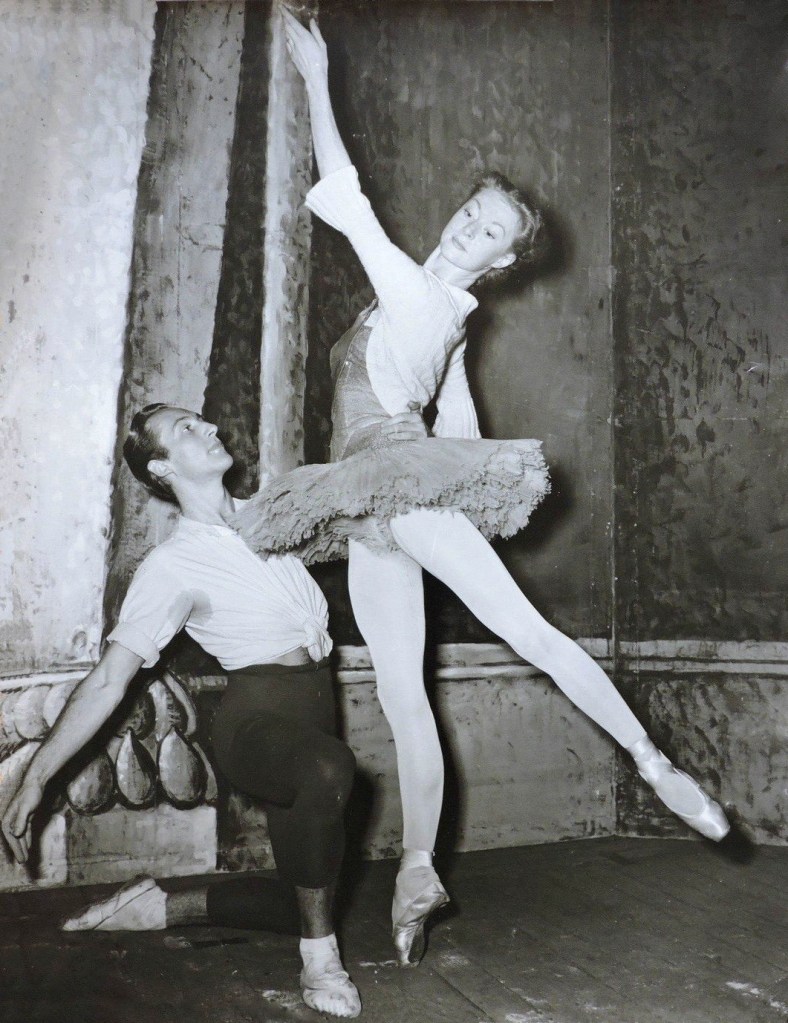
Moira Shearer and John Hart at practice. Date and photographer unknown.
Programmes and Royal Opera House archive records indicate that Shearer and Hart danced together at least 60 times between 1946 and 1951. They were most often partnered in Symphonic Variations but also in Sleeping Beauty, where Shearer danced as Aurora and Hart was Florimund, in Scenes de Ballet, Swan Lake and in Mamzelle Angot. In Ashton’s ballet, The Wedding Bouquet, in which Shearer took the role of the jilted Julia and Hart was the bridegroom, they danced a duet.
Sources.
Moira Shearer interviewed by Dale Harris in Edinburgh, August 29th,1976 and September 1st,1978. Transcript of an audiotape held at the New York City Library, Lincoln Centre.
Royal Opera House archives, Covent Garden, London.
Sadler’s Wells Ballet programmes, 1942 to 1951.
 Moira Shearer
Leave a comment