“Ballet makes unceasing and exhausting demands on its votives…..a dancer often spends the whole day in the theatre and is never free from rehearsals, the daily classes and special classes, photo calls and dress fittings”.
Peter Craig Raymond, Ballet Today, December 1954.
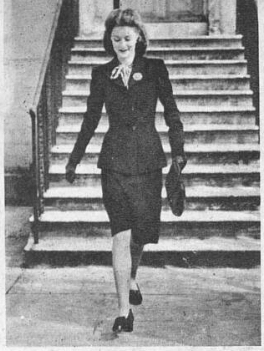
Moira Shearer leaves her parent’s flat in west London and heads off for work at Covent Garden. Circa 1946. Photo by Gordon Anthony.
With the exception of the month-long summer holiday, Sundays and designated days off, and even on the days she was not dancing Shearer went to work at the Royal Opera House in Covent Garden. Depending on daily schedules she would have been expected to be there at sometime between 9 and 10 a.m. Classes or practice lasted until around 11.30 a.m. followed by short break; rehearsals began at noon and lasted until 2 or 3 p.m. Thus class, practice, rehearsals or dress rehearsals might require up to 6 hours in total. Matinees were usually staged at 2 p.m. so, in this case, the time for practice and rehearsal was limited to a couple of hours.
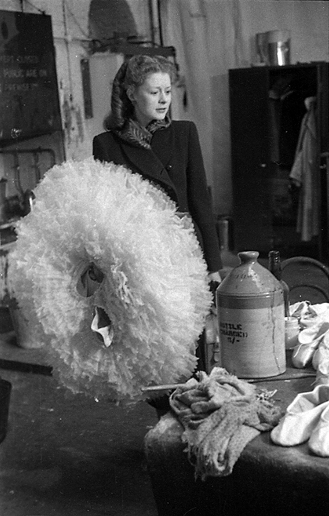
Shearer on her way to the wardrobe department at Covent Garden for adjustments to her tutu. Circa 1948. Photo by Louis Klemantaski.
Also on the schedule were fittings, repairs or adjustments to costumes and the occasional interview or photo shoot. As dancers rarely met with the ballet mistress or master, schedules and casting were posted on a bulletin board that had to be consulted daily. Assignments for the following day were often not known until after an evening’s performances. A dancer’s schedule might change suddenly if another dancer was ill or injured and had to be replaced.
In Shearer’s case the most notable example of this was in 1949 when she was selected to replace Alexandra Danilova as Swanhilda in Coppelia. Danilova and Leonide Massine were dancing with the Sadler’s Wells Ballet for the spring season. Danilova was due to dance as Swanhilda on March 30th but inflamed her tendon in practice and Shearer was chosen to step in at very short notice, so short, in fact that, according to the popular press, she and her partner, Frederick Franklin were still practicing up until the time the curtain went up. The role was, of course, familiar to Shearer, although she hadn’t danced it many times and not for the preceding six months.
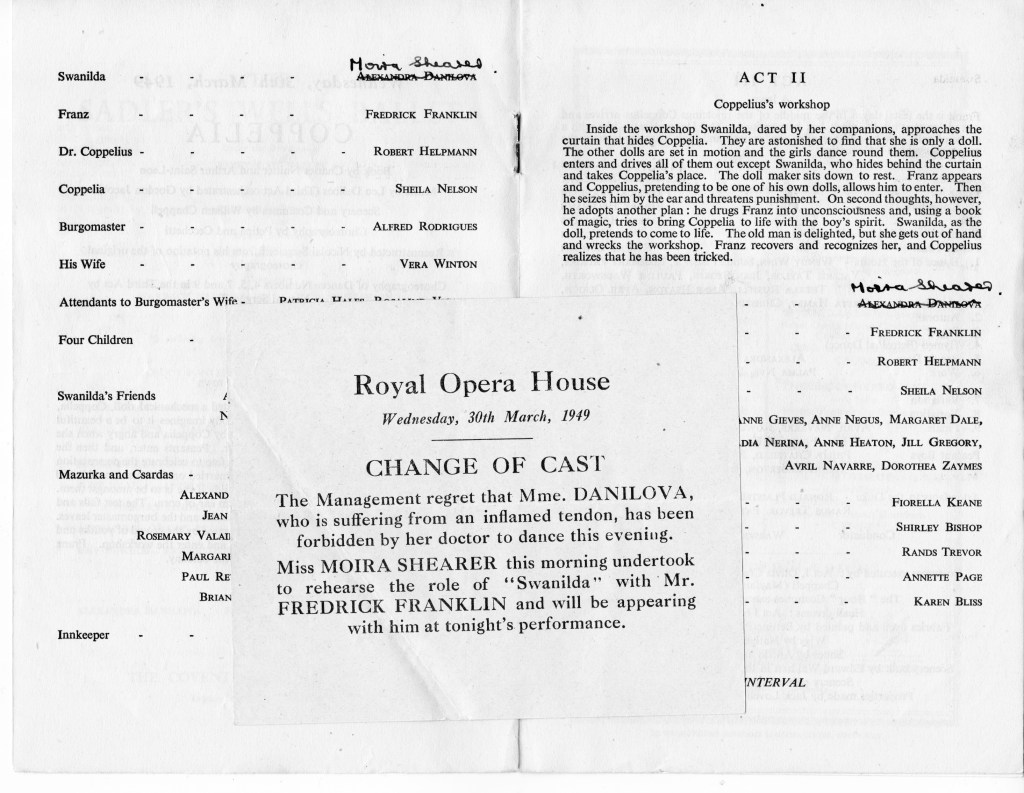
The Sadler’s Wells Ballet programme for March 30th, 1949, noting Alexandra Danilova’s injury and her replacement by Moira Shearer.
There was rarely time for lunch so dancers grabbed a bite whenever they had a spare moment. On nights when that they were dancing they might not eat anything for a number of hours beforehand. Dinner would have to wait until after a performance. Thus, Shearer would often eat at home.
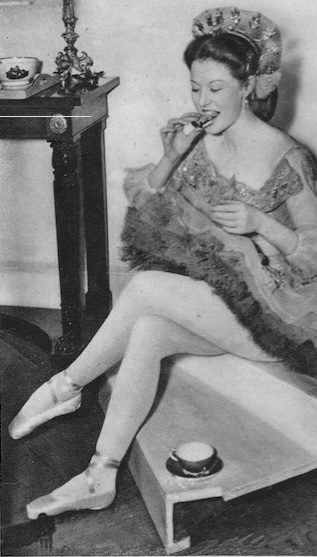
Shearer in her costume as Aurora in Sleeping Beauty grabs a bite and a “cuppa”. Circa 1946. Photograph by Gordon Anthony.
According on the ballets scheduled, evening performances usually began at 6.45 or at 7.30 pm and might last for 2 to 2 1/2 hours.
Preparations for a performance, dressing and make-up might require an hour. Once the performance was complete and the dancer had left the stage, costumes were carefully shed and stored in the dressing room and makeup was removed. Then it was a matter of getting past the autograph hunters at the stage door.
On nights she was dancing she would be lucky to begin her journey home by 10 p.m. Thus, it was a 13 hour day when she was dancing and 10 when she was not.
Until Ludovic Kennedy came into her life in 1949 and offered her a ride home, Shearer would have had to rely on a London bus or the underground.
Sources.
Alan Ivimey, “Ballet Dancer” The Children’s Newspaper, Dec 9th, 1950.
Peter Craig Raymond, Ballet Today, Dec 1954, “The Career of Moira Shearer”.
John Speed, Background to Ballet, circa 1950. Photos by Louis Klemantaski.
Tatler, April 24th, 1946.


Leave a Reply