Moira Shearer’s dancing was often compared to that of her close contemporaries Beryl Grey and Violetta Elvin and most especially to that of Margot Fonteyn. Some critics talked of her dancing in “the shadow” of Fonteyn and, true as this might have been, it did not concern Shearer. She strove to emulate Fonteyn but recognized that there was only one prima ballerina assoluta in the Sadler’s Wells Ballet.
Shearer had many critics. Some praised her dancing in glowing terms; some thought she was a second rate dancer; some wrote for magazines or journals that focused on ballet and were well known and respected in the ballet world; some, in the more popular or provincial press were anonymous or were only known by their initials; some, like Iris Morley had a definite bias in the way they viewed ballet; some were very much part of the ballet “establishment”; some like A.V. Coton were fiercely independent.
Moira Shearer as Giselle, 1948-53
As the reviewer in The Times in March 1950 indicated each ballerina that dances it brings a different interpretation to the title role of Giselle. This critic might well have been thinking of the three English ballerinas who predated Shearer in the role. Alicia Markova, who first danced the role in 1934 with the Vic-Wells Ballet, Margot Fonteyn, who replaced Markova in 1937 and the precocious Beryl Grey, who premiered it in1944 when dancing as a teenager with the Sadler’s Wells Ballet.
After her first performance as Giselle in the summer of 1948 Shearer was photographed at Covent Garden with her 3 predecessors. There is no record that they saw her dance that July evening but perhaps they did.
The critics who saw Shearer’s first attempt at Giselle were sharply divided in their evaluation of her performance. The anonymous writer of a review for The Stage was full of praise; “she gave a moving and distinguished performance…. she possesses what more matured ballerinas sometimes lack, a vital personality”.
On the other hand, the distinguished dance historian and critic, Mary Clarke, writing in the journal Ballet Today in 1950 recalled that, in 1948, Shearer was “badly miscast and (was) putting up a good fight against a tradition into which she could never fit”. Cyril Beaumont, critic for The Sunday Times, agreed. Shearer recalled in her interview with Dale Harris that Beaumont believed she had the wrong colouring to play the part of Giselle. She wanted to write to him and remind him the Carlotta Grisi, the original Giselle, was similarly pale-complexioned and had fair hair. However, contemporary images of Grisi don’t support Shearer’s contention. Perhaps more significantly, in his review Beaumont said nothing of Shearer’s dancing or interpretation of the role.
One critic evoked the recollection of that original Giselle in Shearer’s first performance. He wrote of it that it was a “lovely and gentle interpretation (and had) lightness and grace that perhaps resembled Carlotta Grisi’s”.
After seeing her 1950 performance in Giselle Mary Clarke had cause to change her mind about Shearer’s abilities. Shearer had made great strides and Clarke was genuinely moved by her performance. “She has obviously thought a great deal about the character and presents Giselle first of all as a girl living at an emotional tension which might easily snap and result in madness”.
Clarke goes on, “she dances beautifully throughout and with a new freedom; she has great elevation, is wonderfully light and performs both beats and turns excellently”. However, she notes, as did several other critics of Shearer’s technique, that “her hands and arms are still her weak point”. As Shearer later commented to Dale Harris she had what she termed “spikey hands”. Here she was referring not to their physical appearance …. they were, indeed, long and narrow…. but to the fact she did not use them in the conventional way to create soft, rounded movements.
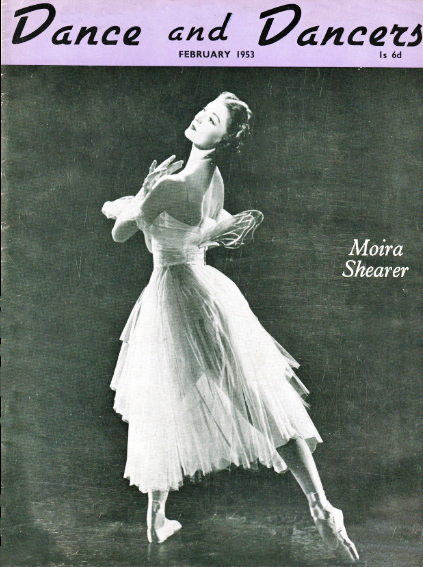
Moira Shearer as Giselle in Act 2. Photo by Maurice Seymour.
Shearer danced about 20 times as Giselle in the years 1948, 1949, 1950, 1951 and 1953. As Clarke suggests Shearer learned a great deal about the demands of the role over that 5-year span and she was obviously intent on improving her interpretation of it. The critics of her later performances often took note of this and, perhaps because of this, she commanded more press for her performances in Giselle than for any other of her ballets including Cinderella which was created for her.
For all her progress in interpreting the role, even in 1950 Shearer remained the second cast to Fonteyn. From March through June of that year she shared the role of Giselle with Fonteyn who typically danced in the evening performances while Shearer appeared in the matinees. However, Shearer danced on the evening of March 20th and the critics seemed to have been out in force to witness her performance.
The anonymous critic for The Times, wrote on March 21st of Shearer’s technique that it much improved but it was not yet of second nature that she could use it to express emotion. However, the same critic conceded, “she showed dramatic power and had a stage personality that suffused sympathy and conviction. She was radiant without false sentiment and made Gautier’s romanticism credible because of her light touch”.
The reviewer in The Telegraph praised Shearer’s “fine performance” but tempered the praise by saying that while her technique was equal to the part, it was not as “mature” as Fonteyn’s. As Fonteyn had danced the role of Giselle numerous times since her debut in it in 1937, this is perhaps hardly surprising. Shearer, the critic concluded, was a well-endowed but “young“ dancer. She showed warmth, grace, and even pathos, but not the “last tragic ounce” of it that made the character of Giselle believable.
Leigh Ashton, the critic for The Daily Mail found the ballet boring but praised Shearer for turning it into what it was supposed to be, “a vehicle for a prima ballerina”.
Audrey Williamson writing in “The Tribune” on April 14th wrote that Shearer possessed the attribute of “genuine youth” needed for playing a young peasant maiden but while she showed lightness, gaiety, “profound emotional power” and poignancy she lacked the “balance and lyrical fire” required of her in Act 2. Nonetheless, Williamson noted that the “mad scene” showed “the fresh intelligence that marks all Shearer’s work as an actress”.
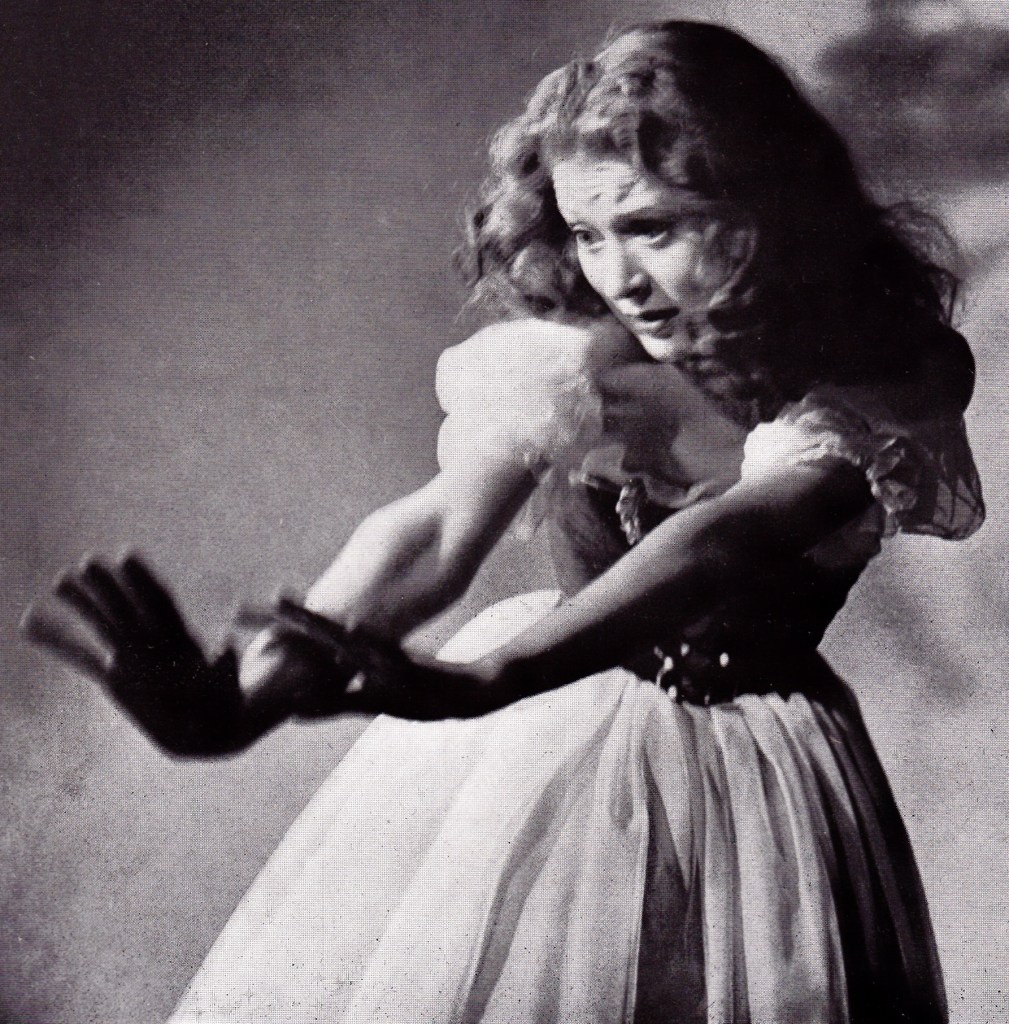
Moira Shearer in the “mad scene” in Act 1 of Giselle. Photo by Duncan Melvin. Undated but probably 1948.
In the winter and spring of 1953 Shearer shared the role of Giselle with Markova and Violetta Elvin and danced it on February 13th and 16th. Markova was then in her 40s. James Monahan, the dance critic for the Manchester Guardian, was in the audience on the 13th and wrote in no uncertain terms of Shearer’s performance. He noted the recent rise of young ballerinas at Sadler’s Wells whose grasp of “classical technique” might challenge Shearer’s but the quality of whose performances “would not begin to compete with hers”.
Monahan continued that “Moira Shearer owes her success less than does any other dancer of her generation to sheer technical ability. She depends essentially on certain inimitable qualities of her own – on a combination of length of line with remarkable lightness and with equally remarkable natural grace”. Monahan also praised Shearer’s ability to mime, especially in the mad scene.
Monahan’s praise for Shearer was not, however, boundless. He was, for example, highly critical of her March 1953 performance in Swan Lake. In his review of Shearer’s interpretation of the aristocrat in the adagio in Mamzelle Angot, he makes the observation that it is “an example of a dance being suited perfectly to a particular dancer”. In other words, Shearer’s abilities were often but not always equal to the demands of the role she was dancing.
Sources.
Leigh Ashton, The Daily Mail, March 21st, 1950.
Mary Clarke, The Sadler’s Wells Ballet, a History and Appreciation, MacMillan, 1955.
C.V. Coton, The Daily Telegraph, A New “Giselle”, July 14th 1948.
Dale Harris, transcript of interviews with Moira Shearer in Edinburgh, August 29th, 1976 and August 31st and September 1st, 1978. New York City Library Archive, Lincoln Center, New York City.
The Daily Herald, March 21st, 1950.
The Daily Telegraph (P.F.J.) March 21st, 1950.
The Manchester Guardian (J.H.M., James Monahan), November 11th, 1947 and February 14th, 1953.
The Stage, July 15th, 1948 and September 20th, 1951.
The Times, March 21st, 1950.
Audrey Williamson, The Tribune, April 14th, 1950.


Leave a Reply