Moira Shearer, ballerina, had begun to see the writing on the wall as early as 1948. In 1949, when asked what she wanted to do after leaving the ballet she replied, “straight dramatic acting …. that’s why I’m taking drama lessons now, in my spare time – what there is of it”. This is probably a reference to the Central School of Speech and Drama in London. Although she does not specify a date, Gwynneth Thurburn, the principal, recalls Shearer taking lessons with her.
The realisation that she would have to move on from her career in ballet sprung from a number of sources. First, by her own admission, she knew she would never challenge the pre-eminence of Margot Fonteyn at Sadler’s Wells Ballet. By 1948, she was resigned to the reality of being number two. The bigger problem was her place in the “ballet world”. She found it very “narrow” and, thus, ultimately, unfulfilling. In addition, Sadler’s Wells was an hostile environment starting at the top with the director, Ninette de Valois, with whom Shearer often clashed.
This tension came to a head in late 1948 when Fonteyn was injured and Shearer replaced her in the lead of Fred Ashton’s ballet, Cinderella. Consciously or unconsciously many of the members of Sadler’s Wells resented Shearer’s success in the role. This resentment dissipated when Fonteyn returned to dance after 2 month’s absence. Yet, the damage had been done. Shearer’s perceived ambition, it seems, was proven on the basis of a chance event that had advanced it.
Another source of Shearer’s impending decision to quit ballet for acting was, of course, The Red Shoes. While very little acting was required of her in that film, she was exposed to other actors with whom she had to interact. Chief among these were Anton Walbrook who played, Lermontov, the director of the ballet company and Marius Goring who played Julian Crastner, her lover and, later, her husband. With barely a moment of preparation or any training Shearer was forced to “act” and thereby, how to act. From the point of view of dancing the making of The Red Shoes was extremely disappointing and frustrating to Shearer but the film had made her aware of a world beyond ballet that was potentially open to her. This would have been reinforced by the eventual success of the film. She could not yet act but her obvious “star appeal” led audiences to believe she could.
Shearer continued to labour at Sadler’s Wells for a further 5 years. In that time she enjoyed continued success, as Giselle, for example. She travelled with the company to North America in both 1949 and 1950 and consolidated her position as “number two”. However, illness and injury began to have its impact and she was often out of commission for months on end. Gradually her position at Sadler’s Wells was seriously eroded and she was replaced by other developing ballerinas like Violetta Elvin and Nadia Nerina.
She married Ludovic Kennedy in 1951 and therefore marriage and, later, pregnancy also had to be factored into her decision-making process. Also, in 1951 she appeared in another Powell and Pressburger film, The Tales of Hoffmann although she was not required to act.
After a further injury in the Spring of 1953 Shearer hung up her point shoes at Sadler’s Wells and her final ballet performance was as a guest with The Festival Ballet in January 1954.
Meanwhile the stage and film producers had been circling, waiting for an opportunity to exploit her talents. Thus, in April 1954, she was persuaded to “star” in a British film called “The Man who loved Redheads”, that was based on a Terrence Rattigan play called “Who is Sylvia”. With Rattigan’s approval the title was changed and the script was modified to ensure that the four characters portrayed by Shearer were “front and centre”. She was to play, in quick succession, a teenage girl, a gullible cockney lass, a Russian ballerina and a middle-age social butterfly. The film was panned by most critics as were Shearer’s performances. However, A.H. Weller, the film critic for The New York Times was seduced by Shearer’s charm and noted that she “has developed acting talents that are both surprising and refreshing”.
Michael Benthall, director of The Old Vic Theatre in London, also apparently believed in Shearer’s potential acting abilities and invited her to join his upcoming production of A Midsummer Night’s Dream that would open at the Edinburgh Festival in August 1954 and then tour North America. Shearer would play a major role as Titania. She accepted the invitation and began rehearsals in July.
Benthall’s confidence in her appeared justified by Shearer’s performance at the microphone when the cast and orchestra recorded the play’s soundtrack in August. On the recording, she was a confident and authoritative Titania.
However, her subsequent performances on the Edinburgh stage were another matter. The critics roundly criticised the production as a whole and many singled-out Shearer’s acting. They concluded that her voice was too small and did not project to the audience; many of her lines were lost. Her dancing was impeccable, as always, but the majority of the audience had come to hear Shakespeare’s prose and not to see her dance.
The production fared no better on the other side of the Atlantic. The review of the New York opening night in The Stage for October 7th concluded that “while Miss Shearer’s exquisite beauty and grace comes close to being worshipped, her reading of Titania disappointed even her greatest admirers”. Walter Kerr, reporting in The New York Herald Tribune labelled the production as “tedious”. Of Moira Shearer he wrote, “when lovely Moira Shearer is distracting you from the language by weaving her enchanting arms through the air, you forgive a lot. (Miss Shearer must move to be arresting though; her diction is faulty, her delivery all on one key)”. The correspondent for The Brooklyn Daily Eagle echoed this criticism, saying that Titania “simply isn’t up to her lines”.
In the American press it was rare to find a positive review of Dream. The critic in the Oakland Tribune had a great deal to say that was positive but judged Shearer’s performance on her “grace of movement and elegance of posture and gesture”. He said nothing of her acting. Thus, it seems, he witnessed the ballerina and not the actress.
When interviewed late in the tour Moira Shearer was put on the defensive by being asked to address the consistently bad reviews. Her assertion that the tour had been a commercial success rang hollow and her final lament that the bad reviews “stuck in the craw” must have reflected her disappointment at the negative reaction to her best efforts. She must have left Dream realising that she still had much to learn of acting and when, subsequently, Benthall offered more opportunities at The Old Vic she turned them down, choosing, instead, to spend a year in repertory at The Bristol Old Vic where she hoped to learn her craft.
Dream closed in Montreal on December 18th and Shearer flew back to London. After a 6-week break, early in February she began rehearsals in Oxford for a play called I am a Camera. Camera was written by John van Druten and was based on Christopher Isherwood’s novel about life in Berlin in the 1930s. The play was originally produced in New York in 1951. When it opened in London in 1953 Dorothy Tutin played the lead role of Sally Bowles. As it was successful in the West End, the producer, Donald Albery, booked it for an extended tour of the British “provinces”. However, Tutin was not available for the tour and had to be replaced. Albery asked Shearer to take on the lead role and, despite her misgivings, she took up the challenge.
Camera opened at the New Theatre, Oxford on February 7th, 1955. John Barber, the drama critic for The Daily Express was in attendance and wrote a gushing review of Shearer’s performance. While she still lacked craft and skill of Tutin, he had, he claimed, witnessed the birth of an actress.

Moira Shearer as Sally Bowles in I am a Camera, February 1955. Photo by Angus McBean and used by permission of the Houghton Library, Harvard University.
Like the West End run Camera played to packed audiences at every venue. One member of the cast, John Gale, suspected that a considerable portion of the audience was there primarily to see Shearer who had, of course, star billing.
A very deferential article in the June 1955 issue of Theatre World addressed on the problems Shearer confronted in the transition from ballet to acting. Focusing on her success in Camera the writer concluded that it had been an ideal vehicle by which Shearer could improve her acting. “Each scene in the play reveals a different facet of Sally’s character and so provides Miss Shearer with an opportunity to acquire a wealth of experience in a short space of time”.
Perhaps because appearances at each theatre were limited to a week Camera didn’t generate much press either locally or nationally. Thus, the critics were essentially silent.
Shearer left the play in May 1955, probably at the end of an appearance at The Theatre Royal in Nottingham. In August she moved to Bristol and began rehearsals at the Bristol Old Vic. Her first appearance was on October 18th in the title role in Giraudoux’s play called Ondine. This was followed in quick succession by roles in Uncle Vanya and Volpone. As a repertory company the Bristol Old Vic had only 15 permanent actors at its disposal. This meant that each actor would be expected to participate in almost every production. Shearer was no exception and in early 1956 she was exceptionally busy. On February 14th she opened in King Lear as Cordelia; on March 6th she was Miranda in Don Juan or The Love of Geometry and on April 17th she was Lily Sabina in The Skin of our Teeth. On June 19th she was photographed at London Airport en route to Zurich where she was to appear in The Rivals and on June 26th she was back in Bristol to appear in Shaw’s Major Barbara.
A few years later, when discussing her decision to quit the stage, she admitted that she had grave doubts her acting ability from the very beginning of her tenure at Bristol. She stated in a 1994 interview that she was fully aware that she had to rid herself of all the techniques that she had been trained to perform as a dancer. Gwynneth Thurburn remarked on the tension in Shearer’s posture and movements when she first came to her and thus lessons focused how to breathe and relax as well as how to walk. However, most importantly of all Shearer had to learn how to use her voice. “After being mute for all those years”, she said, “I had to force my voice into a new mould when I started acting”.
Thus, when she opened in Ondine, she was still a work-in-progress and was filled with self-doubt. After the first night she told her interviewer that “If I could give it all up tomorrow I would”. Reflecting previous criticism of her acting, a reviewer wrote of her performance that “naturally Miss Shearer is graceful but vocally the part is above her”.
A review in The Stage for February 23rd, 1956, is very critical of the Bristol Old Vic’s production of King Lear and says of Shearer’s performance that she “makes little impression as Cordelia”.
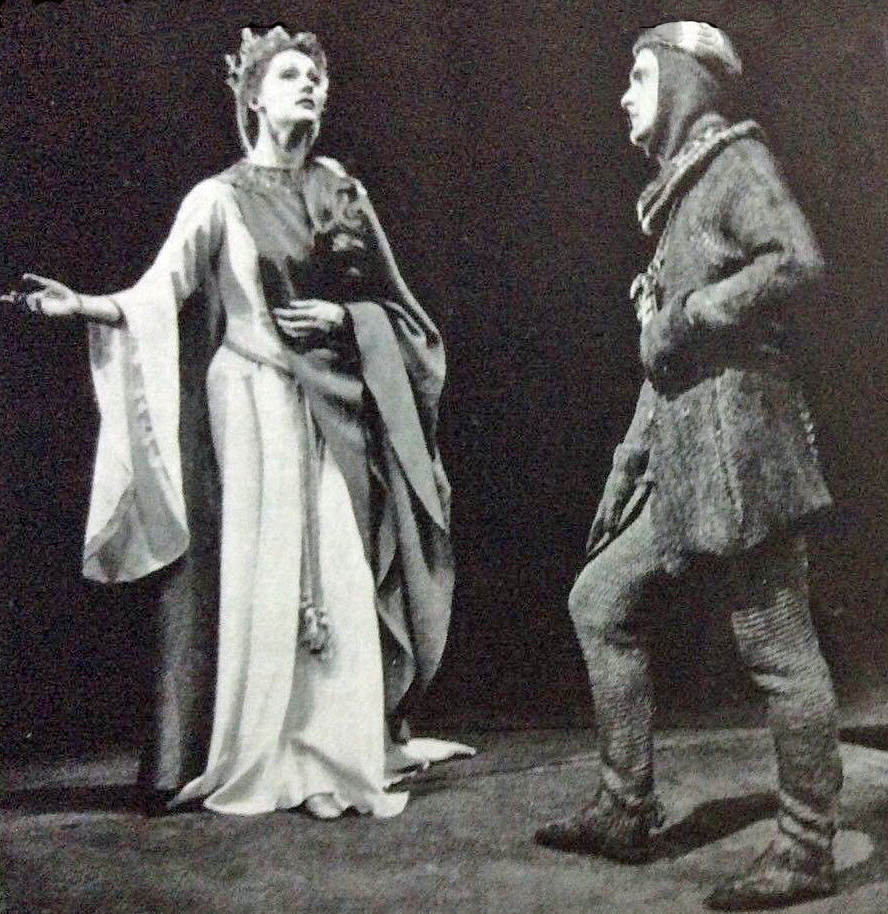
Moira Shearer as Cordelia in the Bristol Old Vic’s production of King Lear in February 1956. Photographer unknown.
The poor reviews were hardly unanticipated. She was, after all, in Bristol to learn her craft and she had given herself a year to do so. Major Barbara, her final role with the company, would be the acid test. The drama critic Caryl Brahams was at the opening night and wrote a lengthy review of Shearer’s performance. She began by saying that “there can be no doubt that Miss Moira Shearer is a star – whether she is an actress or not is perhaps another matter”. Brahms is gently critical of Shearer’s voice and her movements on stage but highly praises her skill as a satirist. She concludes by asking the question, “but is she that hard-working … hard-hitting Major Barbara? No – or, at least, not yet. At the moment she must gives us, not what the part requires of her, but what she can, and that is her intelligent, sweet-natured and touchingly hopeful imitation of an efficient young actress playing Major Barbara – a performance at one remove from the part and without much contact with the audience”.
If Shearer had read Brahms’s review it would be little wonder that she was again discouraged. Yet it undoubtedly echoed her own evaluation of her status.
Major Barbara ended its brief run at The Old Vic in late July 1956 and Shearer, about 5 months pregnant, took a break.
In the summer of 1957 Shearer was persuaded to return to the stage by the prolific producer Henry Sherek. The play was Man of Distinction, a comedy by Walter Hansenclever set in Berlin in the 1930s. Shearer played the role of Lia Compass, Eric Porter was her father, and Anton Walbrook was Hugo Mobius. It was to prove to be a disaster.
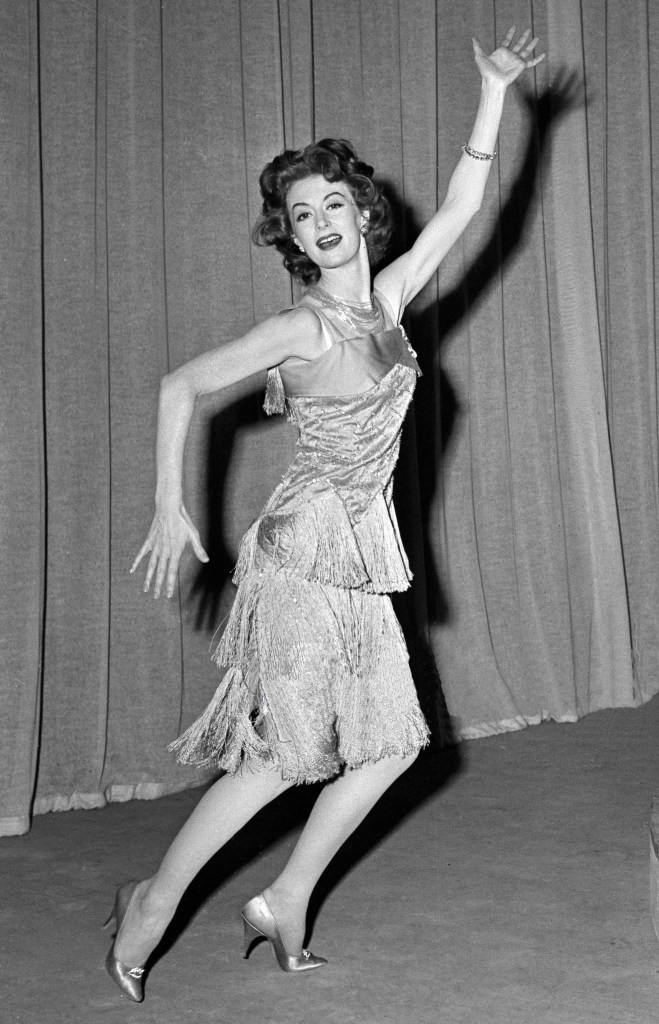
Moira Shearer as Lia Compass in Man of Distinction, August 1957. Photographer unknown.
Rehearsals began in London in early August and the play opened at the Edinburgh Festival on the 14th. In September it moved to Manchester, Leeds, Newcastle and Blackpool, each for a one-week run and on October 15th opened at the Princes Theatre in the West End. A review in the magazine Plays and Players noted that Shearer “brought the only touches of distinction” to an outdated play. John Barber, writing in The Daily Express also praised her performance but advised his readers to not see the play. It closed two weeks later, on October 28th. On the same date an unhappy Moira Shearer told Barber that she would quit the stage. This was to be her only appearance as an actress in the West End.
Shearer briefly returned to the stage in 1977 and 1978 at the Royal Lyceum Theatre in Edinburgh. She played Yelena Renevskaya in The Cherry Orchard and Judith Bliss in Hay Fever and received good reviews in the local press. The drama critic for The Glasgow Herald praised Shearer’s Renevskaya as “wonderfully elegant, charming and in several senses, light; she almost seems to float through the play”.
Her final stage appearance was in Glasgow in 1994, when aged 68 she appeared as the crone, Juliana Bordereau, in The Aspern Papers. The review in The Stage praised her performance. “Moira Shearer is splendid as the aunt and her caustic conversations with Dibbens have an expressive clarity”.
Sources.
John Barber, The Daily Express, February 7th, 1955 and October 28th, 1957.
The Brooklyn Daily Eagle, September 22nd, 1954.
Clifford Gessler, The Oakland Tribune, October 28th, 1954.
Walter Kerr, The New York Herald Tribune and Post Dispatch, October 3rd, 1954
Jackie McGlone, The HeraldScotland (The Herald/Sunday Herald), Beyond the Aspic Papers, September 10th, 1994.
The Stage, October 7th, 1954 and September 29th, 1994.
A.H. Weller, “Four of a Kind: Moira Shearer plays Air in “Redheads”, New York Times, July 26th, 1955
 Moira Shearer
Leave a comment