In 1937 an 18-year-old Michael Benthall, who was then an undergraduate at Oxford, went to see a production of Shakespeare’s A Midsummer Night’s Dream staged by Tyrone Guthrie at the Old Vic Theatre in London. Vivien Leigh played the part of Titania and Robert Helpmann was Oberon.
The production included music that Mendelssohn had written for the play in the 19th Century. Unlike most previous 20th Century interpretations of A Dream, Guthrie’s was designed as a spectacle. One critic termed it “neo Victorian”, a reference to the way it had been presented in London by Charles Kean and Beerbohm-Tree in the previous century.
Benthall was impressed by what he saw and apparently carried the memory of Guthrie’s interpretation forward to 1954 when he was established as director of the Old Vic and was considering staging a new production of the play. In cooperation with the Edinburgh Festival, it was decided to present the play at the festival in August and September of that year. Subsequently Benthall negotiated with the American impresario, Sol Hurok, for a 9-week tour of the U.S. and Canada, beginning with 29 performances in New York at Metropolitan Opera House in late September.
A Dream ran at the Empire Theatre in Edinburgh from August 23rd to September 8th, 1954.
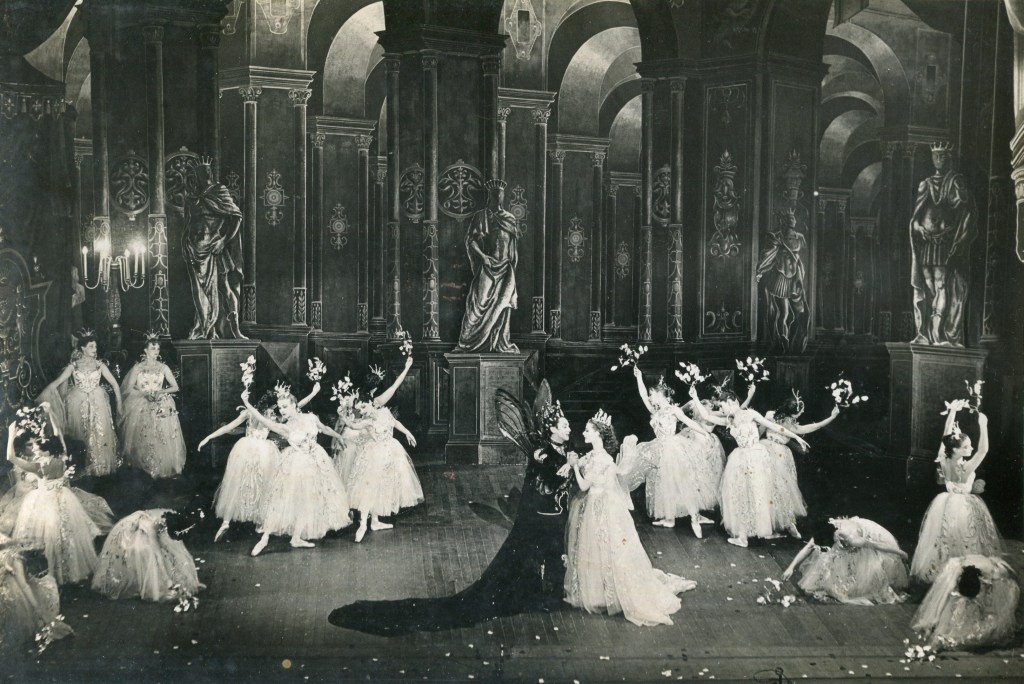
Robert Helpmann as Oberon and Moira Shearer as Titania in a performance of A Midsummer Night’s Dream in Edinburgh in August 1954. Photographer unknown. Photo published in The Scotsman.
The drama critic for the Glasgow Herald on September 2nd published a review under the headline “Shakespeare with all the Trappings”. It was highly critical of the production. For example, of Shearer’s performance the critic wrote, “Moira Shearer looked ideal as Titania but her voice is too small and one missed some of her words”. While largely unimpressed by the acting he conceded that “the choreography is exquisite, especially the nocturne ballet danced by Moira Shearer, Robert Helpmann and the corps de ballet”. The nocturne was choreographed by Fred Ashton; the balance of the play by Helpmann.
J.C. Trewing, writing in the Illustated London News for September 1954 seemed reluctant to either praise or damn the production and Shearer’s part in it.
“Agreed, the ballets are the best things in this evening. Moira Shearer, as we all know, is a snowflake-dancer. The pas de deux with Robert Helpmann is a pleasure. But we do go, or should we …. to A Midsummer Night’s Dream for the sake of the verse”. He then places Shearer’s acting performance in true perspective. “Moira Shearer, delicate, auburn-haired, is a ballerina for our affection; but she speaks Titania thinly, without apparent zest”.
The day after the last performance in Edinburgh, the cast and 30 tons of props were loaded onto a charter plane for the journey across the Atlantic. On arrival of the company at Idlewild Airport in New York on September 18th, Benthall was interviewed by a New York Times correspondent.
When asked about the genesis of the production Benthall said, “I can compare the production with nothing I know in the straight classical theatre; what I think it’s really most like is the great court masques of the 17th and 18th Centuries. This all started 6 years ago, at Stratford on Avon, when I put on a production of “The Dream” using a recorded bit of the Mendelssohn score as background ……. That production was presented entirely for the play alone, the music being just incidental; but I fell in love with the music, which I thought brought the play marvellously alive. By some miracle, Mendelssohn managed to weave into his score the same kind of color and magic that Shakespeare had written in verse more than 200 years before”.
Benthall continued, “the logical next step was visual …. the sprites played by dancers, for … only then would they be given the ethereal lightness to set them on a plane far removed from the mortals of the play. I realize the play is beautiful by itself, but I became convinced that if presented in combination with Mendelssohn’s full score, it would make and evening so full and rich as is rarely found in the classical theatre today”.
The Times correspondent interjected “perhaps his dream of The Dream would have remained a dream … without Robert Helpmann and Moira Shearer” and Benthall added that “in a musical-ballet version you needed dancers who could also act…. I knew Moira Shearer could act….”
Benthall’s evaluation of Shearer’s acting skills was somewhat ingenuous. By 1954 she had had virtually no training in acting. That would have to wait until she joined the repertory company, The Bristol Old Vic, in the summer of 1955.
When asked about preparations for her “acting” role in the 1948 film, The Red Shoes, Shearer told Dale Harris that the director, Michael Powell, had provided her with the services of a young actor but all they achieved was a brief discussion about “The Importance of Being Earnest”. Powell, in fact, cautiously shielded her from exposure to any demanding dialogue. Her most memorable lines, beginning with “I am that horror”, were mercifully brief. In her next film, The Tales of Hoffmann (1951), Shearer utters not a word. In A Story of Three Loves (1953) her conversations with James Mason were dominated by him.
Thus, by 1954, Shearer would have been the first to concede that she could not act. However, she had a beautiful voice. Prior to the Edinburgh Festival premiere between August 16th and 20th the full cast and orchestra recorded the play for a long-playing record. In front of the microphone, according to one critic, Shearer’s Titania is “powerful and convincing”.
A Dream opened on September 23rd at the Metropolitan Opera House in New York to a packed audience and overwhelmingly negative reviews. The general consensus of these was that the actors were not “first rate” and that spectacle drowned out Shakespeare’s wonderful verse. Shearer received the lion’s share of adverse criticism but she was not alone. Stanley Holloway’s Bottom was hardly convincing. Only Helpmann escaped the critics’ wrath.
The review in the magazine, Time, for October 4th, 1954, was kinder than most but still damning. For that reviewer the Old Vic version of A Dream was “lovely” and “fairylike” and Mendelssohn’s score was enchanting; it was A Dream “employing the classic patterns of romantic ballets, A Dream mounted with lush moonlit décor”. However, the review continued, Mendelssohn was the hero of the evening rather than Shakespeare and “Moira Shearer’s dancing far surpasses any actor’s speech; the ass’s head that Bottom wears is far more entertaining than Stanley Holloway’s Bottom”.
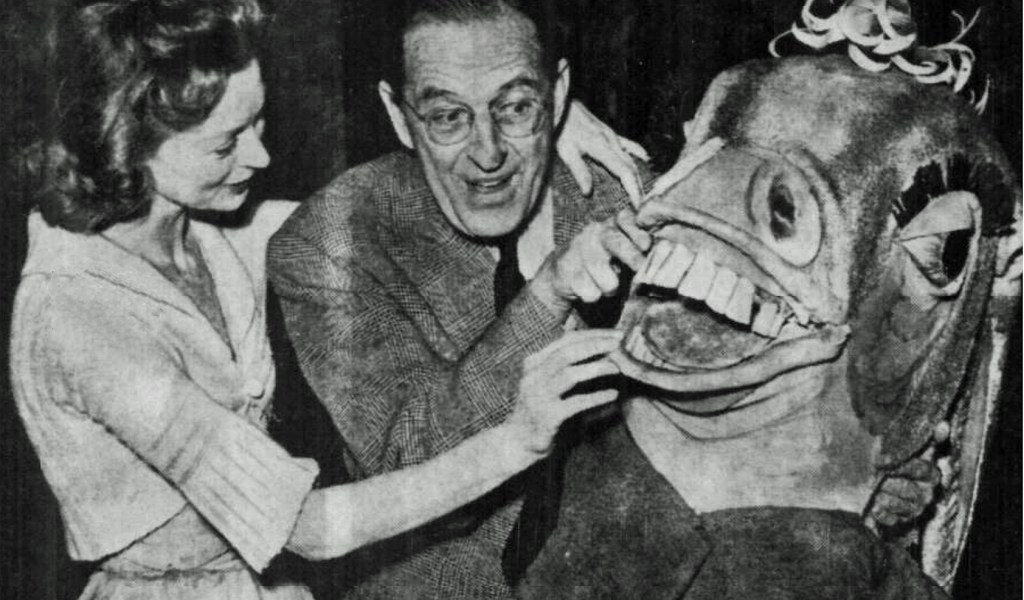
Stanley Holloway, who played Bottom, explains the animated ass’s head he wears in the production to Moira Shearer, August 1954. Photographer unknown. Photo published in The Scotsman.
The reviewer characterised the overall performance by saying, “ultimately the worst defect …. is that by using an almost uncut text it makes matters too sluggish and protracted for a musical spectacle while so much dancing and music are fatal to a true unfolding of the play”. In sum, it is only ”a medley of impressions (and) much that is unmercifully dull”.
John Gassner, reporting in the Educational Theatre Journal for December 1954 under the heading “Broadway in Review”, was one of the more virulent critics. He writes that “The marriage of Shakespeare’s words to Mendelssohn’s music was more conducive to boredom than bliss. The intercession of Moira Shearer’s loveliness and of the painstaking choreography was futile. The production was ill-conceived … everything was lovely, everything proficient” but, he concludes, mightily boring.
After the performances in New York and Philadelphia on October 18th the company set off on a tour of the US and Canada that included cities like Los Angeles, San Francisco and Montreal but also venues on university campuses like the University of Minnesota and Michigan State.
The criticism in the local newspapers that evaluated the overall production largely reflected that in the New York press. The exception was the reviewer in the Oakland Tribune who had seen the production in San Francisco and felt it was a successful amalgam of verse, music and dance.
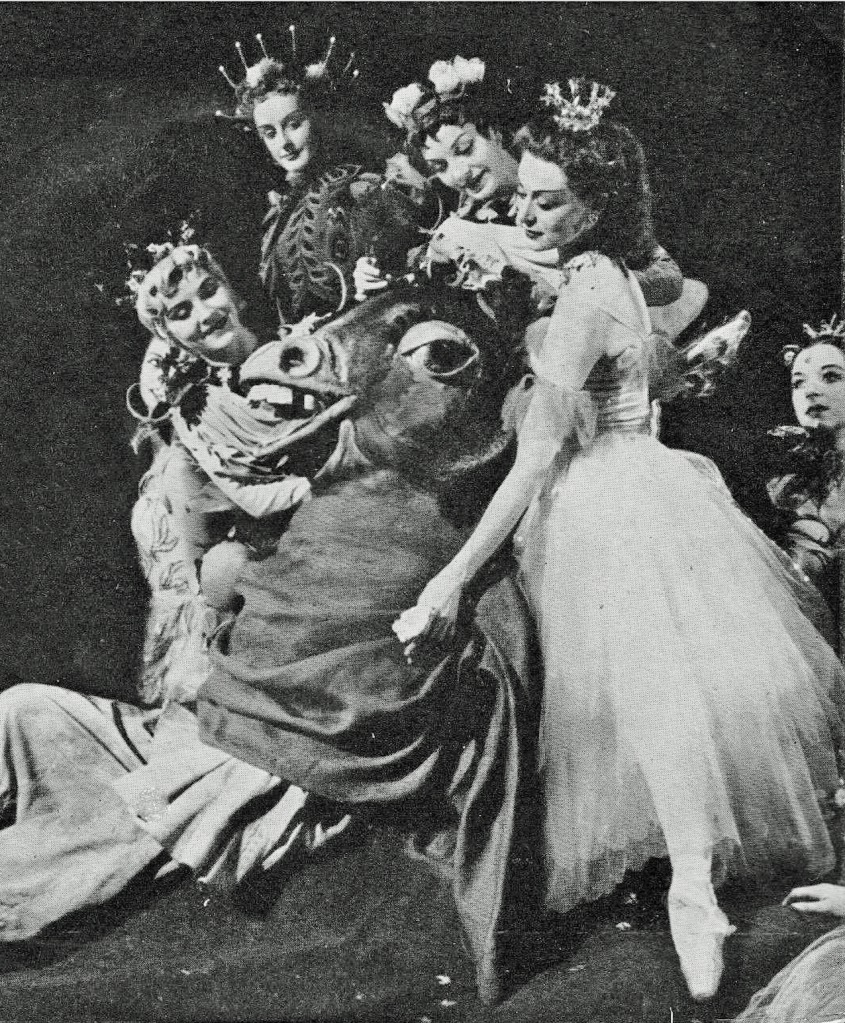
Moira Shearer as Titania professes her love of the ass to the assembled fairies. Neither date nor photographer known. Photo published as a cover to a record of Mendelssohn’s music.
Much of the local press focused on Shearer, partly because she had just announced her intention to quit ballet. These critics, too, concluded that, while she looked the part, she didn’t deliver her lines.
When interviewed for the Minneapolis Star Tribune Shearer was asked for her reaction to the widespread criticism of the production. She felt that much of it was misguided and was at pains to stress the fact that the production was more elaborate than any “Metropolitan” opera; there was a huge cast of 42, a ballet corps of 28, a 60-member orchestra and all those props. To her the sold-out performances indicated that the public response was positive. Yes, she conceded, there had been mixed reviews from the critics. The reporter wrote, “Miss Shearer offered a few flatfooted comments on some of the critics”. “Really”, she said, “you’ve got to approach this as a spectacle. Some of them (the critics) are disturbed because they expect this bare stage and lectern business …. The public ultimately is the final judge and they’ve been most enthusiastic… they wouldn’t sit through it if they were bored”. She concluded, “I suppose you always remember the bad reviews. They stick in your craw”.
Sources.
Glasgow Herald, September 2nd, 1954.
Dale Harris, transcript of an interview made on August 31st, 1976, and September 1st, 1978 in Edinburgh, New York City Library Archive, Lincoln Centre, New York.
Minneapolis Star-Tribune, October 23rd, 1954.
New York Times, “Extravagant Dream, Old Vic to open at Met.”, September 21st, 1954.
Oakland Tribune, October 28th, 1954.
Time Magazine, “Old Play in Manhattan”, October 4th, 1954.
J.C. Trewing, Illustrated London News, September 11th, 1954.


Leave a Reply