Michael Powell and Emeric Pressburger brought in Sir Thomas Beecham, the British conductor and impresario, to conduct the music for the ballet sequence that was the centrepiece of their 1948 film, The Red Shoes. The music was written by Brian Easedale who also served as conductor for the balance of the film.
After The Red Shoes was released, Beecham suggested that Powell and Pressburger consider the opera The Tales of Hoffmann as the subject of their next film. The opera was created by Jacques Offenbach in 1880. Beecham also offered his services as conductor and those of The Royal Philharmonic, the orchestra he had founded.
Powell and Pressburger enthusiastically accepted his offer and in 1950 Beecham created the score and commissioned the English libretto which were to become the basis for the film. Beecham worked with the Royal Philharmonic to make a recording of the opera sung in English. The voiced parts were sung by a number of established opera singers like Dorothy Bond and by the Sadler’s Wells Chorus. In the film itself, with the exception of Anne Ayars and Robert Rounseville, who actually sang their parts, the other actors and dancers would lip-sync theirs’s to Beecham’s recording.
Before the opera itself begins, Hoffmann, the poet, who is the subject of the piece, and his current love interest, Stella, are introduced. In the original opera Hoffmann is in the audience at the theatre where Stella is singing. In the film Stella becomes a ballerina who is played by Moira Shearer and Powell and Pressburger create an epilogue as a way to showcase her dancing talents. As William Germano expresses in his book on the film, the creators “give the audience a view of Moira Shearer doing what they came to see her do: dance”.
This addition, titled The Enchanted Dragonfly, in which Shearer dances with and, eventually, consumes her partner, Edmond Audran, was choreographed by Fred Ashton to match Shearer’s dancing style. Many of the critics praised the ballet and Shearer’s execution of her role while others objected to it as being superfluous and, thus, an empty exercise. An article in the July 1951 issue of Ballet Today wrote of the ballet itself that it had “undistinguished choreography which is acrobatic in movement and curiously static in design”. The critic in the Paris Review focused on Shearer’s performance and wrote, “her adamantine, technically flawless executions in the “Enchanted Dragonfly Ballet” … are bloodless perfection”.
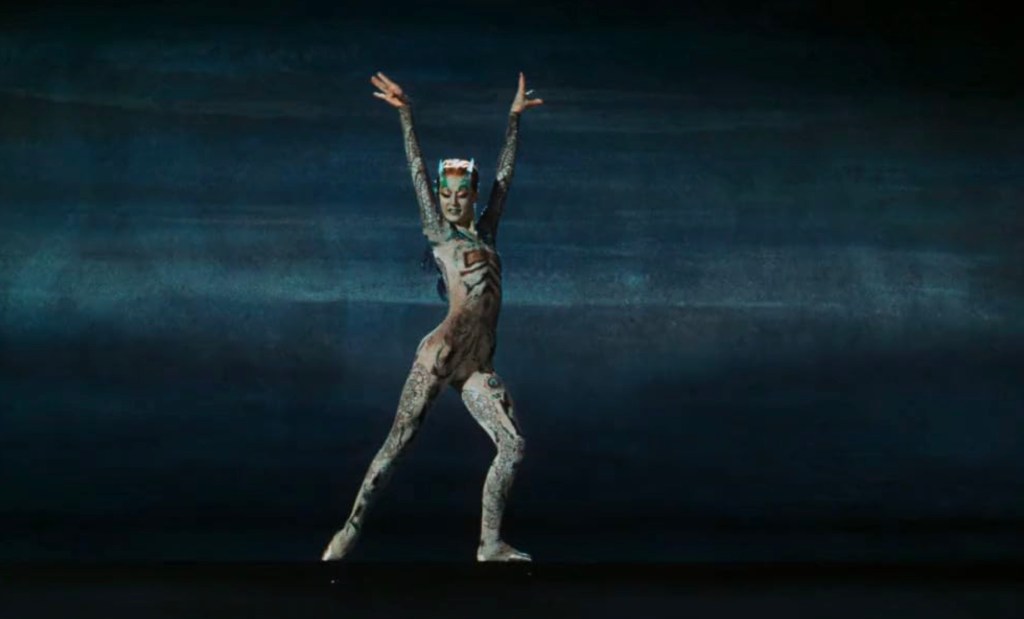
Moira Shearer as a dragonfly in The Tales of Hoffmann. Photographer unknown.
Hoffmann is stricken by desire for Stella at her performance. Stella obviously returns his affection as she writes him a love note on a handkerchief and encloses her room key. This she gives to Andreas, her perfidious servant, in a break in the performance and instructs him to deliver it to Hoffmann. It is, however, intercepted by Hoffmann’s rival, Lindorf, who bribes Andreas and, thus Hoffmann is left unaware of Stella’s interest.
Hoffmann leaves the theatre and enters Luther’s Tavern to drink and regale his friends with “tales” of his many loves. While there and perhaps already drunk Hoffmann imagines a hunchback named Kleinzach, portrayed on one of the beer steins displayed in the tavern, coming to life. The hunchback emerges from the front face of the stein and attempts to woo a beautiful young woman dressed in a medieval costume. Kleinzach is played by Ashton and the object of his love by Moira Shearer. However, she appears to be more intent on regarding her reflection in her mirror than on his advances and summarily spurns him. Hoffmann’s story of Kleinzach seems to unconsciously mirror his own rejection at the hands of his lovers. In the original opera Kleinzach has no love interest and Powell and Pressburger appear to have inserted this to reinforce the parallels between the hunchback and the unrealistic Hoffmann. The change also gives them another opportunity to utilize Shearer’s talents. While the vignette makes no demands on Shearer’s dancing skills her miming forcefully portrays her character’s arrogance.
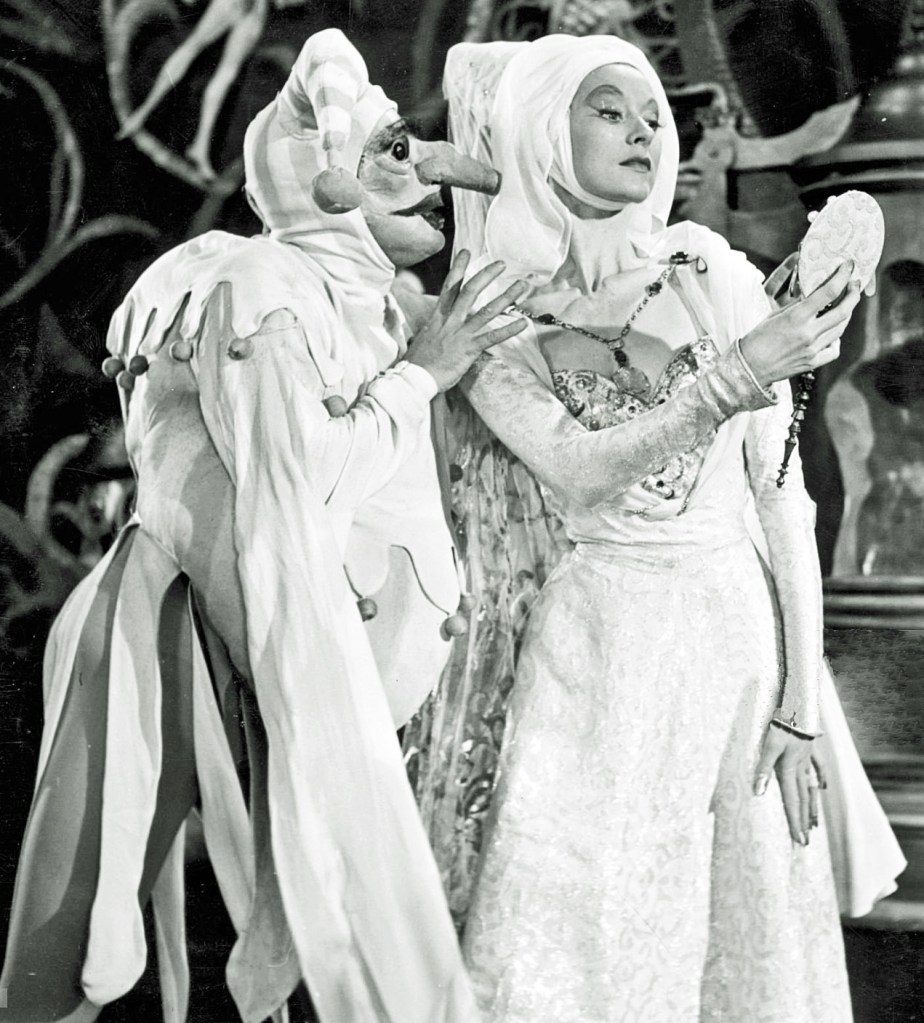
Fred Ashton as Kleinzach and Moira Shearer as his “lady love” in The Tales of Hoffmann. Photographer unknown.
Shearer returns to dance (and sing!) in the first act of the opera itself. Here she plays the part of Olympia, the animated doll created by the inventor Spalanzani played by the Russian dancer Leonide Massine. Spalanzani is aided and abetted by Dr. Coppelius, played by Robert Helpmann, who creates magic eyeglasses that complete the deceit. Together they dupe an unsuspecting Hoffmann into believing that Olympia is real. When he realizes that she is an illusion, Hoffmann is both crestfallen and out of pocket.
Many of the critics expressed that they considered Shearer’s portrayal of Olympia as her most successful foray into films. She was generally praised for her lightning-fast footwork, for her mime and her humour. Bosley Crowther wrote in the New York Times that “(her dance numbers) are cinematic gems, combining a rare and thrilling fusion of pantomime, music and dance”.
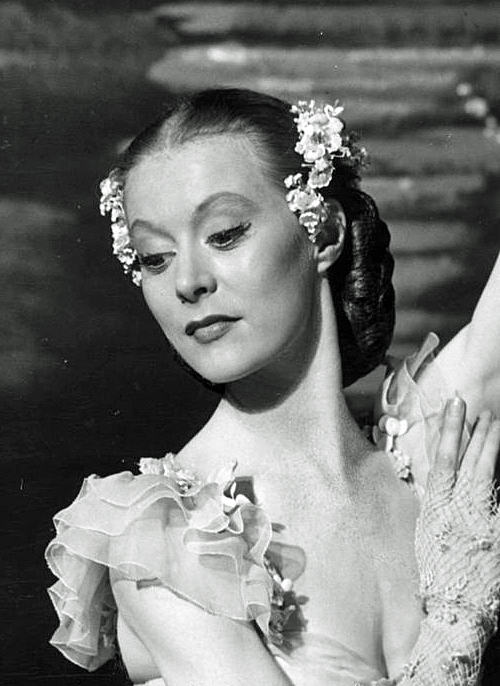
Moira Shearer in her role of Olympia in The Tales of Hoffmann. Detail of a photo by Baron.
Shearer confessed to Dale Harris that she generally disliked portraying dolls like Swanhilda in ballet but enjoyed dancing as Olympia and especially liked working with Ashton.
In addition to dancing with Shearer in his role as Spalanzani, Massine was also involved in its choreography and often arrived early at the studios at Shepperton to prepare. Shearer sometimes shared his taxi from west London to rehearse with him and to participate in production of the many costumes she would use.
Shearer is absent from Acts 2 and 3 that concern two of Hoffmann’s other lovers. She returns in the epilogue which again takes place at Luther’s Tavern.
However, before this final scene Powell and Pressburger inserted another vignette that was intended to showcase Shearer’s talents. It opens with Shearer dancing alone on stage where she creates the image of Stella embodying all of Hoffmann’s lovers. She is then joined by Audran to dance a thoroughly romantic duet in which she wears a reproduction of the calf-length tulle skirt worn by the renowned 19th Century ballerina Marie Taglioni. Finally, she and Audran appear together dancing in a churrigueresque landscape dominated by four massive pillars. As they finish their dance, they disappear into the sunset and the curtain is shown falling on their performance.
This image then dissolves to one of Hoffmann and his companions in the tavern. Shearer suddenly reappears as Stella, this time wearing a sumptuous fur-trimmed gown. Having completed her performance at the theatre next door she rushes to find Hoffmann. As the tavern is in a cellar she enters from the street above, stands atop the steps and, according to the original libretto, “gushing with excitement”, proclaims to Hoffmann, “My darling! What a night! I have never sung better. The ovations!” She pauses as she sees her would-be lover slumped over and exclaims, “Hoffmann! Asleep?”
Nicklaus, Hoffmann’s companion and muse, informs her, “No, ma’am”, “Passed out. You have come too late”
In the original libretto Stella expresses her anger and frustration at Hoffmann, “Asino! Porcaccio!” (“ass, dirty pig”) but in the film Powell or, perhaps, Ashton instead shows her looking at Hoffmann with sadness and disappointment. As she does so Lindorf enters to present her a small bouquet, wrap her in his cloak and lead her away up the steps to some unknown destination. His triumph over his love rival, Hoffmann, is complete.
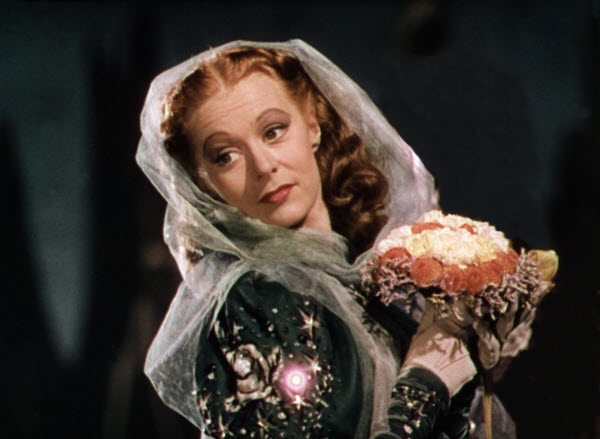
Moira Shearer in her role as Stella at the conclusion of The Tales of Hoffmann. Photographer unknown.
However, this is not quite the end of the film. Instead, Beecham, in a final vignette, is shown energetically conducting the last few phrases of Offenbach’s music and then laying down his baton on the lectern. One suspects that Powell and Pressburger intended this postscript acknowledge Beecham’s central role in creating the film.
Sources.
Ballet Today, July 1951.
Pigeon Crowle, Our Star Ballerina: Moira Shearer. Woman’s Own magazine, September 1950.
Bosley Crowther, New York Times, April 5th, 1951.
William Germano, The Tales of Hoffmann, BFI Classics, 2013.
Dale Harris, transcript of interviews conducted with Moira Shearer in Edinburgh, August 29th,1976, August 31st and September 1st, 1978. New York City Library Archive, Lincoln Center, New York City.
The Paris Review, March 26th, 2015.


Leave a Reply