Moira Shearer and Fred Ashton, one of the principal choreographers for the Sadler’s Wells Ballet, had a long professional relationship that extended from 1943 to 1967. In that timeframe, he created several ballets that drew upon her extensive and remarkable ballet skills.
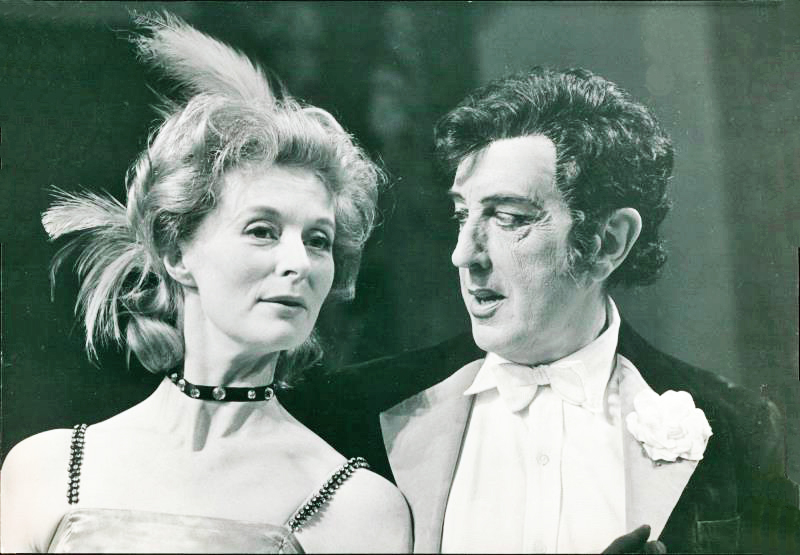
Moira Shearer and Fred Ashton at Covent Garden in 1967. Photographer not known.
In the autumn of 1943, while he was on leave from service in the Royal Air Force, Ashton choreographed a ballet called The Quest. He created the central roles for Margot Fonteyn and Robert Helpmann but also those for the two teenage ballerinas in the Sadler’s Wells Ballet. Beryl Grey played Duessa and Moira Shearer was cast as Pride. Shearer had been with the company for about 18 months, and Pride was her first important role.
In his 1976 interview with Shearer, Dale Harris made the assertion that Ashton chose her for the role of Pride because of her beauty because the “role required it”; Shearer didn’t respond perhaps because this assumption would have made have made her bristle; she spent the majority of her life in ballet trying to get her audience to judge her on her performance rather than on her striking appearance, her “beauty”. When the production of Quest moved from the New to the Princes Theatre in November 1944. Pamela May assumed the role of Pride.
Shearer went on to appear in several of Ashton’s ballets, the most significant of which were the full-length ballet, Cinderella, and, of the shorter ballets, Symphonic Variations. She also had roles Les Patineurs, Scenes de Ballet, Apparitions and A Wedding Bouquet.
Symphonic Variations was the first ballet created after World War 2 by Ashton. The ballet employs six dancers; three female and three male; for the first and for most of the subsequent performances Margot Fonteyn was the lead ballerina and was supported by Pamela May and Shearer. Michael Somes was Fonteyn’s partner and was supported by Henry Danton and Brian Shaw. An article in Ballet Today in 1946 suggested that the six dancers were chosen for their “musicality”, their ability to interpret Franck’s music, as much for their technical prowess.
In Symphonic Variations the curtain rises to silence, to the six dancers standing motionless, the three ballerinas in front. Fonteyn was at the centre, flanked by Pamela May and Shearer. There were six “variations” some of which were duets while others focused on groups of four or on all the dancers. Fonteyn and Somes danced the more demanding duets. The ballet lasted 17 minutes during which time all the dancers remained on stage.
One of the reviews of the premiere performance was published in the Manchester Guardian on April 26th, 1946. “Last night his ballet was performed brilliantly by Margot Fonteyn, elegantly by Moira Shearer, and very competently by Pamela May and the three male dancers”
The ballet remained in the Sadler’s Wells repertoire for many years. Between 1946 and 1953 Moira Shearer danced in it for a remarkable 70 times. This included performances on tours of the British provinces and in Florence, Paris and the US. Occasionally substituting for Fonteyn, she danced the “lead” at Covent Garden about half a dozen times.
Following her 1952 pregnancy Shearer returned to dance at Covent Garden in February 1953. Her first performance was as the lead in Symphonic Variations.
The magazine, The Sphere, reported on her performance. “On February 7th Moira Shearer returned to the Royal Opera House and made her appearance in Symphonic Variations….. The dancer’s pale alabaster beauty makes her an ideal exponent of this choreography, which exploits in an exalted mood the beauty of movement for its own sake and is as detached from everyday life as pure mathematics. Michael Somes partnered Miss Shearer in masterly fashion, giving a feathery lightness to the lifts that did much to accentuate her wraithlike appearance. There could be no more suitable ballet to provide a vehicle for Miss Shearer’s stylish poise and quietly confident attack”.
Scenes de Ballet, Ashton’s next ballet, premiered at Covent Garden on February 11th, 1948. In the lead roles were Fonteyn and Somes. Ashton had written it for Fonteyn and, according to Royal Opera House Archives she danced in it at the premiere and for a further 11 times, most of them in 1948.
Shearer took over as the lead dancer on February 25th, with Somes as her partner, and Grey danced it on February 26th. In the period that Shearer was at Sadler’s Wells she appeared in Scenes about 20 times. Her fInal appearance was on September 21st, 1951, when John Hart partnered her.
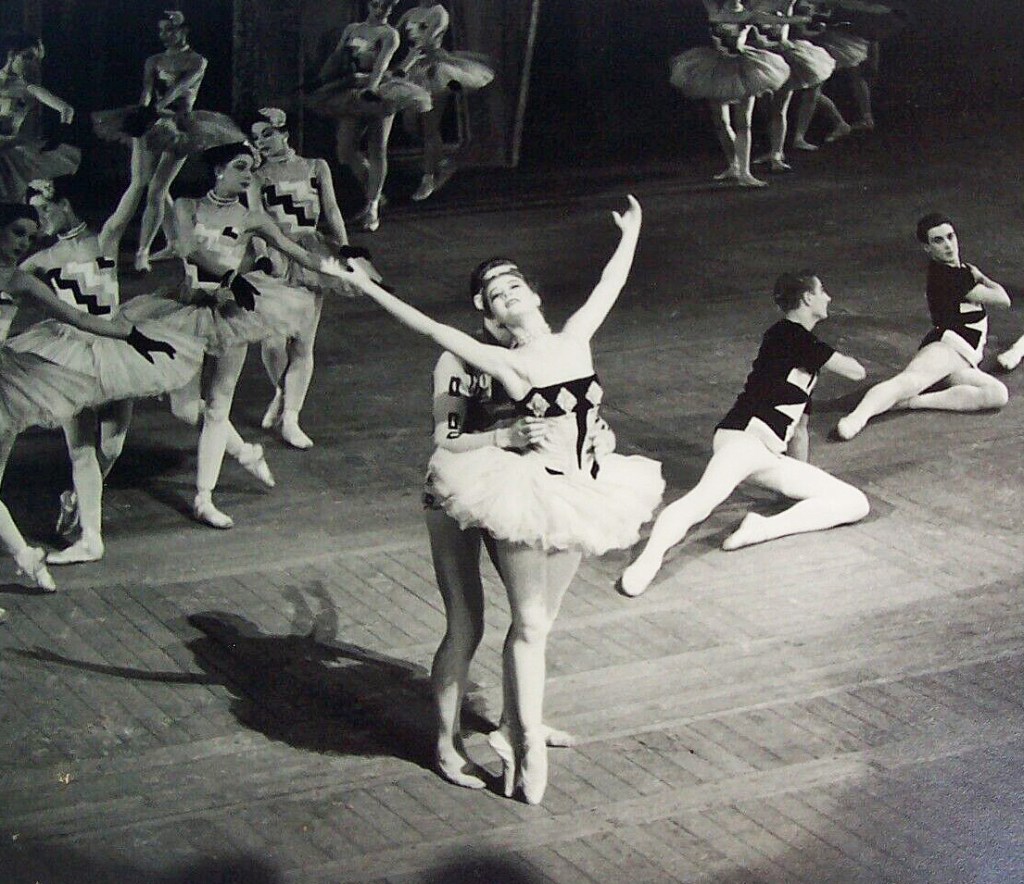
Moira Shearer in Scenes de Ballet, 1948. Photographer not known.
Macaulay writes that Scenes was one of the few ballets where Shearer challenged Fonteyn’s pre-eminence at Sadler’s Wells. Nonetheless, Fonteyn danced at the majority of the first season’s performances while Shearer dominated those in 1949, 1950 and 1951.
The journal, The Stage, for March 16th, 1950, reviewed Shearer’s performance in her March 14th appearance in Scenes. “In her elegant lime green costume, she brought a glamorous sophistication to the brilliant glitter of Ashton’s choreography”.
Also in 1948 Ashton created his first full-length ballet, Cinderella. The lead and title role was again created for Margot Fonteyn. However, Fonteyn decided that she did not want to dance the role at every performance thus Ashton and the director of Sadler’s Wells Ballet, Ninette de Valois, decided that Shearer would share the “first cast” with Fonteyn. Typically, Shearer as second cast would have had no first-hand direction from Ashton. Instead, she would have been expected to learn what she needed simply by observing Fonteyn’s rehearsals and performances.
In this unusual case, when rehearsals began in the autumn both Fonteyn and Shearer received Ashton’s direction.
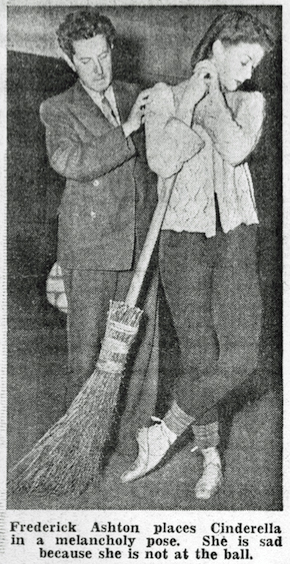
Fred Ashton rehearsing Moira Shearer in Act l of Cinderella. Early November 1948. Photographer unknown.
In late November both Fonteyn and Shearer appeared in the premiere of the ballet, Don Juan, that was choreographed by Robert Helpmann. Toward the end of the final act Fonteyn was injured but managed to complete the performance. However, what she had thought was a slight sprain turned out to be a torn ligament. Fonteyn was taken to hospital, examined and her ankle placed in a cast.
Her injury would require 6 weeks of rest thus Fonteyn was ruled out of the December 23rd premiere of Cinderella. Shearer would dance the lead and Violetta Elvin, the original third cast, was moved up the order to dance as Shearer’s deputy. There were 18 performances up until February 28th , 1949 when Fonteyn returned. Up until this time Shearer and Elvin danced the lead about the same number of times. After Fonteyn’s return Shearer didn’t dance in the ballet for the rest of this initial season.
While each ballerina had her individual strengths in the interpretation of the role, all three ballerinas received positive and, sometimes, rave, reviews from the dance critics. However, the general consensus was that Fonteyns interpretation of the role was the most successful. Ashton maintained that he had created the role for her. While Shearer was successful in her duets with Michael Somes several critics felt that she didn’t display enough pathos in her solo in the kitchen scene in Act I.
When asked about Shearer’s interpretation Ashton described Shearer’s dancing as “brittle” which perhaps implied that it lacked emotional depth. This was a criticism that was repeated often by other critics throughout Shearer’s career.
Shearer’s final stage collaboration with Ashton was in his ballet, Façade. Shearer’s first appearance was on October 31st, 1942, when she danced a minor role in the “valse”. Several years later Ashton took advantage of the elegance of her dancing to cast her as the naïve “debutante”, opposite his lascivious “dago” in the tango. They were to repeat this pairing several times, including during both tours of North America by Sadler’s Wells, in 1949 and 1951.
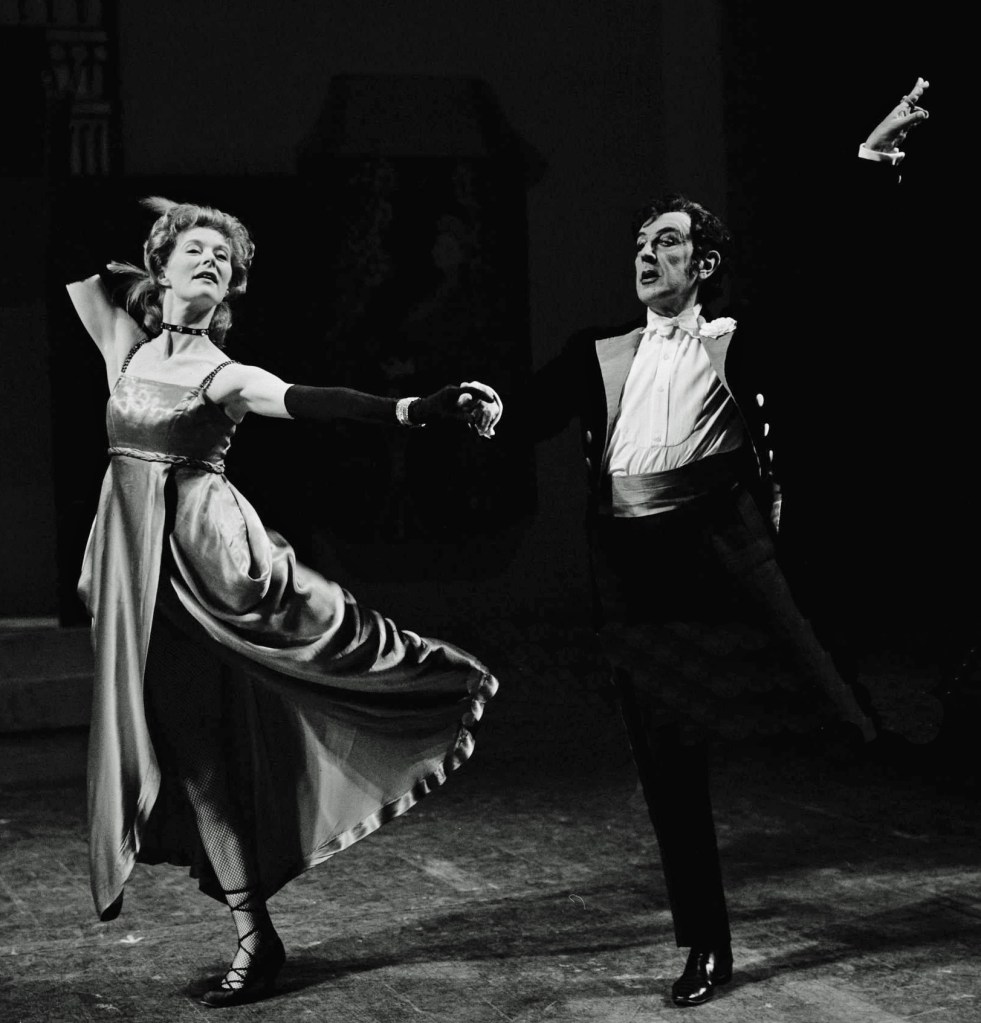
Moira Shearer and Fred Ashton dance the tango in his ballet, Facade, at Covent Garden on December 17th, 1967. Photographer not known.
Ashton and Shearer also gave charity performances of the tango, the first at The Opera Ball on March 22nd, 1950, in Stanhope Gate in London and subsequently in 1967 on December 17th, at The Friends of Covent Garden Ball. In the first case they had danced the role several times during that spring season. In the second, however, both came out of retirement. Ashton was 63 years old and Shearer a slim and youthful 41. She remarked after their brief rehearsal that even after 16 years that she remembered the steps but admitted that she lacked the stamina.
Sources.
John Amis, Notes on Covent Garden, Tempo, number 10, Winter 1948-49.
Ballet Today, July 1946. Edited by P.W. Manchester.
Dale Harris, transcript of an interview of Moira Shearer in Edinburgh, August 29th, 1976, and September 1st, 1978. New York City Library Archives, Lincoln Plaza, NYC.
Alastair Macaulay, www.alastairmacaulay.com/all-essays, no date indicated.
Manchester Guardian April 26th, 1946.
The Sphere, February 12th, 1953.
The Stage, March 16th, 1950. “Covent Garden”.
Yorkshire Post and Leeds Intelligencer, March 23rd, 1950.


Leave a Reply