In 1931 when Moira Shearer, who was then known as Moira King, was five years old she accompanied her parents to live in the small town of Ndola in Northern Rhodesia. Her father was a civil engineer and was working to help establish the copper industry there. The following year Shearer’s mother enrolled her daughter in a small dancing school where she took Saturday morning classes. In her interviews with Dale Harris, Shearer concedes that she remembered little of the classes nor did she recall the name of the teacher. However, the classes were probably run by a former dancer called Ethel Lacey. Lacey had been trained in the Cecchetti method.
Shearer did recall that Lacey’s lessons were very informal and involved all forms of dance, including folk dancing. In the spring of 1932, the Ndola newspaper reported on a dance recital where Shearer performed to the music of the Scottish pipes. The reporter noted, somewhat prophetically, that Shearer’s dancing exhibited the “lightness and spontaneity (that) are the special qualities of all born dancers”.
Lacey confided to Mrs King that she believed her daughter had the talent to become a ballet dancer and encouraged her to continue her training once they returned to Britain.
In 1934 the King family returned to Scotland and Shearer began her formal academic education at Bearsden Academy, north of Glasgow. Mrs King contacted Nicolai Legat, the former Marinsky dancer who, after the Russian Revolution, moved to Britain and with his wife, a former ballerina, set up a dance school in Colet Gardens in west London. In 1934 he included Leonide Massine, Tamara Karsavina, Andre Eglevkski and the American, Sono Osato, among his students.
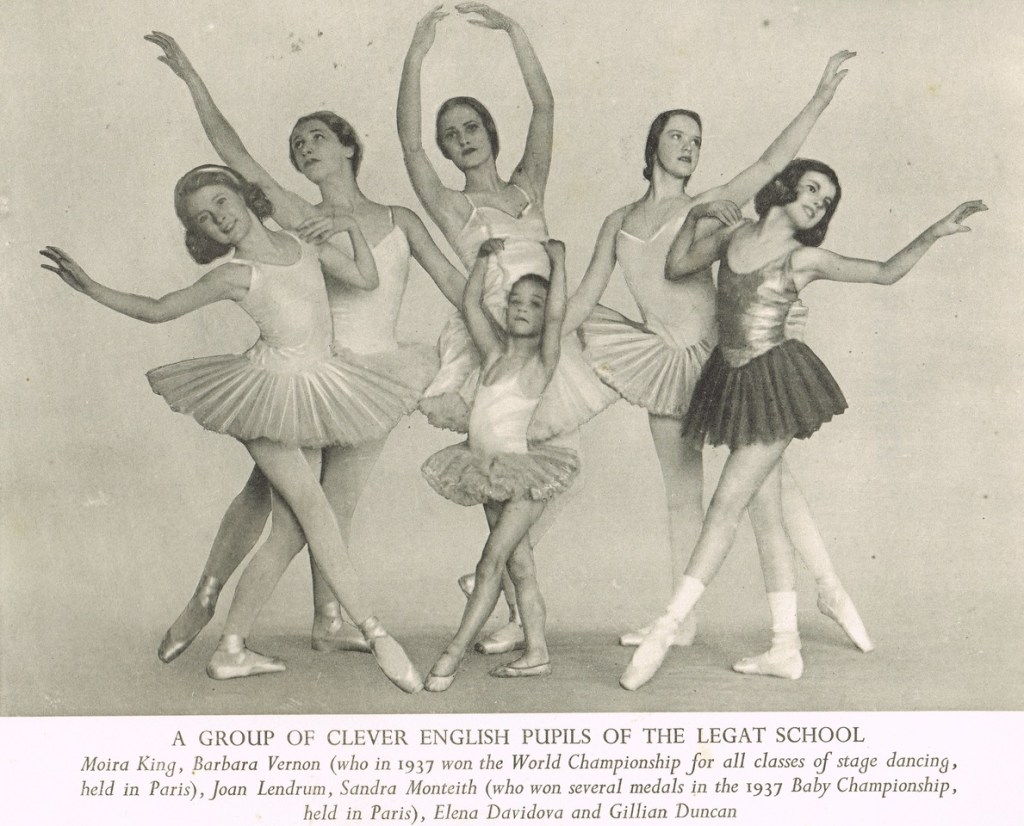
However, on the basis that he did not accept beginners, Legat turned down Mrs King’s request that her daughter join his school. He recommended that, instead, she enrol her in the Mayfair School of Dancing that was run by the former choreographer Flora McDonald Fairbairn. Thus, in the summer of 1937 when the King family moved to London Moira began her formal training. She attended an academic school each morning and took dancing lessons every afternoon.
She had been studying with Fairbairn for only a few weeks when Legat came poaching for dancers that he needed for a planned dance recital. He took note of Shearer’s dancing and asked Fairbairn who she was. When Fairbairn gave her name Legat realised that was the same student he had rejected earlier. He immediately judged her to be no “beginner” and in September 1936 offered her a place at his school.
Shearer recalled in her interview with Harris that she learned a great deal from Legat. However, initially Shearer intensely disliked his regimented teaching style but as she progressed she began to enjoy the classes more. Sadly, Legat died within a few months and in January 1938 his widow, Nadine Nicolaeva, took up the reins of running the school. Shearer considered her a good teacher although not as talented as her husband.
Later that year Fairbairn requested of Nicolaeva that Shearer dance in an open-air “Pageant of the Dances of Europe in London’s Regent Park”. Fairbairn directed the event and most of the dancers came from her school of dancing.
As the attached programme, dated June 18th, shows Moira King had a couple of roles; one as a jester and another in a dance of the Austrian Tyrol.
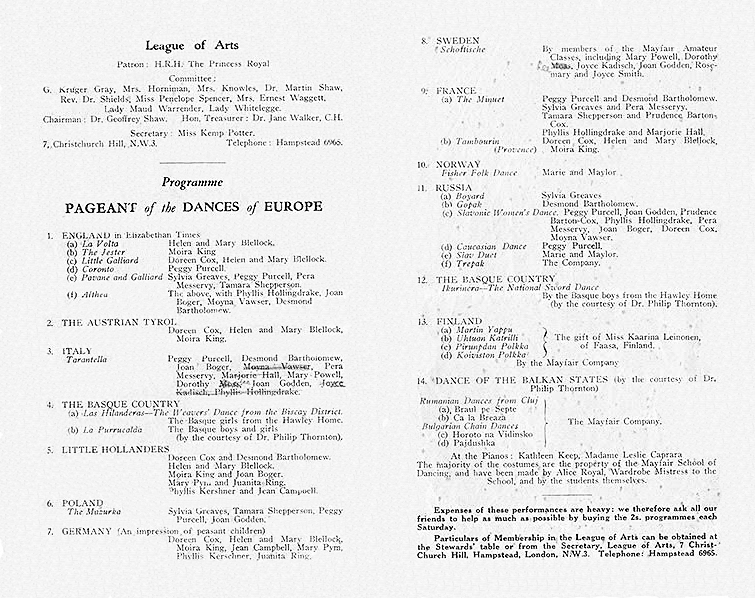
The programme for “The Pageant of European Dances” in Regents Park, London, June 18th, 1938. The Henry Mein Collection at the University of Surrey Archives and Special collections.
Thus, other than her appearance in Ndola, this was her first foray into the limelight.
Shearer remained Nicolaeva’s pupil until the beginning of the war in September 1939 when the school closed temporarily and the Kings returned to Scotland.
Mona Inglesby was also a student at Legat’s school and she met Shearer there. When Inglesby founded The International Ballet in 1941, she invited Shearer to join the company. She was then barely 15 years old. In 1938 Inglesby had known her as Moira King. However, when Miss King attended the Vic-Wells School in 1940, the principal, Ninette de Valois either suggested or perhaps, demanded, that she change her name to Moira Shearer which, as history records, she did.
Sources.
Dale Harris, transcript of interviews with Moira Shearer in Edinburgh, August 29th, 1976 and August 31st and September 1st, 1978. New York City Library Archives, Lincoln Center, New York City.
Barbara Newman, Striking a Balance, Elm Tree Books, 1982.
The Russian Ballet Society, russianballetsociety.co.uk/history/
University of Surrey, Archives and Special Collections, Henry Mein Collection.


Leave a Reply