When Moira Shearer transferred from the International Ballet to the Sadler’s Wells Ballet in the spring of 1942, she was moving from a very small barebones company of 21 to 22 dancers to a considerably larger one, which according to the published programmes, had a complement of between 29 to 34. The International Ballet had a repertoire tailored both to the number of its dancers and to the physical constraints of many of its venues. Typical theatre stages in the towns and cities where they performed did not allow for production of full-length classical ballets with big casts. Rather the repertoire focused on production of excerpts of these ballets and on what might be called “divertissements”. Many of these were choreographed by the director of the company, Mona Inglesby.
During the war The Sadler’s Wells Ballet was constrained in much the same way and their repertoire also included a large number of shorter, less complex ballets. Nonetheless, with a roster of around 30 dancers it was able to stage the classics like Sleeping Beauty, Giselle, Coppelia and Lac des Cygnes (Swan Lake).
As a result, when Shearer joined the company, she was confronted with the challenge of learning parts in about 20 ballets almost all of which would have been new to her. It is little wonder that she spent the first 6 weeks doing nothing but learning and rehearsing. She did not dance in public until May of 1942.
The ballets she learned probably began with Les Sylphides which was often used to open performances by Sadler’s Wells at that time. Her role in Sylphides was initially as a member of the corps of 16 dancers and she appeared in this relatively lowly capacity on many occasions. In September she graduated to dance a more demanding role with Beryl Grey and Pauline Clayden and in October she joined Margot Fonteyn and Celia Franca in the same role.
On May 27th and, much to her surprise, Ninette de Valois, the director of Sadler’s Wells, assigned her the role of a peasant in a pas de deux in de Valois’ ballet, Orpheus and Eurydice. This was her first “solo”. She recalls that it was a major challenge for her and, while she received no feedback from de Valois on her performance, she danced the role several times. Her partner was probably John Hart.
During her first 6 months Shearer danced in about 10 ballets in corps roles. These included The Prospect before Us, as a court lady, in Rendezvous as a “walker out”, in Lac des Cygnes as a swan and court lady and in Coppelia in the “dance of the hours”. This latter role she would have known well as she had danced it with Sadler’s Wells in April 1940 while she was a student at the Vic-Wells School.
On November 24th Shearer danced her second “solo” as a serving maid in The Gods Go-A-Begging, a ballet choreographed by de Valois. While there is no record of this performance there are several photos of her in her simple “peasant” costume carrying a basket of lemons. The photos capture both elements of the choreography and Shearer’s obvious pleasure of dancing the part.
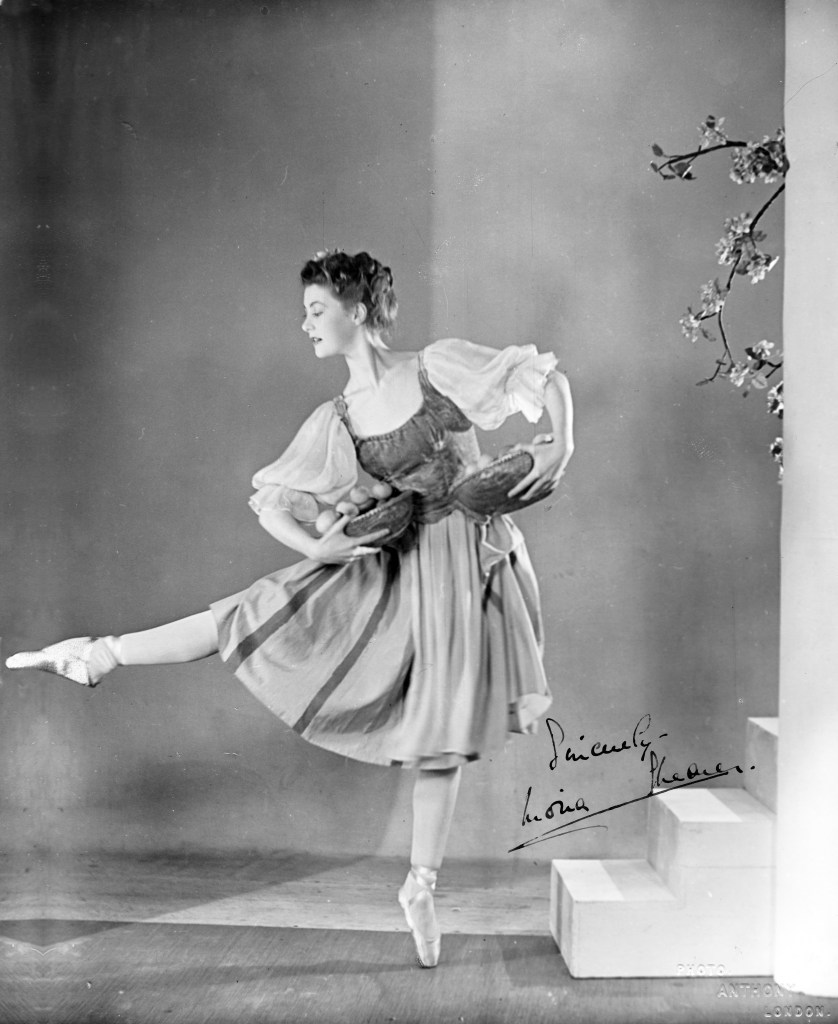
Moira Shearer in her role of a serving made in The Gods Go A-Begging. Photo by Anthony.
On November 26th Shearer danced as an attendant dove in “The Birds”; Beryl Grey took on the more difficult role of the nightingale and Alexis Rassine was the male lead. Shearer graduated to assume Grey’s role in February 1943.
Shearer continued in her corps roles into 1943 and beyond. New roles emerged in February 1943 when she danced the mazurka in Coppelia and was one of a dozen wise virgins in de Valois’ ballet, “The Wise Virgins”.
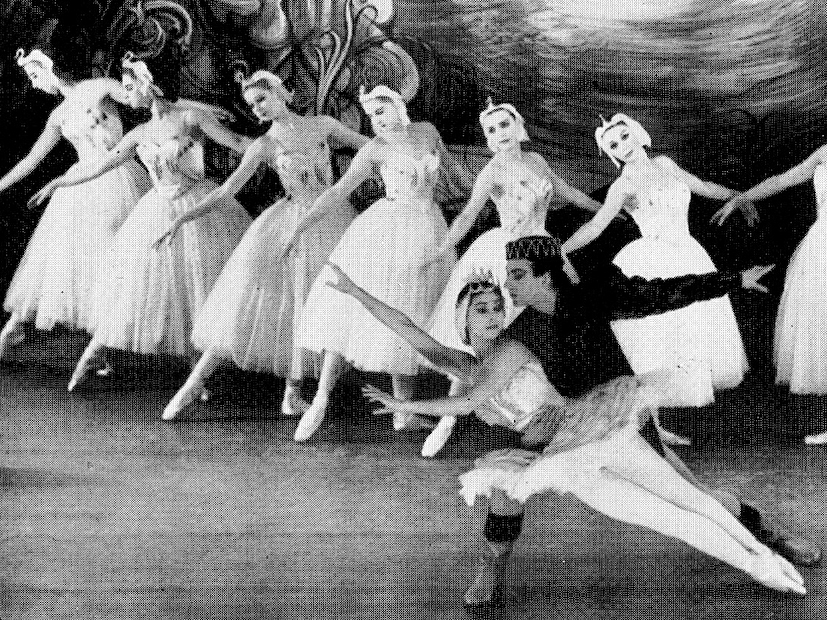
Shearer, third from left, dancing as a swan in Swan Lake on September 7th, 1943. Margot Fonteyn portrays Odette and Leslie Edwards is Benno. Photographer unknown.
In a major break she danced the role of Pride in Fred Ashton’s new ballet, “Quest” which premiered on April 6th. This was the first role written for her. Dale Harris, in his 1976 interview of Shearer speculated that Ashton had chosen Shearer based on her “beauty”, as the role required it. Shearer did not respond to this assertion. She may have preferred to believe she was chosen based on her ability.
Her performance in Quest generated her first press coverage. This appeared in the magazine, The Tatler, the trade journal, The Stage and in the daily newspaper, The Manchester Guardian. The Tatler praised her “exceptional grace and lightness of movements” and the Guardian for her “beautiful dancing”.
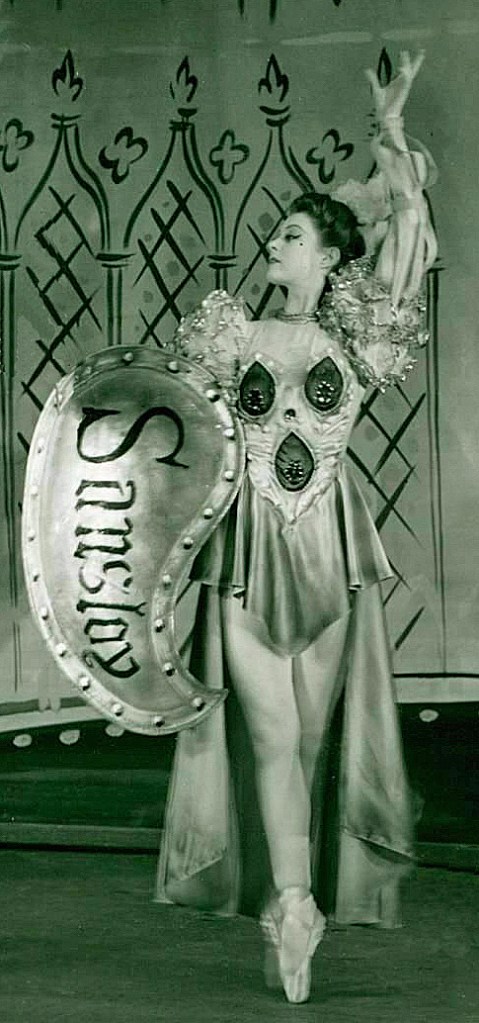
Shearer in her role of Pride in Frederick Ashton’s ballet Quest in 1943. Photographer unknown.
Thus, in her first year at Sadler’s Wells had progressed from being yet another swan in Swan Lake to a dancer who commanded the attention of the national press. Throughout 1943 and into 1944 she continued to dance in the corps as, in a small company, especially in wartime, this almost daily contribution was what was required. Shearer recalled that she danced in the corps for 4 years, a period that extended up until the company moving to Covent Garden. She added that she regretted not a moment of it.
Sources.
Dale Harris, transcript of interviews conducted with Moira Shearer in Edinburgh, August 29th, 1976 and August 31st and September 1st, 1978. New York City Library Archive, Lincoln Center, New York City.
The Manchester Guardian, July 8th, 1943.
The Stage, April 8th and May 27th, 1943.
The Tatler, March 24th, 1943.
Notes.
- The repertoire at Sadler’s Wells Ballet in 1942 and early 1943 consisted of 19 ballets. These included Lac des Cygnes (Swan Lake), Sleeping Princess (Sleeping Beauty), Coppelia, The Birds, The Wanderer, Dante Sonata, The Prospect before Us, The Gods Go A-Begging, Rendezvous, Les Sylphides, Orpheus and Eurydice, Quest, Comus, The Wise Virgins, Giselle, Casse Noisette, Les Patineurs, Facade and Hamlet. A review of available programmes indicates that Shearer danced in the corps in most and the principal role in 3 of them.
- The major ballets would occupy an entire performance. Swan Lake lasted between 2 hours 45 minutes and 3 hours and had 2 intermissions. The shorter ballets or divertissements typically lasted between 20 to 30 minutes. Quest lasted about 45 minutes.
- The number of dancers varied by ballet. Swan Lake required almost the full company whereas Les Patineurs required only 15. The Birds and Les Sylphides required 20 dancers, Façade 23 and Comus 26.
- The available programmes record approximately 180 days on which Shearer danced; as she often danced in 2 if not 3 ballets on any given day, she probably gave at least 300 performances between May 1942 and May 1943.
- The signed photo of Shearer in The Gods Go A-Begging is by Anthony and might date to either 1942 or 1943. It comes from a collection of photos and programmes made by a ballerina at The Anglo-Polish Ballet. It has been slightly edited in Photoshop as the original cuts off her toe!
- Shearer’s signature on the photo by Anthony is one of the earliest known.


Leave a comment