The May 1958 issue of the vaguely risqué British magazine, Men Only, included an article on Moira Shearer by the American writer, Sam Solon (S. L. Solon). The article was titled “Bewildered Beauty” and explored Shearer’s career as an actress.
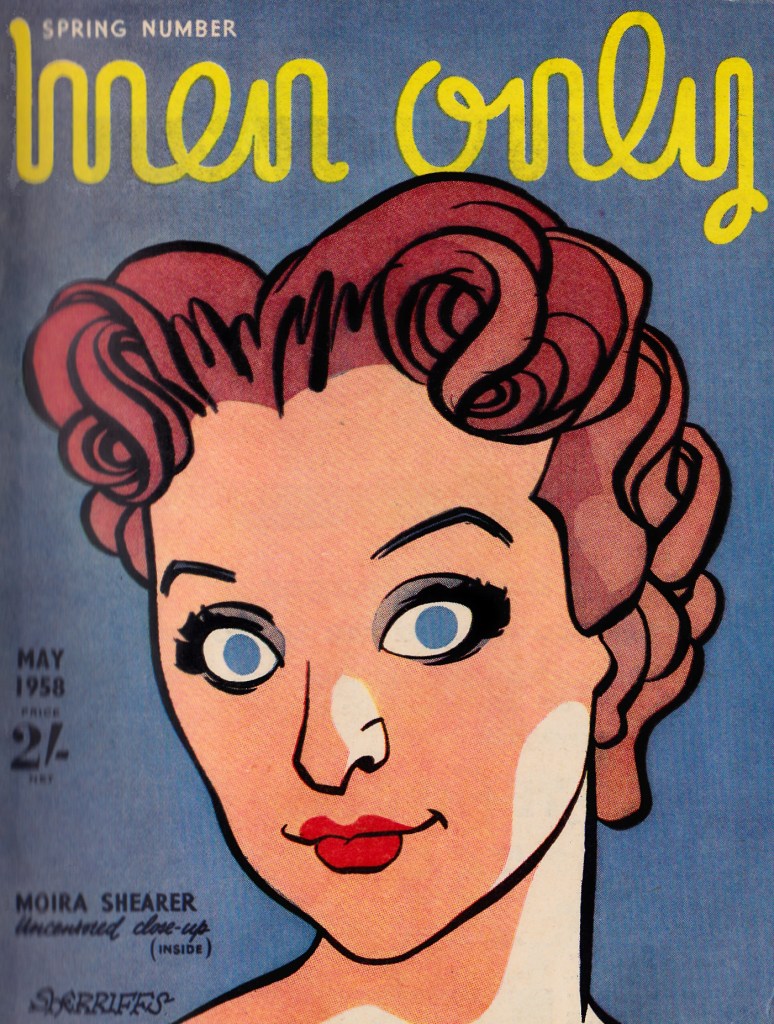
The cover of the May 1958 issue of Men Only. The artwork is by the Scottish illustrator, Robert Sherriffs.
An edited and annotated version of the article appears below. Much of the biographical information is omitted because it is covered elsewhere in this blog.
“The young woman who wept in the dressing room of London’s Princes Theatre was beautiful, famous, happily married, with two children, and bewildered. Moira Shearer had just announced that she was through with the theatre. “I don’t think I have any talent for it”, she told John Barber. “And coming from the tight little Covent Garden world I’ve always felt a bit of a stranger in the theatre. It seems silly after all this work”.
This was the third time Moira appeared to abandon a course which seemed ready made for her…. she had quit the ballet after almost reaching its eminence. She had spurned films after showing she could act successfully in them, and now she was giving up the theatre. No wonder that those who like Moira and admire the delicate Bayeux tapestry-like quality of her art were appalled. Was it true that Moira, not yet 32 years old, had had her fill of a stage career?
Well, it was announced the next morning that it wasn’t true….
She gives the impression of uneasy wanderer in the jungle of the arts, as if she did not really believe in its creatures and their strange ways. The reason is perhaps that she is far “too-well-brought-up” to enjoy the noise, the passions, the glitter, and the noisome ballyhoo that are an inseparable part of show business. If Moira could act in some exquisite company of another age, performing masques and charades before kings and their ladies at Fontainebleau or St. Petersburg, she might avoid the plain vulgarity which invests the atmosphere of the “performing player”.
Moira does not give the impression of greatness in her art as much as of fineness. There is meticulous craftsmanship and attentiveness to detail in her best ballet roles. The excitement of her unexpected beauty – and ballerinas are not as a rule beautiful- adds to a quality of other-worldliness. What is lacking is only felt in the long run- that is, a sense of total abandonment to her role which the greatest performers convey. Her capacity falls short of the tragic mood, and instead of the dying swan fading in an infinitude of sorrow, the viewer is suddenly aware of a tidy little girl worrying (it may be) about a hole in her tights.
It is doubtful if she has contributed any lasting innovations to her chosen art. It came as a surprise when she suddenly – to her public- announced that she was leaving ballet for good. “I didn’t want to go on like Ulanova leaping about the stage until I was nearly fifty”. Not that anyone would find much wrong with that.
She inveighed against the techniques used in film-making. “After six months of The Red Shoes method of filming, a dancer would have no technique left”.
(She) went on to make two more films – The Tales of Hoffmann, which went nowhere in particular and did nothing much for Moira; and The Man who loved Redheads, which confirmed that she had a pleasant comic talent, a sense of timing and a lot to learn.
Moira decided to learn the business of acting as seriously as she had studied dancing. She joined the Old Vic Company in Bristol and there in repertory went through an assortment of parts from I am a Camera to Major Barbara. It was harder work than dancing, and possibly drama critics are not as even-tempered as dance critics.
When Man of Distinction opened in London with Moira playing opposite Anton Walbrook, the critics received it sternly. One said: “it is breathtaking in its lack of impact”. Another was even more succinct: “here is a play to avoid”. Most agree, however, that despite the feebleness of her part – not her fault – she looked like a promising actress. She needed more promising plays.
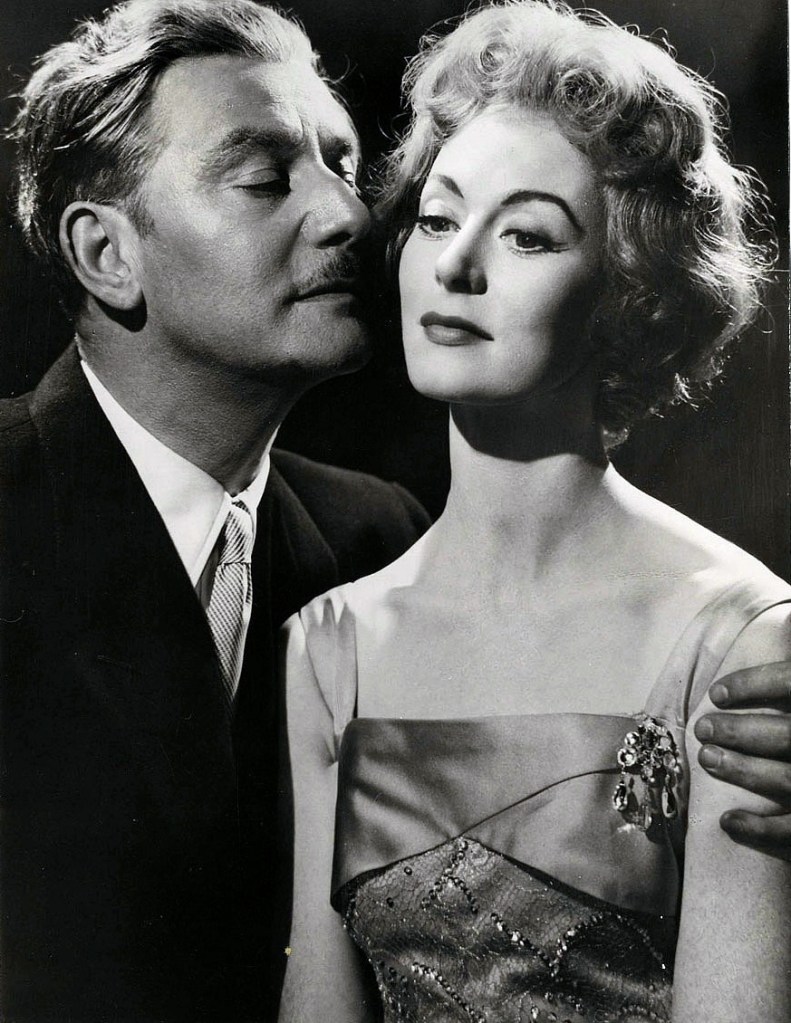
Anton Walbrook as Hugo Mobius and Moira Shearer as Lia Compass in the play, Man of Distinction in 1957. While they portrayed lovers in the play as actors they did not get along well. Photographer unknown.
The next year or two may see the settling down of Moira’s confused ambitions. She can become a considerable actress, but only if she chooses roles with care. In temperament and background she is more suited to the elegant comedies of Oscar Wilde than with the dramas of Ibsen. It would be a mistake if a few setbacks should discourage Moira from continuing her stage career. After all, how often is it that a single slender beauty embodies so much zest for performing, and so much authentic quality.
Notes.
The article seems to rely heavily on the reporting of John Barber, theatre critic for the newspaper, The Daily Express, who was actually present for Shearer’s announcement on October 28th 1957. Solon was not.
“It seems silly after all this work”. Shearer was, in fact, correct. Despite all her best efforts, detailed by Solon in the article, she was not yet the actress she wished to be. She was, however, beautiful and famous and theatre impresarios lined up to take advantage of these qualities. She was, like many would-be actors before and after her, exploited. She was also paid, and, perhaps, paid well, for her efforts.
“She had spurned films….”. This is inaccurate as the films obviously showed she was, up until that time, an unaccomplished actor.
“Bayeux tapestry-like”. A mysterious analogy.
“… it wasn’t true”. This is not case. Shearer quit the theatre on October 28th, 1957 on the night that the play in which she was appearing, “Man of Distinction”, folded after a three-week run at the Princes Theatre. Shearer did eventually return to acting but not until many months later.
“an uneasy wanderer in the jungle of the arts”. Two critics who saw Shearer’s performance in “A Man of Distinction” praised it. One was John Barber, and the other was “RBM” who wrote for the trade journal, The Stage. Barber advised his readers to avoid the “desperately unfunny” play even though that would mean that they would miss Shearer’s “performance of twinkling enchantment”.
RBM wrote, “with her well-defined and amusing portrait of Lia (Compass) …. Moira Shearer shows that her apprenticeship to acting, first undertaken when she left the world of ballet, is bearing good results. Her performance has drive, variety and character. Her charm, which she uses with discretion, does much to make the evening enjoyable. One now feels that in the right part in a good play she could at last replace her ballet stardom with the other stardom she has worked so hard to achieve”.
Solon writes as though he was familiar with ballet. While he was an American he may have been living in Britain at the time he wrote this article (in 1957 or 1958) and may have seen Shearer dance (up to 1953). He had been a writer for the London newspaper, The News Chronicle, during World War 2.
“Not that anyone would find anything wrong with that”. Is Solon referring to Ulanova’s leaps or Shearer’s desire to quit ballet while she was still young?
Making the Tales of Hoffmann gave Shearer a great deal of pleasure and, presumably, allowed her to continue to pay off her mortgage. While the film did not acquire the blockbuster status of The Red Shoes most critics considered it to be a success. Shearer’s brilliant dancing and mime were central to this success.
I am a Camera was not produced under the aegis of the Bristol Old Vic; Major Barbara was. Camera with Shearer in the lead role was performed for 4 months in British provincial towns; it generated a great deal of critical press and was financially very successful. Major Barbara received almost no press. What little appeared was highly critical of Shearer’s performance.
“the dramas of Ibsen”. After she completed her year in repertory at the Bristol Old Vic the company invited Shearer back as a “guest” to play Miss Julie in Strindberg’s play of the same name. However, it was not to be, as during rehearsals, both she and her leading man fell ill and the production was abandoned.
‘The next year or two……”. Solon’s hopes for a continuation of Moira Shearer’s were largely dashed. While she continued to appear occasionally on the stage and in films she gradually assumed a life of domesticity. When this article appeared in 1958 she had just settled into a large Georgian house in Amersham, Hertfordshire, caring for her husband and two daughters. By 1963 there were 4 children and the die was cast.
Source.
S. L. Solon, Men Only, May 1958


Leave a comment