When asked by a reporter during one of her lecture tours of the U.S. in the 1980s why she took on such a long and exhausting schedule, Moira Shearer replied succinctly, “I have a terrible overdraft”.
Needless to say, she was being euphemistic. One of her chroniclers at the time described the Kennedy family as being comfortably well off. Yet Shearer seemed to be aware both of the financial pressures on her and the importance of taking advantage of opportunities when these presented themselves.
In 1948 the British newspaper, the Birmingham Post, in an article on “Ballet Dancing as a Profession” indicated that the minimum pay for a fulltime ballet dancer in London was £4 a week. The wages at the Sadler’s Wells Ballet Company probably exceeded that figure and perhaps even topped the London average of £7 a week. A fulltime dancer performed on average 8 times a week and the annual contact at Sadler’s Wells included a three-week paid holiday. All dancers, irrespective of sex or status, were allocated 2 pairs of point shoes a week. As they might well wear out at a single performance, shoes were carefully repaired by the dancers themselves. Like all other dancers Shearer learned to be frugal.
By early 1950 the salary of members of the corps de ballet at Sadler’s Wells rose to between £6 to £8 and Margot Fonteyn as the prima ballerina earned £25 a week. Shearer, as one of the premiere danseuses, received between £12 to £15 a week.
In 1947 Michael Powell, director of “The Red Shoes” offered Shearer the lead role in the film. The contract they negotiated was initially for 3 but was extended to approximately 5 months. Her salary was £5000 plus expenses. This represented a sum about 20 times greater than she would have earned at Sadler’s Wells over the same period.
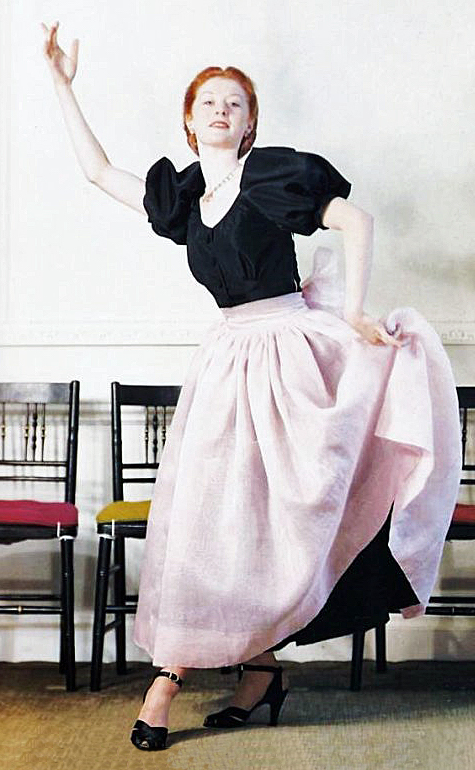
A portrait of Moira Shearer in 1947 at around the same time as when Michael Powell approached her about appearing in “The Red Shoes”. Photograph by Cecil Beaton for Vogue magazine.
It is little wonder that she eventually agreed to these terms, although they were arrived at only after some tough negotiating by her agent. The agreement gave her financial independence and security of which other British ballet dancers could only dream.
Sources.
The Bath and Wiltshire Chronicle, “Ballerina’s Life without Glamour”, January 7th, 1950.
The Birmingham Post, A Woman’s Notebook, “Ballet Dancing as Profession”, December 12th, 1948.
David Thompson, The Independent, February 12th, 2006, “Film Studies: What made Moira a Star? Poise and charm? Suspicion and fear, actually”.


Leave a comment