In 1987, while he was working in California, Powell wrote an article for the magazine, American Film. It was titled “Dance, Girl, Dance” and documented how, 40 years earlier, he persuaded Moira Shearer to appear in his film, “The Red Shoes”.
The article is reproduced below with minor edits intended to add clarity to the text.
“It is 1946. The Red Shoes are quivering with impatience in the wings. I am 41 years old and weigh 110 lbs. By now (J. Arthur Rank’s) Independent Producers are a power in the land…. Arthur Rank and John Davis, impressed by the half a dozen Academy Award nominations for Black Narcissus and by the success of A Matter of Life and Death, were anxiously waiting to know of our next subject – and what it would cost. They must have paled and looked at each other with a wild surmise when we answered them – “a film about ballet”.
I can’t describe the plot better than Boris Lermontov does in the film.
Lermontov: “the ballet of The Red Shoes is from a story by Hans Christian Anderson ….. oh! (by the way) in the end she dies”.
On and around this beautiful tale Emeric (Pressburger) had spun a full-length screenplay for London Films in 1937 or 1938. I had read Emeric’s material. I said (to him), “I’ll do it if a dancer plays the part and if we create an original ballet of “The Red Shoes” instead of (just) talking about it”.
There was a great deal of rewriting to be done. (In 1946) we figured on about four month’s preparation before we started shooting on location in France in June 1947. We allowed 4 weeks for that, to include a few pick-up shots in London, followed by the studio scenes of the principals, some of which would include the whole ballet company. Last of all came the ballet of “The Red Shoes” itself. This scheme worked out, more or less.
We had to buy back Emeric’s script from Alex (Korda) ….. a score was commissioned and it was time to look for the girl.
At this point fate, in the shape of Jimmy Granger, took me by the arm in the noisy Pinewood canteen. He had become a big star by now.
(Granger said) “Mickey! You’re looking for a ballerina, aren’t you?”
Jimmy always knew all the new girls as soon as they hit town, so I said, “Yes, Jimmy” and waited.
(Granger) “Well, there’s a new girl at the (Sadler’s) Wells. She’s in Bobby Helpmann’s new ballet. Go see her. She’s got it, whatever it is”.
The ballet was “Miracle in the Gorbals”. It was in the repertory already, and I would have to wait a week to see it. (In the meantime) I spoke to Bobby.
(Helpmann) “Oh … Moira….. yes. You could do worse, I suppose. She’s very spectacular looking”.
“Do you think she could do it?” I asked.
(Helpmann) “Mmm …. she might … she’s coming up very quickly. She ought to be out there dancing leads, but you know Madame”.
I said that I knew Miss (Ninette) de Valois.
(Helpmann continued) “Yes, She believes in bringing them on slowly. There’s Margot (Fonteyn) too, you know. Ninette thinks the sun shines out of Margot’s little a..e. She wouldn’t want anyone to stand in her light, would she?”
(Powell asked) “What sort of voice has this girl got?”
Helpmann) “Well, she has a voice. She’s Scottish, you know”.
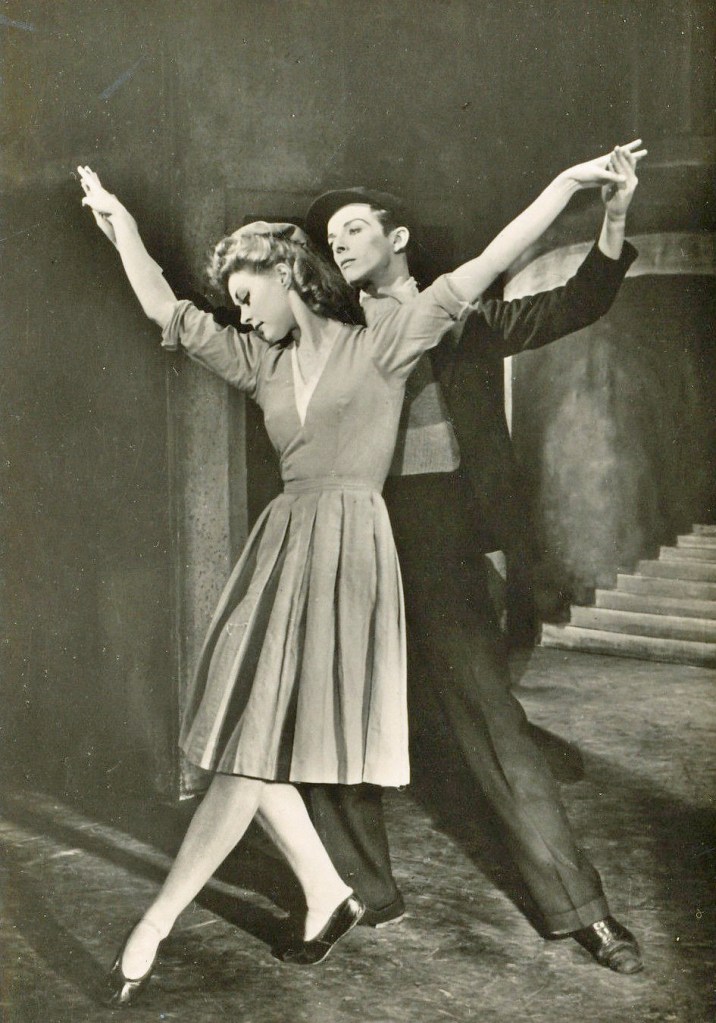
Moira Shearer and Alexis Rassine in the dance of the lovers in the ballet, “Miracle in the Gorbals”, 1946. Photographer unknown.
In due course I saw “Miracle in the Gorbals”. The girl was sensational. I asked that a meeting be arranged. A month went by – Miss Moira Shearer was at a class …. Miss Shearer was at a rehearsal … Miss Shearer was having costume fittings – then, finally she managed to fit me in between a hairdresser’s appointment and a performance.
She was tall with the most glorious hair of Titian red that I had ever seen on a woman. And I’ve seen some. She had a cheeky face, well bred and full of spirit. She had a magnificent body. She wasn’t slim, but she didn’t have one ounce of superfluous flesh. Her eyes were blue. After a few minutes conversation I offered her the part. I would have offered it to her the moment we met but I didn’t want to seem frivolous. As it was, she looked startled.
(Shearer) “Are you serious, Mr Powell?”
(Powell) “Quite serious. The part is yours. We don’t start shooting until June next year. But, you understand, you have to prepare a long way ahead”.
(Shearer commented) “You, too, I suppose”.
Silence. Then.
(Shearer) “What are you going to pay me, Mr Powell?”
I grinned. She was Scottish, alright.
(Powell) “Oh, a thousand pounds or so, and a retainer and expenses during the running up period”.
(Shearer) “I see. I would have to get Miss de Valois’ permission, of course”
(Powell) “Are you under contract to the Wells?”
(Shearer) “We have no contracts”.
(Powell) “Do you think she’ll be sticky about it?”
(Shearer) “I beg your pardon, Mr Powell”.
(Powell) “I mean, it cuts both ways, doesn’t it? No contract, I mean. She can hardly stop you from doing what you want to do, so long as you give her plenty of notice”.
(Shearer) “The ballet is my career, not the cinema, Mr Powell. I must go now”
A week later an agent rang up. He was not a very big agent, but I knew him. He said he represented Miss Moira Shearer. He understood that Powell and Pressburger had offered a leading part in a dance film entitled “The Red Shoes” to his client, at a proposed fee of £1000 plus a retainer and expenses. Miss Shearer would want a retainer of £1000 to be paid immediately, expenses to be agreed, and a fee of £5000 for a 12-week film, half of it to paid at the end of the first day’s shooting and the balance on the last day.
To myself I nodded approval. She was Scottish alright. To the agent I said, “who did he think Moira Shearer was? Deborah Kerr?”
At this point in their career the Archers (the Powell and Pressburger company) were tall in the saddle and pretty arrogant about it. They had recovered from the shock of the failure in “A Canterbury Tale” and were being courted by Sir Alex (Korda) who promised them the earth, moon and stars and a charge account at Claridges if they would only leave Rank for one picture and make for him a remake of “The Scarlet Pimpernel”. They seemed to have the world at their feet, or, at any rate, a ballerina’s feet, with “The Red Shoes” next on their list. But the gods smelled hubris and a thunderbolt struck. Moira’s agent wrote to say that she had changed her mind about doing the film.
Bobby Helpmann was unsympathetic. “I told you so. The old girl has her dander up. She talks about gratitude and devotion, discipline. You won’t get Moira”.
(Powell) “Why?”
(Helpmann) “Because she’s scared”
(Powell) “Of what?”
(Helpmann) “Of losing her place in the running. Don’t be dumb. She’s out to take Margot’s place as prima ballerina assoluta”. She would give that up for all the tea in China. Ninette has already promised Moira the lead in “Sleeping Beauty”.
As soon as she made her decision Moira regretted it. At this point, when she was still hesitating, Emeric came to me. He looked more than usually mischievous. “Michael, we must find another girl for the part of Vicky”.
(Powell) “I dare say, but what makes you think we’ll find another Moira”.
(Pressburger) “Michael, have you heard the phrase “(use) a sprat to catch a mackerel”? It is in the Oxford Dictionary of Quotations”.
(Powell) “You mean a redheaded mackerel?”
(Pressburger) “You go to America, you find another girl, you bring her back to England with lots of publicity to make a test for the part, and Bob’s your uncle”.
(Powell) “Is that in the Oxford Dictionary of Quotations too?”
(Pressburger) “No, I learned it from Bill Wall. When I say, “Bob’s your uncle”, you say, “and Fanny is my aunt”.
In America I met a lot of Russians all with ballerinas in tow. I met Sergei Denham. He found me a girl. I brought her back to England and we announced she was going to be tested for the leading role in “The Red Shoes” – and Fanny was my aunt: Moira changed her mind.
To hell with Miss de Valois! She wanted to play and dance that part. So, is it any wonder that Emeric had such a seraphic smile?
“Not a mackerel”, I said, “but a whale!”
Emeric looked pained. “What a way to talk about a lady!”
Notes.
Caveat. While it is obvious that Powell had a prodigious memory it beggars belief that he could have remembered conversations from 40 years earlier in such detail.
Emeric Pressburger was Powell’s partner and co-producer in the film company called The Archers.
“… if a dancer plays the part”, of the female lead, Victoria Page
London Films was owned by Sir Alexander Korda.
In the finished film the choreography of “The Red Shoes” ballet was created jointly by Robert Helpmann and Leonide Massine.
“This scheme worked out, more or less”. There were eventually cost and schedule overruns. Powell attributed the former to having to keep 60 to 80 dancers on hand for the ballet scenes. Shearer was originally contracted for 3 months but her participation extended into early 1948. There is no record of Shearer’s contract being updated.
The score for “The Red Shoes” ballet was written by Brian Easedale. He received an Oscar for it.
Jimmy Granger was the British actor, Stewart Granger. He was born Jimmy Stewart but changed his name to Stewart Granger when he became an actor in the early 1940s. However, his old friends and acquaintances continued to call him “Jimmy”.
Michael Powell was known as “Mickey” to his friends and acquaintances.
Robert Helpmann was known as “Bobby” to his friends and acquaintances.
“Madame” was the name everyone gave the director of the Sadler’s Wells Ballet, Ninette de Valois.
“But you know Madame”. Was Powell a ballet-goer? Granger’s comment and Powell’s response suggests he was.
Margot Fonteyn, was the prima ballerina at Sadler’s Wells.
“What kind of voice has this girl got?” This questions seems to pertain the Powell’s intent of finding a dancer who could act.
Shearer’s dance with Alexis Rassine as lovers in “The Miracle in the Gorbals” lasts only 90 seconds.
“She was tall”. Shearer was 5’ 5 1/2”
“Titian red”. Elsewhere Powell admitted to being attracted to red heads.
“Her eyes were blue”. When asked what colour they were, Shearer’s daughter replied ,“blue grey”.
“We don’t start shooting until June next year”. In Shearer’s case filming began, in Monte Carlo, on June 23rd, 1947
“We have no contracts”. Other sources indicate that Sadler’s Wells dancers were under contact.
“Do you thank she’ll be sticky about it?”. Powell’s recall omits that, given Shearer’s commitment to the Sadler’s Wells, any discussion with her would have involved Shearer being assured that filming not interfere with her dancing schedule at Covent Garden.
“She can hardly stop you doing what you want to do ….”. Powell seems to arrogantly assume that Shearer would want to take up his offer. She would have undoubtedly bristled at this. This is clear in what she says next.
£1000 versus £5000. The major discrepancy between Powell’s offer and the agent’s proposed fee is so great that it appears that either Powell or Shearer misjudged the situation. This is reinforced by Powell’s subsequent reference to Deborah Kerr who was one of the lead actresses in “Black Narcissus. Shearer would eventually be paid £5000 which probably represented the equivalent £2 million in 2026.
“The old girl” refers to Ninette de Valois. Despite what Helpmann asserts, there is no record of de Valois having “threatened” Shearer. She didn’t need to, as Shearer knew the rules and played by them. Later, when she bemoaned the impact of “The Red Shoes” on her career at Sadler’s Wells, Shearer said, “(in 1947) I was just beginning to take on the big classical roles”.
Helpmann’s memory is faulty as Shearer had danced as Aurora in “Sleeping Beauty” as early as 1946.
“… the part of Vicky” refers to Victoria Page, the focus of the story of “The Red Shoes”.
“…. find another Moira”. Powell later confessed that the film could not have been made without Shearer.
Bill Wall was Powell and Pressburger’s chief electrician.
Powell’s description of the denouement is altogether fanciful. In fact de Valois encouraged Shearer to accept the role and guaranteed her that she could return to Sadler’s Wells in the autumn of 1947. Shearer’s fears were also considerably mollified when she learned that both Massine and Helpmann had parts in the film.
Source.
Michael Powell, “Dance, Girl, Dance”, American Film, volume 12, number 5, 1987.


Leave a comment