Introduction.
The interviews excerpted here were conducted by Dale Harris in Shearer’s home in Edinburgh in 1976 and 1978, 25 to 30 years after the fact. Harris was an American dance critic and historian.
The transcript in the New York Library archive is in its original typed form with redactions and edits, some in Shearer’s hand; it is publicly accessible but only with permission from the archivist, to be read only at the Lincoln Center Archive; as no photocopying is allowed it was transcribed by hand, using a pencil only.
While the transcript is in the public record, the audio on which it is based will not be available until 2036.
As there were 2 years between the 2 interviews there is some repetition. The following record and analysis is focused on themes concerning De Valois. There is a certain amount of editing of materials which involves combining those from 1976 and 1978. I have added text (in italics) to increase clarity where I considered it necessary.
The interviews spanned 3 days and thus the audiotape is many hours in length. The transcript runs for more than 263 pages.
The notes are based on other sources and on my interpretation of them.
The International Ballet (1941-42).
I was supposedly fully trained. I had 5 years of training but, goodness you begin to learn when you join a company. That’s when you really start learning. But I was adequately equipped technically so I could go into the company. Then ….. I started learning and stayed with the company for exactly one year. De Valois, meanwhile, wrote to my mother and said she would like me to join her company.
Joining Sadler’s Wells Ballet.
I went in the spring-summer of 1942 into the (Sadler’s) Wells. They were at the New Theatre and we worked there right through the war. I adored the New!
Almost the first thing I did was Karsavina’s waltz, her part in Sylphides, and went on in it as well as all the corps de ballet work taught by the other people who pushed one through it.
I did The Gods Go A-Begging which was a ballet by De Valois. That was more important really as it was the principal part … I don’t know why De Valois gave this part to me or whether it was unusual. Beryl (Grey) also did the same kind of thing but she was very exceptional, and she had been trained entirely in the (Sadler’s Wells) school. De Valois was, I think, training her up for a particular position in the company. Then she was age 15. I was 16 by the time I went into the company, and we were just within the same year but at either end of it. She was doing the second act of Swan Lake and all sorts of things right away. Did she do corps work? Yes, I think she must have done.
De Valois also gave me a lovely thing to do but, oh! she nearly killed me in the course of it too.
It was a very hard thing for somebody brand new in the company to be put through however there it was and it did no harm. I’m sure strength of character came through …. because of it. She gave me a lovely pas de deux that June Brae did at that time in De Valois’ own ballet Orpheus and Eurydice. It was called the “peasant” pas de deux although it had nothing to do with peasantry (in) the way that Giselle has, nothing, in a lovely suit of Grecian draperies. I was very surprised to find myself doing this but it was lovely. I don’t know if she approved of the way I did it or not but I went on doing it for a while so it must have been alright. As well as that I had a tremendous lot for 4 years of corps work – a terrific lot. But I don’t regret that at all. I was delighted to do it – not at the time – one grumbles bitterly as everyone did but it was marvellous training. Also, I think you are more acceptable within a company ….. there are a great many dancers always in De Valois’ company….. De Valois was a great one for favourites … the corps was totally filled with long gone favourites. They didn’t leave because there was no other company to go to at the time. But because of the narrowness of the life you just stuck with it. So, they came back and back until they were the corps de ballet of the Sadler’s Wells Company.
It was something I minded terribly. I’d come from the outside and, in a way, luckily for myself was never really one of them. I was never really accepted by them or by De Valois … one was always the outsider, a little bit distrusted, a little bit disliked and I’m sure I may have been dislikeable. You know there are always 2 sides to everything and I’m sure I may have been difficult and tricky, perhaps, just to work with daily. But luckily one was knocked down all the time. They heard me being bawled out. They heard me having a really rotten time. There I was, backrow, backrow, backrow for years. I did my best. I went through it all so they couldn’t pretend they hadn’t seen that one had at least gone through the mill too. I was never a favourite…. Absolutely not. Oh no. Thank goodness!
Cecchetti training vs the Russian style; regimentation.
(Harris noted that De Valois had received Cecchetti training; Shearer commented…)
She was very much a dancer of this kind; very neat, very exact, very quick. The Russian style gives you almost more training for the top half of the body than for anything else… They concentrate on epaulement. This was the great thing, how you used your shoulders, your back…. The manner of using the arms and shoulders was considered (terribly) important. This was ignored in the other (Cecchetti) style which I thought was a great loss.
We all suffered from .. regimentation and this came from De Valois who is nothing but strong-willed. She had an absolutely precise idea of how everything should be performed – her own ballets, and others – and exactly how everyone should dance.
She’d always run the company that way – saw us as girls and boys to be drilled …. I always felt pulverised by nerves and lack of confidence which so took away what you were able to do …. never gave you a sense of arrival. De Valois wanted to make sure that none of us would get grand ideas about ourselves … throwing weight around.
When I joined the company … with Margot Fonteyn as (prima) ballerina she (De Valois) was … attempting to turn us into replicas of Margot. De Valois ran her company in a very British way – naturally enough ….. I realized from the very start that I was at a very great disadvantage with De Valois in that my training and my subsequent way of dancing were not, in her view, acceptable, not in the Sadler’s Wells style.
So, she tried to change this, to knock this out of me and this went on for several years. I was … rather strong-willed and, with the arrogance of extreme youth, I felt I was dancing the way I could. Looking back on it I think I was right. Everyone is made so differently in their own individual way … physically, temperamentally and mentally … so each dancer moves and interprets a part slightly differently, in their own individual way. (This is) surely infinitely more interesting and varied for audiences too.
De Valois was … very rigid in this way and there were constantly rows over my inability to conform. Finally, I think she became exhausted as I adopted a very simple little stratagem. I would rehearse with her in the way she wanted …. this kept the peace and was more tolerable for everyone. Then in the performance I danced the only way I could while trying to give my best performance. Of course there was trouble afterwards.
(Harris asked for an example and Shearer explained the mechanics of how she danced a pas de deux in Les Sylphides)
The company (was) a fairly small company – big by the standards of British ballet companies because it was virtually the only one – but very small on an international scale. We then went in 1946 to Covent Garden and suddenly everything had to expand and be really professional …. on a big international scale…. Ninette de Valois’ great years were the early years. Because a woman with less tremendous administrative drive, driving ability, ruthlessness and discipline – discipline was her great, great thing -could not have achieved what she did.
I often felt that it was like a young ladies’ finishing school and she was the matron and we were all being drilled into shape but, in a way, in those early years that is what was wanted (needed). Maybe she carried it too far, but I think this is what built the company up into a marvellously disciplined force…. Then it got to the watershed and (to) Covent Garden (and having really become big scale) she continued in exactly the same way and seemed to fight against the company becoming really international, professional, commercial … a certain commercial quality has to come into it and, as Hurok did when took us to America in 1949, to sell the company in a big way. We had to put ourselves across as Diaghilev had always done with his companies. I think De Valois not only wouldn’t do this, but couldn’t. I think this was beyond her scope and … she undid a lot of the good she had done in the early days. She did waste a great many dancers in her company.
De Valois and Sadler’s Wells Ballet teaching.
(Harris commented that De Valois “always liked neat dancing. Shearer replied …)
She was that kind of dancer herself ….. we all like dancers who dance in our way… it upset me very much to be forced into something which, not only did I not like, but which I knew I didn’t do well – with any sort of style or elegance. I genuinely thought (that) the Italianate-British style was ugly…
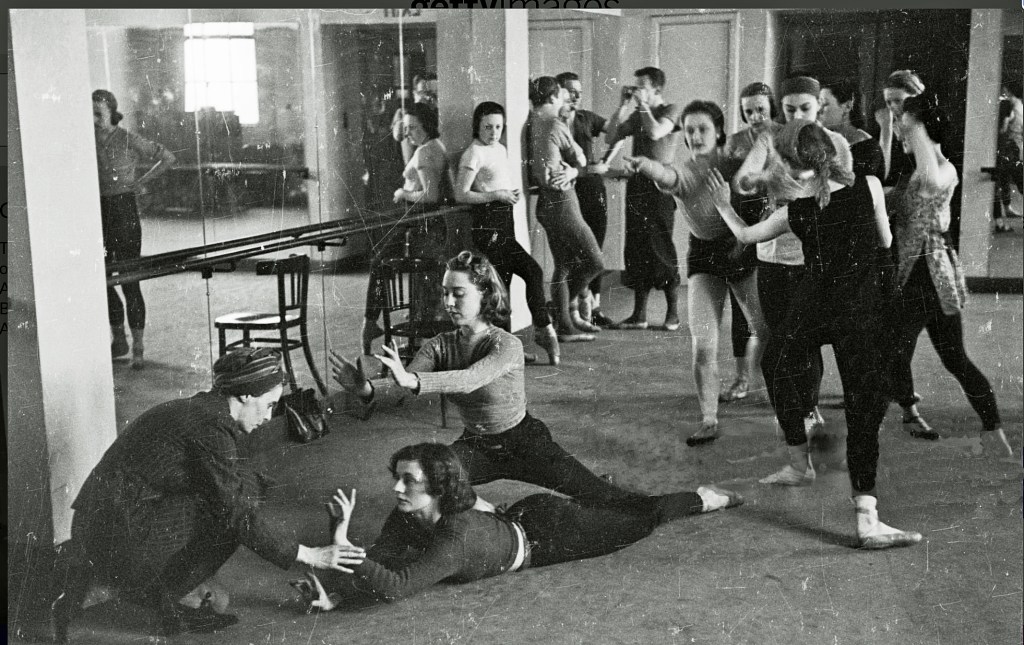
De Valois, at lower left, rehearsing her ballet, Orpheus and Eurydice, with the female cast probably prior to its premiere in 1941. Photographer unknown.
(Ursula Moreton) I’m afraid (that) I refused to go to her classes because they were mechanical and ugly … there was one very British teacher there who I liked very much … Ailne Phillips, Dabs as we always called her. She was a very technical teacher which was exactly what I needed at the time. She had a way of getting me through my private lessons – it was which I found enormously helpful because she allowed me to stay within my own style. And she gave me more technical strength and stability than I had when I first went there, because, as I said, I wasn’t a great towering technician.
…. Then old Nicholas Sergeyev was still giving hopeless classes …. He was a lovely old boy but he couldn’t teach for nuts.
I had to join the Sadler’s Wells school for 2 weeks because I came from another company (and) because I was Russian trained which was frowned upon then (which was uppermost with everything) and (because) I had not been to the Royal School. De Valois put me into her Sadler’s Wells school for these 2 weeks. I suppose to say that I had come to (from) her school …. Which I did, literally. Sergeyev gave all those classes and I was stunned, of course, because I had never quite gone through this before.
The Russian Style.
I’ve always loved the Russian style and the Russian school of ballet so much more than any of the others. I think the Italian style in the old Cecchetti way was probably the most perfect technically … I think it would give you a steely, brilliant technique which possibly the Russian style would not give you. There are some people, of course, who want to see this, who want to go for the technicalities…. but I didn’t find that beautiful… I’m so grateful (that) I had all my original training in that (Russian) style.
(Harris asked if the “notion of performance” was foreign to De Valois’ view of ballet. Shearer replied ..)
Yes, sadly. De Valois actively disliked it in some of her dancers. One or two of us had individuality, which was inevitable, it was going to come over inevitably even in the most straightforward technical things that you did …. It is something which some people have and can do nothing to alter.
The Red Shoes and aftermath (1947).
(Harris asked Shearer how she was chosen for The Red Shoes)
Powell went to the ballet a lot and saw me in Giselle which involves some acting. He got in touch, arranged to meet, showed me the script, told me to take it away and read it, hoped I would like it and so on. He built it up as a very great chance for a young, unknown dancer. I found the script rather dreadful – still do to this day. It really was women’s magazine stuff. Sentimental backstage story which could never happen. No dancers or ballet companies are like that. Really, I couldn’t take it seriously. So, I said “no” – I hope as politely as possible. A year went by. I discovered Helpmann and Massine would be in the film. That made quite a difference as I had faith in both of them. But, in the end, it was De Valois who almost made up my mind for me.
The moment I made this film De Valois completely changed towards me. It had always been difficult of course. But now there was an atmosphere of total mistrust (whether she used this as a lever, I don’t know). The very fact that she would then say, “oh well, she will always be going off … we can’t trust her … she’s strange and she’s really got her feet in both camps”. She couldn’t have felt that genuinely about me. It was so absolutely untrue. But I just know that from the moment I did go back into the company after doing the film or dancing “Carmen” in Paris – the suspicion and the feeling .. of her suspiciousness of me… (of) things being tougher. To me it is terribly sad that there wasn’t greater rapport in the company. It’s a very good illustration of what she could do to a dancer. If one didn’t have a certain strength inside one it could really have demolished one for life.
The Bluebird Incident.
… (on) the first tour (of North America) in 1949 she (De Valois) had a particular point of wanting every member of the company on stage dancing in that (first) performance of Sleeping Beauty. One saw the point of this. (However) it was difficult when one or two of us were also going to dance Aurora and therefore wouldn’t normally have been on (stage) until the 3rd or 4th performance. However, she said we must all be in it so she recast some parts so she could get us all on…. she didn’t discuss this with any dancer …. She just told you what you were going to do…. She put it on the (notice) board (at Covent Garden) and there it was and one read it. I saw to my absolute amazement that I was down to dance the Bluebird with Alexis Rassine. I thought “heavens” because this was something I had never done at all, may never do again and it’s going to be awkward.
I knew the rehearsal formula ….. or lack of it…. of course, the worst happened and there was no rehearsal (although) we did go off to a basement 2 or 3 times. Rassine, who I had loved dancing with, was a help but he was not a strong partner…. If you’re going to be flung very quickly in a very important occasion … one obviously loved the rock-solid solidity of someone like John Hart with whom I danced a great deal and … loved dancing with, a wonderful partner. No terrific dancer but a wonderful partner.
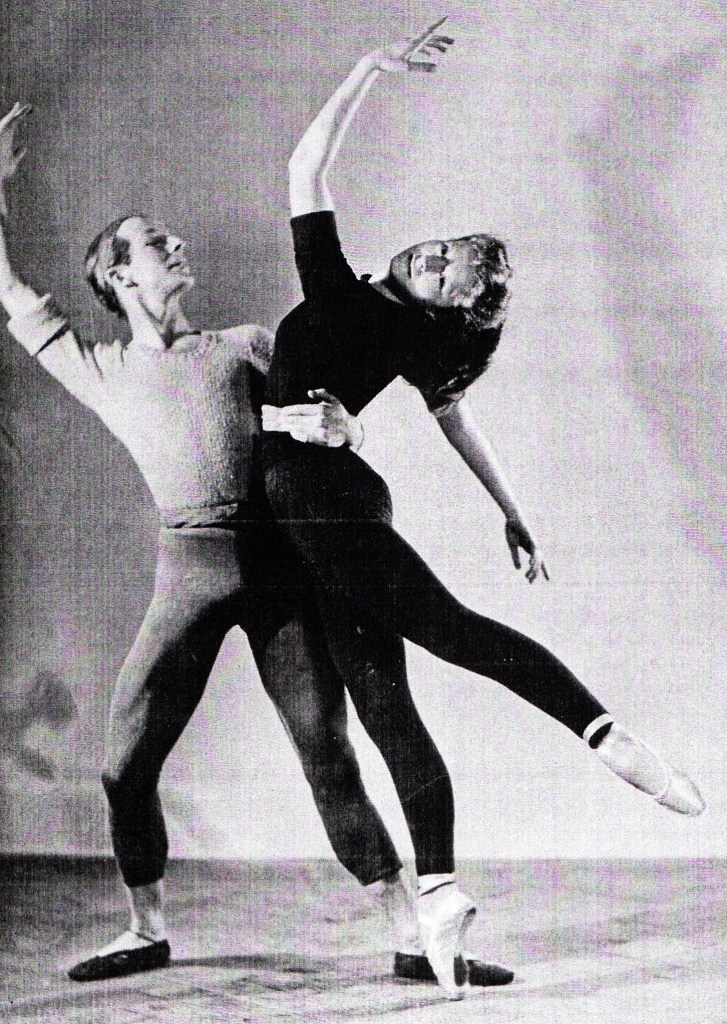
Shearer rehearsing her role in the Bluebird pas de deux in The Sleeping Beauty with her partner Alexis Rassine in August 1949 at Covent Garden. Photographer unknown.
However, there it was and I had to cope with the situation. He (Rassine) was very bored at having to rehearse it because he had performed it so often. I had 3 very rough rehearsals of this with the piano. Then we arrived in New York City and De Valois, of course, knew (of) my problems..
Looking back I think I was temperamentally unsuited to being in the ballet. I don’t think it was my thing. I think I had the same problem (as Olga Spessivtseva) because I suffered from the most terrible nerves you could imagine. I tried not to let this show through too much but I had to go through agonies before performances especially over the big classics because I was never a great thundering technician. I had a very adequate technique and I had some good points, great speed and … a very good jump. Technically I was OK. I don’t want to minimize myself and then people take you at your own undervaluation…. But I wasn’t a great technician who could come out and do 8 fouettes or anything like this. As a result, this was another worry (as) I was never absolutely certain if I could produce all the technical fireworks again and again and the nerve strain was very great. De Valois knew this. And with the Bluebird I had to wait until the third act that (opening) night and she knew I would get (to the theatre) way before performances began and put my makeup on and warm up and do my class. But I would have to sit through the whole evening in the dressing room, and I would be a wreck by the time it got to the Bluebird. She was right; she couldn’t have been more right…. Everyone else in the company seems to have been aware of this and thought me a perfect fool (for) not having refused (to do) this arrangement but I just didn’t think I could refuse. I was very naïve … (and) never did say, “no, I won’t do (it)”. I just felt (that) one didn’t do that…. I was obviously rather slow and naïve about all that. As a result, De Valois was able to use me considerably.
When it got to the evening (of the premiere of Sleeping Beauty) The (old) Red Shoes film had been shown in New York (from) the year before (and) it was still running…. I … hadn’t tumbled to this by De Valois had. (Consequently) I was the only person in that company (Sadler’s Wells) that anybody in America knew. As a result (when) all the characters (in Sleeping Beauty) make the polonaise round the stage in procession – the minute Rassine and I came on stage there was cheering, banging and yelling and I could hardly do (hums melody) … my knees went to jelly and (as) we came around to the front of the stage, it just got louder and so one realized that this (is what it was because, again, you aren’t sure). At heart I was never sure. I thought some marvellousness had happened somewhere (else, and) which they were applauding (that) – but it (then) became clear (that, in fact) this was for us. I felt a) so embarrassed by it that I couldn’t wait to get off the stage (quickly enough) and, b) I thought, “oh my god I’ve really gone to jelly now. I don’t think I can dance at all”.
De Valois didn’t allow me on stage again for the next 10 days of that season so I just had to sit around in New York and go and do my classwork and go out again. For 10 solid days I did not dance. Then she put me on in matinees as Aurora 10 days later. I think she thought, as they say in Scotland, “well, that’s settled her hash” which means “I made mincemeat of her anyway”. I’m being very straightforward about this …and I don’t hold it against De Valois. Perhaps, from her point of view it was a sensible, wise thing to do… but it was very rum to be on the receiving end of it. I think she thought that the matinee would go by absolutely unnoticed by anybody, but this is where America, I find, is wonderfully fair and interested and gives encouragement. All the critics bothered to come along. It really saved me because – the John Martins of this world … – because I did dance well. By that time I was so low (that) I thought I had nothing to lose at all. I went on – De Valois wasn’t in front …. nobody who mattered at all in the company was there. It was just a boring old matinee and I was on. There were all the critics and they gave me smashing reviews; they really did. It just gave me a marvellous lift to get going again. But even thinking about it still upsets me rather because I thought it was so unnecessary. She didn’t have to do that and it really crippled me forever more.
(Harris asked what other roles she danced in North America in 1949)
I never did Swan Lake. She (De Valois) just firmly said she didn’t like me in Swan Lake. I was the wrong colouring and I was too lightweight … so I was taken out of that; don’t know if I danced Giselle. I believe I may have done some matinees.
Balanchine and Ballet Imperial (1950).
De Valois (had a) policy of working with (rehearsing) only the first cast – the rest of us were left to pick up the scraps. So, when Balanchine came with Ballet Imperial he rehearsed only with the first casts which was Margot (Fonteyn), Michael (Somes) and Beryl (Grey). I was 2nd cast and Violetta (Elvin) was 3rd – we learned the choreography by listening to (attending) rehearsals (but (standing) at the back of the stage).
(Then) Balanchine told De Valois (that) he wanted to rehearse 2nd and 3rd casts.
I arrived terribly early in good practice clothes, clean and tidy. And we started. I had listened to him very much in the early rehearsals and I knew he wanted this strange “offness” to everything. Instead of being up and down on your legs, he wanted you to give the impression (that) you were falling all the time … you were at a diagonal.
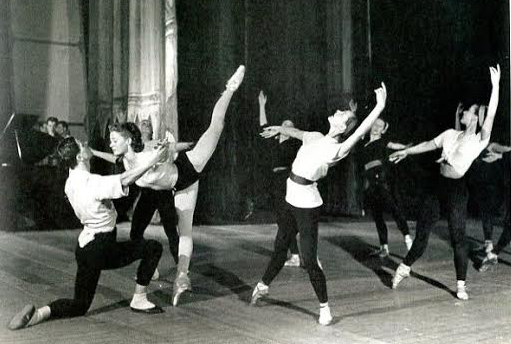
Shearer rehearsing Balanchine’s ballet, Ballet Imperial, at Covent Garden in 1950. Her partner is Michael Somes; at far left is Beryl Grey. Photographer unknown but possibly Roger Wood.
It was fiendishly difficult …. I picked up the steps by watching Balanchine showing Margot. Didn’t go through it with anybody although my partner was watching too … I busted my gut for him at the first rehearsal (and thought) (“well, I might break a leg but, here goes”). Mastered it and got pleasure from it.
Balanchine (said) (to me), “Oh, my dear. You know I didn’t know you could dance like this because, you see, I saw The Red Shoes”. And to me it was the …… I could have kissed him. I wish I had now because I never had the opportunity again. But I was just so thrilled because I felt, how wonderful. Of course, he saw the failings in my dancing in the movie and it was so marvellous that one had the opportunity to, so to speak, show him that it wasn’t like that anymore and he saw and he understood and was so glad to bring so much more out of me through this ballet (Ballet Imperial). It was lovely….. Balanchine was a breath of fresh air from the outside (like Massine).
De Valois.
(Shearer attended De Valois’ 80th birthday party in 1976 at the Dorchester Hotel, London)
I saw old friends but didn’t know how they would greet me. De Valois was not (had not been) exactly wild about me. Anyway, I waited my turn. As we were all going up to speak to her she seemed nonplussed …. “Oh! Moira” and embraced me.
Then she said to her husband, “Arthur, look, your favourite, the only one you wanted to see!”
…. But De Valois could be caring … she nursed me through the pain of an appendicitis between acts of Sleeping Beauty. So, she could be kind and motherly.
Notes.
The International Ballet.
Shearer joined the International Ballet on May 19th, 1941 when she was just 15 years old and left on February 28th, 1942. De Valois was well aware of Shearer’s potential because she had been briefly a pupil of the Vic-Wells Ballet School in 1940 and even danced twice (in Coppelia) with the Vic-Wells Ballet on April 15th and 27th. De Valois may also have seen Shearer dance with The International Ballet when they performed in London.
“De Valois wrote to my mother”.
Shearer’s parents might have been living in London at that time. Mrs Shearer and her daughter left for Scotland when the Blitz began in September 1940. Shearer recalls she was a student at the Vic-Wells school for only 6 weeks.
The Vic-Wells Ballet formally became the Sadler’s Wells Ballet in February 1941 although the transition was begun in 1939)
Cecchetti vs the Russian Style.
Ninette de Valois was the founder, director of the Vic-Wells Ballet (later the Sadler’s Wells Ballet), a choreographer and former dancer, Diaghilev-trained.
Shearer admits to arrogance but would have made sure her changes would be minor and not affected others’ performance. Shearer’s attitude eventually led to her being increasingly sidelined; De Valois demanded conformity; Beryl Grey was seen as a “good” girl because, as she recalled, she was “terrified of Madame”, Shearer was the “bad” girl and was not afraid to confront her.
The correspondent for magazine, The Tatler, wrote on October 19th, 1949, “Some in London fear that this adulation (poured on the Sadler’s Wells Ballet after their performances in New York) will turn the heads of such as Mesdames Margot Fonteyn and Moira Shearer. Not if Mme. Ninette de Valois knows it. The cool, little Anglo-Irishwoman, who has given her life to the creation of this superb corps de ballet and its works, has a sense of discipline that frightens even the most renowned of dancers. She treats the whole troupe as a mixed class of potentially disobedient children, nice children and clever children; but, just the same, children”.
The Red Shoes and aftermath.
Powell may have seen Moira Shearer in Giselle but, as she didn’t dance the lead until 1948, it is unlikely. In 1946 and 47 when he was pursuing her, she was dancing only as a Wili or as Zulme, their leader. She had danced as a Wili, which was essentially a corps role, since 1942. She first danced Zulme in 1944.
Powell’s memory of first seeing Shearer was when she was dancing as a lover in “Miracle in the Gorbals” possibly in March, April or May 1946.
“oh well, she’ll always be going off…”.
Shearer is only speculating here based on her suspicion and insecurity. There is no record that De Valois expressed these opinions, although, obviously Shearer believed her capable of it.
Sadlers Wells teaching.
Ursula Moreton was assistant director of Sadler’s Wells from 1946 to 1952. Ailne (Babs) Phillips was a former Sadler’s Wells and International Ballet dancer and from 1942 on both taught and acted as an administrator at Sadler’s Wells. She became De Valois’ friend and confidant and helped her get the Turkish Ballet School up and running in the late 1940s.
“I came from another company”, i.e. The International Ballet.
“I was Russian trained”, i.e. by Nicholae and Mme Legat.
The Royal School… Shearer means the Sadler’s Wells School, as she explains subsequently. The Royal School of Ballet was founded later.
Sadler’s Wells Ballet.
“the other people who pushed one through it”.
This is probably a reference to learning the minor parts by watching other members of the corps.
Beryl Grey joined Sadler’s Wells in August 1941 about 9 months before Shearer.
Orpheus and Eurydice. The programmes show that Shearer danced both as a “spirit” and peasant on May 27th, 1942, and June 6th. De Valois might have been looking for someone to (occasionally) replace Brae and, in a small company like Sadler’s Wells, she would have needed to use any and all her dancers to full potential.
Corps de Ballet. Shearer indicates that she danced in the corps for 4 years, i.e. until the company moved to Covent Garden in February 1946. In fact, while regularly taking on major roles like Aurora in Sleeping Beauty, she continued to dance in the corps throughout 1946.
“the narrowness of the life”.
Shearer here refers to the world ballet in general. It seems unsurprising that less gifted dancers would never advance beyond the corps. Shearer often lamented the strictures of life at Sadler’s Wells and found it difficult to find anyone who, like her, had wider interests.
“They heard me being bawled out”, i.e. by De Valois.
The Russian Style.
Shearer’s first dance teacher in Northern Rhodesia was Cecchetti-trained.
The Bluebird.
The Bluebird is a pas de deux that is danced in Act 3 of Sleeping Beauty. It is about 2 ½ minutes long.
Olga Spessivtseva was known to be shy, introverted and a fanatical perfectionist.
“one or two of us …..”. Shearer refers to Beryl Grey, Pamela May, Violetta Elvin and herself; as far as the Bluebird was concerned Shearer had previously danced it several times with Alexis Rassine in the public “rehearsals” starting on August 8th, 1949, at Covent Garden.
Rassine was of light build and barely taller than Shearer; John Hart was tall and more muscular but was dancing as one of the suitor princes in Sleeping Beauty in New York.
“I didn’t think I could refuse”.
Shearer was correct. She couldn’t because, as she stated earlier, that she both and accepted that De Valois wanted everybody to dance the first night. Shearer “did it for the team”. Shearer’s nerves were her problem, not De Valois’.
Shearer disliked the The Red Shoes and thus made fun of it by inserting “old” into the name of the film. It opened at the Bijou movie theatre in New York in 1948.
Newsreels of the premiere include footage of Fonteyn and Shearer leaving the stage at the end of the performance with huge bouquets. It appears that Hurok made sure that Shearer was recognized that night.
“For 10 solid days I did not dance”.
After 27 years (in 1976) Shearer’s recall isn’t always accurate. The programmes indicate that she danced in Symphonic Variations on October 12th and 13th, 1949 and the matinee that she refers to was on October 15th, 6 days after the opening night.
From De Valois’ point of view, she had obligations to her prima ballerina, Margot Fonteyn and to Pamela May who still outranked Shearer. Thus, May danced the second performance of Sleeping Beauty on October 11th. The third performance was on October 14th and was probably danced by Fonteyn; the fourth, on October 15th was probably again danced by May. There were a further 3 evening performances of Sleeping Beauty in New York, all danced by Fonteyn; the 2 remaining matinees were danced by Shearer.
“there were all the critics ….”.
John Martin wrote in the New York Times on October 20th, 1949 and compared Shearer’s interpretation of Aurora to Fonteyn’s. “It is an extremely youthful performance in spirit but danced with wonderful skill and precision… her interest is apparently more in total effect rather than in the relish of detail for its own sake, and what emerges is a completely winning characterization of a story-book heroine who is as much at home in the air as on the ground”.
Beryl Grey danced in Swan Lake on October 22nd, as did Margot Fonteyn on November 1st. Grey was tall, athletic and dark; Fonteyn was smaller than Shearer but was also dark.
This is no record of any performance of Giselle during the 1949 tour of North America.
Balanchine and the Ballet Imperial.
Robert Helpmann choreographed most of the ballet in The Red Shoes and most critics agreed that it was uninspiring at best.


Leave a Reply