In 1974 Frank Entwisle wrote the following article for the Sunday Express Magazine. It was one of a series entitled “Things I wish I’d known at 18”. It begins with a short introduction. It is reproduced here unedited except for minor additions to punctuation.
Notes are added to provide context.
Once upon a time the cinema-crazy world wept at the magic feet of a beautiful young dancer in Technicolor tear-jerker called The Red Shoes (1948). In her Georgian Edinburgh home – five films, a ballerina’s career and a raised family later – Mrs. Ludovic Kennedy (55) recalls her famous youth with Frank Entwisle.
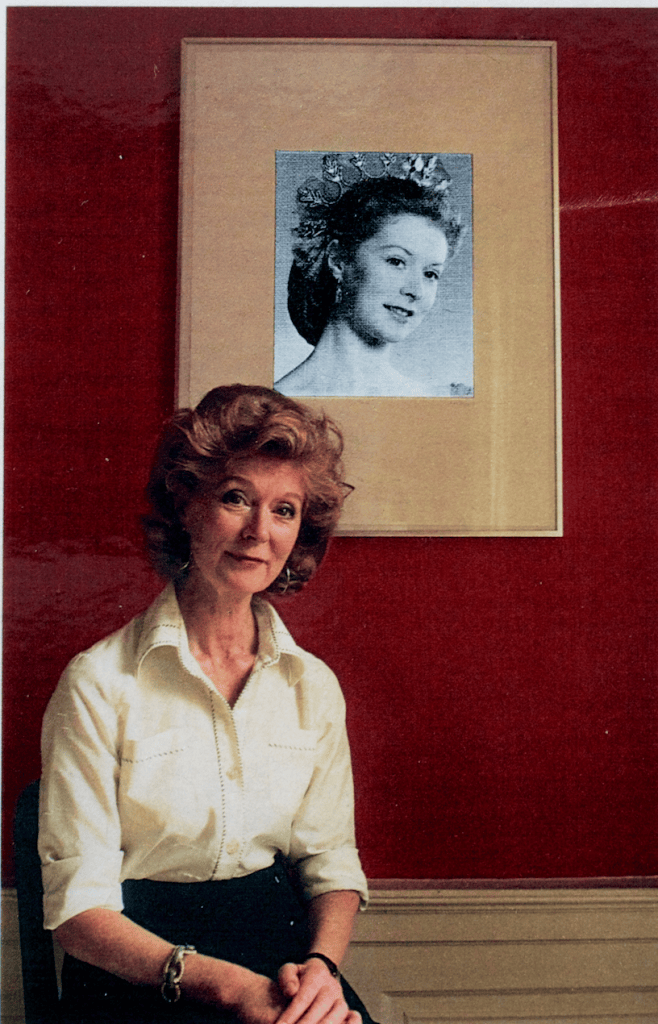
A collage by the photographer Phillip Sayer showing Moira Shearer, in 1984, sitting in front of a photograph her as Aurora in The Sleeping Beauty, circa 1946.
MOIRA SHEARER.
“My life was planned for me. I had no choice. At age 18, I was in Europe in ENSA uniform for the troops. When the Germans made a little foray, we went back; when the Allies went forward – so did we.
In a way that was how my life had always been and how it was to be for years to come. I had been a professional dancer from the age of 15 – working a 52-week work year, shut up in rehearsal rooms and theatres until late at night. I would remove my makeup, go home in the tube and just fall into bed till I had to get up and start it all again.
I had few friends. I met few people. I did few other things. At 18 I was either an old hand or just a little girl. There was no time or energy for boys, little for reflection. It was a highly technical and very physical life. And it had all been decided by other people. That is what happens with dancers.
I was born in my maternal grandparent’s home in Dunfermline. My papa was a civil engineer and – sadly – he was abroad for my first 10 years. When I was between 5 and 8 my mother and I went to Rhodesia to join him. Life in a bush farmhouse … a locust plague … some Saturday dancing classes from a rather good teacher who persuaded my mother I had talent.
Back in Scotland I had the only proper schooling I suppose I ever had. Then – at 10 – I was whisked away and taken to London without really knowing what was happening and was popped into a ballet studio run by a White Russian who had taught Pavlova and Nijinsky.
My father – well, I knew he loved me, but he was a gentle, shy, retiring Englishman who would never have voiced that kind of thing. My mother – very Scottish – gave me her version of love only when I had achieved something. I literally had to earn affection.
And my mother’s family, though very well educated and artistic, was very, very Scottish – severe, critical, prejudiced, set in their views, and none of them liked children very much.
You see there are two types of Scots – the hot Scot and the cold Scot. I think that was my problem as an adolescent. I was a hot Scot – sometimes piping hot! – surrounded by very cold Scots, and the feeling of repression was strong.
I had to excel in everything. To have shown signs of laziness would have meant disgrace.
I was much on my own. Music and books became my passions. At 10 I had read most of Dickens, Tolstoy, Dostoyevsky, Dumas, the Brontes, Mrs. Gaskell, George Eliot, Flaubert, Jane Austen, some Chekov, some Shakespeare. It was ridiculous. I lived in a semi-fantasy world. High-spirited, emotional – I laughed and cried a great deal everyday – I longed for some eccentric or outrageous behavior in my all-too-predictable and puritanical family. I was ill at ease with most of my contemporaries.
Looking back then at my adolescence I see myself as an only child expected to behave like an adult. An exhausting and monastic childhood had imbued me with a strong desire to please everyone and a naïve belief that people always meant exactly what they said – attitudes that have dogged me ever since. If I had recognized these traits at 18 I might have lived a different life.
I suppose if I had been of a later generation I would have made the decision at 18 or 20 – I’m going to throw all this up. It’s not something I would have chosen. Nowadays children do assert themselves. But in my day, I did not even know I could. Anyway, I was trained for nothing else. And if you are successful – well, anyone who is successful at anything and is encouraged by approbation tends to continue.
I suppose my rebellion really came with marriage. There was great tension during those first years and I often felt like a bone being dragged to and fro by two determined dogs – Ludovic and my mother. And I went through a period when I was 34 – really a ridiculous episode – when I felt resentment against whom I’m not sure, myself probably. I just felt I’d never grown up that I’d had no adolescence, that I’d not known what it was to be young.
So, you see it is not so much what one wished one had known but what one might have done. And what I wish I had been able to do – if I could go back and lead my life untrammeled by anyone else’s ideas – was to have had a good university education and then become a first-class musician.
A good education, being exposed to people of intelligence and originality, is something I have missed terribly. However much you study later, you cannot ever replace that age – 18, 19, 20 – when you are receptive in a totally different way.
And music – you cannot imagine how much it means to me. I wouldn’t want to endure one day of my life without hearing music of some kind. It is an absolute essential. Music is something so complete, so entire. So, life as a musician would have been more complete for me.
Of course, that is just a dream. I have no regrets. What a waste of time that would be! After all, the things I have done have been fascinating. They have taken me to places I might not have seen … made me what I am.
But if I may be excused another little dream I wish I had been born into the top bracket of the aristocracy, or in the working class. The worst thing of all is to be plunk in the middle of the middle class amid its social and religious bigotry, its snobbery and jockeying. To anyone with any original perception about themselves, society or family, the worst place to start life from is in that morass.”
Notes.
1974, the year in which this interview took place, appears to have been a quiet one for Shearer. The previous year she had embarked on an extensive lecture tour of the US and in 1975 she and her husband, Ludovic Kennedy, travelled on the QE 2 to give poetry recitals.
ENSA stood for Entertainment National Services Administration. It was responsible for providing performances in theatre, opera and ballet to the British troops overseas at the end of World War 2. The Sadler’s Wells Ballet Company (Sadler’s Wells) travelled on extensive tours in 1944 and 1945 to Belgium, Holland, France and Germany.
Shearer began to dance with The International Ballet in the spring of 1941, aged 15. In the spring of 1942, she moved to the Sadler’s Wells and remained with them until 1953. She progressed through the ranks in the early and mid 1940s and became a lead dancer after 1946. Margot Fonteyn was the company’s prima ballerina and by the late 1940s Shearer was considered to be of almost equal status.
She was born in Morton Lodge. It was owned and occupied by her uncle, her mother’s older brother.
Shearer’s only formal education was in 1934 and, possibly, 1939, at Bearsden Academy, just north of Glasgow. However, while training at ballet schools in London between 1936 and 1939 she attended academic classes each morning.
Her perceived lack of education has to be set against the learning she created for herself by reading the classics she mentions. It seems unlikely that she would not have had access to such books while they lived in Northern Rhodesia. Thus, she must have made use of her uncle’s and, perhaps the Carnegie Library, when they were in Dunfermline. Her mother was a university graduate, and it was probably she who encouraged her daughter to read as widely as she did.
When Shearer moved into the ballet world she was taken aback by the fact that she could not find anyone with whom to share her love of music and literature.
The “White Russian” teacher that Shearer refers to was Nicholae Legat who ran a small studio in west London. When he died suddenly his wife took over the reins and Shearer continued to study with her until the beginning of World War 2 in September 1939.
Shearer makes reference to the struggle between her mother, who, having promoted it from the first, was intent on her daughter continuing her ballet career, and her husband who, understandably, wanted his wife to focus on her marriage and her family. It is unclear where Shearer’s acting ambitions would have fitted into this equation. Perhaps she believed that the stage would make less demands on her.
Shearer mentions that she got the “blues” at age 34. The year was 1960 and she was living in a large Georgian house in Amersham, Hertfordshire with her husband and 2 young daughters. She doesn’t specifically indicate the origin of the issue but there are perhaps some clues. First, her brief career on the stage had effectively come to an abrupt halt in December 1957. As she had devoted over 2 years to developing her acting skills, this failure must have been a major emotional blow. She continued to act but only appeared on the stage very occasionally. She had to come to terms with the fact that she could not act nearly as well as she had hoped. Second, immediately after the demise of her acting career, she joined her husband as he campaigned to become a member of parliament for the Liberal Party. This effort also failed and Ludovic Kennedy returned to broadcasting and writing. Third, while Shearer had been the major breadwinner for the family throughout the early and mid 1950s, she relinquished this role to her husband in the later years of the decade. She became a full-time wife and mother. After almost 20 years in the spotlight this change would have required considerable adjustment in her priorities.
Shearer’s marriage to Ludovic Kennedy lasted well over 50 years and was, by all accounts, a very happy one.


Leave a Reply