When, in 1946, Michael Powell and Emeric Pressburger (Powell and Pressburger) began to assemble the cast for their film, The Red Shoes, the biggest hurdle they faced was, of course, who would play Victoria Page, the young dancer around whom the plot revolves. Powell insisted that the role must be played a ballerina who could also act. Based on a tip from the British actor Stewart Granger, Powell was eventually led to Moira Shearer who was then dancing with the Sadler’s Wells Ballet. How he eventually persuaded her to take the role is documented elsewhere in this blog.
Other major roles in the film went to well-established actors, some of whom Powell and Pressburger had worked with previously. Anton Walbrook was chosen to play the role of the Impresario, Boris Lermontov and Marius Goring was an aspiring composer who, in the film, later fell in love with and married Victoria Page. In the scenes which Walbrook and Goring share with her, they play the dominant role in the conversations. Powell and Pressburger made sure that their ingenue star was not unduly burdened by dialogue.
The decision who to hire to play Ivan Boleslawsky, the lead dancer for the Ballet Lermontov, was again made easier by the fact that Powell and Pressburger had worked before with their choice, Robert Helpmann.
Michael Powell first met Helpmann probably in 1941 when they were neighbours in west London and cast him in a small role in his film, One of our Aircraft is Missing, that was released in 1942. Helpmann was already of an actor of standing, having been cast, for example, in the 1937 Vic-Wells production of Midsummer Night’s Dream in which he played Tiberon opposite Vivien Leigh’s Titania. However, he was best known as a dancer and appeared often with the Vic-Wells Ballet in the late 1930s and 1940s. It is probably a result of a combination of their friendship and Helpmann’s proven ability as a choreographer that Powell chose Helpmann to both choreograph the ballet sequence in The Red Shoes and to act the part of Boleslawsky, the lead dancer of the fictitious Ballet Lermontov. Powell obviously did not expect too much of Helpmann in this acting role. He has only two insignificant lines. However, he is given ample opportunity to employ his abilities as a mime.
Powell also hired the Russian dancer and choreographer, Leonide Massine to act as the director of the ballet for the ballet company and to dance the role of the shoemaker in the ballet. As Massine was then the preeminent choreographer in Europe it is no surprise that, when Powell offered him the part, Massine stipulated that he be allowed to choreograph his role as the shoemaker in the ballet sequence. In his autobiography Powell indicates that Helpmann, perhaps somewhat reluctantly, agreed to this arrangement. Nonetheless, as noted by Leonard Boucher, Massine and Helpmann rarely seemed to see eye to eye during filming, As a result here must have been tension between them especially, as a number of critics complained, Helpmann’s choreography was uninspiring.
By contrast, Massine’s depiction of the messianic shoemaker was animated and dramatic, especially in the scenes where he persuaded the girl, played by Shearer, to put on the red pointe shoes he had created.
The attached photos document his seduction of her and its tragic aftermath.
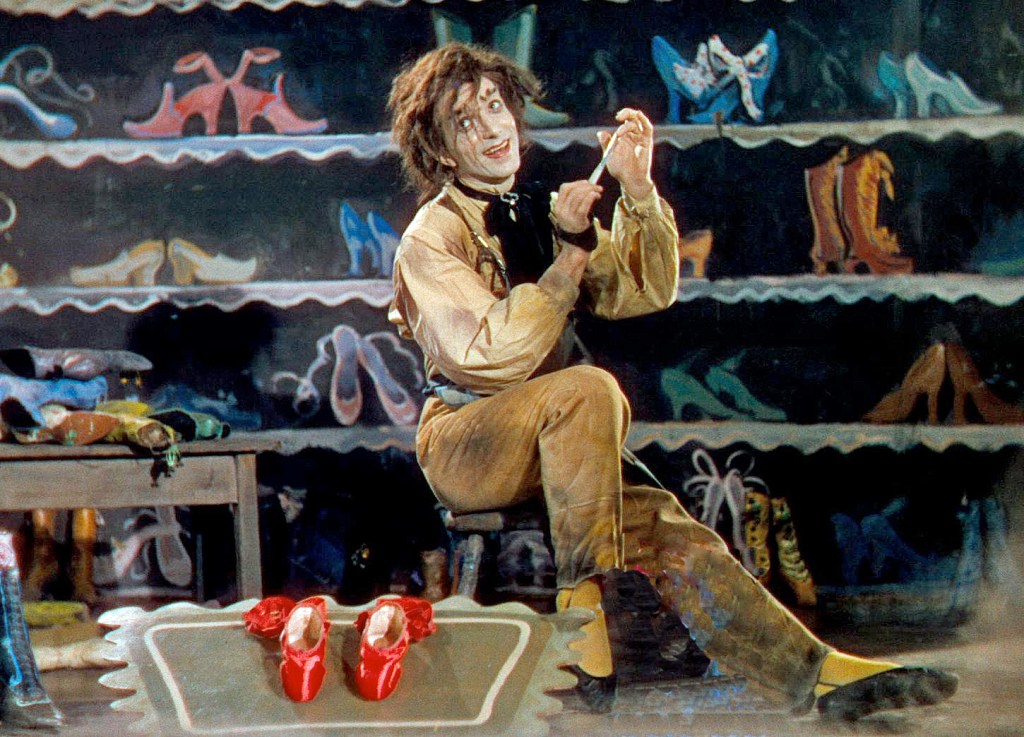
The curtain rises on the ballet of The Red Shoes with the shoemaker, played by Leonide Massine, at work in his shop.
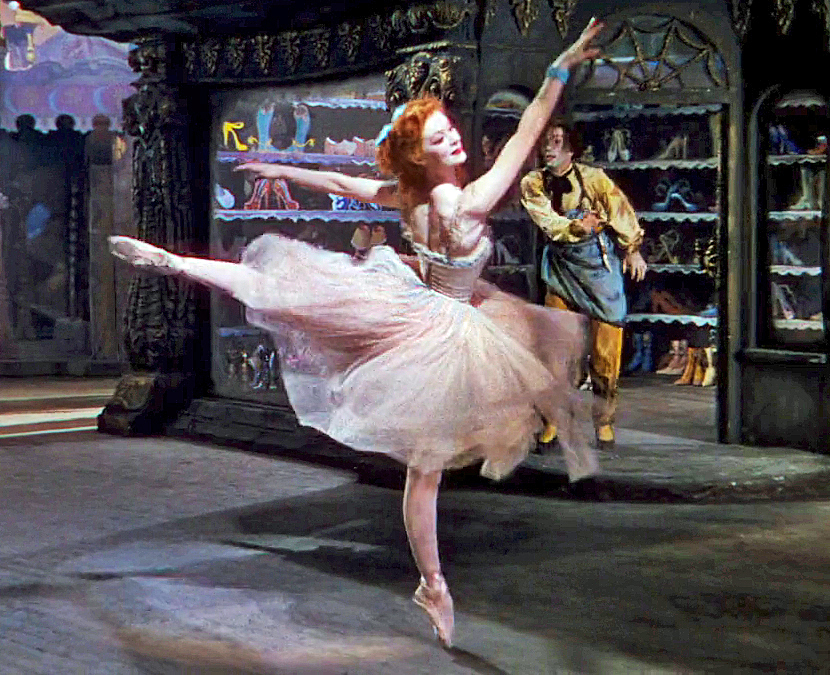
The girl, played by Moira Shearer, dances in front of the shoemaker’s in her pink pointe shoes. The shoemaker rushes out to beckon her in.
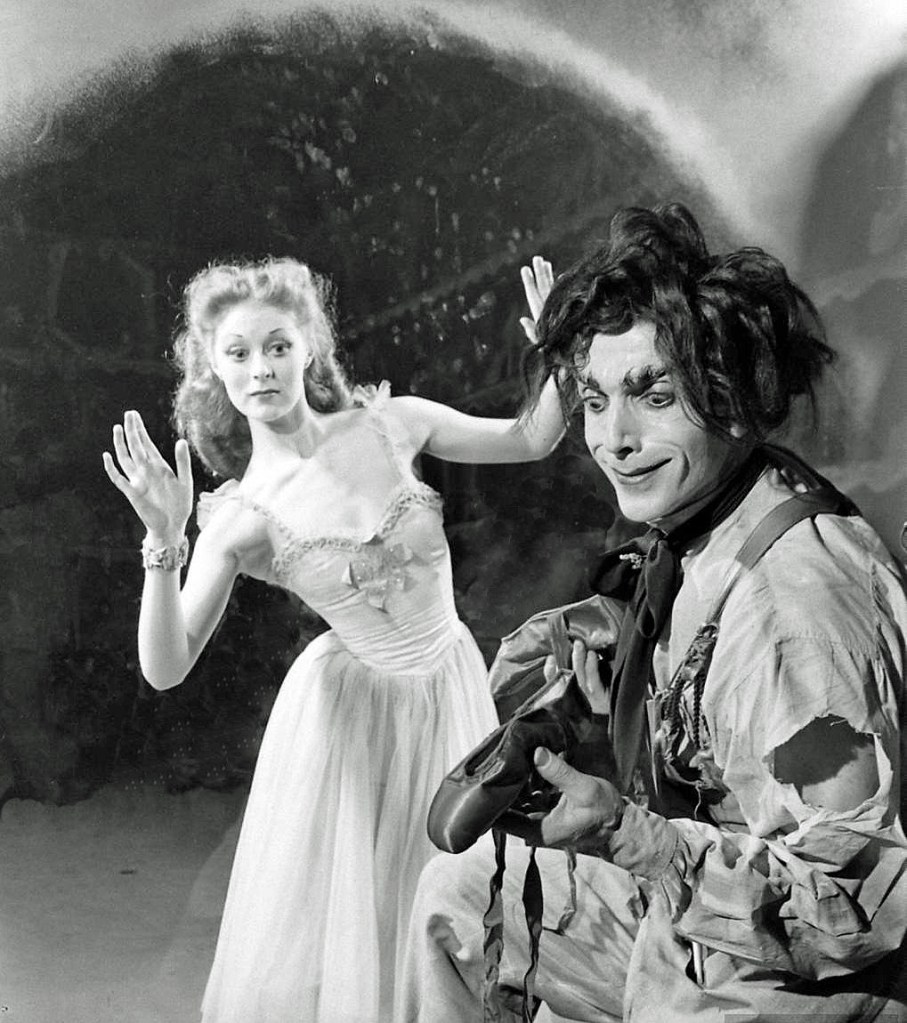
As she stands expectantly at the shop window the shoemaker holds the red shoes up to entice her. Her lover, played by Helpmann tries to caution her. Photo by Nat Farbman.
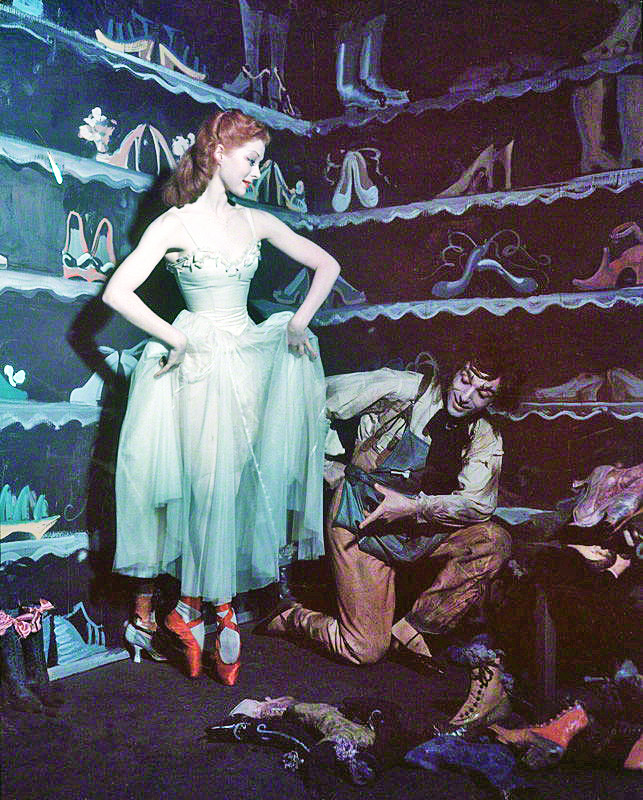
The shoemaker persuades the girl to enter his shop and to try on the red shoes. She puts them and stands before him a pointe. Her mime expresses her enchantment, and the shoemaker gives his approval. The shop is represented by Hein Heckroth’s painted backdrop. Photo by Russell Westwood.
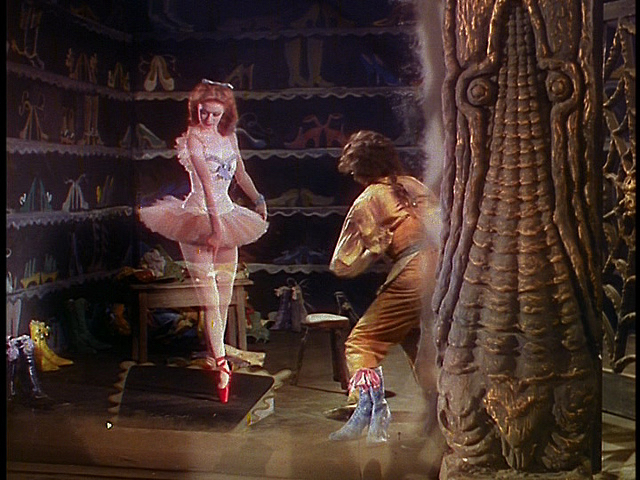
The shoemaker imagines the girl dancing in the red shoes in the shop. When she leaves the shop without them to return to dancing with her lover, the shoemaker, carrying the shoes, pursues her.
He mimes the shoes dancing in his hands and, watched by her lover, she is again seduced into putting them on. She immediately realises that they have possessed her.
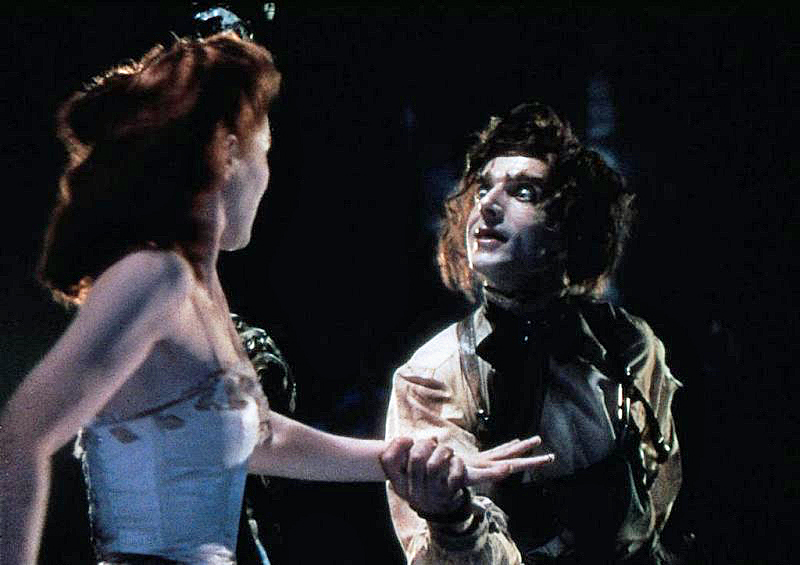
Thus begins her battle with them, a struggle that is, all the while, witnessed by the shoemaker. He sometimes joins her, encouraging, cajoling her to dance, dance, dance.
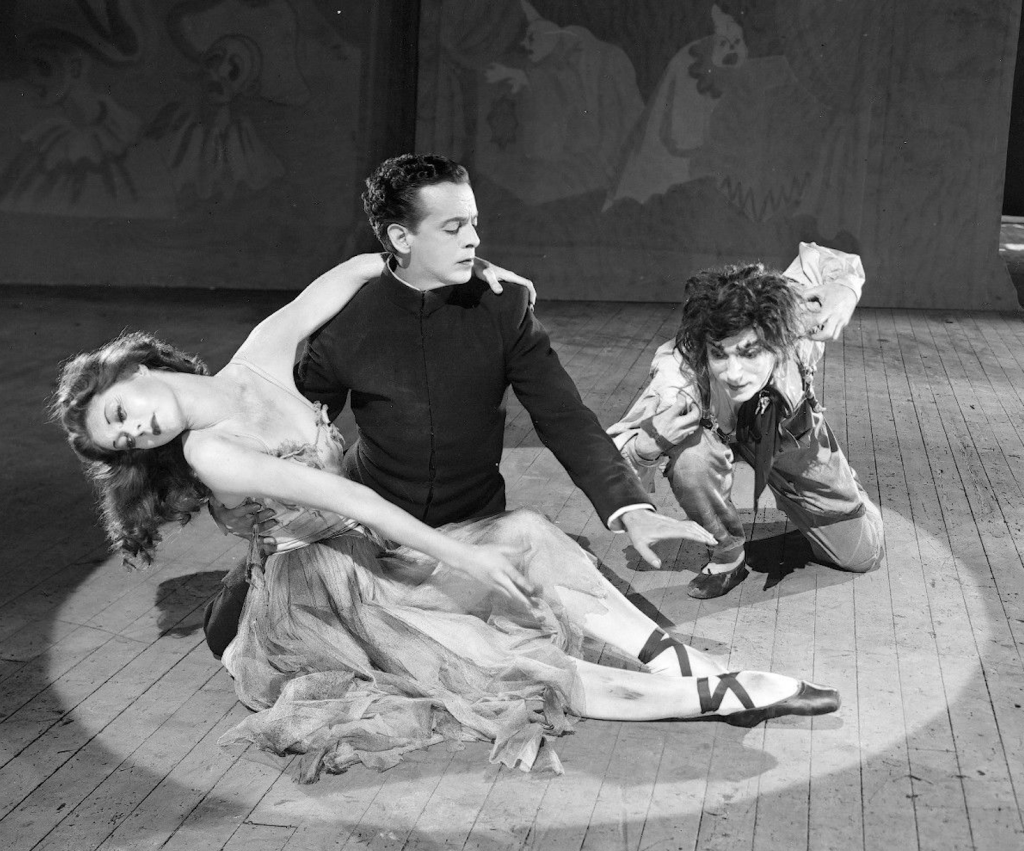
Exhausted, the girl first seeks the help of the shoemaker himself to remove the shoes. He offers her a knife to cut them from her feet, but when she tries, the knife turns into a branch. This cruel trick makes it clear that she cannot escape her fate. She then pleads with a priest, played by Helpmann, to help her. He initially offers only a rebuke but finally agrees to give her solace and to protect her from the shoemaker. The priest removes the shoes but it is too late to save her, and she dies in his arms. The shoemaker, when he hears her ask the priest to remove the shoes, lies in wait, intent on retrieving them.
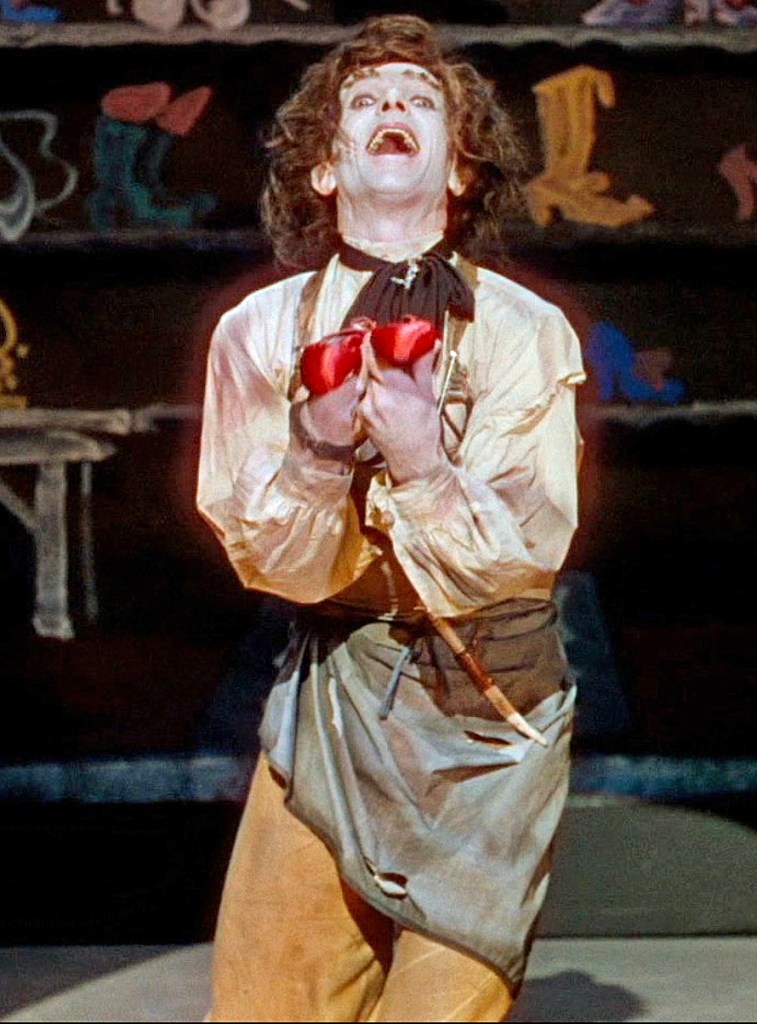
The shoemaker takes possession of the shoes once more, returns to his shop and the curtain falls as he proffers them to the audience.
Notes.
- Helpmann, as Boleslawski, has 2 lines. In the first, he rushes up to the prima ballerina, Boronskaya (played by Ludmilla Tcherina), to congratulate her on her engagement. In the second, during rehearsals he complains to Ljubov, the director of the ballet, that dancing with Vicky Page will be a problem. Ljubov, played by Massine, summarily dismisses his complaint.
- Leonard Mosely writing in the British newspaper, The Daily Express, said of Helpmann’s performance that he gave “a cynical portrait of a typical male dancer full of chi-chi and conceit”.
- Shearer conceded that Helpmann had “one big personality” and, perhaps showing her true feelings, added, “whether you like it or not”. Elsewhere she offered her opinion that “he wasn’t a great dancer – he wasn’t a great actor – but he was certainly a great mime”. At the Sadler’s Wells Ballet during the 1940s she rarely danced with him as he was invariably paired with the prima ballerina, Margot Fonteyn.
- Helpmann’s choreography came in for considerable criticism. Alastair Macauley, the dance critic for the New York Times summed it up in one word – “bad”. Fernau Hall, a Canadian dance critic, wrote a lengthy analysis in which he concludes that “what we see is Moira Shearer … performing a series of conventional steps against a rapidly changing background of décor and other dancers…. continuity suffers from poor editing and confused patterns of group movement, so that often it is impossible to tell what is happening … (that) leaves the viewer with a vague sense of dissatisfaction”. Thus, in Fernau’s view there’s plenty of blame to go around.
- Monk Gibbon in his study of the ballet (which was commissioned by Michael Powell) writes of Moira Shearer’s “expressiveness/miming ability, as when she sees the red ballet shoes for the first time”. He also singles out “Massine’s excellent acting and mime; his charisma, sometimes charming and amusing, sometimes menace and evil itself”. Gibbon concludes his analysis of the ballet with the image of the priest carrying away the body of the girl and the shoemaker seizing the shoes “before reappearing to offer them with a graceful bow to the next prospective purchaser”.
Sources.
The Age (Australia), September 11th, 1954 (review of A Midsummer Night’s Dream)
Leonard Boucher, Diary, Filming of The Red Shoes at Pinewood. July 8th to October 15th, 1947. Freepages.rootsweb.com/-lind/genealogy/people.
Monk Gibbon, The Red Shoes Ballet, A Critical Study, Saturn Press, 1948.
Fernau Hall, New Theatre, volume 3, September 1948.
Dale Harris, transcript of interviews conducted with Moira Shearer in Edinburgh, August 29th, 1976 and August 31st and September 1st, 1978, New York City Library Archive, Lincoln Center, New York City.
Dan Lybarger, Pitch Weekly, January 22nd, 1999. Interview with Moira Shearer.
Internet Movie Database, (IMDb)
Alastair Macauley, New York Times, Arts and Leisure, August 3rd, 2008. “60 years of The Red Shoes; bad choreography”.
Leonard Mosely, The Daily Express, July 23rd, 1948 (review of The Red Shoes)
Dilys Powell, The Sunday Times, July 27th, 1948. Films of the Week. The Red Shoes.
Michael Powell, A Life in the Movies, Heinemann, London, 1986
Audrey Williamson, The Dancing Times, December 1947. Filming The Red Shoes.


Leave a Reply