There follows a skeletal, fragmentary account of the life that Moira Shearer and Ludovic Kennedy spent together, primarily during their 56-year marriage. It is based on a 10-year search of the public record that includes newspaper/magazine articles and interviews of the subject by writers, critics and historians. In public Moira Shearer maintained her “stage name” throughout her life. In private, once the family moved to Scotland, she often became known as Mrs Ludovic Kennedy. Here she will be referred to as “Shearer”. Ludovic Kennedy is referred to as “Kennedy” and when they appear as a couple they are referred to as “the Kennedys”.
This account is broken down into 3 periods. This first is 1949 to 1956, the latter date being when Kennedy began his professional career in television broadcasting; the second is 1956 to 1965, the latter date being when the Kennedys moved to Scotland; the third is 1965 to 2002 during which time they both gradually removed from the public limelight.
1949 to 1956.
Moira Shearer and Ludovic Kennedy met for the first time on February 2nd, 1949, at a costume ball held in at the Lyceum Ballroom, London to raise funds for the Vic-Wells Association, the organization that supported the Sadler’s Wells Ballet and the Old Vic Theatre. Shearer was on hand to hand out prizes for the best costumes. Kennedy had been given a ticket to the event at the last moment. At some point in the evening, he asked her for a dance. As he had seen the film “The Red Shoes”, he already knew who she was, thus this required some courage. She was the “star” of that film while he, at the time, was still a student at Oxford and working as a librarian at Ashridge College in Hertfordshire to fund his studies on Admiral Nelson.
He subsequently invited her to dinner, setting in motion a very short courtship. On May 14th, 1949, he proposed to her, while they were driving through Covent Garden, and she immediately accepted.
Their engagement was announced in July while they were on holiday in a rented villa in Opio, near Grasse, in the south of France. The first published photo of them together was released to the press on August 17th. They are seen striding arm in arm through a west London street that was probably close to where she lived with her parents at an address on Melbury Road.
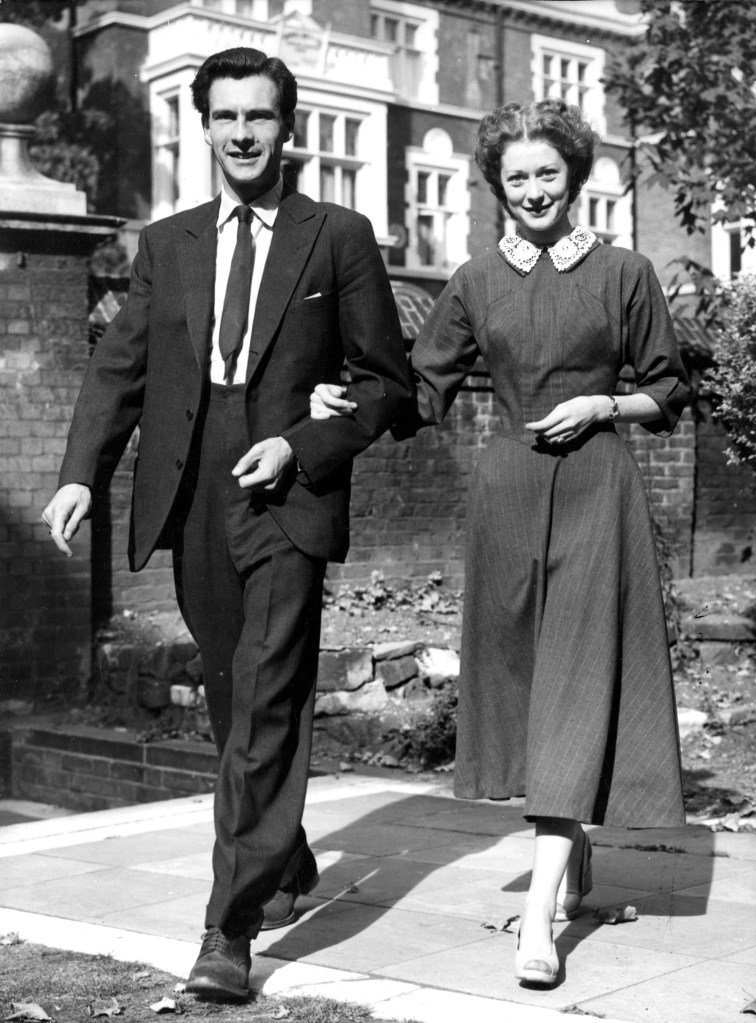
Ludovic Kennedy and his fiance in London on August 17th, 1949 shortly after announcing their engagement. Photographer unknown, an AP stringer.
On October 4th, 1949, Shearer joined the rest of the Sadler’s Wells Ballet to fly from London to New York to begin their first tour of North America. They returned on December 13th. While his fiancé was away Kennedy had left his librarian’s position at Ashridge and moved in with his mother at Hampton Court. He was on hand to welcome Shearer home at on December 17th at London Airport.
It was from her parents’ house that Shearer left by car for the chapel at Hampton Court where she was to be married on February 25th, 1950. After the ceremony the newlyweds flew to Paris where they caught an express train to Perpignan. From there they took a local train to Vernet les Bains in the Pyrenees, where they spent a 7-day honeymoon. When they returned to London Mr. and Mrs. Kennedy moved into the new house in Claborn Mews in Knightsbridge in west London. On March 7th Moira Shearer was back at work with the Sadler’s Wells at the Royal Opera House, Covent Garden. That night she danced roles in Les Sylphides, Façade and Symphonic Variations. Ludovic Kennedy went back to his writing in a study in the mews house.
On June 16th the Kennedy were guests of Princess Margaret, the Queen’s younger sister, at Boughton House, Kettering in Northamptonshire. Princess Margaret was one of the major patrons of the Sadler’s Wells. Later in June they travelled north for a short holiday in the north of Scotland. Kennedy was an avid fisherman and his wife often accompanied him on trips to promising rivers. On their journey north they stopped in Dunfermline to visit her uncle, James Shearer.
On July 1st, 1950, Shearer began 2 weeks work at Shepperton Studios outside London on her second film with the director Michael Powell. The film was “The Tales of Hoffmann”. During filming she and her husband took time out on July 10th to attend the opening of the New York City Ballet’s season at the Royal Opera House.
On September 4th Shearer joined the other dancers of the Sadler’s Wells Ballet at London Airport for a charter flight to New York where on September 10th the company opened its second tour of North America. Her husband also flew to the US and using a car loaned to him by the Austin Motor Company closely followed the ballet company’s itinerary during the 6-week tour. Kennedy documented various events where he and Shearer were involved and included descriptions in his 1989 autobiography. He recounts, for example, that while in Los Angeles they met with the movie impresario Sam Goldwyn to discuss Shearer’s participation in a proposed film with Danny Kaye. They returned to the UK at the end of January although not together. Shearer flew home with the rest of the Sadler’s Wells Ballet and Kennedy travelled from New York in the Queen Mary.
On March 7th, 1951, Shearer developed appendicitis that required an operation and laid her up for 6 weeks. At some date during this period of recuperation the Kennedys returned to the villa at Opio for an extended holiday. In Cannes they met with the British film producer, Alexander Korda and, on his yacht sailed to Italy. They returned on June 13th and Shearer returned to work at Sadler’s Wells. A photo dated October 24th shows Kennedy on hand at Euston Station to see his wife leave for Blackpool where she would be dancing. From Blackpool the Sadler’s Wells continued to Glasgow for a week’s run so Kennedy was once again briefly a bachelor. At some date in 1951 he published his first book called “Nelson’s Band of Brothers”.
An undated photo from November 1951shows the Kennedys leaving Claborn Mews for the last time. A limousine waits to take them to the station. They travelled by train to Southampton and a transatlantic liner that took them to New York. From New York they took the train to Chicago and Cheyenne, Wyoming where they rented a car and drove to Hollywood where Shearer was due to appear in the film with Danny Kaye. They arrived on December 7th. Filming would require several weeks and the Kennedys settled into a house rented from the British actor Brian Aherne in Santa Monica.
Rehearsals began on December 10th. On December 20th Shearer withdrew from the film when she realised she was pregnant and the scheduling of her dancing would extend too far into her pregnancy for it to be safe. With her husband acting as her agent, she negotiated a role in another MGM film, “The Story of Three Loves”. Filming for this required only a month and was completed in late March 1952. The Kennedys then took a short holiday in British Columbia after which they returned to the UK. They arrived back at Southampton on May 2nd.
Three weeks after their return, in early June, they moved into a new house in Hampstead, north London. Ailsa, their first child was born a few weeks later, on August 11th, 1952. Shearer was briefly back at work at Sadler’s Wells on December 12th and on December 22nd the whole family took a short holiday in Copenhagen.
Moira Shearer quit her role of “guest artist” at Sadler’s Wells in April 1953 and briefly joined the Festival Ballet later in the year. In June the family took a month-long holiday in Sweden.
In January 1954 Shearer travelled to Monte Carlo to appear with the Royal Ballet in Spectre de la Rose. Immediately afterwards she retired from the ballet.
While living in Hampstead Kennedy began to research injustice in the British legal system and wrote a script for a play that dealt with one example of this that concerned the wrongful conviction of a young man. The play, titled “Murder Story” opened at the Cambridge Theatre in London’s West End on July 22nd. Both the Kennedys were on hand for the opening. Sadly, though it received some good reviews, the play only ran for 3 weeks.
Early in summer Michael Benthall, director of the Old Vic Theatre invited Shearer to play Titania in his planned production of A Midsummer Night’s Dream. The play was to open at the Edinburgh Festival on August 23rd and extend for 3 weeks. Immediately afterwards the company travelled to New York to open a 3-month tour of North America. Thus, Shearer was away from home for 4 months and her husband, aided by a live-in nanny, was charged with caring for Ailsa, who was 2 years old at the time.
On February 2nd, 1955, Shearer began rehearsals at the New Theatre, Oxford for the play “I am a Camera”. The play had just completed an extended West End run with Dorothy Tutin acting in the lead role as Sally Bowles. Shearer was to take over her role for a tour of British provincial roles. It was to be her first primarily dramatic role. The play opened in Oxford on February 7th. John Barber, drama critic for the Daily Express wrote an enthusiastic review of Shearer’s performance and claimed he had witnessed “the birth of an actress”. Indeed, probably based primarily on Shearer’s participation, the play was a great success. She left the production in mid-May and briefly returned home. While Shearer was on the road Kennedy continued his research, writing and political activism from his base in Hampstead. The house was large enough for a live-in nanny with whom her shared care of Ailsa.
At some point in the summer of 1955, probably in August, Shearer joined the repertory theatre company, the Bristol Old Vic and moved into digs in Bristol. As it was a repertory company with less than 20 actors, Shearer, like everyone else, acted in some capacity almost every day. Thus, there would have been little opportunity for her to travel to London to see her family. Kennedy continued to assume the major role for caring for their daughter. Shearer acted with the Bristol Old Vic until late July 1956 when she was 5 months pregnant. As her last role as Major Barbara was staged at the Old Vic Theatre in London, she was probably able to live at home during that production.
1956 to 1965.
Kennedy joined ITN (Independent Television News) as a newscaster at some date in 1956. This represented the moment when he would assume the role of major breadwinner for his family for the first time. His work required that he be present in the studio between 2 or 3 times a week. However, he had a relatively easy commute whether it was from Hampstead or Hampton Court where, for a time, the Kennedys lived in his mother’s 30 room apartment. As Kennedy related in his autobiography, they had grown tired of what he called the “social pressures” of living in Hampstead. By then they were both well-known faces and were on the hunt for a more private home. While they searched, they lived at Hampton Court.
In late summer and autumn of 1956, during her pregnancy, Shearer had a light schedule. The Kennedys went on holiday in Scotland late August. Shearer was entertained with traditional Scottish dancing at Dalgatie Castle while her husband went fishing.
Rachel, their second daughter was born in November 1956.
On June 21st, 1957, the Kennedys were photographed at Rachel’s christening. With them was Margot Fonteyn who was Rachel’s godmother. At some date that summer they took another fishing trip, this time in northern Spain. The children were left with their nanny.
The British impresario, Henry Sherek, persuaded Shearer to take the lead in a comedy called “Man of Distinction”. She began rehearsals in London on August 7th, and the play opened at the Edinburgh Festival a week later. The production went on the road in provincial towns and cities until mid-October 1957 and during this time Shearer lived in hotels or digs in those locations. On October 15th the play moved to the Prince’s Theatre in London’s West End and Shearer was able to live at home. During this London run the Kennedys moved into a large house in Amersham, Hertfordshire and Shearer daily commuted to work from there. The production was a flop, one critic writing that the only thing of distinction in it was Shearer’s presence. It folded after a 2-week run and on October 28th, 1957, Shearer announced she was quitting the stage. Thus, during his wife’s participation in the play Kennedy was one again primarily in charge of his daughters’ care. Given his commitments at ITN Kennedy was often absent from home for long hours on each of the days he was working.
While working at ITN Kennedy met with the leader of the Liberal Party, Joe Grimmond, and decided to join political forces with him. As he couldn’t run for office while working at ITN, Grimmond suggested they wait for the ideal opportunity for him to enter politics. This arrived when the standing Conservative party candidate for the seat in Rochdale, Lancashire, died, thus triggering a by-election. Grimmond saw this is as an opportunity for the Liberals to challenge for the seat and he proposed Kennedy as his candidate to the local party committee in January 1958. On January 6th the Kennedys travelled to Rochdale to be vetted. Kennedy was duly approved and resigned from ITN. He almost immediately began his campaign. Initially he campaigned alone but was soon joined by his wife. It is likely they stayed in a hotel or digs for the entire month-long campaign. While he didn’t prevail in the election Kennedy recorded a respectable runner up to the Labour party candidate. During this campaign their 2 daughters were cared for by the nanny and housekeeper in Amersham.
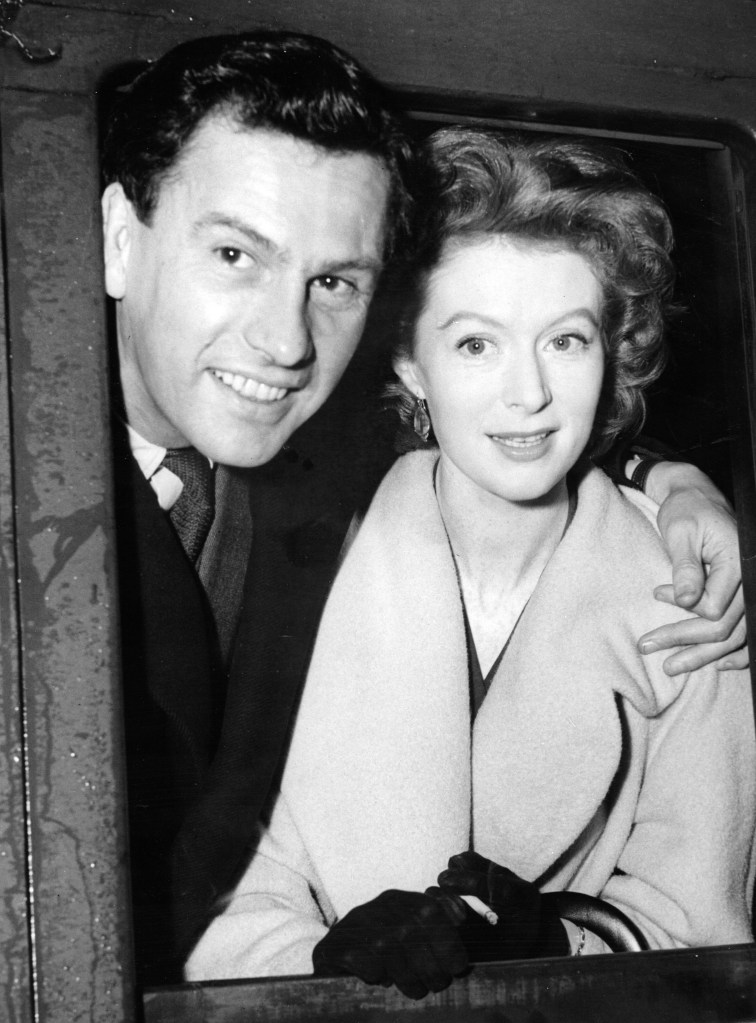
The Kennedys at Euston station in London, en route to Rochdale on January 6th, 1958. Photographer unknown, a Central Press stringer.
In late February the Kennedys flew to the south of France for a holiday. It is not known if the children accompanied them. Ailsa was then 5 years old and Rachel just 2.
Spring and summer 1958 were a relatively quiet period for the family, although Shearer made 2 brief stage appearances. In late August they went on another fishing trip, this time to Connemara in western Ireland. Shearer spent the autumn of 1958 primarily at home caring for her family while Kennedy, who had returned to work at ITN to host the news programme, This Week, also continued his writing and political activism.
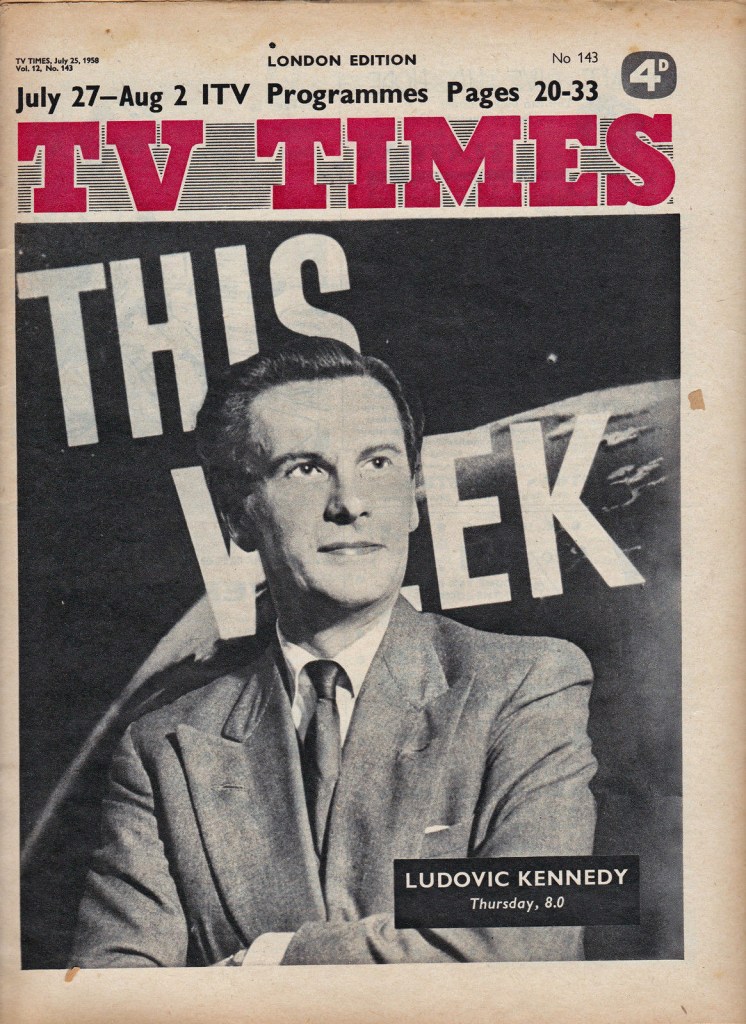
Ludovic Kennedy on the cover of the TV Times, July 25th, 1958. Photographer unknown.
In January 1959 at The Old Vic Theatre in London Shearer was due to appear as a guest artist in the title role in the play, “Miss Julie”, but due to illness to both her and the leading man, the production was first postponed and eventually cancelled. Spring and summer were again spent primarily at home in Amersham but in late September Michael Powell asked Shearer at short notice to make a brief appearance in his film, Peeping Tom, that was filmed at Pinewood Studios. Filming required 2 weeks during which she may have lived with her mother-in-law in Hampton Court.
At about the same time Kennedy again campaigned in Rochdale, this time during a general election. He lost to the Labour candidate once more and decided to quit active politics.
In 1960 he joined the BBC News programme, Panorama and spent the next 3 years travelling the world to report on international political issues. As Shearer indicated in a 1961 interview, he was away from home for long periods. While at home Kennedy researched and wrote his book, “Ten Rillington Place” that concerned the miscarriage of justice in the case of Timothy Evans. The book was published in 1961.
In June 1960 Shearer travelled to Paris to film the ballet, Cyrano, that was choreographed by Roland Petit and was part of a film called “Black Tights”. During filming Shearer stayed in an apartment in the city. The film was to be her last “public” appearance for many years.
Early in March 1961 Shearer was told she was pregnant and her third daughter, Fiona, was born in Amersham Hospital in December. In February 1963 she gave birth to her 4th child, a son named Alastair and settled into a life of domesticity. Kennedy quit Panorama in 1963 but continued to be a presence in reporting of political issues in Britain. He was also still very much involved in researching and exposing failings in the justice system and wrote several books on the subject. The most important of these, published in 1964, was “The Trial of Stephen Ward”.
In 1965, as Kennedy didn’t need to be constantly in striking distance of London the family moved from Amersham to a rented house in the Borders of Scotland.
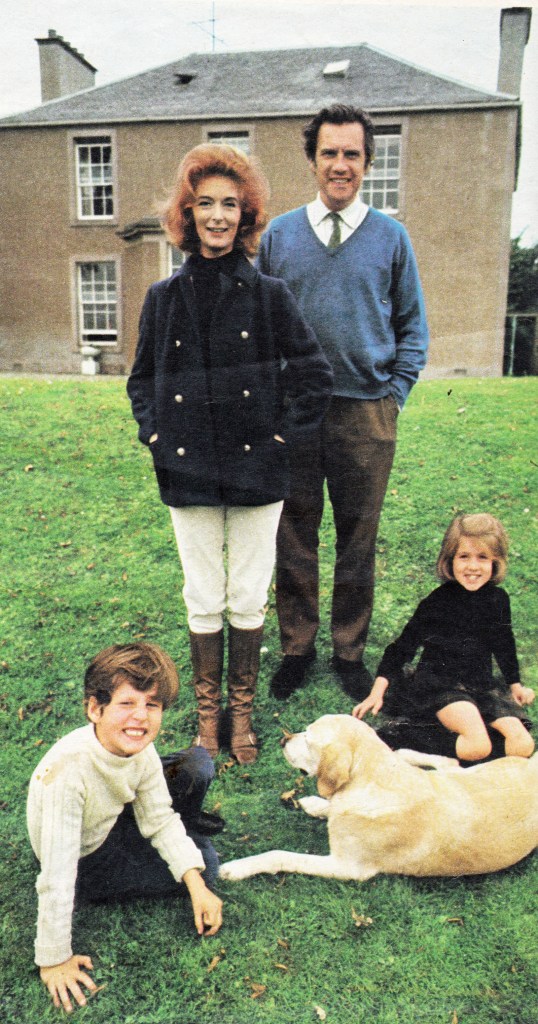
The Kennedy Family outside their “manse” in the borders of Scotland. The children are Fiona and Alastair. Radio Times, circa 1970. Photographer unknown.
1965-2002.
In December 1967 Shearer danced again in London, if only for a single performance. She joined the choreographer and dancer, Fred Ashton, to dance the tango from his ballet, Façade. The occasion was a charity performance for the Friends of Covent Garden.
Early in 1970 the Kennedys travelled to New York and Chicago, ostensibly to promote his book on ex-patriot Americans, “Such Beautiful People”. While there they appeared together on the “Dick Cavett Show” and Shearer was interviewed for an article in the New York Times, titled “Moira Shearer as Wife and Mother”. At about this same time Shearer began to tour Britain speaking on the history of ballet. In 1973 the tours were extended to the US.
On January 10th, 1973, while driving with 3 of the children, Shearer was involved in an accident in southern Scotland. At the time her husband was working in London and thus had to rush back to be with her. Fortunately, none of them was seriously injured and Shearer was discharged from an Edinburgh hospital after a 5-day stay. Rachel, then aged 19, was detained longer because she had to have splinters of glass removed from from her eyes. The accident appears not to have affected Shearer’s plans greatly as on March 7th she was lecturing in Fond du Lac, Wisconsin at the beginning of a 6-week lecture tour.
Based on their mutual love of British literature and poetry the Shearers decided to “go on the road” to share these particular interests with audiences. This primarily involved appearing in theatres across the UK but also included cruises on the QE2. They set sail 3 times between 1975 and 1979. Their travels took them to New York, Capetown, Bombay, Singapore, Hong Kong and Acapulco.
In 1976 the Kennedys decided to downsize and bought a Georgian terrace house in an upscale part of Edinburgh. At the time neither Ailsa or Rachel was living at home and Fiona, aged 15 and Alastair, 13, were initially in boarding schools in Scotland. For a while Shearer’s mother who had been living elsewhere in Edinburgh, became too frail to live alone and thus, moved in with her daughter and son-in-law.
In 1977 the pace of Shearer’s public life increased considerably as she appeared in “The Cherry Orchard” in an Edinburgh theatre, lectured, performed in a poetry reading with her husband and began writing book reviews for Channel 4 (TV). Kennedy continued his research on British Naval history and on legal injustice and his reports for the BBC News programme, “Tonight”, required occasional commutes to London between 1977 and 1979.
In 1978 Shearer appeared in the play, “Hay Fever’ a production staged in Edinburgh, and set out on her 2nd US lecture tour.
In 1979 Shearer became a presenter on Scottish Television (STV) of a programme called “Encore for the Arts” and in1982 worked as a news presenter on BBC Radio.
From1980 to 1988 Kennedy hosted the BBC news programme, “Did You See..?” which reviewed the previous week’s TV programmes and again required his regular presence in the London studios. Remarkably he hosted it over 200 times over that span of time, being replaced on only on few occasions due to illness. While the programme was presented weekly there were breaks in the scheduling for 3 weeks at Christmas and for a more extended period in the summer.
In 1985 Kennedys decided to leave Edinburgh and move to southern England. The weekly commute to London had begun to take its toll on him, they found social life in Edinburgh stultifying and all the children were by now independent. After unsuccessfully searching for a house in London, they decided to move to a small Georgian house in Avebury, Wiltshire. The commute to London from nearby Swindon required about an hour.
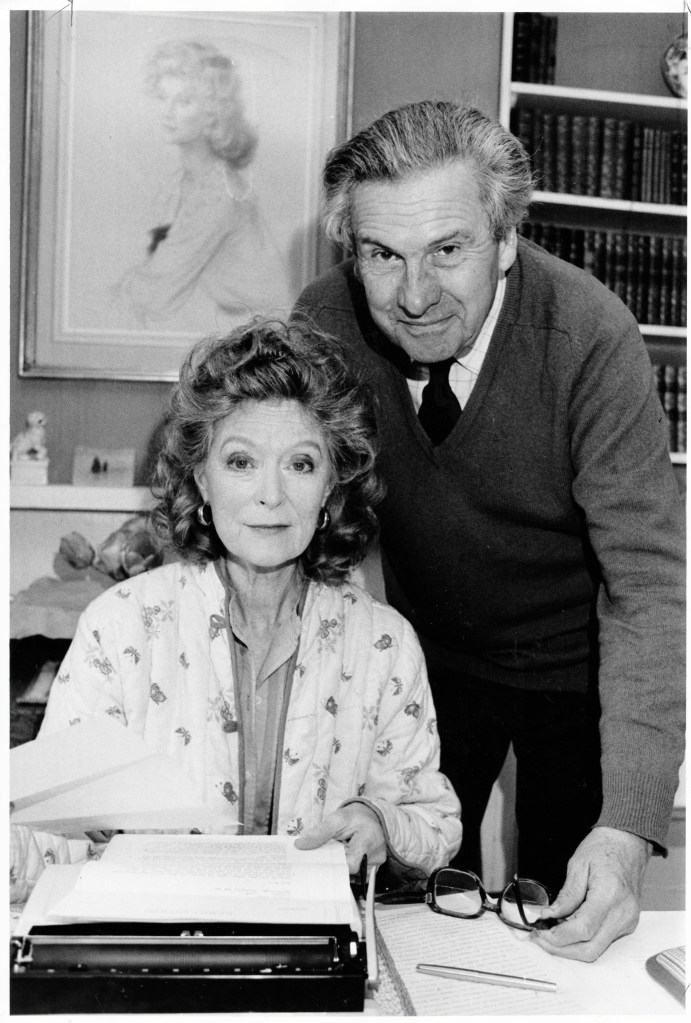
The Kennedys at home in Avebury, Wiltshire in May 1986. Photographer unknown.
From 1986-89 Shearer wrote occasional book reviews for (BBC) Channel 4. In 1989 she accompanied her husband at Bafta awards in London where he was honoured for his service to journalism. Also, in 1989 Kennedy published his autobiography which he titled “On my way to the Club” and presented a BBC TV documentary on the World War 2 German battleship, Bismarck, that was based on his earlier book. He began to take an active role in a campaign for voluntary euthanasia. In 1995 he published a book titled “In Bed with an Elephant” that set out the case for Scottish independence.
Shearer spent the 1990s largely enjoying her quiet life in the Wiltshire countryside but in1998 she began to write insightful book reviews for the newspaper, The Telegraph.
In 1999 Kennedy published another book that explored his personal secularism; he titled it “Farewell to God”.
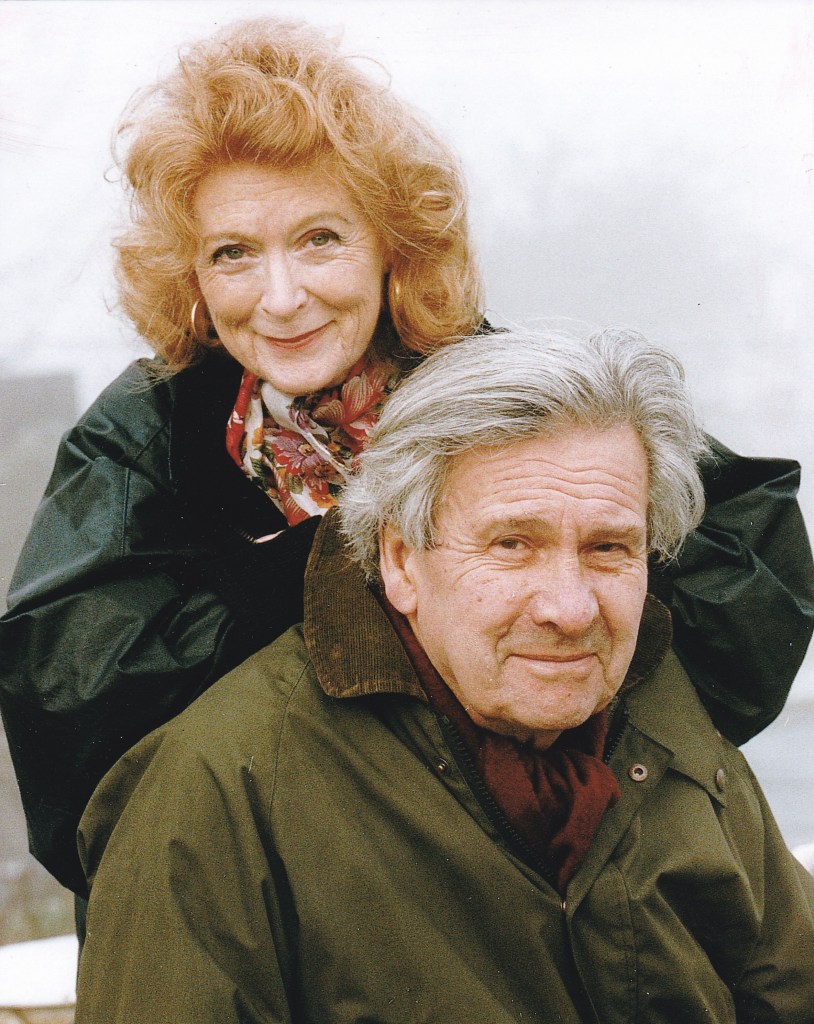
Darby and Joan in the garden of their house in Avebury, Wiltshire circa 1990. Photograph by Denis Jones.
In 2002, because they were unable to maintain what was a rather large house in Avebury, the Kennedys moved to an assisted living facility in Boars Hill, Oxford. Their last public appearance together was in 2003 when they attended the funeral in January of the Lib-Dem politician, Roy Jenkins.
Notes.
Data concerning “Did you see…?”, derived from the Internet Movie Database (IMDB, online)
Shearer’s father, Harold King, died in 1962 and her mother, Margaret Crawford Reid Shearer in 1980.
Sources.
Aberdeen Evening Express, April 9th, 1952.
Aberdeen Evening Express, August 23rd, 1956.
Berwick Advertiser, March 16th, 1972.
Daily Express, December 14th, 1949, The Ballet is Back.
Daily Express, 23rd October 1957, Moving Time.
Dale Harris; Moira Shearer interviewed by Dale Harris in Edinburgh, August 29th, 1976 and September 1st, 1978. Transcript of an audiotape held at the New York City Library Archive, Lincoln Center, New York.
Dundee Courier, August 13th, 1952, “To Moira a Daughter”.
Dundee Courier, December 21st, 1954.
Dundee Evening Telegraph, June 20th, 1950, “Moira on Holiday”.
Edinburgh Evening News, September 2nd, 1954, Ludovic Kennedy, Writer.
Evening News, August 20th, 1957.
Illustrated Evening News, October 13th, 1956.
Kennedy, Ludovic, ‘On my way to the Club, an autobiography”, 1989, Collins, London.
Picture Post, 28th March 1953, “Moira’s Baby”.
Radio Times, December 3rd, 1970.
Sketch, November 14th, 1949, “Ballerina and Groom to be”.
The Stage, August 11th, 1954.
The Stage, October 20th, 1955.
The Stage, October 24th, 1957.
The Stage, November 27th, 1958.
Theatricalia, theatricalia.com/play/ (online).
The Scotsman, January 10th, 1973.
TV Times, July 25th, 1958, This Week.
Woman’s Own (Collie Knox), March 11th, 1961, “Moira Shearer dances again”.
Woman’s Weekly, September 13th, 1975, “Silver Wedding”.
Yorkshire Post, December 22nd, 1952.


Leave a Reply