At some time in the early summer of 1947 and before filming began on June 22nd, Michael Powell, director of the film “The Red Shoes”, convened a meeting at his house on Melbury Road, west London. Present were his co-director and producer, Emeric Pressburger, Anton Walbrook, the lead male actor, Moira Shearer, Hein Heckroth, the artistic director, and Jacques Fath, the French couturier. Fath was to design most, if not all of Shearer’s clothes for the film although the London designer, Jo Mattli, would produce many of them.
While there are a number of publicity images of this meeting there is no written record of it or of what discussions might have preceded or followed it. Thus, much of the following discussion of Fath’s role is based on speculation. Where it is employed, it is indicated as such.
There is no record why Powell decided to hire Fath to create Shearer’s wardrobe for the film. However, Powell appears to have invested in him some of the responsibility for creating the romantic illusion that he was intent on achieving. Powell intended that the clothes will be used to reinforce the drama created by the actions of the actors and their dialogue. Exploring Shearer’s “costumes” worn in the film is therefor of some importance to an understanding of how Fath went about tackling the challenge with which Powell had presented him.
Shearer wore about a dozen different sets of “street” clothes that Fath or Mattli designed or produced. Below is a description of each in the order in which they appear in the film.
The first time we encounter Shearer is when she appears as a young socialite, Victoria Page. She is seated in a box with her aunt at the theatre where they watch the premiere of a new ballet. Victoria (or Vicky) is wearing a dark-coloured strapless evening gown, probably in silk and with considerable décolleté. In the next scene we meet her again in the same evening dress at a reception after the performance where she meets the impresario and ballet director, Boris Lermontov, played by Walbrook. Vicky moves effortlessly through the reception party acknowledging acquaintances as she does. Even though she is bullied by Lermontov to do something against her wishes she appears almost imperious and her flowing gown reinforces her status as the centre of attention.
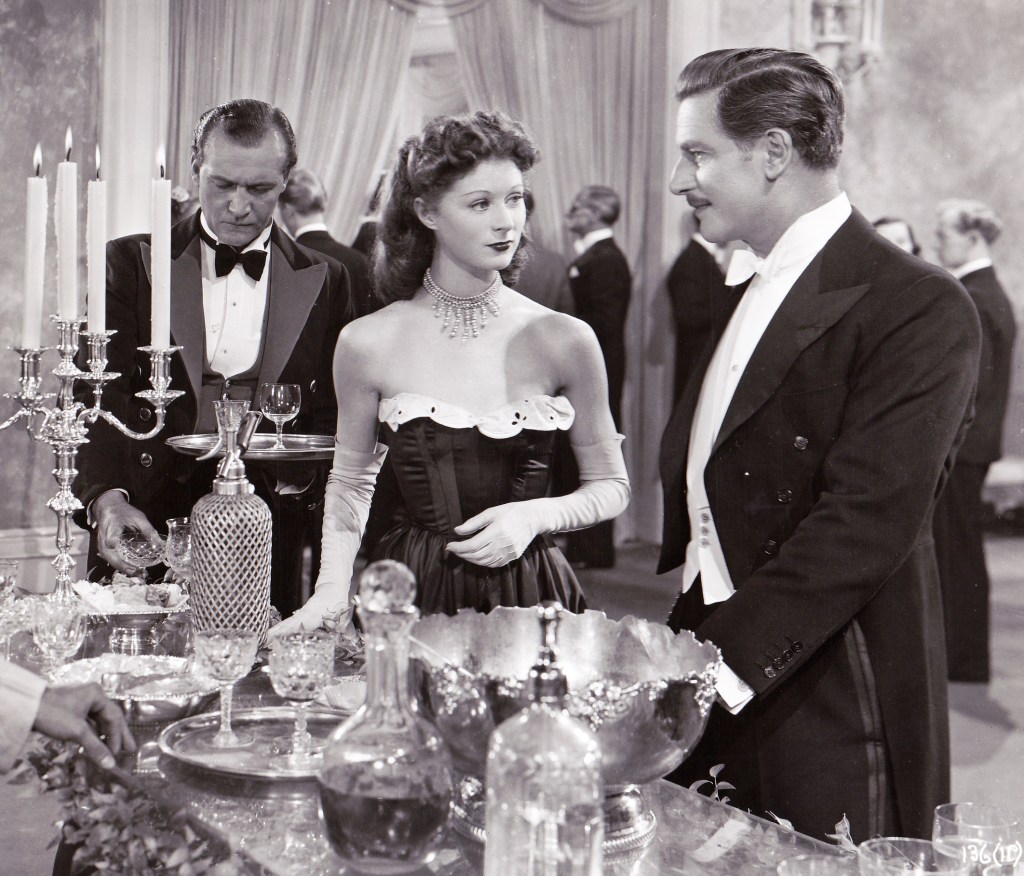
Victoria Page (Vicky, played by Moira Shearer) meets Boris Lermontov (Anton Walbrook) for the first time at a cocktail party. She wears all full length evening gown designed by Jacques Fath. Photo derived from a screenshot. The director of photography for the film was Jack Cardiff.
When she next appears, the stage and mood have changed entirely. Wearing a rather frumpy brown 2-piece suit and matching hat she tries to negotiate the melee of the market in Covent Garden. She is on her way to the Opera House where she is to meet Lermontov once again. In his choice of this very conservative clothing Fath seems to make a statement that she has cast off her aristocratic aura and has replaced it with one of a dancer who is about to enter the lowly ranks of the corps de ballet. Thus, in this same vein, she appears rather meekly at the stage door and awaits her turn to be admitted by the doorkeeper. Once inside she changes from street clothes to her practice outfit and becomes virtually indistinguishable from all the other dancers limbering up and practicing on stage.
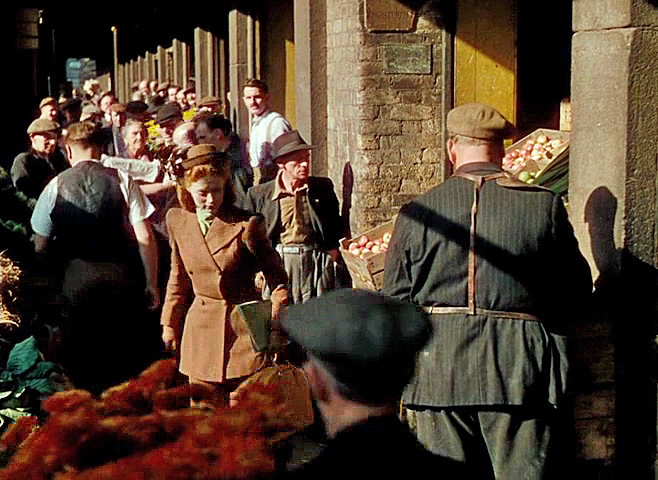
Vicky on her way to work on her first day at the Opera House at Covent Garden. She wears a 2-piece suit designed by Fath. Photo derived from a screenshot. The director of photography was Jack Cardiff.
Subsequently on leaving Covent Garden for lunch one day Vicky runs into one of her society acquaintances sitting in his chauffeured 1936 black Rolls Royce. He indicates that he is waiting for Lermontov to join him for lunch. Surprised to see her and unaware of the new direction her life has taken, he breezily asks, “what are you doing here?”. Vicky wears a simple and elegant black coat that sets off her striking auburn hair. With this singular stroke Powell, aided by Fath, has momentarily transported her from the world of the mundane repetitions of the corps de ballet to her former status as a London socialite.
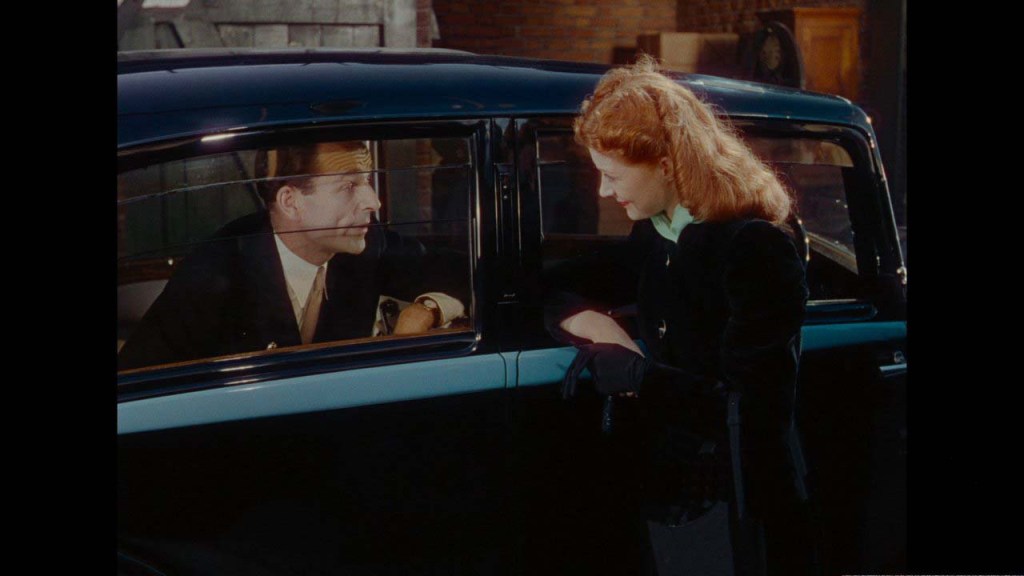
Vicky meets an acquaintance by chance outside the stage door to the Opera House at Covent Garden. Her dark-coloured overcoat was designed by Fath. Photo derived from a screenshot. The director of photography was Jack Cardiff.
While Lermontov has accepted Vicky into his company it is only in the lowest ranks. When the time comes for him to announce who among the corps will be travelling on tour to Paris and Monte Carlo, he gathers the female dancers to hear his decision. Powell creates a shot of Vicky waiting to hear if she has made the cut. Her face is filled with expectation and her summer dress announces she is ready to travel to sunnier climes. Fortunately, she is accepted. The dress she wears is a lightweight one-piece in a gay printed pattern. It will reappear several times while she is in Monte Carlo but only in publicity shots like the one of her asking the way of a local. Ironically, as Shearer was a true redhead and had very pale skin, her time in the sun was very limited. Powell did not want his female lead to show any evidence of a suntan.
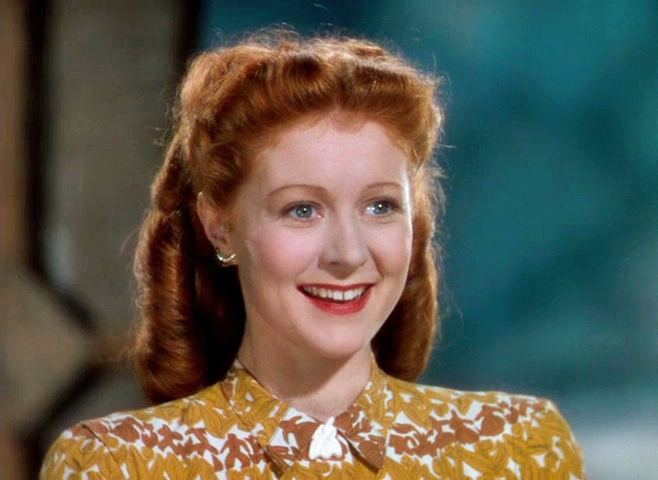
Vicky learns from Lermontov that she has been selected to go on tour on the Continent. Her printed dress was designed by Fath. Photo derived from a screenshot. The director of photography was Jack Cardiff.
The company of the Ballet Lermontov crosses the Channel to open a tour of the Continent in Paris. Here Lermontov learns that his premiere danseuse, Boronskaya intends to marry and he summarily fires her. Once their stay in Paris is over the company boards a train for Monte Carlo and in one brief scene Vicky, wearing a dark dress with guipure lace trim at the neck, gazes from the window of her carriage to witness Lermontov’s frosty parting from Boronskaya. The lace trim is repeated in a band on Vicky’s head and her face is covered by a veil. The outfit seems altogether too formal for an arduous rail journey to the Mediterranean and it is unclear what impression Powell and Fath wish to convey. This uncertainty is compounded by the fact that on her arrival in Monte Carlo, when Vicky emerges from the lift on the plaza in front of the Opera House, she is wearing entirely different clothing. Her fitted blouse with the long sleeves has multiple coloured horizontal stripes in yellow, purple and pink on white and is worn over dark coloured stovepipe slacks. The message is clear. Her sleeves are rolled up and she is ready to go to work.
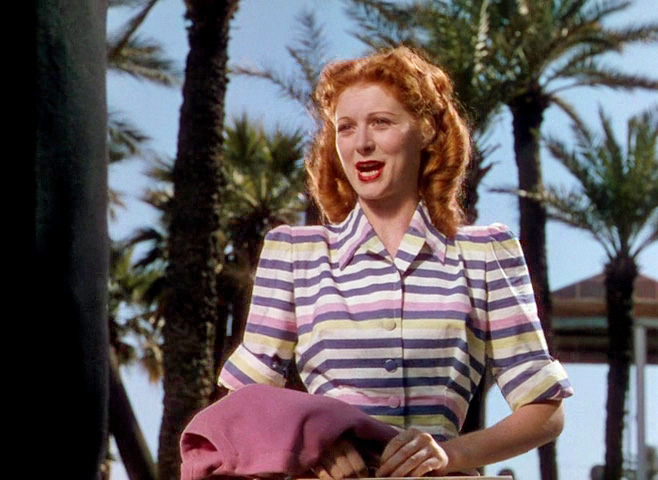
Vicky arrives in Monte Carlo where the Lermontov Ballet will perform. Her cotton blouse and lightweight wool jacket were designed by Fath. Photo derived from a screen shot. The director of photography was Jack Cardiff.
The use of slacks was one of the biggest innovations employed by Fath in the film. Slacks were extremely rarely seen in either Britain or France in 1947 and it would be another 10 or 15 years that they became fashionable even in films. However, they are symbolically put to considerable use in subsequent scenes.
However, first comes the introduction of perhaps an even more iconic example of Vicky’s wardrobe. During rehearsals and much to Vicky’s surprise Lermontov puts her up in Monte Carlo’s most luxurious hotel, the Hotel de Paris. He assures her that she’ll be “very comfortable there”. There is clearly an intent in his choice. In a later scene Vicky is seen leaving the lobby wearing a sumptuous, turquoise-coloured multi-layered evening gown with a full-length cape and a tiara perched atop her striking hair. As she explains later, she was dressed to the nines as she was about to go out to dinner with friends. She cancels these plans when Lermontov suddenly summons her to a meeting in the Cap Ferrat villa in which he is staying. He sends his car for her and we see her get into it for the ride along the Corniche. Inexplicably the chauffeur drops her not at the main entrance but at the base of a long weed-strewn stone stairway that leads to the villa. Hitching up the hem of her heavy gown Vicky sets off up the hundred or more steps. She arrives at the top betraying not a trace of perspiration on her brow on the warm Mediterranean evening. This is perhaps the greatest of Powell’s flights of fancy in the entire film.
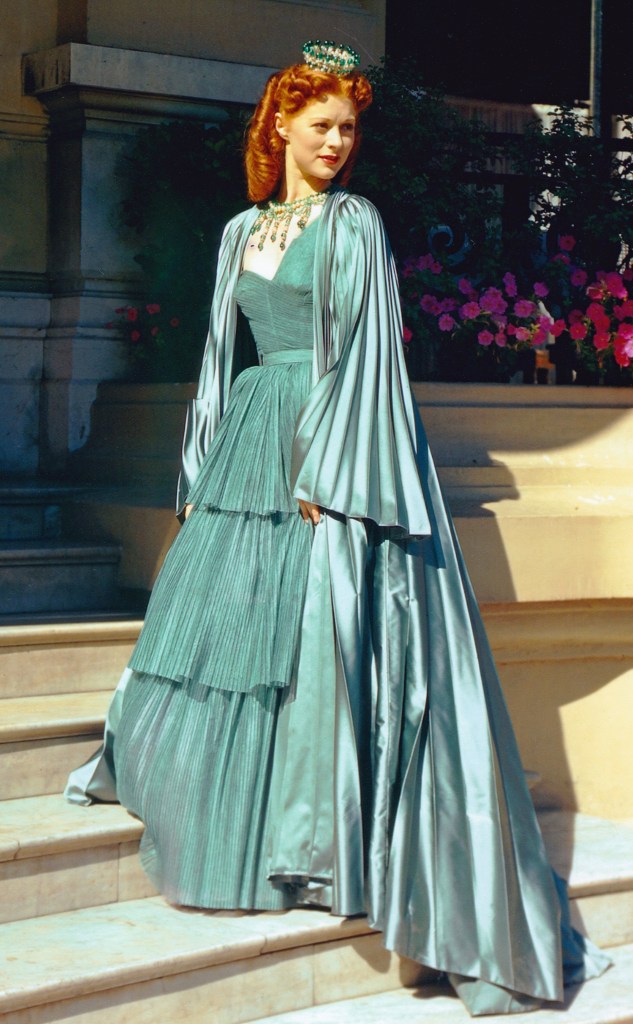
Vicky stands on the steps of the Hotel de Paris in Monte Carlo prior to her meeting with Lermontov at his villa. Her silk gown and cape were designed by Fath. Photographer unknown.
Fath’s gown is entirely out of character with anything else Vicky is called upon to wear but possibly symbolizes her transition from a lowly dancer labouring in the corps de ballet to the status of the star of the company. Powell has her left at the bottom of the stairway precisely so that he can record her ascent.
In the meeting at the villa Lermontov announces to Vicky that he has chosen her to replace Boronskaya as the premiere danseuse in the company. As she will go to work the next morning he sends her home to bed.
Instead of going to bed immediately as ordered, Vicky walks out to take in the view from a terrace below the Opera House that overlooks Monte Carlo. Here, by chance, she meets Julian Craster, the composer of the music for the ballet of “The Red Shoes”. Julian is casually dressed in a lightweight jacket over an open-necked sports shirt. Vicky wears a buttonless jacket with slightly padded shoulders over her striped blouse, slacks and white open-toed wedge shoes. As they part for the night it is clear that they are, at this time, still “just friends”. Their casual clothing seems to reflect their light-hearted conversation.
Despite some early arguments between them over the tempo of the music Julian has created for the ballet, they eventually fall in love. Later we find them together in a hired horse-drawn “coche” that transports them slowly along a road beneath the pines on the seashore. The evening is warm and both wear casual, unself-conscious clothing. Julian wants to talk of love, but Vicky seems more intent on finding out from the driver where they are.
When he hears of their love affair Lermontov reacts angrily and concocts a premise for firing Julian. Subsequently, in a scene set in the Monte Carlo Café, Grisha Ljubov, the company’s dance director, played by Leonide Massine, tries unsuccessfully to console the lovers. Later in the conversation, Sergei Ratov, the set designer and confidant of Lermontov mentions that Lermontov is leaving Monte Carlo by train the next morning. Vicky decides to go to the station to confront him.
She is next seen waiting for Lermontov on the platform. She wears the same slacks she had worn earlier but, this time, with a bold, banded lightweight blouse. The combination seems to signal to Lermontov that she is here for a serious discussion. Politely but forcefully, she says to Lermontov, “I’d like to talk to you” and leads him to the waiting train. In their conversation Vicky makes it clear to Lermontov that if he fires Julian, as he has planned, she will quit his company. As it turns out, both held their ground. Vicky quit and moved to London to be with her husband.
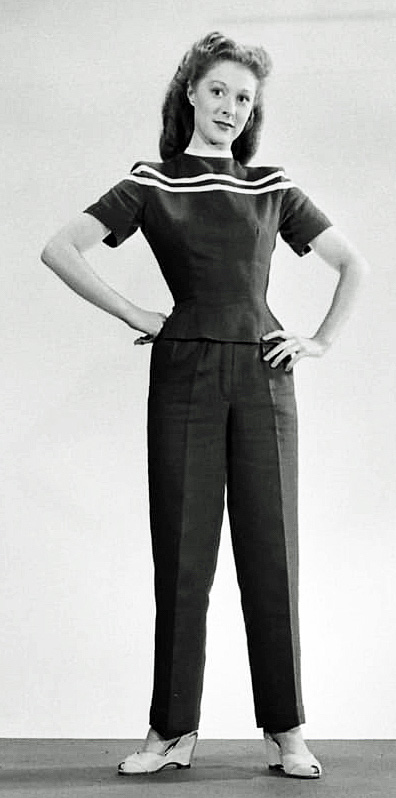
Vicky in the clothes she wore for her fateful meeting with Lermontov on Monte Carlo station. The cotton slacks and blouse were designed by Fath. Shoe designer unknown. Photographer unknown but possibly one working for Life Magazine.
Nonetheless, the following year she returns to Monte Carlo, on holiday with her aunt. For the train journey there Vicky wears a dark green linen long-sleeved “jacket” over a full pleated skirt in green and white and an extravagant beige straw hat, a combination guaranteed to enchant any man but not, apparently, Lermontov. As the train pulls into Cannes station Vicky, much to her shock, sees him on the platform. He had learned of her impending return and has cynically engineered a meeting with her by waiting for her in Cannes. He boards the train and enters her carriage. After some initial banter, Lermontov earnestly tells Vicky that nobody else could dance the role in “The Red Shoes” but her. She listens intently and during the hour-long journey allows herself to be seduced. He obviously understands her passion for ballet and is able to persuade her to rejoin the company.
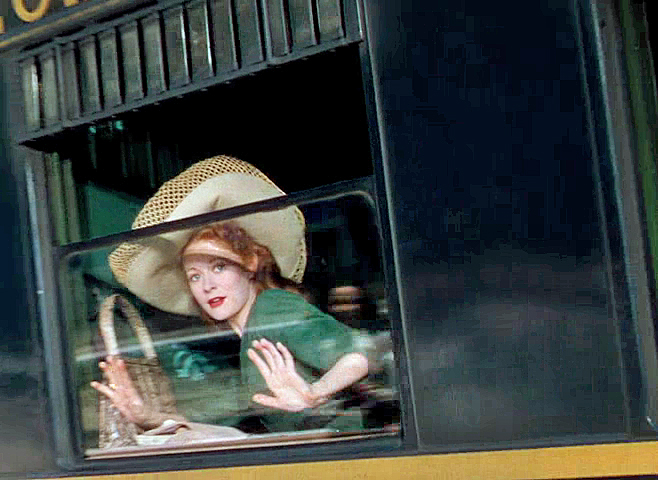
Vicky catches a glimpse of Lermontov standing on the platform of Cannes station. She wears a dark green linen jacket designed by Fath. Photo derived from a screenshot. The director of photography was Jack Cardiff.
This is last time we see her in formal clothes. When she subsequently returns to the Opera House to dance she exchanges them for a ballet costume and red pointe shoes. Vicky’s decision eventually leads to her death by suicide as she comes to the realisation that she is unable to reconcile her love for ballet with her love for her husband.
Note.
- There is no record of whether Fath created clothing to specifically fit Moira Shearer’s diminutive frame or simply took items off the hanger and had a fitter modify them as needed. There is a photo of Fath taken in May 1947 showing an evening gown to a group in Paris. With the exception of trim absent at the hem, the gown appears identical to that worn by Vicky when we are first introduced to her in the theatre box and subsequently at a cocktail party. The material appears to be a dark coloured silk with white accents at the bodice.
- Once more there is no record of the material used in the suit Vicky wears to her first day at work at Covent Garden but it appears to be a pale brown lightweight wool. At her neck she wears a cream-coloured silk scarf and her matching pillbox hat is trimmed with stylized blossoms. Her face is veiled.
- The full-length gown and matching cape that Vicky wears to her meeting with Lermontov in his villa appears to be of silk.
- The balance of Vicky’s wardrobe appears to be primarily of cotton or lightweight wool.
 Moira Shearer
Leave a comment