Writing in the May 1948 issue of the magazine, “Sound”, under the title, “Ballerina; a study of Moira Shearer”, Jean Tucker, their dance critic, looked forward, perhaps a little apprehensively, to the projected September general release of the film, “The Red Shoes”. In it, Shearer played the part of a young dancer who was forced to choose between her love of her husband and her career in ballet. Tucker predicted the birth of a new “star”.
However, Tucker wanted to remind her readers that Moira Shearer, dancer, had already been under the scrutiny of the ballet-going audience for many years. She outlined Shearer’s rapid progress through the ranks at the Sadler’s Wells Ballet starting in 1942. Characterising her roles as a swan in Swan Lake and as the leading Wili in Giselle, Tucker concluded that Shearer was “cool and remote and looked lovely”. However, Tucker continued, while she was “technically strong she never had … an obvious technical strength and force”. Yes, “she had superb poise, and a delicacy and precision” but this “at times bordered on irritating finickyness”.
Tucker continued her outline of Shearer’s development as a dancer noting that she had gradually shed some of her more annoying “mannerisms” and had begun to assume a “stage personality”. She had grown from being a dancer and, in her interpretation of Aurora in Sleeping Beauty, had become a “ballerina”. Tucker expanded on what this status represented.
“To the layman every dancer is a ballerina but actually it is a title earned only by a very few and after years of hard work, disappointment and success. A dancer may have technique or personality; style, histrionic or musical ability; she may be beautiful or have a perfectly proportioned figure; but unless she has all of these, plus the undefinable something which promises greatness, she will never be a ballerina. Even then success is largely dependent on opportunity. Moira Shearer has the main of these attributes. She has, of course, still much to learn and faults to correct. But she has earned the title ballerina while her promise remains unfulfilled”.
Thus, in 1948, Shearer was still a work in progress. Shearer would have agreed with this assessment. Later in life, when lamenting her participation in “The Red Shoes” she said that in 1947 she was just beginning to take on the big, demanding roles at Sadlers Wells. She didn’t dance the lead in Giselle, for example, until July 13th, 1948.
In a 1974 interview Shearer recalled what her success had required, starting with her year with The International Ballet.
“I had been a professional dancer from the age of 15 – working a 52-week work year, shut up in rehearsal rooms and theatres until late at night. I would remove my makeup, go home in the tube and just fall into bed till I had to get up and start it all over again…. It was a highly technical and very physical life. And it had all been decided by other people. That’s what happens to dancers”. Those people included her mother, who launched her career by signing her up for her first dance lessons at the age of 6 or 7. Of her Shearer said, “my mother – very Scottish – gave me her version of love only when I achieved something. I literally had to earn my affection. I had to excel in everything. To have shown signs of laziness would have meant disgrace”.
Among her subsequent mentors were Mona Inglesby, director of the International Ballet and Ninette de Valois, director of Sadler’s Wells. Both were strict taskmasters. Shearer rather ruefully concluded, “anyway, I was trained for nothing else (but dancing). And if you are successful at anything and are encouraged by approbation, (one) tends to continue”.
Continue she did, through the ranks of Sadler’s Wells and by 1947 Shearer was second only to the company’s prima ballerina, Margot Fonteyn. However, that was to prove to be as far as she could expect to progress. As Shearer expressed to a reporter during the Sadler’s Wells tour of North America in 1949 each company had but one prima ballerina. She expected to remain in Fonteyn’s shadow.
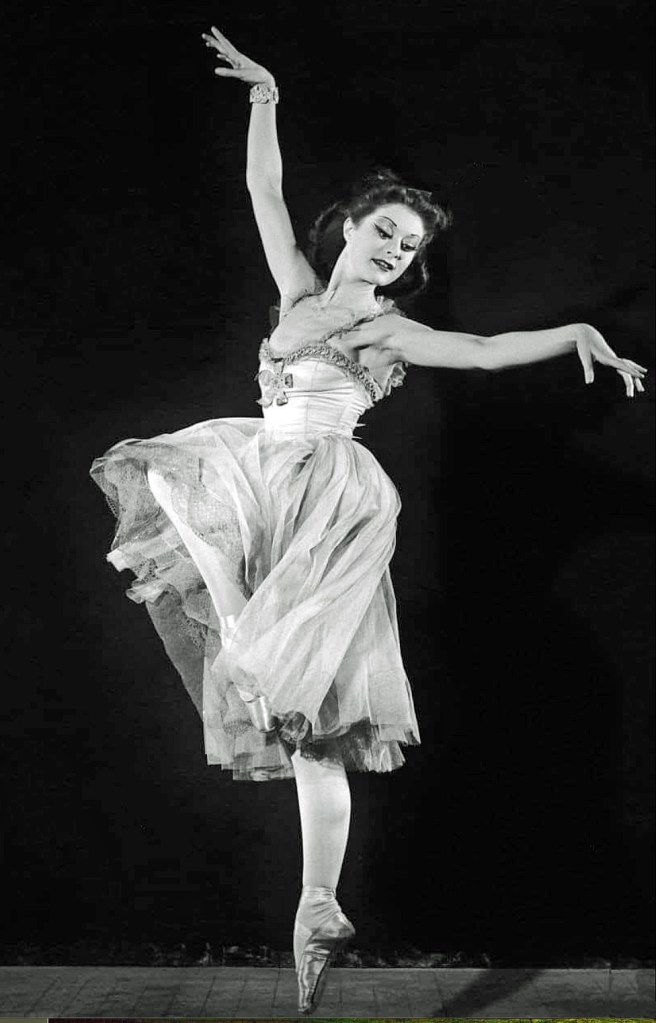
Moira Shearer dancing in The Red Shoes, 1948. A number of dance critics criticized her for her “spikey” fingers. Photographer unknown.
Sources.
Frank Entwistle, Sunday Express Magazine, 1974. “Things I wish I’d known at 18”.
Dale Harris, transcript of interviews conducted with Moira Shearer in Edinburgh, August 29th, 1976, and August 31st and September 1st, 1978, New York City Library Archive, Lincoln Center, New York.
Jean Tucker, Sound, May 1948.


Leave a Reply