In her interview with Dale Harris Moira Shearer recalls that her first solo role at the Sadler’s Wells Ballet was in 1942, as the serving maid in a ballet choreographed by Ninette de Valois and named The Gods Go A-begging. The date of her premiere was November 24th, 1942. She also noted that Beryl Grey had danced the role before her and during the seasons 1942-43 it is likely they alternated in it. Julia Farron also danced the role at this time. Alexis Rassine invariably played the part of the shepherd, with whom the serving maid danced a duet.
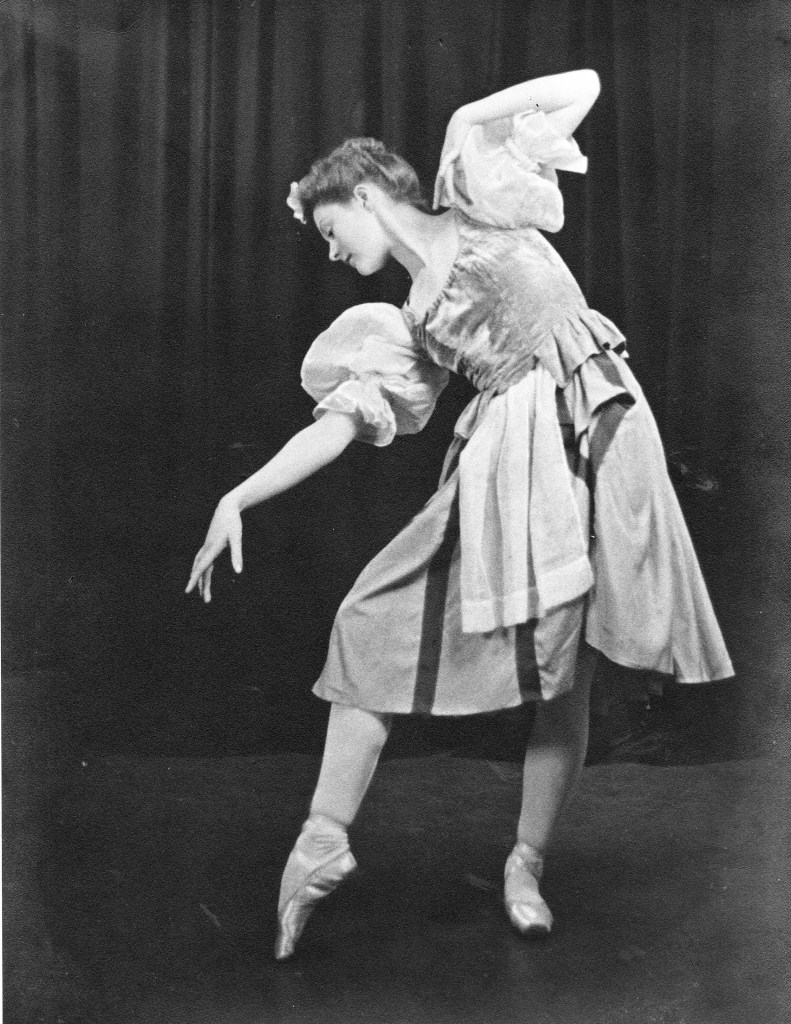
Moira Shearer as the serving maid in The Gods Go A-begging in the mid 1940s. Photographer unknown.
Several of Shearer’s performances were during tours in Manchester, Liverpool and Newcastle. As it was a short (20 to 25 minute) divertissement requiring a relatively small cast (21 dancers) and limited stage props it was well suited to the confined stages often offered by provincial theatres.
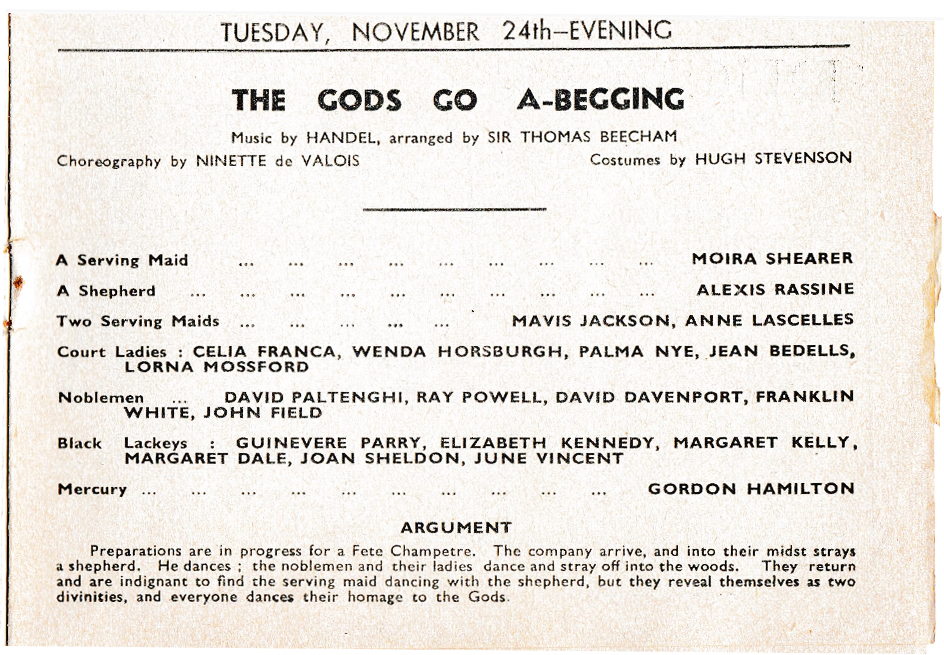
Programme for the Sadler’s Wells Ballet at the New Theatre, London, November 24th, 1942.
The ballet, with George Balanchine’s choreography, premiered in 1928. In the 1930’s Ninette de Valois created her version and in 1938 Pamela May danced the part of the serving maid.
The plot involves a picnic or “fete champetre” held by some aristocrats into which a shepherd wanders. He is invited to dance by two noble ladies but spurns them, choosing, instead, to dance with their serving maid. The noblemen are outraged and chastise the shepherd and maid at which point they reveal the fact that they are gods in disguise. The aristocrats close out the ballet by dancing in their honour.
The only review of Shearer’s performances of any note was written by R.H.S. Stallard. the dance critic for the Liverpool Evening Express in May,1943, reporting of a performance by the Sadler’s Wells Ballet at the Royal Court Theatre. He writes, “Ninette de Valois’ version … with Sir Thomas Beecham’s arrangement of music by Handel, has always stood far above all rivals. Last night’s well set and finely danced performance was an all-round triumph for the company and a personal success for Alexis Rassine and Moira Shearer, the divinities in disguise as shepherd and serving maid to whom … the whole company of noblemen, ladies, servants and black lackeys dances homage in a finale made all the more effective by the costumes designed by Hugh Stevenson”.
Sources.
Dale Harris, transcript of interviews conducted with Moira Shearer in Edinburgh, August 29th, 1976 and August 31st and September 1st, 1978. New York City Library Archive, Lincoln Center, New York City.
R.H.S. Stallard, Liverpool Evening Express, May 4th, 1943.
Notes.
The ballet didn’t command much attention from the critics. The most complete review was written by the dance and music critic for the Manchester Guardian, Granville Hill, on September 29th, 1943. He reports on the visit of the Sadler’s Wells Ballet to the Manchester Opera House the previous evening.
“The fully grouped sections were vivaciously acted last night and important as are the solo parts, the success of the stage action depends chiefly on the vigour and rhythm of the ensemble dancing. The setting often drew into focus many glancing figures from diverse quarters. During the finale the change to an austere deportment was effectively managed. Through each scene … Alexis Rassine and … Beryl Grey danced and mimed gracefully and with a certain naiveté quite in keeping with the supposed rusticity of the characters”.
The Gods Go A-begging was the first of three ballets on the evening of November 24th; the second was The Birds, in which Shearer played an attendant dove, and the third was Les Patineurs. As there was no interval and her costume in The Birds was elaborate, her change between performances must have been hurried.
Julia Farron danced the role of the serving maid 6 days before at a matinee on November 18th. With the exception of the two “serving maids” the supporting cast was identical to that on November 24th.
Shearer danced the role at least 10 times between 1942 and 1946.


Leave a Reply