Leaving aside her personality, her intelligence, wit and musicality this post initially focuses on how Shearer’s physical attributes helped determine her development as a dancer.
According to a November 1950 American newspaper article, Shearer was then 5’ 5 ½” tall and weighed 104 lbs. It added that she “ate like a longshoreman”. She remained at this height and weight throughout most of her life. Her body was probably ideal for a ballerina but, more important than these basic physical characteristics, was the way in which she trained it to dance. As it was with all ballerinas, it was a long and demanding process that began when she was 6 years old. At that time, in 1932, Shearer was living with her parents in Ndola, Northern Rhodesia. A local paper attended one of her first performances and commented, “her lightness and spontaneity are the special qualities of all born dancers”. While the young Shearer may have, indeed, then possessed these attributes, great dancers are, of course, not born; they are made.
In his introduction to Celia Sparger’s book, “Beginning Ballet” the British dance historian, Arnold Hasker, likened a ballerina’s body to a violin. To function well it must be finely tuned. Sparger’s slim book features many images of Moira Shearer “tuning” her body.
Sparger describes the group of daily exercises that made up the foundation for all the steps and poses employed in the classical ballets. Together, she explains that these exercises bestow on the dancer’s body the strength, flexibility, balance and speed necessary to succeed as a ballerina. She goes on to explore the concept of “placement” that allows the body to move seamlessly from one pose to another. Central to placement is how the back is held in standing and in exercises or movements at the barre. Sparger stresses how important it is that the dancer “feels her body” particularly in the way that contact is made with the floor. To achieve this, the dancer, Sparger asserts, must stand on the ball of the foot and not on the toes.
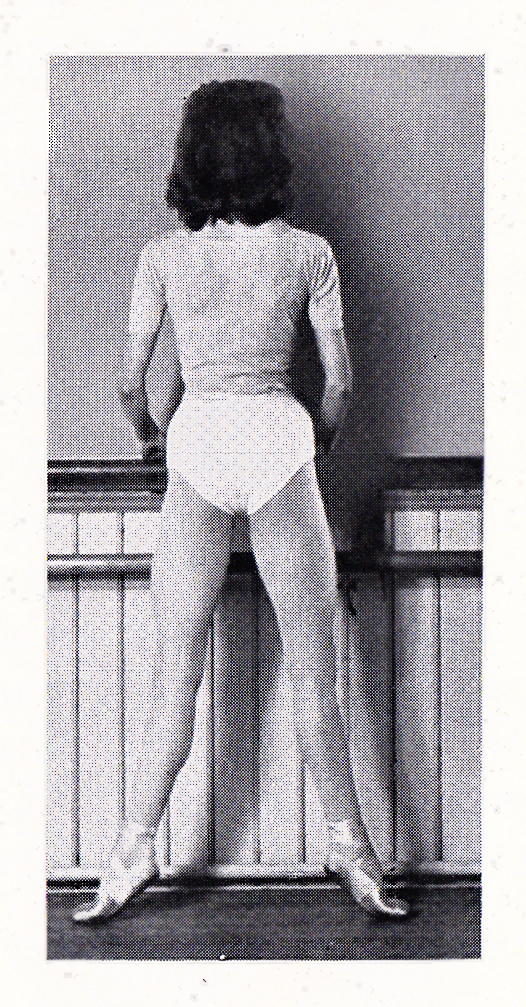
Moira Shearer standing at the barre in the demi-pointe (half point) position. The photograph is from Celia Sparger’s book, Beginning Ballet.
The book illustrates the first exercises at the barre that primarily involve the legs and torso in pliés, demi-pliés and relevés. These exercises are followed by the arabesque where the arms are brought into play. Finally, exercises move to the upper body and to learning how to hold and move the shoulders, arms and hands, the so-called épaulement and port de bras. While the book was intended for beginners and doesn’t go into detail, it provides an unique snapshot of Shearer at her daily routine of practice.
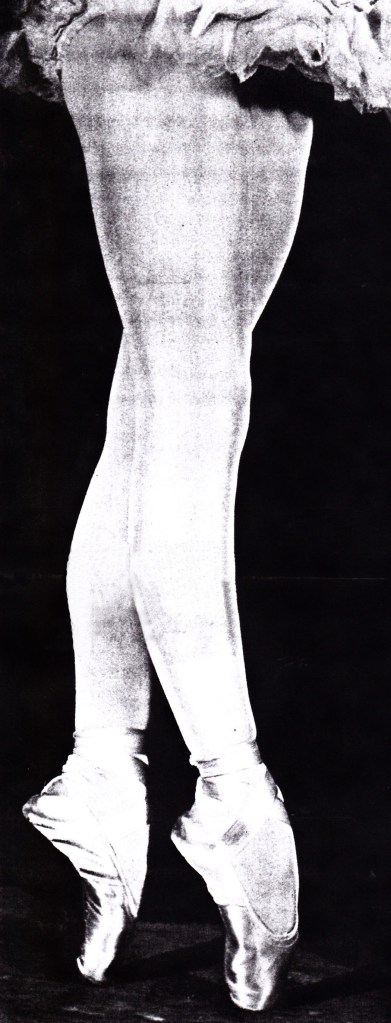
Moira Shearer standing en pointe. Photograph by Hans Wild in The Strand, December 1948
The December 1948 issue of the monthly magazine, The Strand, published two photos of Moira Shearer; one, by the British photographer, Hans Wild, was of her legs en pointe; the other was an X-Ray of those same legs. The caption to the photos read, “The picture on the left shows the pose in which Moira Shearer stood on her points – technical phrase for standing on her toes – in front of the X-Ray camera….the most interesting feature, from the point of view of bone structure, is the angle of Shearer’s feet. Assuming that, in an ordinary standing position, the feet are at an angle of 90 degrees to the leg, an average person can stretch the bones of their feet to an angle of 135 degrees. Shearer, as a result of years of practice, can stand absolutely upright on her toes, which means 180 degrees. And it is noticeable that the stretch comes entirely below the heel bones. The only support in the ballet shoes is that the tips are slightly flattened and hardened. Contrary to popular belief there is no wood in the tips of the shoes at all”.
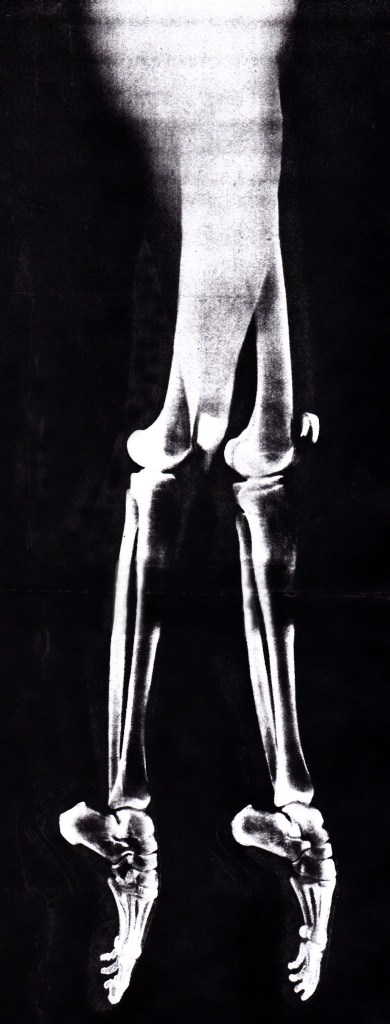
An X-Ray photograph of Shearer’s legs published in The Strand, December 1948.
In 1951, Shearer danced four roles in the film The Tales of Hoffmann. After thousands of hours of practice and performance, by then her body was probably at the apex of its powers. As Stella dancing as a dragonfly and as Olympia, the doll, we are witness to what a number of critics described as her almost flawless technique.
Over the course of her career in ballet Shearer received considerable criticism of her style of dancing. Much of it was positive. Some critics, for example, praised the way in which she moved her torso, arms and hands. However, some took issue with her hand movements in particular. There was certainly no consensus. Early on, critics like Caryl Brahms commented critically on her “mannerisms” but these seem to have been discarded as she developed.
Shearer herself commented little on her physical attributes but when asked by Dale Harris about her mannerisms she replied, “I’d always been told that I had bad hands – very spiky. I’ve a very thin wrist – boney, a long index finger”.
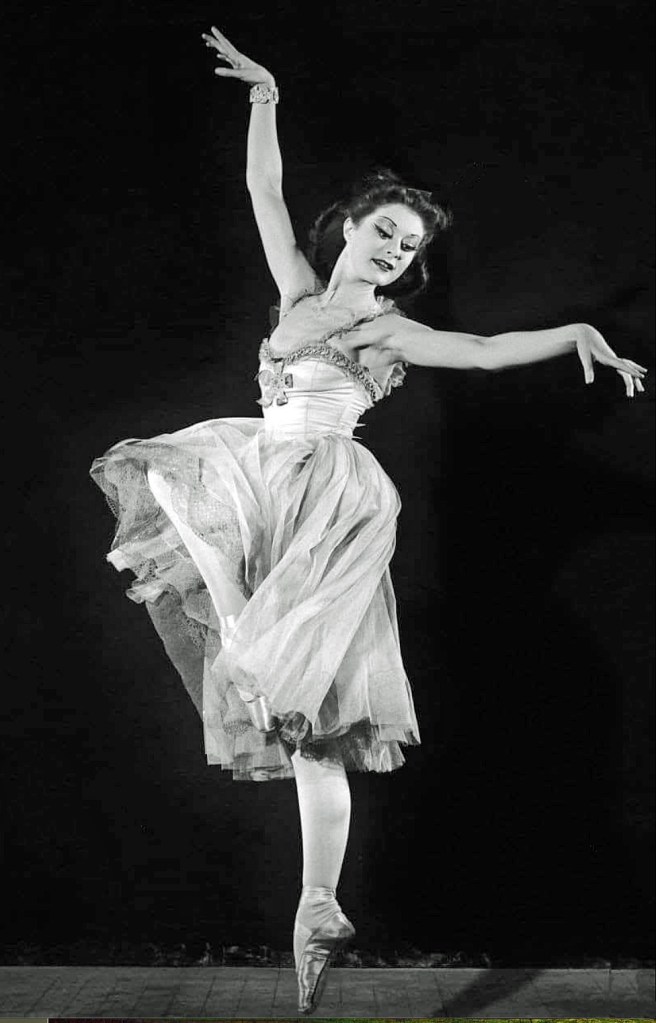
Moira Shearer’s “spikey” fingers as she dances in the film, The Red Shoes, 1948. Photographer unknown, possibly Nat Farbman.
By delving into the ballet archives it is possible to find numerous critics who focused on one or other of Shearer’s particular attributes, for example, the strength of her ankles; another of her back. However, in the final analysis what really matters in any assessment of a dancer is, of course, the sum of the parts, the overall impression. In Shearer’s case the consensus of the critics was that her dancing was characterised by lightness and lightning-fast attack. However, these physical traits were not, of course, what primarily made her an accomplished dancer. Instead, her intelligence, personality and emotional strength were the foundation of her success. These are discussed in the two following reviews.
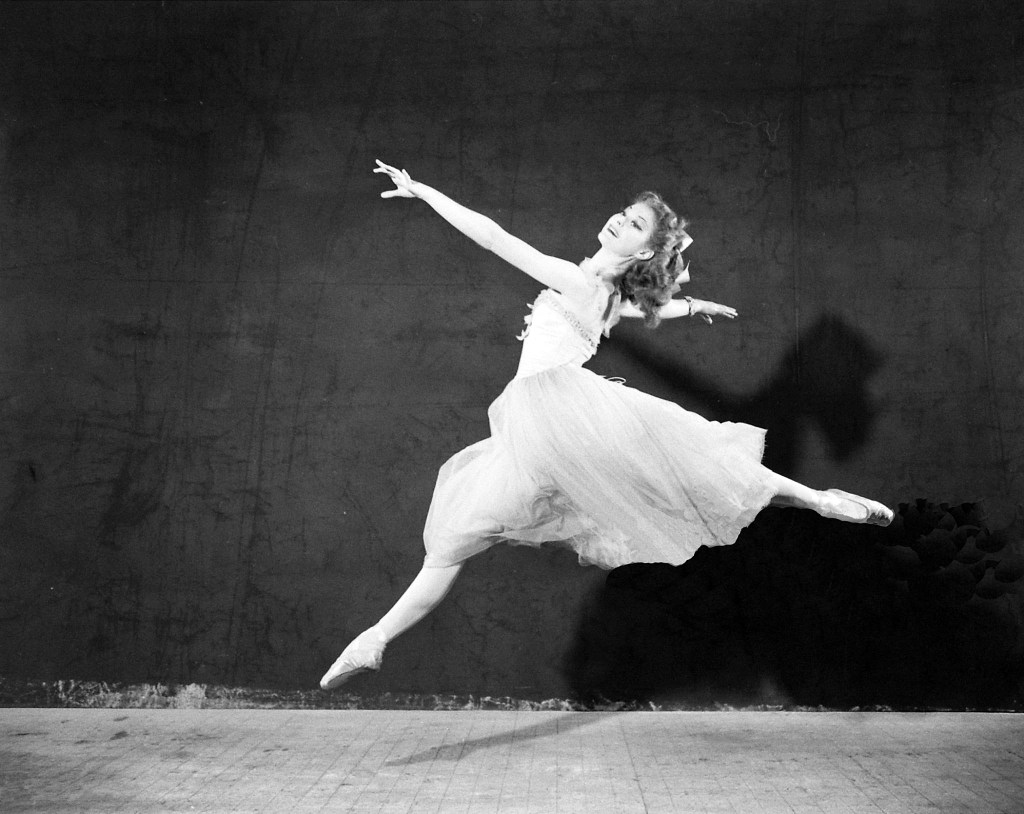
Moira Shearer dancing in the film, The Red Shoes, 1948. Photograph by Nat Farbmann.
Writing in 1947 of her performance as Aurora in Sleeping Beauty, the critic for The Stage said, “she has mastered the …. theory of art concealing art so that the mechanics (of the dance) are no longer visible. She performs miracles of point work … there is nothing but effortless motion, in itself a vision of grace and enchantment.
John Percival, the dance critic for the British newspaper, The Times, wrote in 1945 of one of Shearer’s early interpretations of the roles of Odette-Odile in Swan Lake that, “the title of “ballerina” is earned over many years and requires musicality, lightness, speed in turns, high arabesque, dramatic power, graceful line”. All these, he notes, Shearer has achieved and to them she adds “physical beauty, determination, personality and radiant charm”. Then looking to the future he poses the question, “will she live up to expectations? The answer is surely (in) her own stern criticism, her intelligence (and) the will to distinguish between true encouragement and false praise”.
Percival was, of course, also aware of Shearer’s faults and in his 2006 obituary of her he concluded that her dancing had lacked “emotional depth”. Here he was perhaps unconsciously comparing her to Margot Fonteyn, whose lyricism was one of the main reasons that she remained the prima ballerina at the Sadler’s Wells Ballet long after Shearer had left the stage.
Sources.
Dale Harris, transcript of interviews conducted with Moira Shearer in Edinburgh, August 31st, 1976 and August 31st and September 1st, 1978, New York City Library Archives, Lincoln Center, New York City.
Macdonald Hastings, “Dear Miss Shearer”, The Strand (magazine), December 1948.
John Percival, dance critic for The Times, review of a performance of Swan Lake, June 1945.
Celia Sparger, Beginning Ballet, A & C Black, 1952.
The Stage (anonymous writer), review of performance of Sleeping Beauty, April 3rd,1947.
Notes.
In her 1976 interview with Dale Harris, Shearer recalls that in 1939, when she was being considered as potential pupil for the Vic-Wells School, Ninette de Valois examined her and declared that she had “weak ankles”. Fortunately, this turned out to be not the case.


Leave a Reply