In her interview with Dale Harris in 1976 Moira Shearer talked about life as “number two” at Sadler’s Wells Ballet in the late 1940s. Margot Fonteyn had joined the Vic-Wells Ballet (later to become the Sadler’s Wells Ballet) in 1933. Shearer started at the Sadler’s Wells in 1942. When the attached photo of Fonteyn was taken in 1939, she had been the lead dancer for two years. At that time, Shearer, aged 13, was still a pupil at Mme. Legat’s school in west London. Thus, at Sadler’s Wells, there was never any question as to who was the prima ballerina.
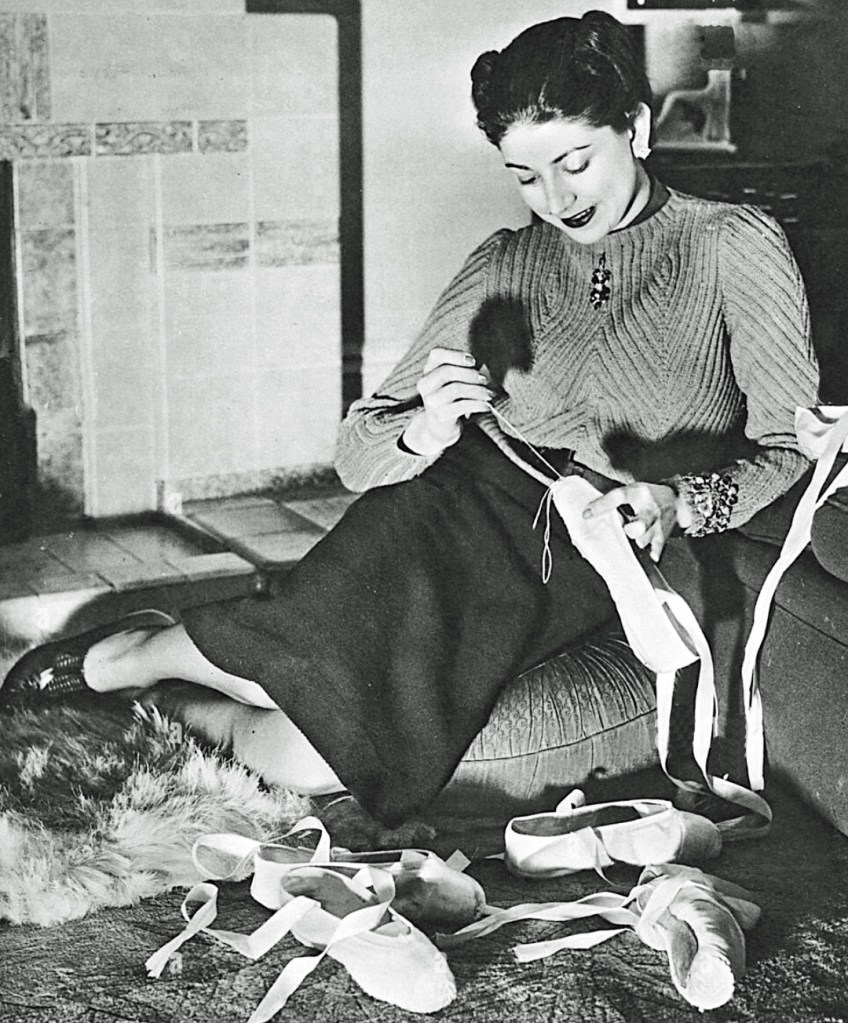
Even a prima ballerina has to darn her point shoes. Margot Fonteyn working at home. Photo published in the British magazine, The Sketch on March 15th, 1939. Photographer unknown.
Shearer accepted Fonteyn’s status as a given, as she did all the day to day consequences of it. One of these was how the second and third cast ballerinas learned the choreography of the ballets in which they were expected to perform. While the first cast ballerina practiced on stage, often with the choreographer and with accompanying music, usually on the piano, the lesser casts had to learn by watching the first cast. Practice for them was rarely on the big stage. Often it was in a practice studio with no musical accompaniment.
The dance critic Beryl de Zoete decried this undemocratic state of affairs in her January 1947 review of Moira Shearer dancing in Lac des Cygnes. Her review was titled “Homage to a Star”. “I hope that more will be written …. about Moira Shearer’s first performance of Odette-Odile in Swan Lake at Covent Garden on December 21st. I want to stress one point in particular of this performance. Incredible as it may seem, this very difficult part, one of the most exacting in the classical repertory, and one which makes such demands on the technique, intelligence and temperament of the dancer, was performed for the first time by this young dancer without rehearsal with the orchestra, without, I believe, even a rehearsal on the stage where she would have to perform it. That she performed it almost perfectly is quite amazingly to her credit, but not at all to the credit of the management. For beauty, intelligence and grace she is in the front rank the Odettes who I have seen and she showed again a particular gift for acting. The sinister glitter of her cajolery as Odile was as remarkable as her tenderness as Odette, and her technical performance in both roles was admirable. She is clearly a very intelligent as well as a beautiful and musically gifted dancer. But the management has no right to rely on such a degree of intelligence in a young dancer whom it has every interest to cherish as a star. If she had been less resourceful or less well partnered by David Paltenghi she might easily fallen below her real standard. Imagine a solo pianist or violinist standing up before the public without rehearsal with the orchestra. It is unthinkable. And a dancer has not only the problems of musical space and dynamics to consider, but actual stage space to cover”.
There were frequent reminders in the press of Shearer’s position relative to Fonteyn. An issue for the British magazine, The Tatler, for March 1947 ran a full-page photo of Shearer as Odette in Swan Lake. The byline to the photo read, “Margot Fonteyn’s deputy” and continued, “Moira Shearer, leading dancer of the Sadler’s Wells Ballet Company is one of the premier danseurs deputizing this month at Covent Garden for Margot Fonteyn, who is indisposed. The picture shows her in Act II of “Lac des Cygnes” in which this season she has danced the dual role Odile, Odette. Moira is twenty one …. and she works very hard”.
Fonteyn, reported the trade journal, The Stage, had sinusitis. She did not, in fact, resume dancing until the preparations for the first Edinburgh Festival in August. Thus, Shearer and Beryl Grey, as Fonteyn’s deputies, were put under a great deal of pressure during that spring season.
As noted by de Zoete, Shearer first danced as Odette/Odile on January 10th. She subsequently appeared in this role, and in the lead as Aurora in Sleeping Beauty, multiple times in April-May 1947. The demands on Shearer were further increased by the presence of Leonide Massine at Covent Garden for the season and she appeared with him in Boutique Fantasque and The Three-cornered Hat. In March, Shearer worked on 17 nights out of a possible 26.
Fonteyn’s illness apparently also prevented her from appearing with Massine that Spring season. Under a photograph of Shearer dancing with him titled “Understudy gets her chance, becomes success”, the byline read, “Five minutes after she took the stage with Massine in Boutique at Covent Garden last night 21-year-old Moira Shearer, understudy to Margot Fonteyn, the prima ballerina of the Sadler’s Wells Company, who is away ill, was greeted with a burst of applause. That as she ended her ‘Can-Can’ dance. When the ballet ended Miss Shearer was given a second ovation lasting five minutes, with eight curtain calls, and Massine, greatest dancer of them all, led her to the footlights to take her bow”.
Shearer was presented with another opportunity to display her balletic talents early in 1948. In February, Fred Ashton, the Sadler’s Wells primary choreographer, presented a new ballet called Scenes de Ballet. As always, it was designed to showcase Fonteyn’s prodigious abilities. However, for some reason, the choreography did not suit her and 10 days after the premiere that Fonteyn had danced, Shearer assumed the lead role. Ashton and de Valois must have decided that Shearer would be the more successful interpreter for she danced it for 3 more evenings in quick succession. Her light touch and rapier-like speed were apparently better suited to the neo-classical choreography. There were problems ,however, with Shearer’s colouring. Her auburn hair had to be covered in black wig and the costume was changed from yellow to lime green.
The ballet briefly disappeared from the repertoire but when it resurfaced Shearer appears to have resumed as the lead and she danced it a further 10 times during the year. Her final appearance in it in 1948 was in December.
While Scenes de Ballet showed that there were some ballets which Shearer could interpret more successfully than Fonteyn, her most significant opportunity to emerge from Fonteyn’s shadow occurred by chance late in 1948. At the time they were both dancing in the ballet Don Juan, Fonteyn as “la morte amoureuse” and Shearer as the young wife. At the first performance Fonteyn injured her tendon and, as a result, was out of commission for 6 weeks. The injury was all the more significant as, at the same time, Ashton had just begun rehearsals for his new 3-act ballet, Cinderella. Originally the ballet was, as usual, “designed on” Margot Fonteyn in the title role. Shearer was the second cast and Violetta Elvin was the third. Typically, they would have been expected to learn their parts by observing Ashton working with Fonteyn. However, there are several newspaper accounts, with accompanying photos of Ashton rehearsing Shearer in a scene in Act 1 prior to Fonteyn’s injury. Perhaps Ashton judged that Shearer needed instruction in how to express the pathos required in these dance phrases in the first act. Perhaps Shearer requested it. By 1948, she, Ashton and de Valois as director of the company all would have been aware of her limitations.
In her 1976-78 interview with Dale Harris, Shearer, referring to Fonteyn’s injury and working with Ashton, recalled that “I think he left it (the choreography) exactly (the same). …. he kept the dancing with the broom then went on (with the rehearsal) with me”.
In the same interview Shearer told Dale Harris that, at Sadler’s Wells, typically rehearsals for a ballet started no earlier than 4 weeks before opening night. The newspaper articles of her rehearsing Cinderella with Ashton were dated November 25th. The premiere was on December 23rd.
With Margot Fonteyn’s injury Shearer and Elvin “moved up” with Shearer dancing the opening night (December 23rd), December 24th, 27th and 30th and Elvin matinee performances. Shearer danced the role 12 times in 5 weeks of December and January 1949, and on further 4 occasions in February. By any measure this was an exhausting schedule, and it is little wonder that Fonteyn baulked at the prospect of it when told of it during discussions with de Valois several months earlier.
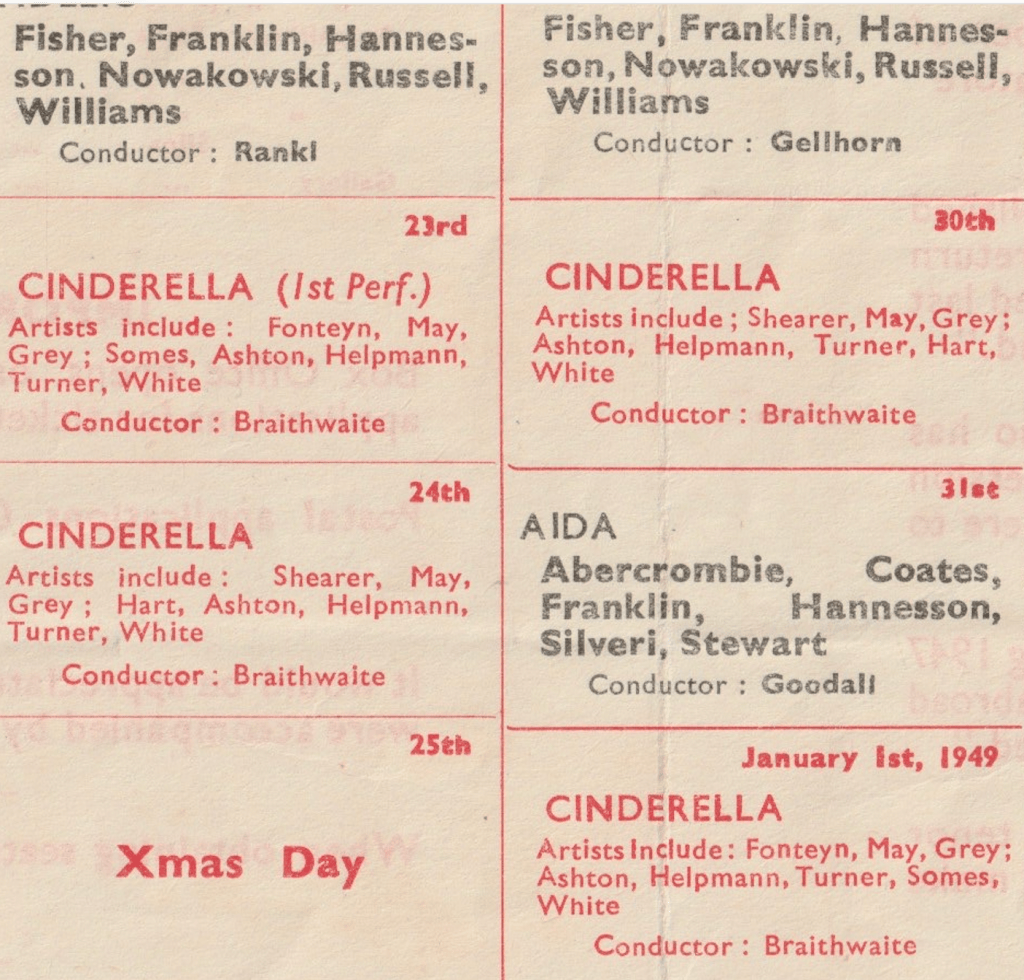
The proposed schedule for performances of Cinderella at The Royal Opera House, Covent Garden in December 1948 and January 1949. The only change in personnel appears to be the substitution of John Hart for Michael Somes as the Prince in Shearer’s appearances. This synopsis was published on November 22nd a few days prior to Fonteyn’s injury..
The attached programme synopsis which summarised “coming attractions” and, was obviously printed before Fonteyn’s injury, shows her dancing on opening night, Shearer appearing on the following evening and their essentially sharing the role until the middle of January. Rather than a question of Fonteyn getting her way, as some commentators have suggested, it seems that, from the outset, it was de Valois’ intention was that Shearer fulfil her usual role as the second cast. However, fate, in the form of Fonteyn’s injury, intervened.
When Harris asked Shearer about her having “saved the company’s bacon” by stepping into the breach in Cinderella, Shearer didn’t rise to his bait but, instead, detailed 2 consequences of it. At the time she told him that she was unaware of Fonteyn’s concern that if she danced well in it Shearer might challenge her in the future. Shearer also sensed that in the company in general there was similar apprehension. Shearer added that, in neither case was there any open resentment towards her. With Fonteyn’s subsequent success in the role the concerns seemed to fade.
Shearer’s final opportunity to shine came in 1950 when the Russian/American choreographer, George Balanchine was invited to stage his ballet, Ballet Imperial, at Covent Garden. When de Valois extended the invitation to him the assumption was that Fonteyn would dance the lead supported by Michael Somes and Beryl Grey. Shearer was second cast and Elvin third and they were to learn their part by observing Balanchine rehearsing with Fonteyn. However, Balanchine requested that he work directly with Shearer and, as a result, he appears to have favoured her over Fonteyn, who was eventually unable to come to terms with Balanchine’s unconventional choreography. Audrey Wiiliamson, the eminent dance critic, wrote of Fonteyn’s interpretation that “her formal dignity was lovely to watch, yet somehow less suitable to Balanchine’s invention than the sparkling gaiety Moira Shearer showed later”. For her part, in her interview with Harris, Shearer recalls her pleasure at working with Balanchine and her regrets at not being able to collaborate with him further.
Ballet Imperial was staged 6 times in 1950. Fonteyn danced the premiere (“badly”, she remembers in her biography) with Somes and Grey; Shearer danced the lead for the next 3 performances and Fonteyn returned for two later performances to complete the short season. Fonteyn appears not to have danced in the role subsequently, while, between 1951 and 1953, Shearer assumed it numerous times, some on the road in Liverpool, Leeds and Edinburgh.
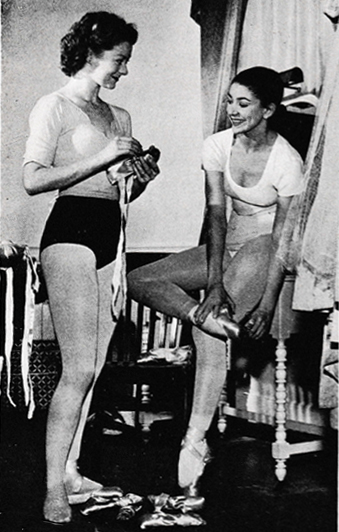
Margot Fonteyn and Moira Shearer in Washington in November 1950 during the Sadler’s Wells Ballets second tour of North America. It was during this tour that Fonteyn and Shearer bunked together on the train that ferried the company between venues. As a result they were able to get to know each other a little better. Photograph published in The Washington Post. Photographer unknown.
Fonteyn’s occasional illness and injury obviously provided opportunities for Shearer to step into her shoes. However, Shearer wasn’t indestructible either and injury was one of the factors in her decision to retire from ballet at the very young age of 27.
Sources.
Dale Harris, transcript of interviews conducted with Moira Shearer in Edinburgh on August 29th, 1976 and August 31st and September 1st, 1978. New York City Library Archive, Lincoln Center, New York City.
Alastair Macaulay, (online resource) Artist and Muse: Margot Fonteyn, Frederick Ashton, and “Cinderella”.
Audrey Williamson, The Tribune (magazine), April 28th, 1950.
Beryl de Zoete, “Homage to a Star”, New Statesman and Nation, January 11th, 1947
Notes.
Margot Fonteyn was 20 in 1939; she had joined the Vic Wells Ballet in 1933 at age 14. In March 1939 Moira Shearer was 13 and studying in west London with Mme Legat.
While she was a seasoned and respected commentator on ballet, Beryl de Zoete’s comments on Shearer have to be read with caution. She was a friend of the musician, Violet Gordon Woodhouse and of the writer and poet, Sacheverel Sitwell who in 1946 fell in love with Moira Shearer. They socialized at Woodhouse’s country house and, thus, Shearer and de Zoete were acquaintances.
The photo describing Shearer as Fonteyn’s “understudy” is not credited or dated but refers to a performance on February 1st, 1947.
Shearer was considered to be a “virtuoso” dancer and was thus perhaps better suited than Fonteyn to dance in ballets with unconventional choreography like Scenes de Ballet and Ballet International.
Cinderella was designed by Ashton from the start for both Fonteyn and Shearer as it was originally intended that they would share the role. It would have been virtually impossible for Fonteyn to dance every night in the crowded Christmas/New Year schedule. As it turned out Shearer essentially did just that, appearing in Cinderella in the premiere on December 23rd and subsequently on December 24th, 25th, 27th. She was due to dance on January 1st, but the programme indicates she was “indisposed’ and was replaced by Elvin. Shearer returned to dance on January 5th and then on the 8th, 10th, 15th, 17th, 20th, 27th and 29th. All matinee performances in this period were danced by Elvin.
Macaulay, quoting Fonteyn’s biography with regard to Cinderella, notes “that Shearer thus danced every performance as Fonteyn had refused to do”.


Leave a Reply