On January 16th, 1947, Moira Shearer made a presentation to 400 students of the Royal Academy of Dancing and the Arts (RADA) in London on the problems she experienced in dancing and acting in the film, The Red Shoes. Her presentation was reported in the Daily Express the following day, under the headline, “Making it was a mistake”. Shearer began with the complaint that “pictures on the hoardings made me look Jane Russell in black tights”. As the attached image suggests this would seem to be a justifiable criticism.
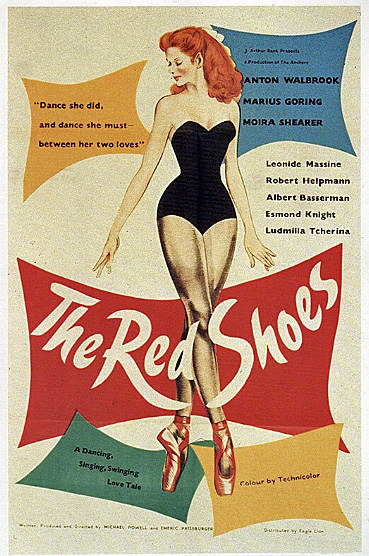
The original poster for the UK release of The Red Shoes, 1948
She continued by characterizing the depiction of the fictitious ballet company in the film as superficial and Michael Powell’s direction as chaotic. She said that she found the entire experience to be “miserable” and exhausting. She concluded by asking herself the question, why did I make the film? Her answer was, ‘perhaps I didn’t realise there would be so much to fight against’.
By way of comparison to Shearer’s evaluation of her experiences it might be instructive to review some unusual behind-the-scenes insights into the production of The Red Shoes that are provided by Leonard Boucher in a diary he kept between June and September 1947. Boucher was a young dancer who danced in the early 40s in companies like the Anglo-Russian Ballet and International Ballet and was hired by Powell & Pressburger to dance in the corps de ballet to be used in performing the ballet sequences in the film. He was involved in the scenes that were filmed in England, primarily at the Pinewood Studios. Boucher kept an informal record of activities “on stage”. As he was primarily a dancer his commentary inevitably reflect this frame of reference.
Filming of The Red Shoes began in Paris, on June 5th, 1947, at Jacques Fath’s studio and at the Gare de Lyon and then, later in the month moved to Monte Carlo. Powell & Pressburger and their production team arrived there around June 11th, and Moira Shearer and Leonide Massine arrived on June 22nd. Filming for Shearer began the next day. Once filming was completed in France, the film crew set up at Pinewood Studios just outside London in the second week of July.
Boucher’s diary begins on July 9th. He notes, “8 o’clock class; Tcherina, Moira Shearer, Joan Harris, Helpmann and Massine”. He may not have seen Shearer dance before as he writes, “(she) is the nicest little thing I’ve seen since (Irina) Baranova… Helpmann is camp; Massine looks tired”. Boucher is obviously already focused on Shearer as he writes, “if Shearer is used well she should develop into a ‘big star’”.
Reflecting Shearer’s comments to RADA, Boucher’s July 10th entry already expresses grave doubts about Michael Powell’s ability as a director.
On July 19th, a Saturday, Boucher records that half the cast, including Mme. Rambert gathered at Pinewood to shoot the scenes that were to take place at the Mercury Theatre. Apart from Mme. Rambert, Shearer and Anton Walbrook were the major protagonists in these scenes so, although Boucher doesn’t mention them, they may have been present.
The July 30th entry reads, “Pinewood for shooting “Heart of Fire” .. the star of this film is Michael Powell”.
On July 31st filming at the Pinewood studio represented the stage at the Royal Opera House, Covent Garden. Boucher writes, ‘the action is Tcherina’s late arrival for rehearsal … Massine’s wrath, remarks from Robert Helpmann and another leg display … rather like a male Dietrich! And then some words to Shearer (by Massine)…. Most of us (including all the principals) merely stand around in groups’.
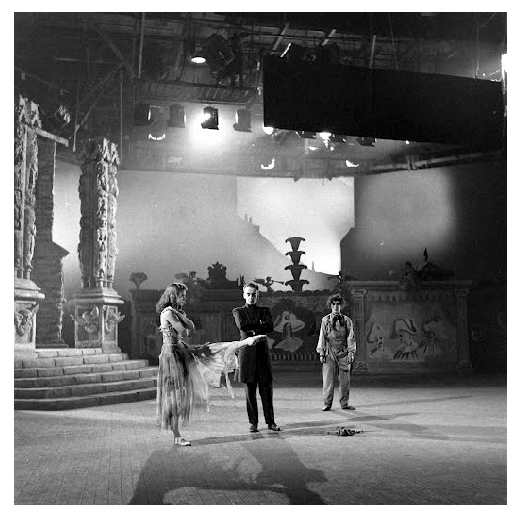
Shearer, Helpmann and Massine at Pinewood Studios in a break from filming. Photo by William Sumits, 1947.
Boucher’s August 1st entry reads, ‘does Robert Helpmann have the artistry and creative power of (Hein) Heckroth? I fear not’.
On August 2nd Boucher continues his criticism of Helpmann. Comparing him to the brooding, aloof yet fascinating Walbrook, Boucher writes ‘one sees Robert Helpmann at a glance – typically theatrical in the non-artistic sense – in comparison’.
The entry for August 5th opens with, ‘Pinewood for 9. Talk with Moira who is very sweet and charming. She told me that (for her) the film began with her “death” and how terrified she was when the train advanced on her!!’
On August 6th Boucher writes, ‘Leonard Massine tends to overact and Robert Helpmann is too effeminate!’
Boucher is obviously enchanted by Shearer and writes, ‘Moira Shearer appears to be an extremely promising actress with a beautifully soft, gentle and attractive voice’. He concludes by saying, ‘Not too soon to say Hollywood’.
On August 7th Boucher continues his attack on Helpmann. He writes, ‘Rehearse Red Shoes Ballet – once more much of it altered but not for improvement. I am now forced to keep my first impression of Helpmann. Selfish, full of self-importance, poor choreographer and ham artist – to say nothing of effeminate! Massine and Helpmann do not get on well together’.
On August 20th, rehearsals for the ‘Dance of Exhaustion’ were at the Stoll Theatre in London’s West End. Shearer was the centrepiece and Boucher notes, ‘Moira is the one who suffers in this’.
August 22nd. ‘Rehearse the first part of “Monsters”….. Moira is working wonderfully well. Helpmann’s choreography is very limited’.
Boucher writes that Moira Shearer was absent from August 28th to September 8th because she developed an abscess in her side. Rehearsals continue without her although Boucher notes that he thinks her absence has impacted the schedule.
The September 5th entry indicates that, in Shearer’s absence Massine is forced to work with her understudies.
September 9th, Boucher notes Massine and Shearer resume work together at Pinewood.
September 12th. ‘After lunch Moira and Massine do their pieces. Moira dances beautifully. Massine is quite grotesque as the shoemaker’.
September 19th. ‘Pinewood for 9. Clowns …. Moira dances beautifully…. Expect Red Shoes to finish at the end of next week’.
September 22nd, ‘Pinewood for 9…. Dance of Exhaustion. Moira very bruised and tired.’
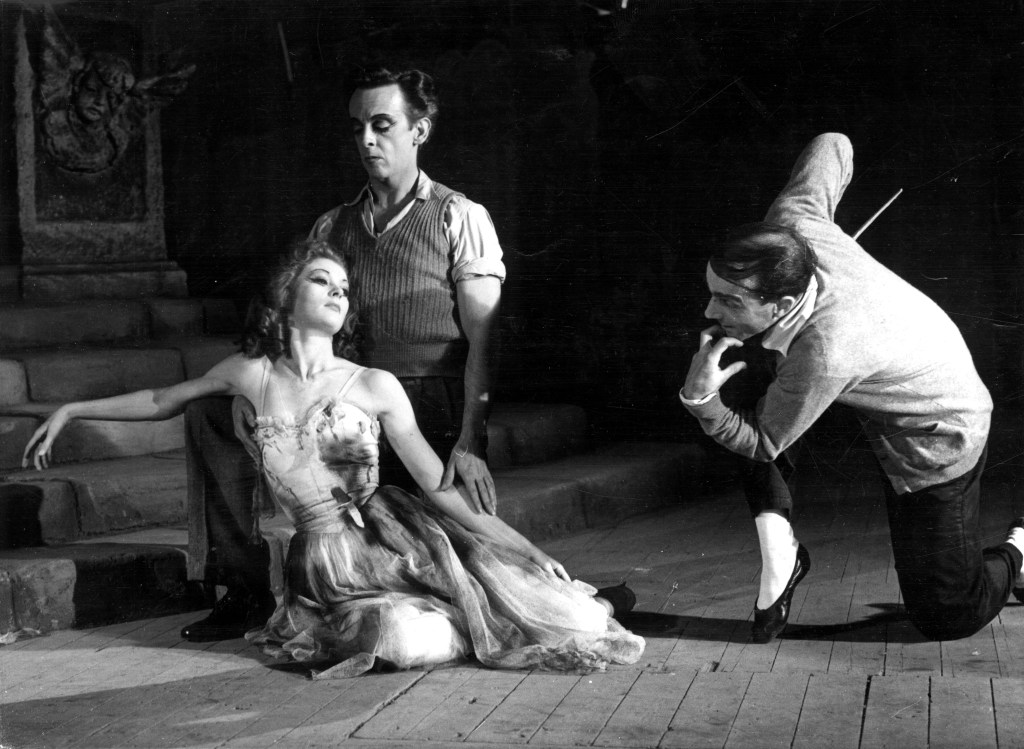
Shearer, Massine and Helpmann rehearse the “dance of exhaustion” on the sound stage at Pinewood, 1947. Photographer unknown.
September 24th, ‘Finish Dance of Exhaustion…. Moira by now is made to look tattered and worn. How wonderful she is. No one would work so hard with such excellent results and so little complaint. In fact, in spite of all, I’ve never seen or heard her complain of anything.’
September 25th, ‘The end of The Red Shoes Ballet for us but not for Moira who goes on and on. Poor dear, very tired but still dancing excellently.’ This entry is the last.
Notes:
In the diary entry for July 9th, Boucher makes reference to Irina Baranova who danced with Les Ballets Russes de Monte Carlo when the company appeared a number of times in London in the 1930s. Boucher had direct contact with her in 1946 when they appeared together in Leonide Massine’s production of the play/ballet called “Bullet in the Ballet”.
Boucher notes that Massine looked tired. In 1947 Massine was 51 years old and had just completed a season at Sadler’s Wells where he danced with Danilova, Shearer and Beryl Grey.
Joan Harris, a ballerina trained by de Valois, acted as Shearer’s stand-in during production of The Red Shoes. For the week in early September when Shearer was confined to hospital due to an injury, Harris was kept very busy.
The exterior scenes of the Mercury Theatre were filmed there. Boucher’s comments for July 19th indicate that the sound stage at Pinewood was used to represent the interior of the theatre and stage. Because of the demands of the Technicolor camera filming of the onstage performance by Shearer would have been impossible in the actual theatre. The same was true of scenes in the Royal Opera House, Covent Garden.
The July 31st entry describes the scene where Victoria (Vicky) Page, played by Moira Shearer, arrives on stage for her first rehearsal. She is confronted by the ballet master, Grischa Ljobov, played by Leonide Massine, who tells her to go to stand at the edge of the stage while he deals with the prima ballerina, Irina Boronskaya, played by Ludmilla Tcherina, and Ivan Boleslawsky, played by Robert Helpmann.
Hein Heckroth was the production designer for the entire film. He won an Oscar for his work.
The August 5th entry refers to Shearer’s first day of work in Monte Carlo when she was filmed jumping from the balcony to her death. The scene where she was, apparently, struck by the train, was omitted from the final print. Instead, we see her on-stage husband, Julian, played by Marius Goring, running down the platform toward her inert body lying on the tracks. There a doctor tells him that there is nothing that can be done for her.
August 7th. Helpmann was responsible for the overall choreography and Massine for the scene in the shoemaker’s shop.
The August 20th entry focuses on the ‘Dance of Exhaustion’ in which Shearer portrays a young woman who dances to her death because she is in the grasp of the red shoes. However, much she tries, she cannot take them off.
Boucher makes reference to the Stoll Theatre being used for rehearsals, but there is no record of any filming taking place there. The theatre may have been more convenient for the 50+ corps de ballet dancers than Pinewood which required a difficult and time-consuming journey.
The August 22nd entry references the powerful scenes in which Shearer dances amid a large group of “monsters” from whom she is attempting to escape. As a member of the male corps de ballet it is likely that Boucher danced as one of these bizarrely clad ogres.
The September 19th entry makes reference to completing the Red Shoes Ballet at the “end of next week” and, in fact, Boucher’s work is completed on September 25th. Shearer continued to work with Massine and Helpmann for another month.
The September 22nd entry again refers to Shearer’s dance when the red shoes, which she cannot remove, cause her to dance to the point of exhaustion and, eventually death. Before she dies, she asks her lover, played by Helpmann, to remove them. As this occurs in a ballet, her request is communicated in mime. Her lover removes the shoes, returns them to the shoemaker, lifts her up in his arms and carries her away.
In the final analysis Boucher’s comments represent the opinions of a young dancer appearing in his first film. Emeric Pressburger, the co-director and author of the script of The Red Shoes, on reading Shearer’s comments made by her at RADA said, ‘Miss Shearer has the right to criticize, like anyone else’ but adding that she knew nothing of film-making. As she was a 23 year-old dancer and ingenue actress, Pressburger’s comments would be seem to be a fair appraisal. The same might be said of Boucher’s commentary.
Sources.
Daily Express, January 17th, 1949, ‘Red Shoes’ Star kicks out at her Film’.
freepages.rootsweb.com/-lind/genealogy/people


Leave a comment