Moira Shearer had about a dozen homes in her lifetime; those in which she lived after 1950 she shared with her husband, Ludovic Kennedy and, after 1952 with their children. By the time, in 1985, Mr and Mrs Kennedy moved into their new home, “Rose Cottage” in Avebury, Wiltshire, they were “empty nesters”.
There follows a review of those homes in chronological order.
Morton Lodge, Dunfermline, Fife, Scotland.
1926-31
In an interview in the Sunday Express Magazine, 1974, Moira Shearer said, “I was born in my maternal grandparent’s home in Dunfermline”. Her birth date was February 26th, 1926. She continues the interview with this assessment of her early childhood, “my mother’s family, though very well educated and artistic, was very, very Scottish – severe, critical, prejudiced, set in their views, and none of them liked children very much …..(I was) surrounded by very cold Scots and the feeling of repression was strong”. She spent the first five years of her life in that rather austere house. Shearer remembered that at one time she had a nanny who would dress her in clothes and hats she did not like and take her for walks.
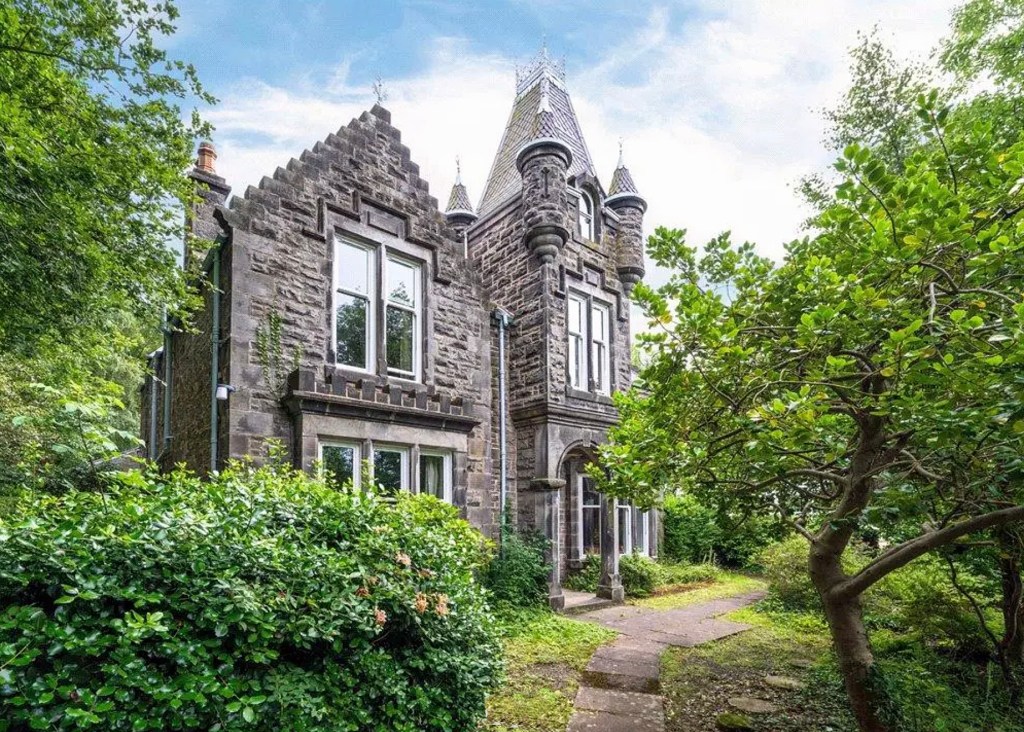
Morton Lodge, Dunfermline in 2025. The exterior of the house is as it would have been when Moira Shearer was born there in 1926. Photographer unknown.
At the time of her birth Morton Lodge was primarily occupied by Shearer’s uncle, her mother’s older brother. It was a large, 4 bedroomed “villa” that had a music room, an upstairs study and a large garden bordering the park. Her mother was an accomplished pianist and Shearer recalled enjoying the musical events that were held there.
When she was older and immediately prior to World War 2 Shearer spent more time in Morton Lodge. She recalls wistfully that, “in my adolescence …. as an only child (I was) expected to behave as an adult”.
Shearer’s father, Harold King, was a Londoner and practicing civil engineer. In the early 1930s he relocated to Northern Rhodesia, to assist in the establishment of the copper industry there. In 1931 he brought his wife and daughter to live in the small town of Ndola.
Ndola, Northern Rhodesia.
1931-34
Shearer recalls, “when I was between 5 and 8 my mother and I went to Rhodesia to join him (her father). Life in a bush farmhouse … a locust plague…. some Saturday dancing classes from a rather good teacher who persuaded my mother I had talent”. While she had many memories of her daily life there, she confessed she remembered little of the dance classes and had to be reminded by photos.
Ndola was just a dusty little outback town but had a newspaper and a reporter happened to be present when Shearer and the other pupils at Ethel Lacey’s dance school gave a performance. Somewhat prophetically he noted in Shearer’s dancing the qualities of a born dancer.
In 1934 the King family returned to Britain and settled once more in Scotland.
Bearsden or Glasgow.
1934-36
There is no record of where the King family lived in Scotland in this period but Shearer attended Bearsden Academy, northwest of Glasgow, where she received her only full-time formal education. As the school was not a boarding school the Kings must have lived nearby or, perhaps, in Glasgow.
Queens Gate (number 3), South Kensington, west London.
1936-39 (46)
The record of where Shearer lived in London is incomplete. However, between 1936 and 1950 it is known she lived, first in Queens Gate in Kensington and later in Melbury Road, also in Kensington but further west. The move probably took place after the war. Because of the danger and uncertainty caused by the outbreak of war and by bombing of London, it is likely the family was forced to break up temporarily. Mr King worked for the Admiralty during the war and thus, might have been required to remain in London when his wife and daughter returned to Scotland.
As, in 1936, Shearer’s mother had decided to promote her daughter’s dancing talent the King family moved into a flat in Queen’s Gate west London. Shearer was briefly enrolled in the Mayfair School of Dancing that was run by Flora Fairburn and subsequently in a school headed by Nicholae Legat.
There is no record of this home in Queens Gate but it was without doubt one of the ubiquitous walk-ups in that relatively upscale area. It would have been one of a number of flats at the address and was therefore modest in size. The address was well located for use of public transportation and Shearer would have commuted by bus or “tube” to Legat’s studio in Hammersmith. As she was so young was probably accompanied by her mother. The journey door to door would have required about 45 minutes.
In September 1939 at the outbreak of war the Legat school closed and Mrs King and her daughter left London for Scotland. They returned a few months later during the “phony war”, early in 1940, as Shearer had been offered a place at the Vic-Wells school. It appears that the Kings continued to live at Queens Gate and in fact may have retained the flat throughout the war. However, when the “blitz” began in September 1940, Mrs King and Moira once again returned to Scotland. There is no record of where they lived although it may have been at Morton Lodge in Dunfermline.
While Shearer was “on the road” dancing with the International Ballet throughout 1941 and in early 1942 she lived in digs in the provincial towns in which the company performed. However, there is no record where she lived in the breaks in the schedule and the summer holiday of 1941. London had to returned to some kind of normalcy after the Blitz and Battle of Britain, so it seems likely that the Kings continued to live there after 1941. Shearer joined the Sadler’s Wells Ballet in the spring of 1942. The company was based at the New Theatre in London’s West End and Shearer would have lived with her parents in west London and commuted to work by bus.
13 Melbury Road, west London.
1946-50
An April 26th, 1946, edition of the magazine The Tatler ran a 2-page article on Moira Shearer. In one of the photos accompanying the article she is shown leaving for work at the bottom of the steps to her parent’s house in Melbury Road. The house was large and in a much quieter and more residential neighbourhood than Queens Gate. As it was so spacious it seems unlikely that the Kings occupied the entire house but records show that its conversion to flats did not take place until 1948.
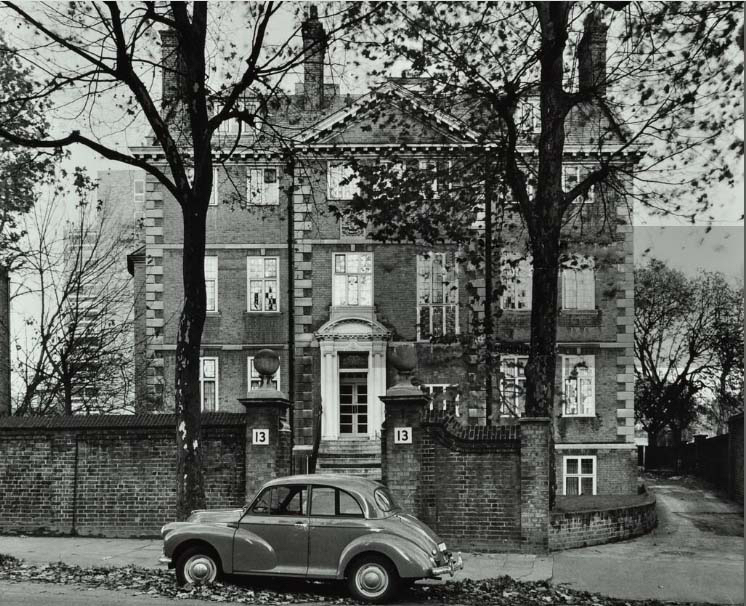
13 Melbury Road, Kensington in the 1960s. The exterior of the house had changed little from the time when the King family lived there in the 1940s. Photographer unknown.
While the location was not quite as convenient for public transportation as was Queens Gate, Shearer still took the bus to work at Covent Garden. In October 1949 a local journalist, in a report titled “Moira Queues”, noted that she’d leave the house sometime after 9 am and walk to the bus stop to begin her commute.
The house suddenly became the focus of public interest in February 1950. Mr King is shown leading his daughter down the steps and out of the imposing gate to an awaiting Packard limousine that was to drive them to Hampton Court where Moira was to marry Ludovic Kennedy.
William Sumits, an American photographer working for Time-Life Magazine photographed Moira Shearer at home in 1949. In a series of photos, she is seen talking to her mother and in reading and answering fan mail some of it probably concerning The Red Shoes which had been released the previous year. The room in which she sits is remarkably sparse …. just a simple bed-settee, an armchair, a bookcase and a single graphic hung from the wall behind her. In one shot a pair of point shoes sits somewhat incongruously beside her, perhaps a “prop” requested by the photographer.
Claborn Mews, Cadogan Square, west London.
1950-51
Prior to Shearer’s return from the Sadler’s Wells first tour of the United States and Canada in December 1949, her fiancé, Ludovic Kennedy was interviewed for a London newspaper. In the interview Kennedy noted that he had been “looking for place (for them) to live”.
Kennedy and Shearer were married in February 1950 and in early May moved into a 4 room converted mews house in the very fashionable area of Knightsbridge, west London. It was relatively small but had a garage and seemed to meet their immediate needs. Kennedy, then a budding writer, had a study in which he could work. As Kennedy later remarked, in those days, his wife was the primary breadwinner.
A photo that appeared in the popular press of the Kennedys relaxing at home shows an interior with walls lined with bookshelves.
Another photo dated November 1951 shows them leaving this mews home for good. A Rolls Royce limousine waits to drive them to the train that will take them to Southampton and a transatlantic liner. They travelled to New York and, by train, onto to Hollywood where Shearer was to appear in a film.
On their return from United States in the summer of 1952, they probably lived with Ludovic Kennedy’s mother in Hampton Court for a few weeks.
Hampstead, north London.
1952-56
Only 3 weeks after returning from Hollywood and probably in early June, the Kennedys moved into a Queen Anne period rowhouse in Church Row, Hampstead. It had 10 rooms that included both a day and night nursery. Their first child, Ailsa, was born in August 1952, so the house needed a bedroom for a live-in nanny.
As Ludovic Kennedy described it, the garden was the length of cricket pitch, had a huge apple, peach, plum and 2 pear trees. There are 2 very formally posed photos of Moira Shearer in this garden.
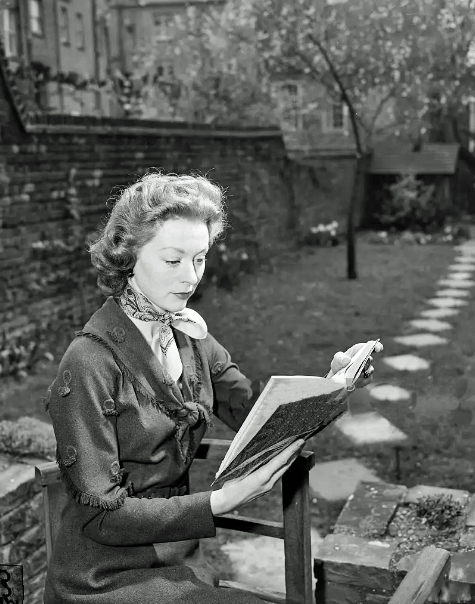
Moira Shearer in the garden of the Kennedys’ house at Church Row, Hampstead circa 1955. Photographer was a stringer for the Daily Express which commisioned the photo.
By Shearer’s account the house and the neighbourhood presented its problems. She complained that as it was a wealthy area there was considerable competition for the domestic help available. As it had 6 stories and as “the charwoman preferred easy one floor flats”, the Kennedys struggled to retain staff. Moira had her professional commitments and could not manage the family and house alone. This is illustrated in the informal diary that Ludovic kept in April and May 1954 when Shearer was acting in the film, “The Man who loved Redheads” that was made at Shepperton Studios. He noted that on Sunday May 30th that his wife was up at 5 am to drive to the studios and didn’t return until late. Thus Ludovic, who was by then a newsreader on Independent Television News (ITV), assisted by the nanny, had to babysit his infant daughter for 10 days.
Shearer was much in demand at this time. From August to November 1954, she was involved in The Old Vic production of A Midsummer Night’s Dream, first in the festival in Edinburgh, and subsequently on tour in the United States. While here is no record of this but Ludovic Kennedy probably continued to live in the Hampstead house where he helped the nanny care for his 2-year-old daughter.
In the summer of 1955 Shearer joined the repertory company, the Bristol Old Vic and remained with them for the better part of a year. As it was a fulltime commitment Shearer must have lived in digs in Bristol. There is no record of this but, again, her husband must have assumed a major share of the care of their daughter. It seems likely that he and Ailsa continued to live in Hampstead. Shearer remained with the Bristol Old Vic until July of 1956 at which time she was again pregnant.
Hampton Court.
1956-57
The Kennedys appear to have left the Hampstead house in early autumn 1956. They moved in with his mother at Hampton Court for a year while they looked for a house large enough to accommodate their growing family.
In November, Rachel, their second child was born while they were living there.
There is no surviving record that describes Mrs Kennedy’s home in Hampton Court but historical records indicate that apartments there were often very large. Mrs Kennedy’s was obviously spacious enough to entertain her son, daughter-in-law and their family.
Amersham, Buckinghamshire.
1957-65
An October 22nd, 1957, newspaper article reports on the Kennedy family settling into their new Queen Anne house in Amersham, a small town in Buckinghamshire. It was a very large house and had an extensive walled garden with a lily pond.
Shearer commented on the long-awaited move. “It’s maddening. It’s a different shaped house to our last, so we have to get all sorts of new furniture. And everything seems to have happened at once – the play opening, moving house, getting a new nanny, hoping for a new housekeeper! She’s coming this week allegedly, but I never believe such things until they happen”.
The play she mentions was a comedy called “Man of Distinction” which, after an extended run in the provinces was about to open in London. She planned to commute to London each day and to return each evening. Thus, she was still trying to reconcile her career on the stage with her commitments to her husband and family.
Fate was soon to intervene. The play was a flop and folded after 3 weeks. Shearer announced her retirement from the stage and settled into domestic life in their new house. She recalled, “Life was fantastically hectic when the children were young. I did have nannies at first and some were marvellous but either they were too expensive or couldn’t stay for one reason or another and temps were sometimes unsatisfactory. Finding a good permanent nanny proved so difficult I became utterly convinced I must bring the children up myself. Anyway this is what I wanted to do”.
While in Amersham their third daughter, Fiona was born in the local hospital on December 21st, 1961. Alastair, their 4th child and only son was born in the same hospital on February 12th, 1963.
Shearer’s return to family life at home was gradual. She supported her husband’s political ambitions by campaigning with him in Rochdale, Lancashire in 1958 and 1959. Later in 1959 the director, Michael Powell, somehow prevailed upon her to make a brief appearance in his film “Peeping Tom” and in 1960 she danced with Roland Petit in his ballet “Cyrano” that was part of a trilogy in the film, “Black Tights”. It was filmed in Paris and thus Shearer lived in an apartment there for several weeks.
Subsequently, driven in part by her 2 pregnancies and the demands of her husband’s TV work, Shearer’s life became increasingly focused on her family. Ludovic was working for ITV from 1956 to 1958 and thus had to commute to their studios in London on the days he appeared. He was on a rotation with Robin Day and Chris Chataway so generally worked every third day. From 1960 to 1963 Kennedy appeared regularly on the BBC’s news programme Panorama. As Shearer noted in an interview she gave at Amersham in 1961, he was on the road a great deal such that she could count on him far less to babysit and, thus, she gradually faded from the public eye.
Makerstoun, Roxburghshire, Scotland.
1965-1976
The “little Georgian manse” was in fact spacious and easily accommodated their rather large family. Only photos of the very plain exterior survive.
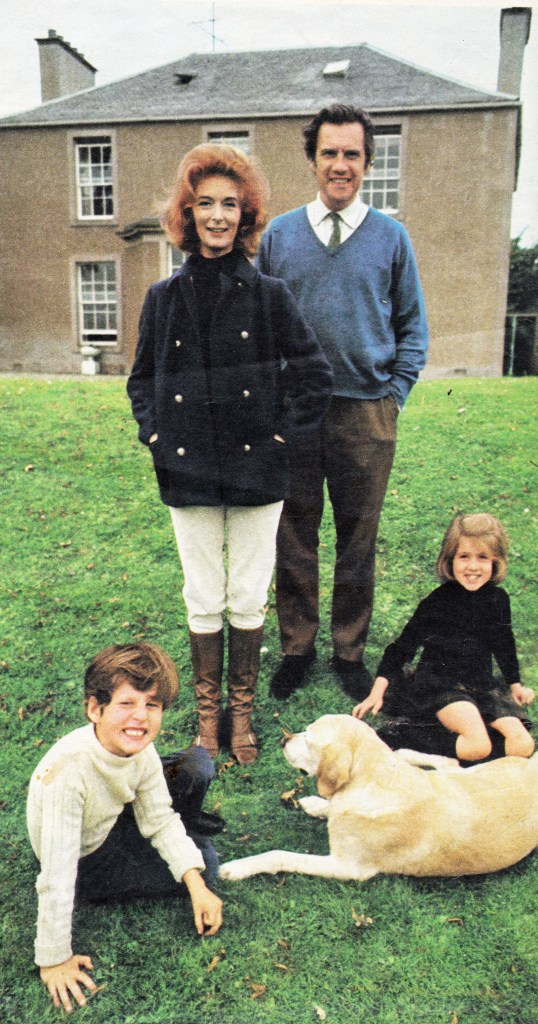
The Kennedy family in the garden of their house at Makerstoun in 1970. The children are Fiona, aged 9 and Alastair aged 7. Photographer unknown. Published in the Radio Times on December 3rd.
When the Kennedys moved from Amersham to Makerstoun in 1965, Ailsa was 13, Rachel was 8, Fiona was 4 and Alastair only 2 years old. As noted above Moira Shearer’s public life had shrunk considerably after completing Black Tights in 1960. She was now preoccupied with raising her family, getting them to and from school, organizing their social life and in keeping house and home. Her husband was less of a familiar face on the TV news programmes; rather he focused on writing and political activism and no longer needed to be in daily striking distance of London. He worked primarily from home. However, as Shearer noted, “now her husband is the family celebrity and breadwinner”.
In an interview she gave in the late 1960s she reflected of the early days in Makerstoun. “As a housewife I was a complete novice. I hadn’t a clue how to cook the Sunday roast… how to make the gravy or bake a cake. At the same time, because I had achieved so much professionally I was quite ready to settle down to domesticity, it was new to me and gave me fresh interests”. “(As a dancer) I’d been living more by night than by day. Now I was getting up at dawn to feed a small baby”.
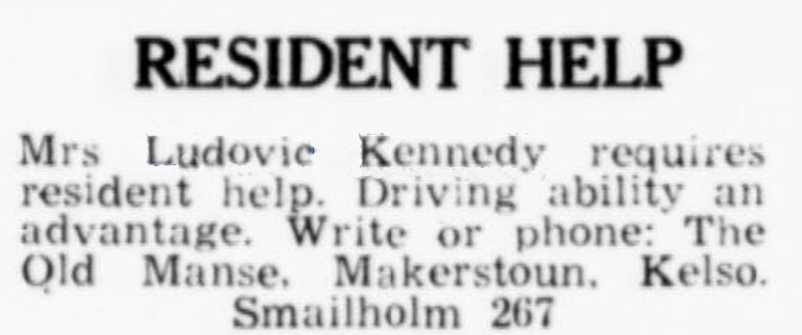
Want Ad placed by Moira Shearer and published in a Caithness newspaper in 1967.
Upper Dean Terrace, Edinburgh.
1976-85
The Kennedy’s Edinburgh home was a Georgian 4-bedroom townhouse in an upscale part of the city; it had both a front and rear garden and access to an adjacent park through which ran the stream called Water of the Leith. The house had 2 bathrooms, comfortably met the needs of its 4 permanent residents and still had room for guests.
By the time the Kennedys moved to Edinburgh, two of their children had become independent. Ailsa had moved to London to study art and married in 1977. Rachel, after studying in Italy, was living and working in South Africa. The two younger children still lived at home, but both were attending boarding schools and thus were absent much of the year. Later both transferred to day schools and thus, then lived at home.
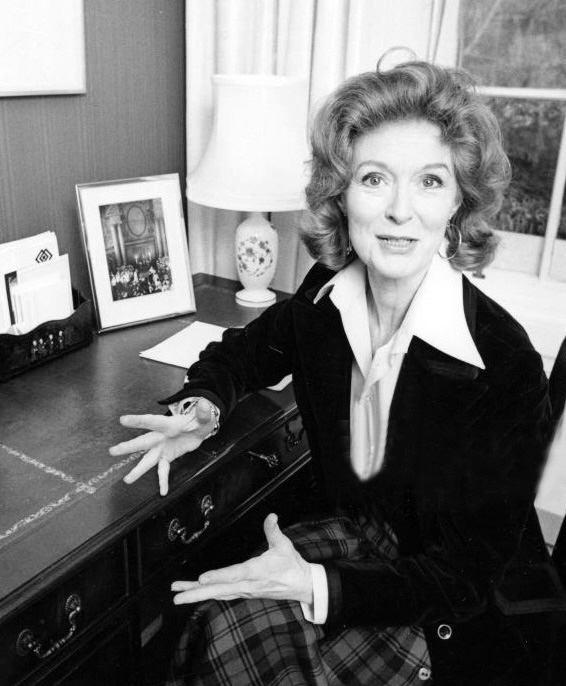
Moira Shearer in her study at her home in Upper Dean Terrace, Edinburgh in April 1979. Photo by Chris Ridley for the Radio Times.
Shearer continued to act in plays in Edinburgh occasionally, to lecture, sometimes with her husband, to travel and to work on television. These commitments combined with her responsibilities at home meant that she remained both very busy and firmly in the public eye.
Avebury, Wiltshire.
1985-2000
In 1985 all four children were independent. Ailsa was 33, Rachel was 28, Fiona was 24 and Alastair 22 years old. Thus, the Kennedys decided to downsize and, in the process, move closer to their daughters living in England. They found a large cottage in Avebury in Wiltshire that, although it was quite isolated, was only a 20-minute drive to Swindon that was on a main rail line into London. Shopping was done in Marlborough, 7 miles away.
There are no surviving details and only a single photo of the interior of the house that shows Ludovic Kennedy standing by Moira Shearer at her typewriter. The garden was extensive and was often used for photo shoots featuring perhaps Britain’s most famous Darby and Joan. The reporters continued to occasionally knock on their door.
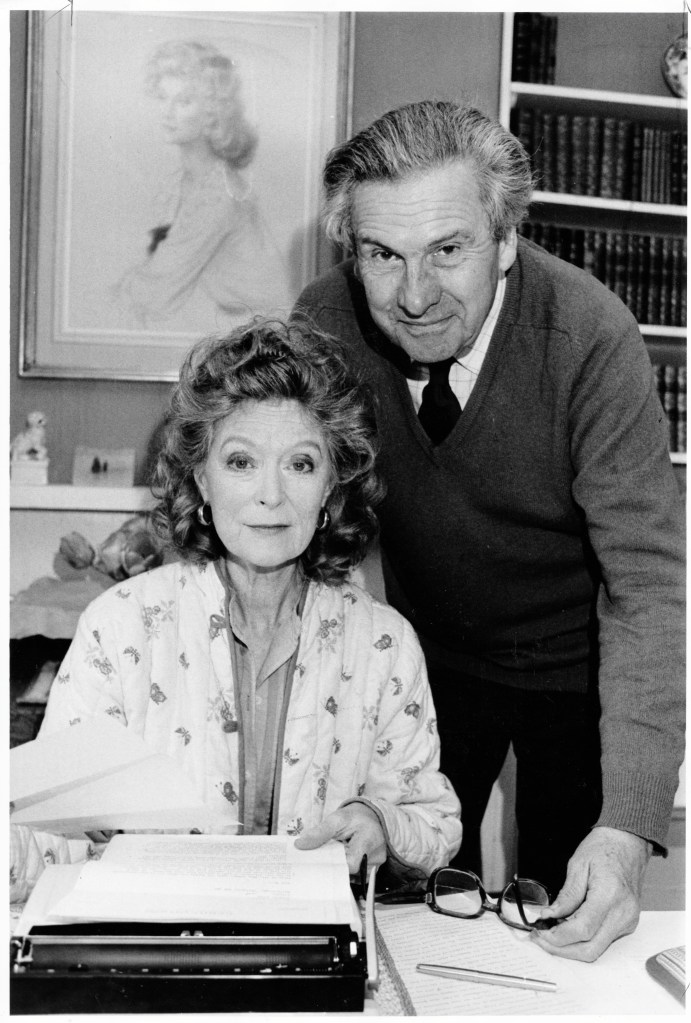
The Kennedys at home in Rose Cottage, Avebury, Wiltshire in May 1986. Photographer unknown.
They settled into a life of writing and travel. Attached is a copy of letter written in Avebury from Moira Shearer to John Guest, one of her publishers and a longtime friend, in which she expresses her hope that she will be “really breaking into the writing world”. The reference to a book on Ninette de Valois suggests the letter was written in 1987 or 1988. Shearer wrote both books and book reviews in the 1990’s and when asked by what occupation she wanted to be listed in “Who’s Who”, she replied, “writer”.
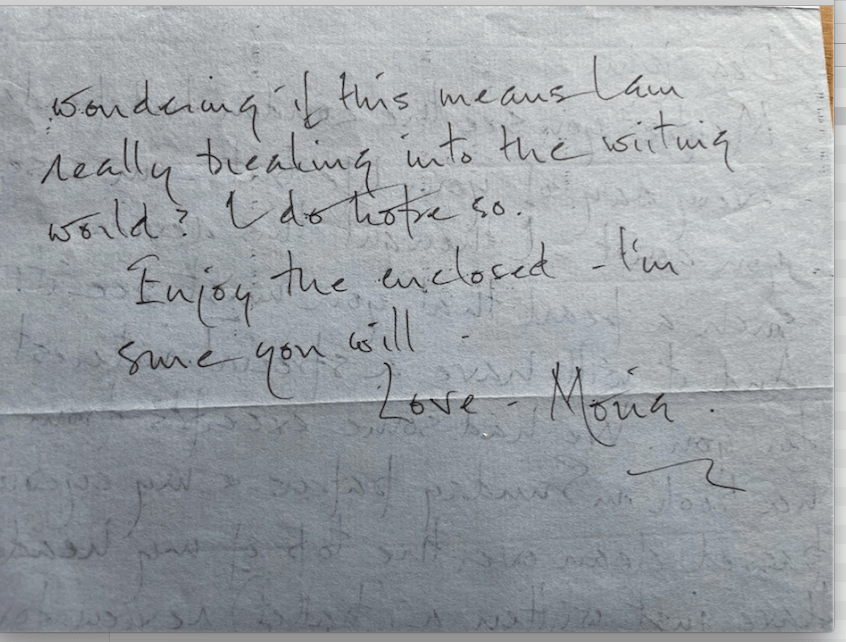
Second page of a letter from Moira Shearer to John Guest probably written in 1987 or 1988.
The Kennedys remained in Avebury until they were no longer able to care for the house by themselves. They subsequently moved to an assisted living facility in Boars Hill, Oxford. This was to be Moira Shearer’s last home.
Sources:
Aberdeen Evening Express, July 5th, 1952
Collie Knox, Woman’s Own, 1961; “Moira Shearer dances again”
Daily Express, October 23rd, 1957, “Moving Time”
Daily News, June 7th, 1954
Evening News, June 30th, 1952, “Ideal Home”.
Parker, Sarah, E., Grace and Favour: A Handbook of Who lived Where in Hampton Court Palace, 1750-1950, 2005
Sunday Express Magazine, 1974, exact date not known.
The Radio Times, December 3rd, 1970.


Leave a Reply